Transformidy

Experience The Skies

Every journey leaves evidence.

Experience The Skies is Transformidy's travel and aviation intelligence channel, reading how loyalty, trust, and journey expectations are being renegotiated across airlines, airports, and hospitality.

A travel disruption ecosystem showing airline, airport, hotel, ground transportation, traveller, and partner evidence moving into recovery decisions.

Travel disruption intelligence

SEO 01

Experience The Skies is the aviation home for disruption recovery, passenger trust, and journey innovation.

Organic traffic needs clear topical ownership. This page is Transformidy's applied travel and aviation hub: airline disruption management, flight disruption recovery, airport experience innovation, travel loyalty partnerships, and passenger recovery experience all connect here before branching into specific articles.

A travel disruption recovery chain connecting airport, airline, hotel, transport, passenger care and loyalty evidence into decisions.
The industry page should show the recovery system, not only the journey moment: disruption, ownership, care, compensation, loyalty, and future intent all belong in the same intelligence view.

Search cluster 01

Airline disruption recovery

How rebooking, standby, bags, compensation, vouchers, crew movement, and communications combine into one passenger recovery experience.

Read connected intelligence

Search cluster 02

Airport disruption ownership

Where air traffic, terminal capacity, ground handling, concessions, hotels, and transport create a shared recovery problem no single dashboard owns.

Read connected intelligence

Search cluster 03

Travel loyalty and partnership risk

How airline, hotel, card, lounge, and destination promises become dead-end experiences when members cannot understand or use the benefit.

Read connected intelligence

Search cluster 04

Passenger trust after disruption

Why arrival does not close the commercial decision: next-booking behavior, review language, complaint follow-up, and loyalty movement keep signalling risk.

Read connected intelligence

Content management loop

1

Capture signal

Use current disruption, loyalty, airport, hospitality, and passenger trust evidence as review candidates before publication.

2

Publish article

Turn approved signals into Special Intelligence or evergreen articles with source status, visual direction, and internal links.

3

Refresh hub

Add the strongest article to this page only when it strengthens the travel disruption, recovery, or loyalty pillar.

4

Route demand

Send readers from the hub into library filters, related articles, service pages, and the next decision window.

A matte paper aviation system map showing a shared infrastructure failure moving through airport, airline, hotel, transport and passenger recovery paths.

Spotlight · Heathrow/NATS

When the system breaks again, recovery needs one owner

The September 8 NATS disruption was not only an air-traffic technology incident. Heathrow suspended arrivals for the remainder of the day, airlines faced aircraft and crew repositioning, and the CAA described continuing knock-on disruption across passenger care, rerouting, refunds and compensation uncertainty.

The Experience The Skies question is who is authorized to reduce the traveller's dead end when the dependency that failed sits outside the airline, airport, hotel or vendor that now has to recover the customer.

Special signal · Pearson and Air Canada

Toronto's hub growth makes the airport part of the destination

Toronto Pearson is adding more than 30 retail, dining and lounge concepts while Air Canada is expanding its Toronto global hub with new and enhanced international routes. Read together, the story is not more stores or more routes. It is whether the airport can recognize passenger context and turn dwell, place identity, recovery and commercial intent into useful experience.

The Experience The Skies question is which passenger contexts create incremental value and which new concessions merely redistribute spending that would have happened anyway.

A matte paper airport system map showing Toronto airport commerce, passenger dwell zones and global route arcs.

One-time signal · Apple

Apple's context layer may become the travel recovery surface

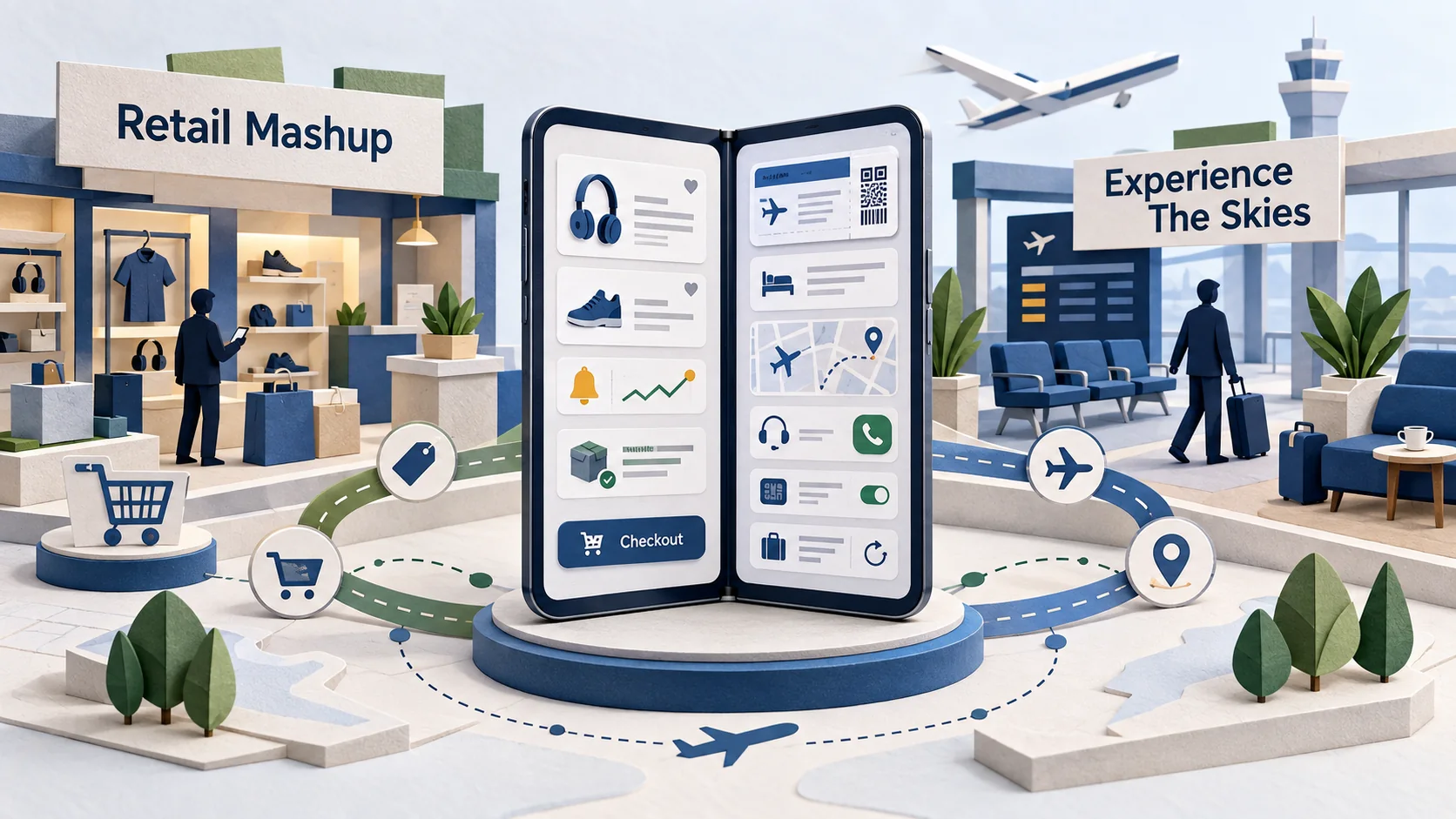
Apple's iPhone Duo and Siri AI announcements matter to travel because the journey is already fragmented across airline apps, hotel confirmations, Wallet passes, Maps, calls, loyalty accounts, eSIM, messages and recovery decisions. A larger context-aware iPhone can make those pieces feel managed at the moment of stress.

The Experience The Skies question is whether travel brands will design for Apple's context layer or let Apple become the system travellers trust when reservations, confirmations, support calls and disruption paths need to be pulled together.

An Experience The Skies and Retail Mashup illustration showing a foldable phone connecting travel recovery and shopping decisions through a context layer.
An Experience The Skies illustration showing airline, airport, lounge, card, hotel, ground transportation and destination nodes connected through traveller value flows.

Special signal · Southwest

Southwest lounges turn airport waiting into a continuity test

Southwest's first airport lounges are not only a premium amenity. They move the airline into a before-flight experience it has historically left mostly to the gate, the airport, and the traveller's own coping system.

The travel question is whether lounges can protect traveller confidence during real airport conditions: delay, crowding, family travel, long waits, partner itineraries and recovery. A lounge that works only on a normal day is comfort. A lounge that helps during disruption becomes experience continuity.

Special signal · United

United turns standby into a disruption recovery path

United says disrupted customers can now join standby lists for up to three earlier flights in the app while keeping their confirmed rebooked itinerary. That changes standby from a gate gamble into a protected optionality path.

The travel question is whether this reduces the dead-end moment after a delay or cancellation. The strongest design move is not the standby list itself. It is preserving certainty while the airline keeps searching for a better recovery option.

An Experience The Skies illustration showing a disrupted traveller, confirmed itinerary, standby options, text alert and airport recovery paths.
A Transformidy Experience The Skies system-map illustration showing one airline-hotel loyalty path ending, one emerging, one cross-border path and a traveller expectation risk.

Special signal · Hyatt

Hyatt's airline reset exposes the partnership dead end

Hyatt is ending its enhanced American Airlines relationship while launching a new Delta collaboration and operating a newer Air Canada Aeroplan relationship. The signal is not only partner churn. It is whether travellers can still understand the promise at the moment they try to use it.

The Experience The Skies question is how much airline-hotel value remains unused when partnerships stay at the level of points, status and terms instead of becoming maintained journey systems. The dead end appears when a member discovers the changed promise through rejection.

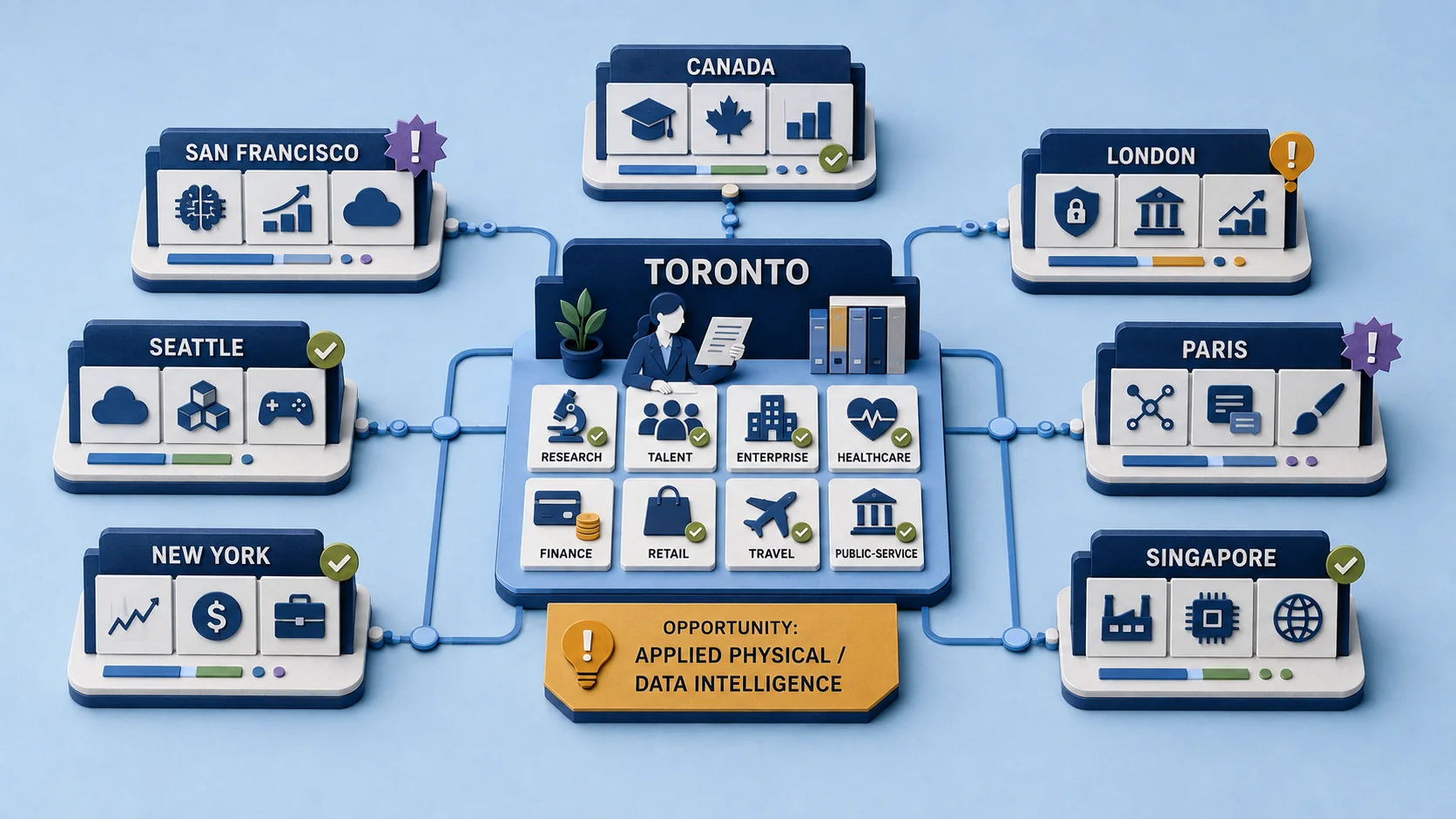
A matte Transformidy comparison map connecting Toronto with global AI hubs and applied travel, mobility, commerce, finance and governance strengths.

Special signal · Toronto AI

Toronto AI is also a travel-intelligence signal

Toronto's AI ecosystem matters to travel when research and talent become applied recognition: disruption recovery, airport crowding, accessibility handoffs, baggage uncertainty, premium intent, partner options, and destination confidence.

The Experience The Skies question is whether AI can help travel organizations act before the traveller relationship weakens. The value is not prediction theater; it is recognizing which journey condition changed and which recovery window is still open.

Travel Experience Index

FRIDAY 2026-08-28

This week's travel signals are ready for review.

Experience The Skies Friday notes are prepared as source-backed review candidates before they become articles, briefings, or social posts. They are not automatic conclusions: each note should be checked for source accuracy, Revenue Unknown clarity, decision usefulness, and whether it deserves publication.

Status

Review-ready

This Friday note set is prepared for editorial review before it becomes a standalone article, campaign item, or outbound briefing.

Demand

Fragile

Travellers still move, but fees, refunds, disruption and cross-border confidence can quickly change the value equation.

Capability

Uneven

Policy, recovery, air traffic control and destination rules are shaping the journey as much as aircraft or hotel product.

Friction

Policy-led

This week's strongest signals sit where the traveller believes the promise is clear, but the rule, refund or recovery path is not.

RU Watch

3

Refund rules, tourist fees and European disruption are the strongest Experience The Skies review candidates for Friday.

An Experience The Skies illustration showing journey evidence across airline, traveller and service touchpoints.

Friday signal · Business Traveller

Refund policy turns booking confidence into an experience test

A refund-rule change is not only a policy update. It changes how a traveller reads risk before purchase, especially when plans are uncertain. The experience question is whether eligibility, timing and exceptions are understood before the customer needs help.

Possible RU: booking intent may still exist, but value can disappear if the traveller cannot recognize the rule, trust the purchase or recover cleanly when plans change.

Review source
A travel passport-style Experience The Skies illustration connecting place, journey, loyalty and destination recognition.

Friday signal · Skift

Thailand's tourist fee returns as a value-explanation problem

A tourist fee can be small in dollar terms and still large in experience terms. The issue is not only the amount. It is whether travellers understand what the fee funds, when it applies, who collects it and whether the destination can turn the charge into visible value.

Possible RU: a destination may collect incremental revenue while missing the relationship value that comes from explaining, proving and improving the visitor experience.

Review source
An Experience The Skies recognition journey illustration showing aviation moments becoming remembered travel evidence.

Friday signal · Travel Market Report via Google News

Air traffic disruption exposes the recovery ownership gap

Air traffic disruption is usually reported as delays and cancellations. For the traveller, the real test is ownership: who explains the disruption, who recognizes the downstream journey, and who helps rebuild the trip when the operating system fails?

Possible RU: disruption cost may be measured by delay minutes, while the larger relationship loss sits in hotel nights, missed events, loyalty confidence and unmanaged recovery.

Review source

Revenue
Unknowns

?What intent rarely converts?!Where does friction reduce value?Which moments create lift?

Perspectives

TravellerAirportDestination

What Travel Leaders Are Missing

PAGE 01

The load factor recovered. The relationship did not.

Load factors and RevPAR recovered; relationships did not. Post-pandemic travelers rebook on different criteria than their loyalty tier suggests, and the gap is invisible in operational dashboards.

Experience Intelligence in Travel

PAGE 01B

The trip is the product. The relationship is the revenue system.

Travel players lose revenue when journey evidence stays trapped in operational categories: on time, resolved, occupied, boarded, checked in. Transformidy reads the journey as a connected decision system where trust, loyalty, service recovery, soft product, and brand integration decide what the traveller does next.

A travel and hospitality disruption loop showing experience evidence moving across partners into recovery decisions, outcomes, and learning.

Diagnostic signal 01

5-12%

premium recovery gap

A diagnostic range for high-value travellers who appear operationally recovered but remain commercially at risk after a disruption.

Diagnostic signal 02

18-30 min

earlier intervention window

The useful lead time created when evidence is read before rebooking, service recovery, staffing, or communication options narrow.

Diagnostic signal 03

8-15%

ancillary intent leakage

Demand visible in search, app behavior, lounge interest, seat preference, or bundle comparison that never becomes an owned offer.

Diagnostic signal 04

2-4x

trust-risk multiplier

The increase in commercial risk when operational friction, poor recovery, and low confidence communication appear in the same journey.

These are Transformidy diagnostic ranges for page storytelling and executive scoping. They are not published industry benchmarks.

Lens 01

Experience innovation

Find the moments where the journey can become easier, calmer, more personal, or more commercially useful without waiting for a new aircraft, property, terminal, or platform.

Lens 02

Differentiation when products converge

Cabins, routes, rooms, and fares often look similar. Soft product, recovery behavior, staff confidence, loyalty treatment, and partner handoffs decide what travellers remember.

Lens 03

Disruption management

Weather, crew, bags, queues, maintenance, and partner failures become revenue questions when the organization cannot see who needs intervention before trust breaks.

Lens 04

Loyalty and trust

Status and points do not equal commitment. Experience Intelligence reads whether the traveller is still emotionally and commercially available to the brand.

Lens 05

Seamlessness and brand integration

A seamless journey is not one system. It is airport, airline, hotel, destination, service recovery, app, and frontline behavior acting like one brand promise.

Where revenue is left on the table

Journey 01

Search and booking

Intent is visible but not interpreted: flexible travellers, premium trade-up behaviour, family complexity, or partner demand gets treated as generic traffic.

Package, fare, partner, and reassurance choices can still shape conversion.

Journey 02

Pre-trip and departure

Anxiety, document friction, weather exposure, bags, seat expectations, and airport capacity start changing the value of the trip before the traveller arrives.

Communication, staffing, upgrades, and recovery capacity can move earlier.

Journey 03

In journey

The hard product may be the same, but meal quality, sleep, staff confidence, app clarity, lounge treatment, and cabin recovery change future preference.

Soft product and frontline authority become differentiation, not cost centers.

Journey 04

Arrival and next booking

The traveller may complete the trip and still leave the relationship. Reviews, rebooking searches, loyalty behavior, and support language tell the real story.

Retention, apology, offer design, and loyalty treatment can be timed to the next decision.

Flight Delay Scenario

PAGE 01C

A delay is not one bad moment. It is three chances to recover value.

Travel brands often measure the event once: delayed, recovered, closed. Transformidy reads the before, during, and after because each stage carries different evidence, different decisions, and different value at risk.

Delay stage 01 / Before

The delay is visible before it is declared.

60-120 min

early signal window

Missed experience

Weather, crew positioning, gate queues, rebooking searches, and baggage location start moving separately. Most brands still wait for an operational status change.

Recovery opportunity

Recognize the marker early enough to protect premium connections, prepare recovery capacity, message customers with confidence, and shape alternatives before the app becomes a panic tool.

Before flight delay Experience Intelligence illustration

Delay stage 02 / During

The disruption is where trust is priced.

2h 45m

active decision window

Missed experience

Rebooking, vouchers, bags, frontline authority, communication cadence, and loyalty-tier risk are handled as separate queues instead of one customer relationship event.

Recovery opportunity

Route scarce recovery capacity by relationship risk and commercial value, not only by complaint volume or booking class.

During flight delay Experience Intelligence illustration

Delay stage 03 / After

The flight is over. The revenue decision is not.

72 hr

relationship recovery window

Missed experience

Arrival closes the operational file, but next-booking searches, compensation acceptance, review language, loyalty movement, and support follow-up keep signalling future value.

Recovery opportunity

Use the recovery outcome to decide apology timing, next-best offer, partner handoff, and retention treatment before the traveller quietly books around the brand.

After flight delay Experience Intelligence illustration

Decision window tool

PAGE 01D

Disruption should not leave the visitor at the problem.

Use the mapper to move from a disruption type to the actor affected, the conditions at risk, the Revenue Unknown, and the Activation path that still exists before the next consequence arrives.

Disruption decision window mapper

Find the decision that is still open.

Select a disruption, actor, and timing. The page turns awareness into a practical recovery question instead of ending at the problem.

Disruption

Actor

Timing

Entries

PAGE 02

Stamps this channel has collected.

Each entry is an unresolved value question forming across airlines, airports, and hospitality, dated the way a border officer would: on arrival, not in the annual report.

Entry RU-001 · Admitted

Loyalty program behavior diverging from actual rebooking decisions

Status: unresolved · Window: open

Entry RU-002 · Admitted

Journey friction tolerated operationally but priced in by premium travelers

Status: unresolved · Window: open

Entry RU-003 · Admitted

Partner and vendor handoffs changing who owns the customer moment

Status: unresolved · Window: open

The Evidence Log

PAGE 03

What to watch between here and the next booking.

  • LOG 1Elite-tier members booking away despite status
  • LOG 2Complaint-to-defection lag shortening in premium cabins and properties
  • LOG 3Ancillary attach rates moving independently of satisfaction scores

Recognition patterns

PAGE 04

How a pattern in this channel becomes worth a decision.

A pattern earns attention when independent evidence keeps pointing to the same change. The public question is practical: what changed, who is affected, what value may be moving, and what decision window is opening or closing?

Pattern validation

  1. Candidate
  2. Watching
  3. Validated

Validation status and lead times are published with the intelligence they support, not asserted ahead of it. Public pages show the experience change, commercial possibility, decision window, and learning loop.

Opportunities

PAGE 05

What turns an unresolved question into a decision.

An unknown becomes decision-ready only when it has an owner, a window, evidence thresholds, value at stake, an activation path, outcome measures, and a learning loop.

Decision Owner
The named person accountable for making the choice — not the committee that discusses it.
Decision Window
The period during which the decision still has options. After it closes, the organization inherits a decision rather than making one.
Evidence Threshold
The standard that defines when there is enough to decide, agreed before the evidence arrives.
Value at Stake
What is being protected, gained or lost — framed so trade-offs between opportunities can be compared.
Activation Path
What actually happens when the decision is made: who acts, in what order, and with what dependencies.
Outcome Measurement
The measure agreed in advance that will show whether the decision produced the change it intended.
Learning Loop
What the organization retains from the outcome, and how that returns to recognition.

Articles

PAGE 06

Published from this channel.

Article

The Airport Is Becoming Part Of The Destination

Toronto Pearson's commercial expansion and Air Canada's Toronto hub growth should be read as one experience system, not separate retail and route announcements.

#Special Intelligence #Experience The Skies #Commerce Intelligence

Article

Apple Waited Until the Foldable iPhone Could Become an Experience Layer

Apple's iPhone Duo is not only a foldable phone announcement. It shows why waiting can be the right experience strategy when a category needs hardware, software, developers, intelligence, and premium economics to become one coherent system.

#Special Intelligence #Experience Intelligence #Revenue Unknowns

Article

Hyatt's Airline Loyalty Reset Shows Why Partnerships Become Dead-End Experiences

Hyatt is ending its enhanced American Airlines relationship while launching a new Delta collaboration and maintaining a newer Air Canada Aeroplan relationship. The Revenue Unknown is whether airline-hotel partnerships can become real experience systems instead of benefit tables customers only discover when they fail.

#Special Intelligence #Experience Intelligence #Revenue Unknowns

Article

The Algorithm and the Randomized Trial

Two education systems built algorithms to help make decisions about individual students at scale. One imposed its algorithm nationally, on results day, with no pilot and no override. The other tested its tool for years, on a smaller population, before trusting it broadly, and built it to route stude

#AI in Practice #Experience Intelligence

Article

How to Find Dead-End Experiences Before Customers Defect

Dead-end experiences don't announce themselves — they hide inside metrics that look fine. Here's a practical way to find them before they show up as defection.

#Dead-End Experiences #Dead-End Experiences #Experience Continuity

Article

United Turns Standby Into a Disruption Recovery Signal

United says its app can now let disrupted travellers join standby lists for up to three earlier flights while keeping their confirmed rebooked itinerary. The innovation matters because it turns standby from a gate gamble into a managed recovery path.

#Special Intelligence #Experience Intelligence #Revenue Unknowns

Article

Hotel Recovery Is Not Finished When the Apology Is Sent

A sincere apology closes a complaint. It doesn't necessarily rebuild the confidence a guest needs to book that hotel again. Here's why service recovery often stops one step too early.

#Dead-End Experiences #Dead-End Experiences #Experience Continuity

Article

Southwest Just Made the Airport Lounge a Revenue Unknown

Southwest Airlines will open its first airport lounges with Chase in late 2027. The move creates a Revenue Unknown: can a low-cost carrier add premium airport continuity without weakening the brand simplicity that made it distinctive?

#Special Intelligence #Experience Intelligence #Revenue Unknowns

Article

Healthcare Referrals Leave Patients Stranded Between Providers

A referral is a handoff between two providers who don't share a single system or, often, direct communication. Here's why that handoff is a common point where care intent quietly stops.

#Dead-End Experiences #Dead-End Experiences #Experience Continuity

Article

Form Submission Is Often Where Intent Disappears

A form submission is a moment of expressed intent — and often the exact point where an organization loses track of it. Here's why forms become dead ends, and what continuity looks like instead.

#Dead-End Experiences #Dead-End Experiences #Experience Continuity

Article

When Flight Disruption Becomes a Dead-End Experience

A cancellation notice ends the airline's obligation. It doesn't end the traveler's trip. Here's why disruption recovery so often stops too early — and what continuity would look like instead.

#Dead-End Experiences #Dead-End Experiences #Experience Continuity

Article

Business Travel Recovery Should Not Stop at Reimbursement

When a business trip is disrupted, the expense process usually resolves cleanly. The employee's actual disruption often doesn't. Here's why reimbursement isn't the same as recovery.

#Dead-End Experiences #Dead-End Experiences #Experience Continuity

Article

B2B Demos That End Without a Decision Path Are Dead Ends

A qualified prospect finishes a demo, genuinely interested, and receives a generic follow-up email instead of a defined path toward an actual decision. Here's why that gap loses more pipeline than "no" does.

#Dead-End Experiences #Dead-End Experiences #Experience Continuity

Article

How a Warning Becomes Wallpaper

Early risk signals rarely fail loudly. They get explained away one at a time, this instance was a fluke, that one was an outlier, until a pattern that would have been obvious viewed together has been rationalized, individually and reasonably each time, into background noise nobody is watching anymor

#Decision Blindness #Experience Intelligence

Article

App Notifications Create Urgency Without a Useful Next Step

A push notification asks for attention right now. Tapping it often leads somewhere that doesn't match the urgency it just created. Here's why that mismatch trains people to distrust the channel.

#Dead-End Experiences #Dead-End Experiences #Experience Continuity

Article

The Dashboard Was Never Wired to a Decision

Most operational dashboards and cockpit-style indicators are built to make a status visible, not to force a specific decision when that status crosses a dangerous line. When no one has been assigned to act on a given signal, and no action has been defined for when it fires, the signal can exist, be

#Decision Blindness #Experience Intelligence

Article

Why Accessibility Breaks When Airport Continuity Fails

Accessibility assistance is usually promised at booking. Whether it actually travels with a passenger through security, boarding, and baggage is a different question. Here's why that gap is a dead-end experience.

#Dead-End Experiences #Dead-End Experiences #Experience Continuity

Article

When Workforce Stress Becomes a Revenue Signal

Workforce stress in service-delivery teams predicts revenue decline weeks before it shows up in financial reporting, in a system nobody has connected to forecasting.

#Revenue Unknown Watch #Experience Intelligence

Article

A Domestic Airport Bet Its Rebrand on a Character the World Already Knew

Oita rebranded its airport, which primarily serves domestic flights, into Hello Kitty Airport for six months in 2025, betting Sanrio's global fame could redirect Tokyo and Osaka's Expo crowds toward Kyushu. Public results remain limited. The bet itself is the story.

#Customer Experience #Retail #Travel

Article

STARLUX's Fastest-Growing Business Is Not Passengers

STARLUX's cargo revenue grew 44% in November 2025, driven by the global AI server shipment boom. The airline's most interesting growth signal in 2025 was not a themed passenger campaign. It was air freight for data center hardware.

#Airlines #Customer Experience #Peanuts #Personalization #Travel

Article

One Fountain Stunt Became a 24-Race Season-Long Program

Disney's Fuel the Magic campaign with F1 started as one Mickey Mouse appearance at the Fountains of Bellagio. A year later it is a season-long program across all 24 races, WEBTOON comics, and multiple retail lines. That expansion rate is the actual story, not the fountain stunt.

#Cars #Content #Customer Experience #Formula 1 #LEGO #Personalization #Technology #Travel

Article

AI in Hospitality: Personalization and Guest Experience Risk

Hotels deployed AI for personalization and staff augmentation. But automation that removes human touch from high-stakes moments (room issues, service recovery) creates guest frustration. Successful properties used AI to enable staff, not replace judgment.

#Artificial Intelligence #Customer Experience #Fraud Detection #IoT #Personalization #Privacy #Sentiment Analysis #Smart Room #strategy #Task Automation #Technology #Travel

Article

The Fault That Shut Heathrow Was Flagged Seven Years Earlier

A moisture reading flagged a failing transformer bushing at Heathrow's power substation in 2018. Nobody replaced it. Seven years later, that exact part failed, shut the airport for 18 hours, and disrupted 270,000 passengers. The warning was not missing. It was ignored.

#British Airways #Customer Experience #Heathrow Airport #London #strategy #Travel

Article

The White Lotus Effect: Who Owns a Demand Spike You Didn't Create

Set-jetting now generates over $8 billion in travel a year, and 81% of Gen Z and Millennial travelers say a show or movie influences where they go. The White Lotus proved a hotel doesn't control its own demand curve anymore—a streaming platform does, and most properties have no plan for what happens when the cameras leave.

#Brand Partnership #Digital Engagement #Four Seasons Hotels and Resorts #MAX #Storytelling #The White Lotus #The White Lotus Effect #Travel

Article

A Record Load Factor Is Not the Same as Slack

IATA's own January 2026 data shows global load factor hit 82%, a record for the month, while demand grew 3.8%. A record load factor sounds like an efficiency win. It is also the number that determines how much room an airline has left to absorb the next disruption without a passenger noticing.

#Accessibility #ACI World #Airport #Airport Dimensions #Customer Experience #Dallas Fort Worth International Airport #Dubai Airport #Frankfurt Airport #Glasgow Airport #Helsinki Airport #Istanbul Airport #London Heathrow Airport #Los Angeles International Airport #Miami International Airport #Munich Airport #Paris Charles de Gaulle Airport #Premium Economy #Premium Plaza Group #San Francisco International Airport #Singapore Changi Airport #Sustainability #Travel

Article

Every 2026 CX Success Story Has the Same Asterisk

Klarna's assistant handled 2.3 million chats and still got its own story oversimplified. Shopify's AI cut support tickets and was still confidently wrong on billing questions. Sephora's visual AI sped up discovery and still struggled with darker skin tones. Every real 2026 AI-CX success shares the same shape: a genuine win, paired with one specific, named failure mode.

#Cleveland Clinic #Customer Experience #Disney #Gucci #Heathcare #IKEA #Instacart #Nike #P&G #Sephora #Southwest Airlines #Travel

Article

Three Years of Snoopy Flights, Zero Published Numbers

STARLUX Airlines just launched its third consecutive year of Snoopy-themed flights, expanded to nearly its entire route network. The airline has never published a booking or revenue number to justify it. That silence is the actual story.

#Travel #Airlines #Customer Experience #Brand Partnership #Experience Infrastructure

Article

Southwest's CEO Says 80% Wanted This. The Backlash Says Otherwise.

Southwest ended more than five decades of open seating on January 27, 2026. Its CEO says 80% of customers wanted assigned seats. The backlash that followed suggests the number and the reaction are measuring two different things.

#Customer Experience #Google Flights #Partnerships #Southwest Airlines #strategy #Travel

Article

Nine Awards In, Competitors Are Still Copying Qatar's 2017 Seat

Qatar Airways has won Skytrax Best Business Class nine times since 2017. The more telling number is how many competitors are still building toward the same seat design eight years later.

#Airbus A350 #Business Class #Customer Experience #Qatar Airways #Qsuite First Gen #Qsuite Next Gen #strategy #Travel

Article

Eleven Straight Years Is Not an Execution Score

Air France has won France's Customer Relations Award for transport 11 years running. The survey behind it scores three separate things: execution, bond, and emotion. Eleven straight years suggests the company is not just executing well, it is winning on the two harder-to-fake dimensions.

#Air France #Customer Experience #Olympics #Paris #Pop-Up #Retail #Travel

Article

1.66 Million Delayed Flights and a Right Most Travelers Never Check

US airlines had their worst on-time performance since 2014 in 2025: 1.66 million delayed flights, more than 100,000 cancellations. Compensation rights exist in some markets and not others. Many travelers do not know which category their own delay falls into.

#Airlines #Customer Experience #Retail #Travel #Travel Disruption

Relevant Services

PAGE 07

The capabilities this channel most often leads to.

All five organizational capabilities apply. These are the three that channel work usually begins with.

Revenue Unknown Assessment and Monitoring

Find unresolved commercial questions.

Read →

Opportunity and Decision Design

Turn an unknown into a decision.

Read →

Executive Briefings, Training and Research

Build recognition capacity and strategic readiness.

Read →

Relevant Briefings

PAGE 08

Bring this channel into your leadership team.

Executive briefings, recognition reviews, and unresolved-question reviews applied to this industry, with the evidence chain intact.

Executive briefings

For urgent or emerging subjects — AI adoption outpacing operating-model redesign, changing travel expectations, loyalty erosion, district recovery divergence, emerging commerce behaviour, Revenue Unknowns affecting a specific organization. Structure: evidence; interpretation; strategic questions; decision implications; what to watch; recommended action.

Recognition reviews

Standing review of validated recognition patterns, lead times, and the decisions they may require.

Revenue Unknown reviews

Standing review of named unknowns, their owners and their decision windows.

Search questions

SEO 02

How the travel intelligence page earns organic traffic.

The page works as a pillar. It gives search engines one stable destination for the travel and aviation topic, then sends readers into the current article cluster when they want examples.

What is travel disruption intelligence?

Travel disruption intelligence is the practice of reading operational evidence, passenger context, partner dependencies, and recovery outcomes early enough to decide how to protect trust, value, and future booking intent.

Why does Experience The Skies focus on disruptions?

Disruptions reveal whether airlines, airports, hotels, apps, loyalty systems, and partners can act like one experience system when travellers need a useful next step.

How does this page help organic search?

The page anchors recurring topics such as airline disruption management, passenger recovery experience, airport disruption communication, travel loyalty partnerships, and irregular operations customer experience, then links to specific analyses inside the library.

Continue exploring

Keep following the travel pattern inside the Experience Intelligence Library.