
Article
Toronto's AI Moment Is Really a Physical Intelligence Test
Toronto's AI ecosystem is gaining global attention. The Revenue Unknown is whether research, talent and trust become physical-world intelligence that helps organizations act earlier.
- Published
- September 4, 2026
- Updated
- September 4, 2026
- Reading time
- 9 min
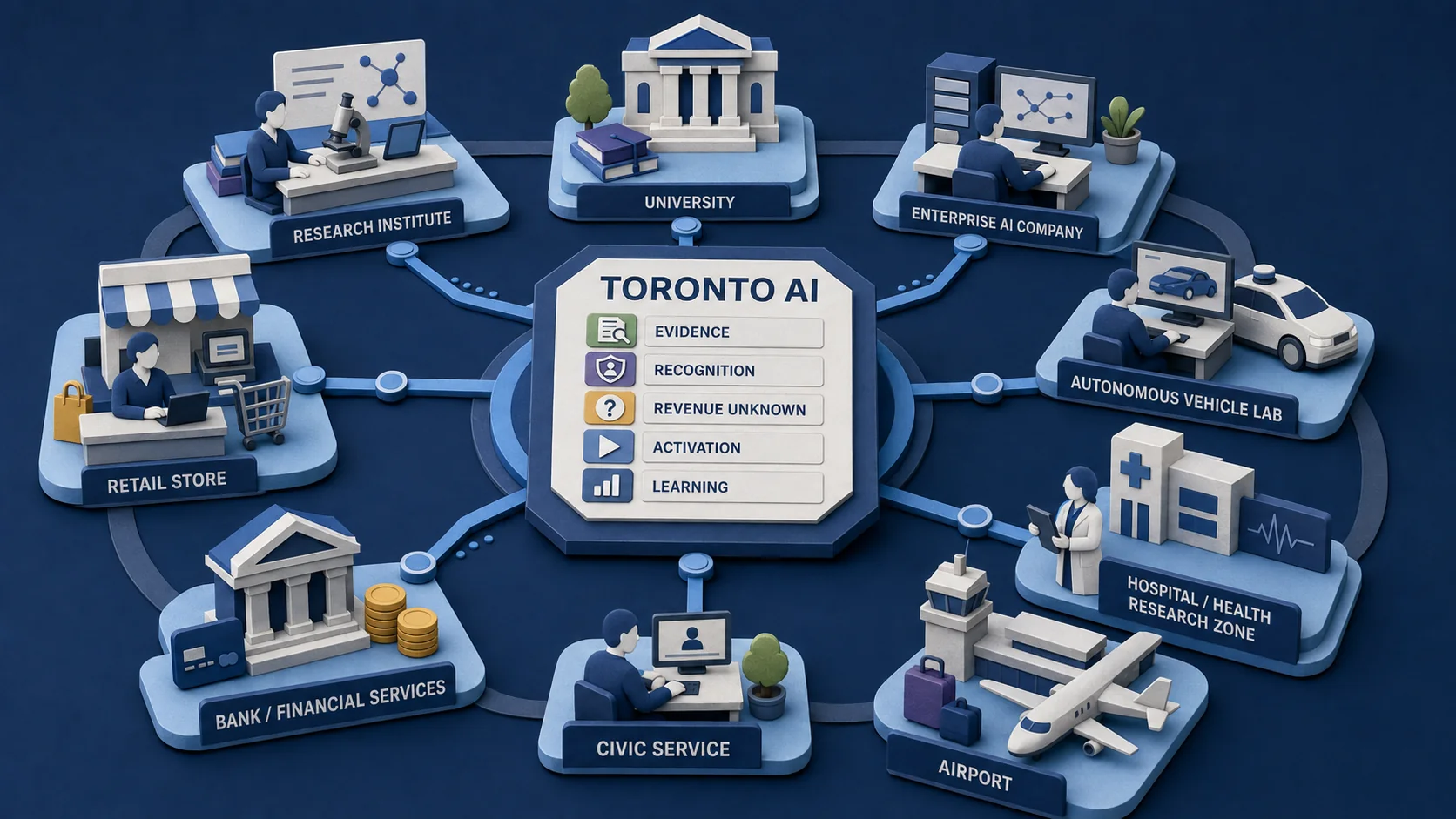
CNN's new profile of Toronto as one of the world's most important AI hubs is not only a story about Geoffrey Hinton, the University of Toronto, Vector Institute, Cohere, Waabi, Sanofi, Nvidia, Google, Meta, Microsoft, and the companies gathering around Canadian AI talent.
It is also a test of what AI ecosystems are ultimately for.
The obvious story is that Toronto has become a serious AI city. CNN points to Hinton's move to the University of Toronto in the 1980s, the role of the Vector Institute, the presence of major technology companies, Sanofi's nearly $300 million Toronto AI investment, Cohere's enterprise AI rise, and Waabi's autonomous-trucking ambitions. It also cites CBRE's ranking of Toronto as the world's third-best tech talent market, behind San Francisco and Seattle and ahead of New York.
But the Transformidy question is different:
Will Toronto's AI ecosystem become a source of better real-world decisions, or mainly another place where impressive models, funding rounds and institutional announcements accumulate faster than organizations can change?
That is the Revenue Unknown.
AI hubs do not create value simply by existing. They create value when research capability becomes usable intelligence inside actual experiences: airports handling disruption, retailers recognizing lost intent, hospitals managing handoffs, banks detecting trust breakdowns, cities serving residents, tourism systems reading demand, and companies deciding before revenue confirms what changed.
Toronto's AI Advantage Is Not Just Model Capability
Toronto's AI story has unusual credibility because it is not built only on hype.
It has academic depth through the University of Toronto. It has ecosystem coordination through Vector Institute. It has enterprise AI presence through Cohere, physical AI ambition through Waabi, healthcare proximity through Hospital Row, life-sciences investment through Sanofi's AI Center of Excellence, and technology-company gravity through Google, Nvidia, Meta and Microsoft offices or research labs.
That creates a real foundation.
But AI ecosystems are often judged by visible signals: funding, headcount, lab openings, accelerator activity, founder density, valuations, patents, conferences, and press attention. Those are useful indicators, but they do not prove adoption, trust, better service, or better decisions.
The next test is whether Toronto can turn AI capability into experience intelligence.
Experience intelligence is not another name for analytics. It is the ability to recognize changing conditions early enough to decide, protect value, activate recovery, and learn before the next consequence arrives.
That matters because most organizations are not short on evidence. They are short on recognition.
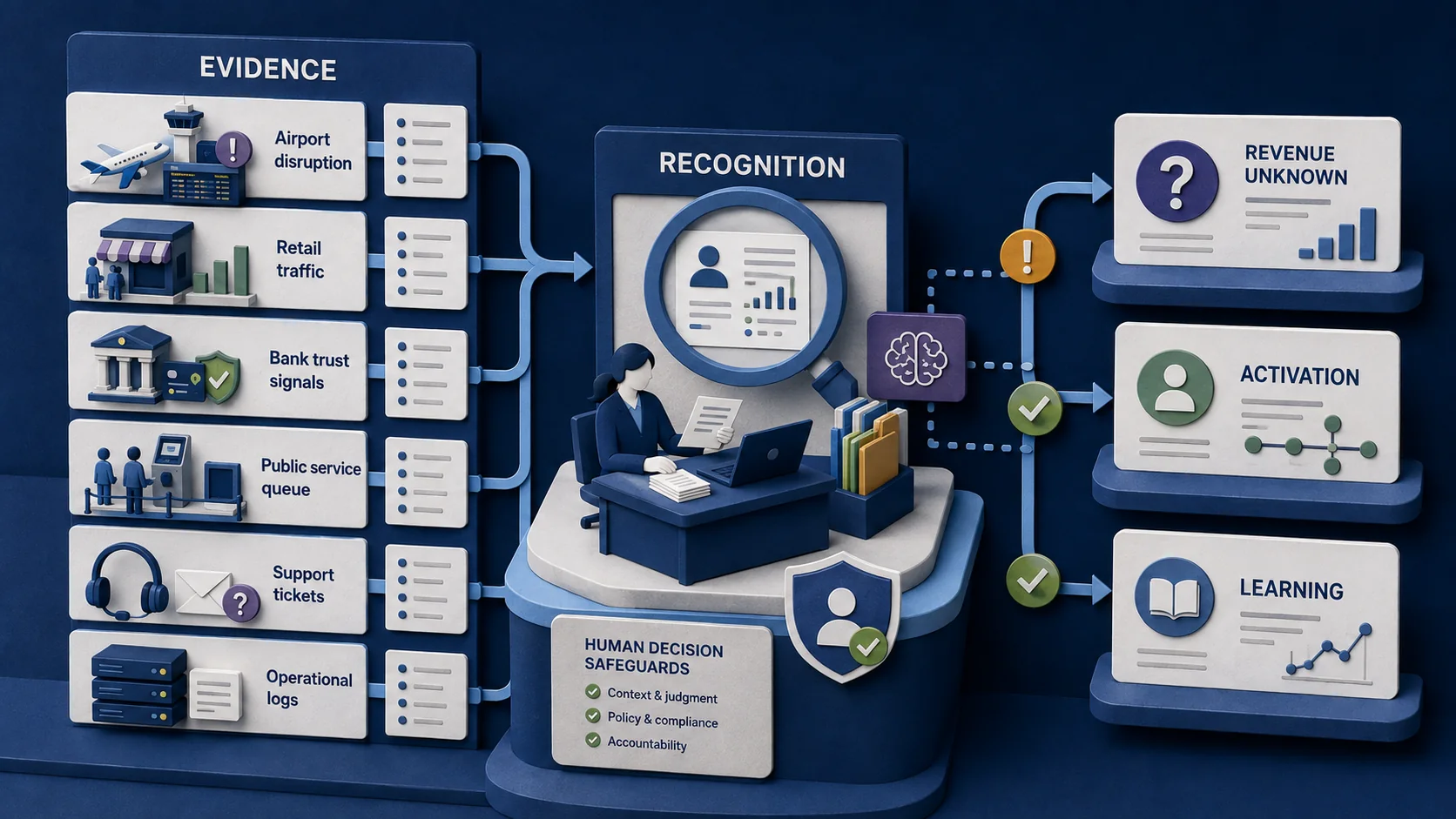
They have call-center transcripts, store traffic, flight disruption data, support tickets, search behaviour, transaction records, survey comments, delivery exceptions, app usage, public complaints, loyalty movement, booking windows, renewal signals, policy exceptions, and operational logs. What they often lack is a disciplined way to ask what changed, who was affected, what remains undecided, and what value is now at risk or newly possible.
AI can help close that gap, but only if it is aimed at the real problem.
The problem is not "more AI."
The problem is whether AI helps people read reality earlier.
The Physical-World Test
Toronto's advantage may come from the fact that it is not only a software city.
It is a financial-services city, a healthcare city, a retail city, a travel city, a university city, a government city, a media city, a sports city, a hospitality city, and a multicultural urban system where real-world experiences create dense evidence every day.
That matters because the next phase of AI will not be judged only by how well models answer questions. It will be judged by how well AI systems help organizations act where evidence is incomplete, actors have different interests, and wrong certainty can create harm.
An airport does not need AI that merely summarizes disruption. It needs intelligence that helps recognize which travelers are stranded, which connections are breaking, which partners can help, which promises remain recoverable, and which relationship damage is still preventable.
A retailer does not need AI that only writes product copy. It needs intelligence that can see when traffic, inventory, pricing, staff confidence, returns, loyalty, and local events are moving in ways that create hidden demand or silent loss.
A healthcare system does not need AI that sounds fluent outside its authority. It needs governed intelligence that distinguishes administrative handoffs, support gaps, capacity constraints, and clinical claims requiring domain expertise.
A city service does not need AI that makes residents wait in a smarter queue. It needs intelligence that detects when the experience has become a dead end and who owns the next step.
That is where physical intelligence and data intelligence meet.
What Other AI Hubs Teach
Toronto should not be compared with Silicon Valley as if every AI hub must become a smaller version of San Francisco.
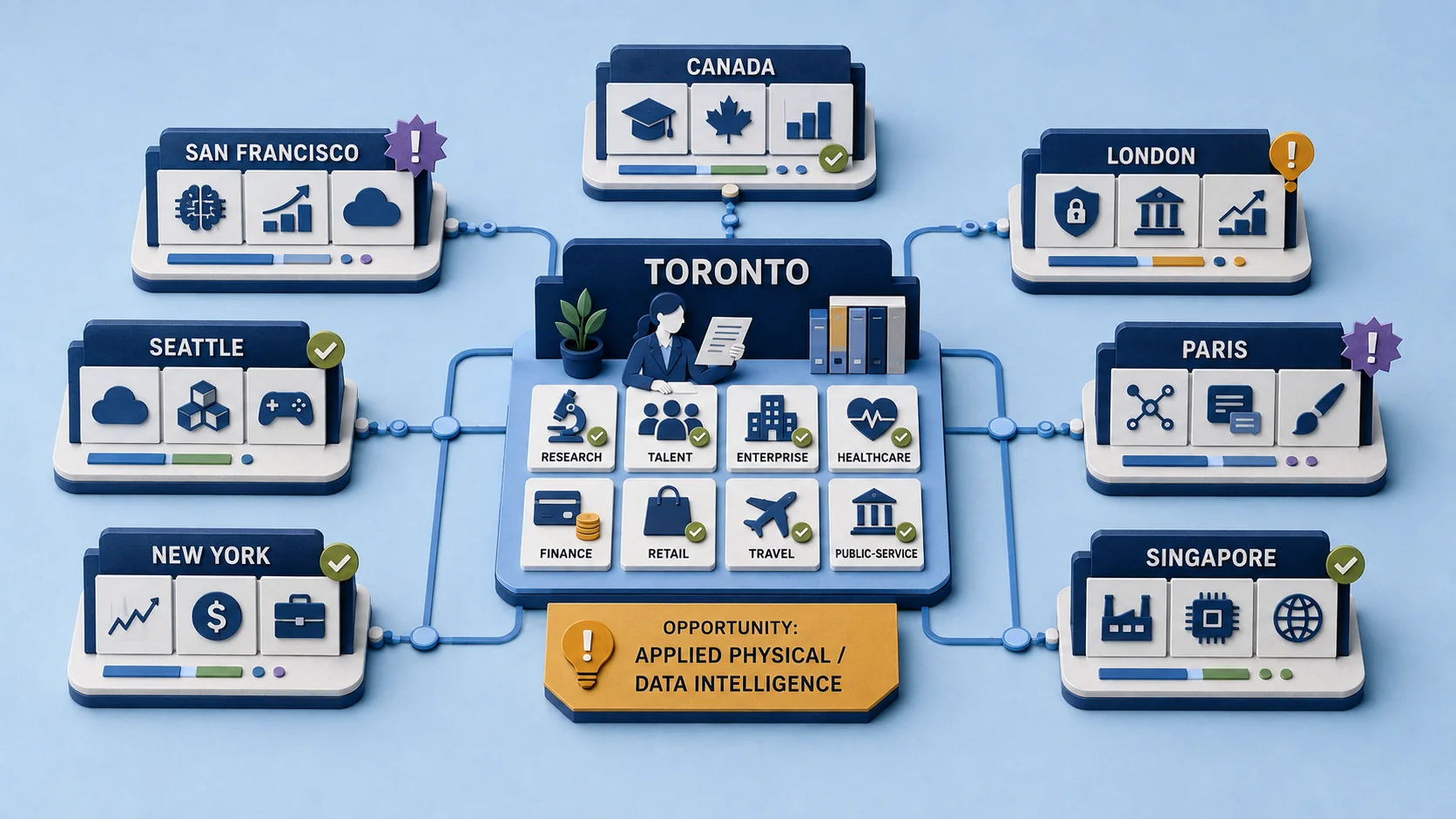
San Francisco remains the center of frontier-company density, venture capital intensity, talent competition, and model-era acceleration. Seattle has cloud infrastructure depth through Microsoft and Amazon. New York has finance, media, legal, enterprise services and customer demand. London, Paris and Singapore bring regulation, public-sector complexity, research ambition, finance, logistics and governance.
Canada has a different map.
Toronto has enterprise, finance, healthcare, public institutions, research, immigration, and commercial scale. Montreal has deep AI research history. Edmonton has reinforcement-learning credibility. Waterloo has engineering and startup depth. Vancouver has technology, gaming, visual effects and cross-Pacific links. Ottawa has public-sector and telecommunications relevance.
The point is not to declare one city the winner.
The point is to understand which hub can convert its strengths into applied capability.
Toronto's opportunity is to become a place where AI moves from research prestige into decision intelligence across physical and commercial systems.
That is a harder advantage to copy than a lab announcement.
The Canadian Trust Question
The CNN article also raises trust. Cohere co-founder Nick Frosst is quoted describing Canada as a trust signal for customers seeking resilience and independence. Hinton speaks about the importance of Canada not relying only on technology from the United States or China.
That trust advantage is useful, but it is not automatic.
Trust can weaken quickly if AI systems become opaque, extractive, careless with proprietary data, or overconfident where evidence is partial. It can strengthen if Canadian AI companies make source lineage, consent, auditability, privacy, accountability, and domain boundaries visible.
For Transformidy, that distinction is central.
AI should not be treated as a permission slip to infer anything from everything. Strong experience intelligence needs safeguards: source verification, confidence separation, human review, explicit decision ownership, validation requirements, and a clear difference between observed evidence, credible inference, and hypothesis.
Retailers, airports, banks, hotels, health systems, governments and sports organizations do not operate in clean data environments. They operate in environments where customers, workers, residents, passengers, suppliers, regulators and partners experience consequences differently.
A model can summarize a signal. An organization still has to decide what it is allowed to know, what it can responsibly infer, who owns the decision, what activation is proportionate, and which outcome would prove or contradict the interpretation.
What Transformidy Is Building Toward
Transformidy is using AI for a specific purpose: to bridge physical evidence and data intelligence so organizations can recognize Revenue Unknowns earlier.
That means AI is not positioned as a replacement for judgment. It is infrastructure for disciplined recognition.
In practice, the work starts with evidence. A flight cancellation, a store-traffic shift, a failed referral, a support backlog, a loyalty-policy change, a price increase, an app launch, a booking pattern, a labour disruption, a new retail format, or a city-service queue can all be evidence. None automatically proves what changed.
Recognition is the step where context belongs. It asks which experience system is involved, who is affected, what condition may have moved, what alternatives remain credible, what confidence is justified, and what validation is needed.
The Revenue Unknown is the unresolved implication. Which demand is hidden? Which value has transferred? Which relationship can still be repaired? Which capability gap will become expensive if no one acts? Which opportunity exists because the system can now see what used to be invisible?
Opportunity is the practical opening created by recognition.
Activation is the decision made real: a recovery path, a test, a service redesign, a briefing, a partner handoff, a data-quality fix, a channel intervention, or a new operating routine.
Outcome and Learning close the loop. Did the interpretation hold? Did value move? Did the relationship recover? Did capability improve? What should be earlier next time?
That sequence is where AI becomes useful for Transformidy: Evidence, Recognition, Revenue Unknown, Opportunity, Activation, Outcome, Learning.
It is also why Toronto's AI ecosystem matters to this work. The city sits near enough real industries, public systems, talent, researchers, investors and builders to make AI accountable to lived experience, not only benchmark performance.
The Revenue Unknown For Toronto
Toronto's AI moment creates several Revenue Unknowns.
Which Canadian AI companies will convert trust and research credibility into durable global adoption?
Which organizations will use AI to become earlier, not merely faster?
Which sectors will turn physical-world evidence into better decisions before competitors do?
Which companies will collect more evidence but still miss the state change underneath it?
Which Canadian strengths become exportable AI advantages rather than local pride points?
The answer will not come from one article, one lab, one funding round, or one model release.
It will come from whether organizations can use AI to improve real decision windows.
Toronto is now visible enough to be watched. The harder question is whether it becomes useful enough to be copied.
Reader Poll
Question: Does AI create a durable advantage in how your organization learns, decides, or serves customers, or does it mainly automate existing activity?
- AI is already improving decisions, learning and service in ways competitors would find hard to copy.
- AI improves some workflows, but the advantage is not yet durable or widely embedded.
- AI mostly automates current work without changing decision quality.
- We have not defined what durable AI advantage would mean for our organization.
Sources
- CNN: This city is one of the world's most important AI hubs
- Vector Institute
- Cohere
- Waabi
- CBRE Scoring Tech Talent 2025
- Sanofi Canada AI Center of Excellence announcement
- Canada's National Artificial Intelligence Strategy
Related Reading
Global examples
Global experience signals in this article
Mapped examples are grouped by theme and evidence basis. Hypotheses stay visibly labelled so the map does not turn interpretation into claimed fact.
- North AmericaReported
Toronto, Canada
Toronto's AI strength becomes more valuable when it is connected to physical experience conditions.
- Theme
- AI ecosystem
- Revenue Unknown
- Which local AI capabilities can translate into measurable improvements in real-world experience systems?
- Decision window
- While ecosystem positioning can still move from talent signal to applied advantage.
- North AmericaInferred
Waterloo-Toronto corridor
The corridor matters as an applied-intelligence pathway, not only as a talent or research story.
- Theme
- Talent and applied research
- Revenue Unknown
- Where does AI capability become operating intelligence for cities, retailers, health, travel, and public services?
- Decision window
- Before global AI hubs define the commercial category without Toronto's experience layer.
Does AI create a durable advantage in how your organization learns, decides, or serves customers, or does it mainly automate existing activity?
FAQ
Why is Toronto considered an AI hub?
Toronto is considered an AI hub because of its research base at the University of Toronto, the Vector Institute, companies such as Cohere and Waabi, major technology-company offices and labs, healthcare and financial-services depth, and a growing pool of technical talent.
How does Toronto compare with San Francisco, Seattle and New York?
San Francisco remains the leading frontier-tech and venture-capital hub. Seattle has major cloud and enterprise infrastructure. New York has finance, media and enterprise-demand density. Toronto's advantage is different: research depth, talent, institutional trust, and proximity to real-world industries where AI adoption can be tested.
Which Toronto and Canadian AI companies matter in this discussion?
Cohere, Waabi, Signal 1 and the former CentML are examples cited in the current Toronto AI discussion. The broader Canadian ecosystem also includes major research institutions, investors, enterprise adopters, healthcare systems, and technology companies with Canadian AI teams.
What does Transformidy mean by bridging physical and data intelligence?
It means connecting evidence from lived experiences, such as travel disruption, retail traffic, service queues, support cases, public services and operational handoffs, with data intelligence that helps organizations recognize what changed and decide earlier.
What is the Revenue Unknown in Toronto's AI moment?
The Revenue Unknown is whether Toronto's AI strengths become durable applied advantage: better decisions, stronger adoption, protected trust, new commercial value, and more useful intelligence across real industries.
Related intelligence
Article
Accountable AI Delegation Is the New Operating Model
# Accountable AI Delegation Is the New Operating Model Production illustration: human-agent collaboration organized around evidence, authority, approval and learning. **Revenue Unknown:** Many organizations are preparing
Article
Apple Waited Until the Foldable iPhone Could Become an Experience Layer
Apple's iPhone Duo is not only a foldable phone announcement. It shows why waiting can be the right experience strategy when a category needs hardware, software, developers, intelligence, and premium economics to become one coherent system.
Article
Apple Is Turning Siri Into an Experience Manager
Apple's Siri AI and Apple Intelligence updates matter because they move AI from answer generation toward experience management. Personal context, on-screen awareness, health intelligence, shopping monitoring, and travel recovery can change where revenue and trust accumulate.