
Article
Why Accessibility Breaks When Airport Continuity Fails
Accessibility assistance is usually promised at booking. Whether it actually travels with a passenger through security, boarding, and baggage is a different question. Here's why that gap is a dead-end experience.
- Published
- July 9, 2026
- Updated
- August 12, 2026
- Reading time
- 8 min

A note on why this article requires extra care
Accessibility and disability accommodation sit inside a heavily regulated, high-stakes space where getting a claim wrong in print could misinform a reader who depends on accurate information to plan safe travel. This draft deliberately stays at the level of the structural pattern — how continuity fails across organizational boundaries — and does not state any specific right, obligation, or airline/airport practice. Any future revision must verify claimant rights and carrier obligations against current, jurisdiction-specific regulator guidance before publication.
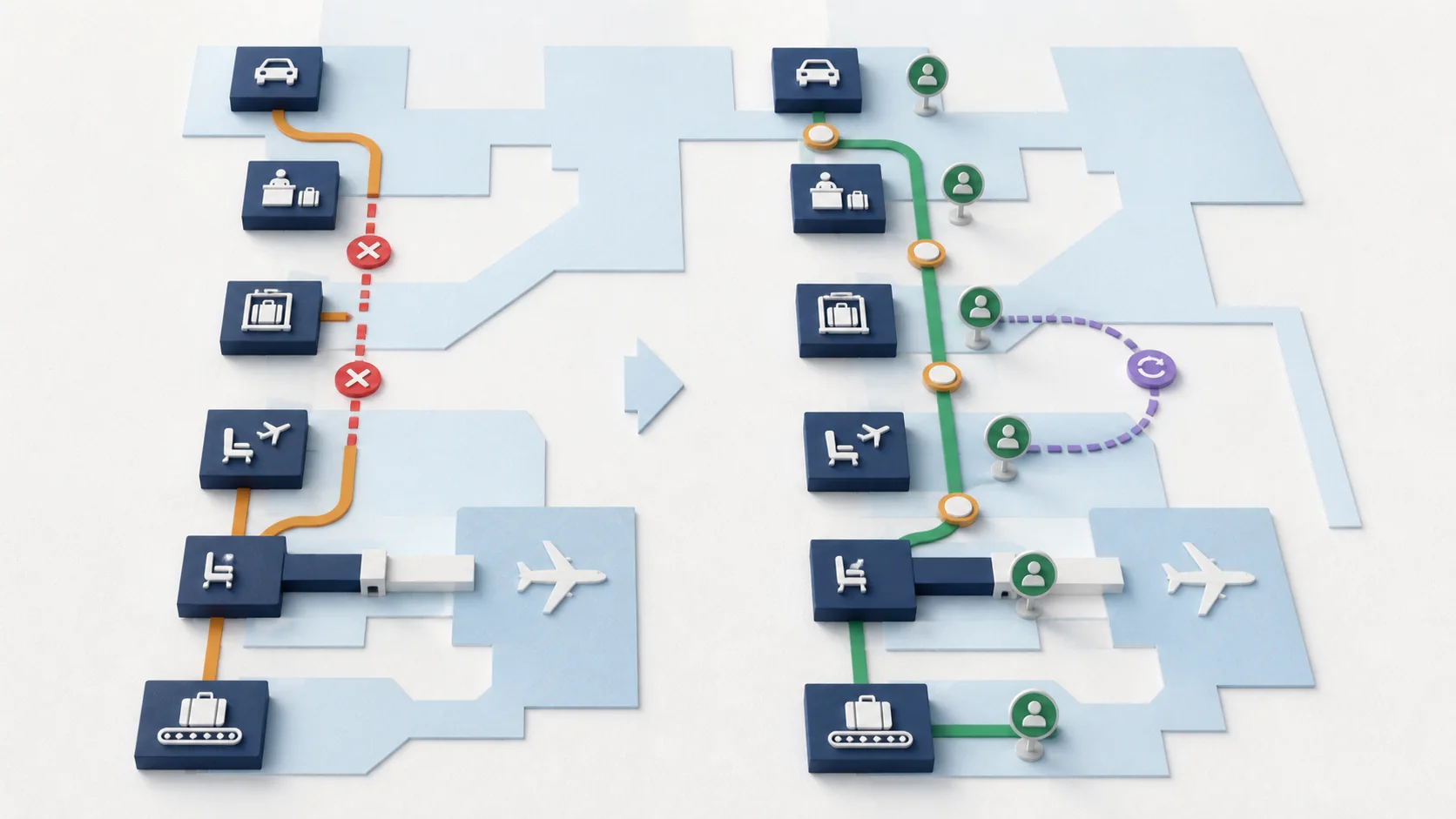
One trip, several organizations, one need
A traveler who requires accessibility assistance interacts with several organizations in a single trip that, to them, feels like one continuous journey: the airline they booked with, the airport operating the terminal, the security screening process, and the ground-handling or wheelchair-assistance provider actually delivering the physical help. Each of these is typically a separate operational entity with its own systems, staff, and definition of where its responsibility starts and ends.
The traveler's need for assistance does not change as they move between these organizations. Whether that need is recognized, communicated, and acted on consistently often does.
Where the break actually sits
A request logged at booking is a piece of information, not a guarantee that the information travels with the traveler to the next organization in the chain. Applying the four-question test: is there a visible next step for the traveler at each handoff (or do they have to re-request help each time)? Is there a single owner accountable for the assistance experience end to end, or does each organization consider its job done once the traveler is physically handed to the next one? Is there a recovery path if assistance doesn't materialize at a given point? Is there any activation of the disclosed need beyond the specific point it was recorded?
In many accessibility-assistance models, the honest answer to several of these is "it depends" — on staffing that day, on whether information transferred correctly between systems, on whether the traveler is able to advocate for themselves again at each new point of contact. That inconsistency, not any single organization's individual competence, is the dead end.
Who is standing at this dead end
Travelers with mobility, sensory, cognitive, or other accessibility needs, and — closely related — travelers experiencing high anxiety for other reasons (first-time flyers, those with medical conditions requiring particular handling) who depend on continuity of information and support across the same fragmented chain of organizations.
What fails to travel with the traveler
Context is what fails to travel: a disclosed need, once made, should not have to be re-established at every handoff, but in a fragmented operational chain, it often does. Trust also erodes with each re-request — a traveler who has to repeatedly advocate for a need they already disclosed reasonably concludes the system doesn't reliably retain what they've told it, which shapes whether they trust the same airline or airport with future travel.
The unresolved question worth asking
Which accessibility-dependent or high-anxiety travelers stop choosing to fly, or choose different routes and carriers, because continuity across this multi-organization chain is inconsistent rather than because any single provider failed outright?
This is deliberately framed as an open question. It is plausible that inconsistent continuity — not any single dramatic failure — is what most damages an accessibility-dependent traveler's confidence in air travel generally, but establishing that, and its scale, requires accessibility-specific research this draft does not attempt to substitute for.
What continuity would specifically require
Continuity here means a disclosed need traveling intact and actionable through every organizational handoff — airline to airport, airport to security, security to ground handling — without depending on the traveler to re-advocate at each step, alongside a single identifiable point of accountability the traveler (or someone assisting them) can reach if a handoff fails partway through the journey.
The decision this puts in front of airport and airline leaders
The organizations in this chain already coordinate operationally in other respects — baggage, boarding sequencing, gate changes. The decision is whether accessibility information is treated with the same cross-organizational coordination discipline as those operational necessities, or whether it remains dependent on the traveler's own persistence at each new point of contact.
The signal worth tracking
A meaningful internal test for any organization in this chain: can staff at the next handoff point see that assistance was requested and what it involves, without the traveler having to say so again? If the honest answer depends on which staff member is on shift that day, that inconsistency is the pattern this article describes.
Closing the loop
This pattern belongs in the series because it is one of the clearest examples of continuity breaking specifically at organizational seams rather than within any one organization's control — which is exactly the kind of dead end that individual-company fixes cannot close on their own.
Before, during and after the dead end
This pattern should be managed across three decision windows, not only after the failure becomes visible. Before the dead end, the organization should watch for the signals that intent, trust, value or responsibility is starting to stall. During the dead end, the priority is to preserve context, name an owner, keep a useful next step visible and protect whatever value can still be recovered. After the immediate moment passes, the organization should measure what changed, identify which Revenue Unknown remains unresolved and redesign the experience so the next cycle starts earlier.
Transformidy infographic
Dead-end experience vs friction
Friction slows movement. A dead-end experience blocks recognition, decision, recovery, or continuity.
- 01
Friction
The person can continue, but with extra effort, delay, or confusion.
- 02
Dead end
The person cannot complete, recover, escalate, or know what happens next.
- 03
Recognition gap
The organization sees activity, but misses the blocked experience condition.
- 04
Decision needed
Someone must own the path, exception, handoff, or recovery rule.
FAQ
Why does accessibility assistance sometimes fail to carry through an entire airport journey?
This article addresses the question through the lens of experience continuity, the unresolved Revenue Unknown, and the decision window leaders still have before the pattern repeats.
What organizations are involved in delivering airport accessibility assistance?
This article addresses the question through the lens of experience continuity, the unresolved Revenue Unknown, and the decision window leaders still have before the pattern repeats.
What is the Revenue Unknown created by inconsistent accessibility continuity?
This article addresses the question through the lens of experience continuity, the unresolved Revenue Unknown, and the decision window leaders still have before the pattern repeats.
How can airlines and airports improve accessibility handoffs?
This article addresses the question through the lens of experience continuity, the unresolved Revenue Unknown, and the decision window leaders still have before the pattern repeats.
Related intelligence
Article
How to Find Dead-End Experiences Before Customers Defect
Dead-end experiences don't announce themselves — they hide inside metrics that look fine. Here's a practical way to find them before they show up as defection.
Article
Hotel Recovery Is Not Finished When the Apology Is Sent
A sincere apology closes a complaint. It doesn't necessarily rebuild the confidence a guest needs to book that hotel again. Here's why service recovery often stops one step too early.
Article
Healthcare Referrals Leave Patients Stranded Between Providers
A referral is a handoff between two providers who don't share a single system or, often, direct communication. Here's why that handoff is a common point where care intent quietly stops.