
Article
Apple Waited Until the Foldable iPhone Could Become an Experience Layer
Apple's iPhone Duo is not only a foldable phone announcement. It shows why waiting can be the right experience strategy when a category needs hardware, software, developers, intelligence, and premium economics to become one coherent system.
- Published
- September 9, 2026
- Updated
- September 9, 2026
- Reading time
- 8 min
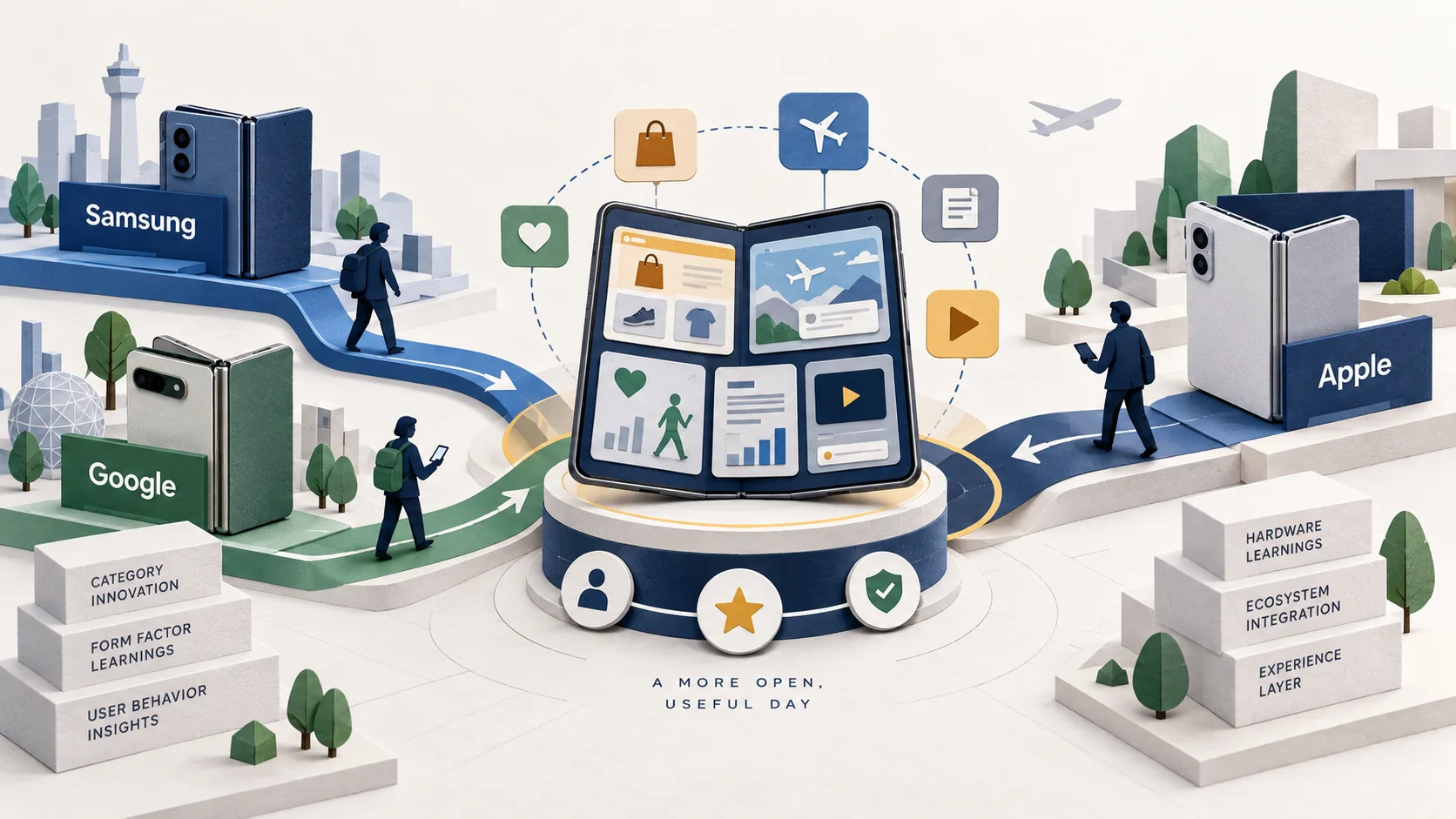
Apple's first foldable iPhone should not be read as a late hardware catch-up.
It should be read as an experience-timing decision.
At its September 9, 2026 keynote, Apple introduced iPhone Duo as a premium foldable iPhone with a 6.5-inch outer display, an 8-inch inner display, a titanium hinge, a dual-camera system, and a starting price of $1,999. The company also framed the device around iOS 27 capabilities designed for a larger folding canvas: Split View, docked app pairs, drag-and-drop between panes, adaptive layouts, iPhone Handoff, and an expanded Siri AI experience that can understand more of what is happening on screen.
The visible signal is obvious. Apple has entered foldables.
The hidden signal is more important. Apple waited until the foldable phone could be positioned as an experience layer, not only a form factor.
That timing matters because Samsung and Google have already done important category work. Samsung has spent years normalizing foldable productivity, large-screen multitasking, Flex mode, app continuity, and app-pair workflows. Google has pushed foldables through Android, Pixel, Gemini, search, camera intelligence, and large-screen app behavior. Both companies helped prove that a foldable phone can be more than an expensive curiosity.
Apple benefits from that market education. It does not have to convince customers that a phone can fold. It has to convince premium iPhone customers that folding changes what the iPhone can manage.
The Revenue Unknown is this:
How much premium-device revenue can Apple unlock when the iPhone becomes a larger personal context surface for shopping, travel, work, health, media, and AI-mediated decisions?
Why Waiting Was The Experience Move
Technology companies are often judged harshly for arriving late. That judgment is too simple here.
In a category like foldables, first movement and best experience are not the same thing. The product has to solve several problems at once. The hinge has to feel durable. The outer display has to be useful enough that the phone still works closed. The inner display has to justify opening the device. Battery, thermal management, weight, app behavior, camera placement, repair expectations, and price all have to feel coherent.
A foldable phone is only meaningfully different when the larger surface reduces effort. If opening the device simply produces a bigger version of the same app, the customer has bought novelty. If opening the device lets the customer compare, coordinate, recover, create, reference, and act with less friction, the customer has bought a different experience system.
This is why Apple's delay can be defended from an experience perspective. A foldable iPhone launched too early would have risked becoming a design object that asked users to justify its existence. In 2026, Apple can make a stronger argument: the Duo is a premium iPhone for people whose daily experiences no longer fit cleanly inside one full-screen app.
That is a better brief.
The customer is not only opening a larger display. The customer is opening a work state, a shopping state, a travel state, a family state, a media state, or a health state. The value is not the fold. The value is the managed transition between those states.
What Samsung And Google Taught The Market
Samsung and Google deserve credit in this story.
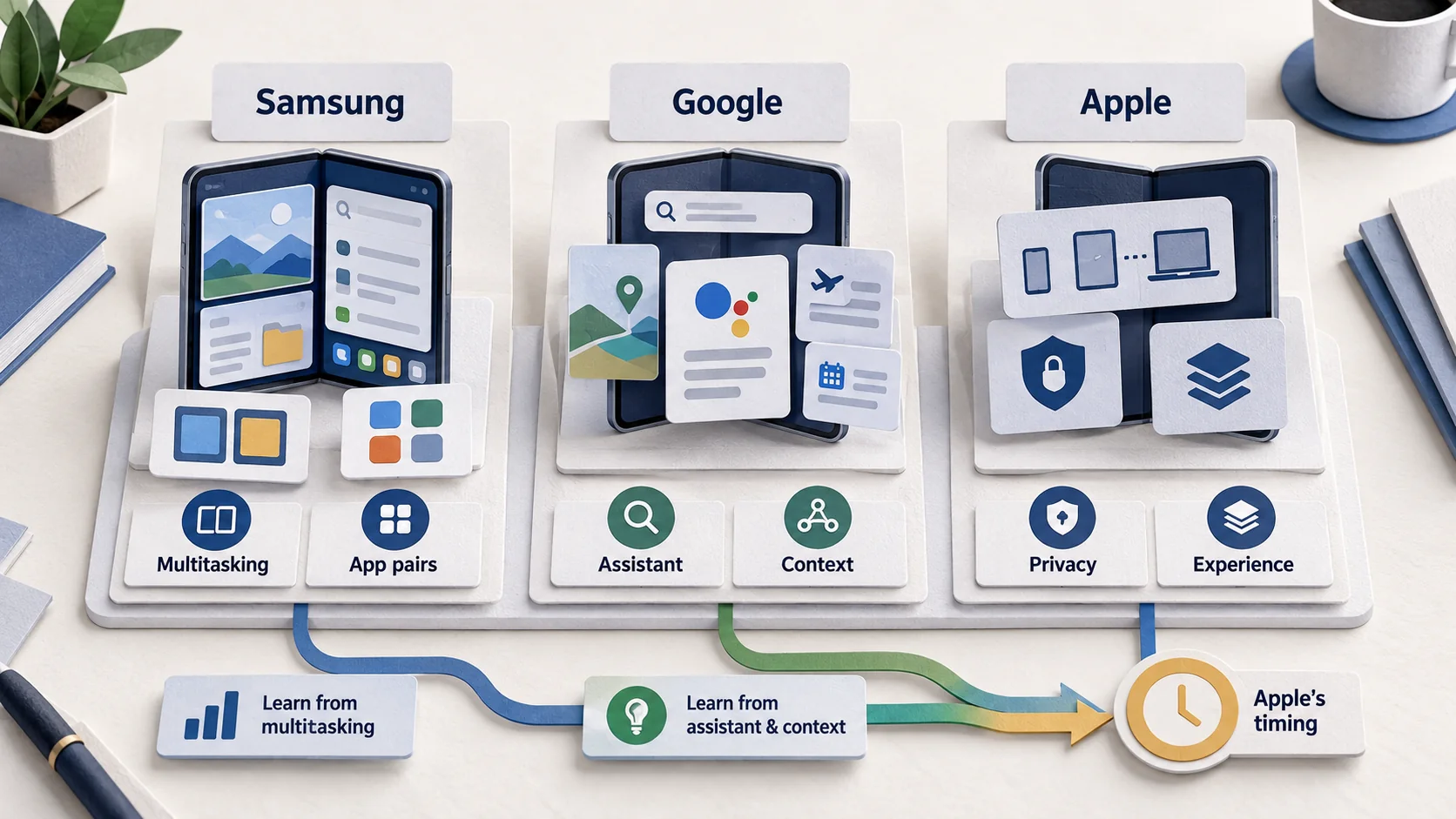
Samsung's foldable strategy has made the book-style phone feel productive. Its Fold line trained users to expect multi-window workflows, app continuity between cover and inner screens, app pairs, Flex mode, and a device that can act like a small tablet without giving up phone identity.
Google's foldable strategy has made the category more context-aware. Pixel foldables connect the larger screen to search, Gemini, camera intelligence, translation, photo management, and Android's large-screen app model. Google has an advantage in assistance because search intent, maps, Gmail, Calendar, Photos, YouTube, and Gemini all sit close to the customer journey.
Together, Samsung and Google have clarified the experience questions Apple now has to answer.
Apple is entering after these questions have become visible. That is not the same as entering after the opportunity has passed.
Apple's Different Bet
Apple's different bet is integration.
That word can sound generic, but in this case it is specific. Apple controls the hardware, iOS, App Store rules, Apple Intelligence, Siri, privacy framing, Health, Wallet, Messages, FaceTime, Safari, Photos, Watch, AirPods, Mac, iPad, and carrier-facing device experience. iPhone Duo gives Apple a larger surface on which these pieces can interact.
That is why the Duo matters beyond the folding screen.
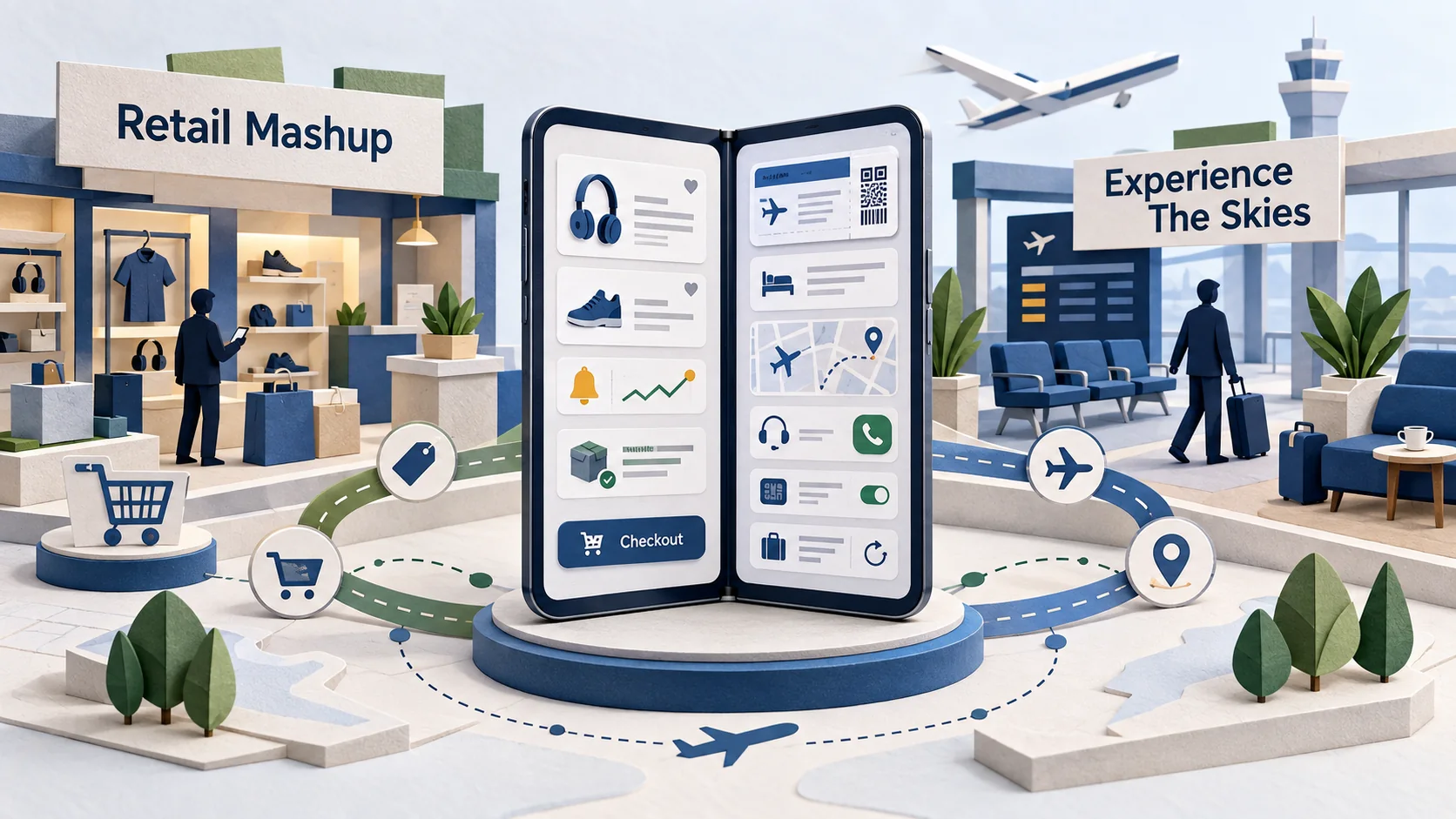
If a customer is shopping, the inner display can hold product research, comparison, cart, messages, financing, trade-in, and price monitoring in a more usable layout. If a customer is travelling, the inner display can hold itinerary, airline app, hotel confirmation, map, support call, wallet pass, and translation at the same time. If a customer is working, the inner display can hold a document, message thread, meeting notes, calendar, and Siri AI assistance without constant app switching.
The value is state continuity.
Apple's premium pricing depends on convincing customers that the Duo protects attention, not just screen real estate. At $1,999, the device cannot live on curiosity alone.
That is also why the standard iPhone absence matters. If the keynote is premium-first, Apple is effectively saying that the next major experience layer begins at the top of the portfolio. That can protect margin, but it also creates a strategic question: will advanced intelligence experiences become premium entitlements before they become mass behavior.
Retail Mashup And Experience The Skies
The Retail Mashup implication is immediate.
Foldable iPhone behavior changes how customers can shop. A larger screen supports comparison, product research, reviews, creator content, messages, inventory checks, price monitoring, financing, authentication, and checkout in one session. Safari's Notify Me capability, if tied to restocks and price drops, pushes Apple closer to the role of shopping monitor. Siri AI and on-screen awareness push Apple closer to the role of shopping interpreter.
Retailers should be careful. A sale may still happen on the retailer's site, but the customer relationship may be mediated by Apple. If Apple helps the customer compare, remember, monitor, authenticate, and decide, the retailer may see the transaction without understanding the decision path.
That is a Revenue Unknown for commerce: value may move into the device layer before merchants can measure it.
Experience The Skies has a parallel problem.
Travel is already a multi-pane experience trapped inside single-screen behavior. A traveler may need an airline app, hotel app, rideshare app, Wallet pass, Maps, Messages, email confirmation, loyalty account, weather, translation, and support call in the same window of anxiety. Foldable hardware makes sense when it reduces that management burden.
An iPhone Duo travel session could show an itinerary on one pane and airline support on the other. Siri could surface a reservation number during a call. Wallet and Maps could sit beside delay alerts. eSIM and iPhone Handoff could make cross-device and cross-border continuity less fragile.
The opportunity for airlines, hotels, airports, cards, and destinations is clear. Design for the customer's context layer, not only the brand's app.
The Operator Takeaway
The foldable iPhone is not important because Apple finally made a phone that opens.
It is important because Apple can now make a premium argument about managed attention. Samsung and Google proved that the category can work. Apple is betting that the category becomes more valuable when the device is connected to personal context, privacy, Siri AI, Health, Wallet, Safari, Messages, and the broader Apple ecosystem.
That creates opportunity for brands, but also risk.
If retailers, airlines, hotels, banks, media companies, and health partners do not design for this larger context-aware surface, Apple becomes the layer that understands the customer's experience better than they do. The brand may still supply the product, flight, room, claim, appointment, or service. But Apple may own the moment when the customer decides what matters next.
That is the strategic consequence of the Duo.
The fold is the visible design move. The experience layer is the business move.
Reader Poll
If your organization has a mobile app, is it designed for the customer's larger context or only for the task your brand wants completed?
Sources
- Apple, "Apple unveils iPhone Duo," September 9, 2026, https://www.apple.com/newsroom/2026/09/apple-unveils-iphone-duo/
- Apple, "Apple debuts iPhone 18 Pro and iPhone 18 Pro Max," September 9, 2026, https://www.apple.com/newsroom/2026/09/apple-debuts-iphone-18-pro-and-iphone-18-pro-max/
- Apple, "Apple Event," September 9, 2026, https://www.apple.com/apple-events/
- Samsung, Galaxy Z Fold product information and foldable multitasking materials, https://www.samsung.com/
- Google, Pixel Fold product information and Gemini-enabled phone experience materials, https://store.google.com/
Related Reading
FAQ
What is the main idea of Apple Waited Until the Foldable iPhone Could Become an Experience Layer?
Apple Waited Until the Foldable iPhone Could Become an Experience Layer explains a change leaders should not treat as background noise. It shows what evidence is visible, what may be changing underneath it, and which decision window remains open.
Why does Apple Waited Until the Foldable iPhone Could Become an Experience Layer matter for Experience Intelligence?
The article helps readers see how an experience, relationship, capability, or value condition may be changing before the consequence is fully visible.
What Revenue Unknown does this article help identify?
It frames the unresolved commercial or operating question created by the change: what value, risk, hidden demand, relationship movement, or capability gap may exist but has not yet been measured or decided.
How should leaders use this article in the Special Intelligence series?
Use it as a prompt to separate observed evidence from interpretation, name the decision that still has to be made, and identify what would validate whether the interpretation is right.
Related intelligence
Article
Accountable AI Delegation Is the New Operating Model
# Accountable AI Delegation Is the New Operating Model Production illustration: human-agent collaboration organized around evidence, authority, approval and learning. **Revenue Unknown:** Many organizations are preparing
Article
Apple Is Turning Siri Into an Experience Manager
Apple's Siri AI and Apple Intelligence updates matter because they move AI from answer generation toward experience management. Personal context, on-screen awareness, health intelligence, shopping monitoring, and travel recovery can change where revenue and trust accumulate.
Article
Hyatt's Airline Loyalty Reset Shows Why Partnerships Become Dead-End Experiences
Hyatt is ending its enhanced American Airlines relationship while launching a new Delta collaboration and maintaining a newer Air Canada Aeroplan relationship. The Revenue Unknown is whether airline-hotel partnerships can become real experience systems instead of benefit tables customers only discover when they fail.