
Article
A Record Load Factor Is Not the Same as Slack
IATA's own January 2026 data shows global load factor hit 82%, a record for the month, while demand grew 3.8%. A record load factor sounds like an efficiency win. It is also the number that determines how much room an airline has left to absorb the next disruption without a passenger noticing.
- Published
- January 27, 2025
- Updated
- June 18, 2026
- Reading time
- 8 min
2026 updated analysis
What changed since the original article
This page keeps the original Transformidy article as the canonical record and leads with the current interpretation, source notes, and Revenue Unknown framing.
The Record, and the Regions Behind It
IATA reported global air passenger demand, measured in revenue passenger kilometers, up 3.8% in January 2026 compared to January 2025, with the global load factor reaching 82.0%, described as a record high for the month. The growth was not evenly distributed. Latin American carriers posted 11.4% growth, African carriers 11.7%, Middle Eastern carriers 7.2%, European carriers 6.3%, and Asia-Pacific carriers 4.4%, while the United States declined 0.7% and China fell 3.8%.
The headline number, 82% record load factor, is the kind of statistic that gets reported once and then dropped, treated as a self-evidently positive result. It deserves a second look, because load factor is a two-sided metric: every point of utilization gained is a point of spare capacity lost.
Global air travel load factor, a record high for the month
Alongside 3.8% year-over-year demand growth, with Latin America and Africa each growing over 11%.
What a Full Network Cannot Absorb
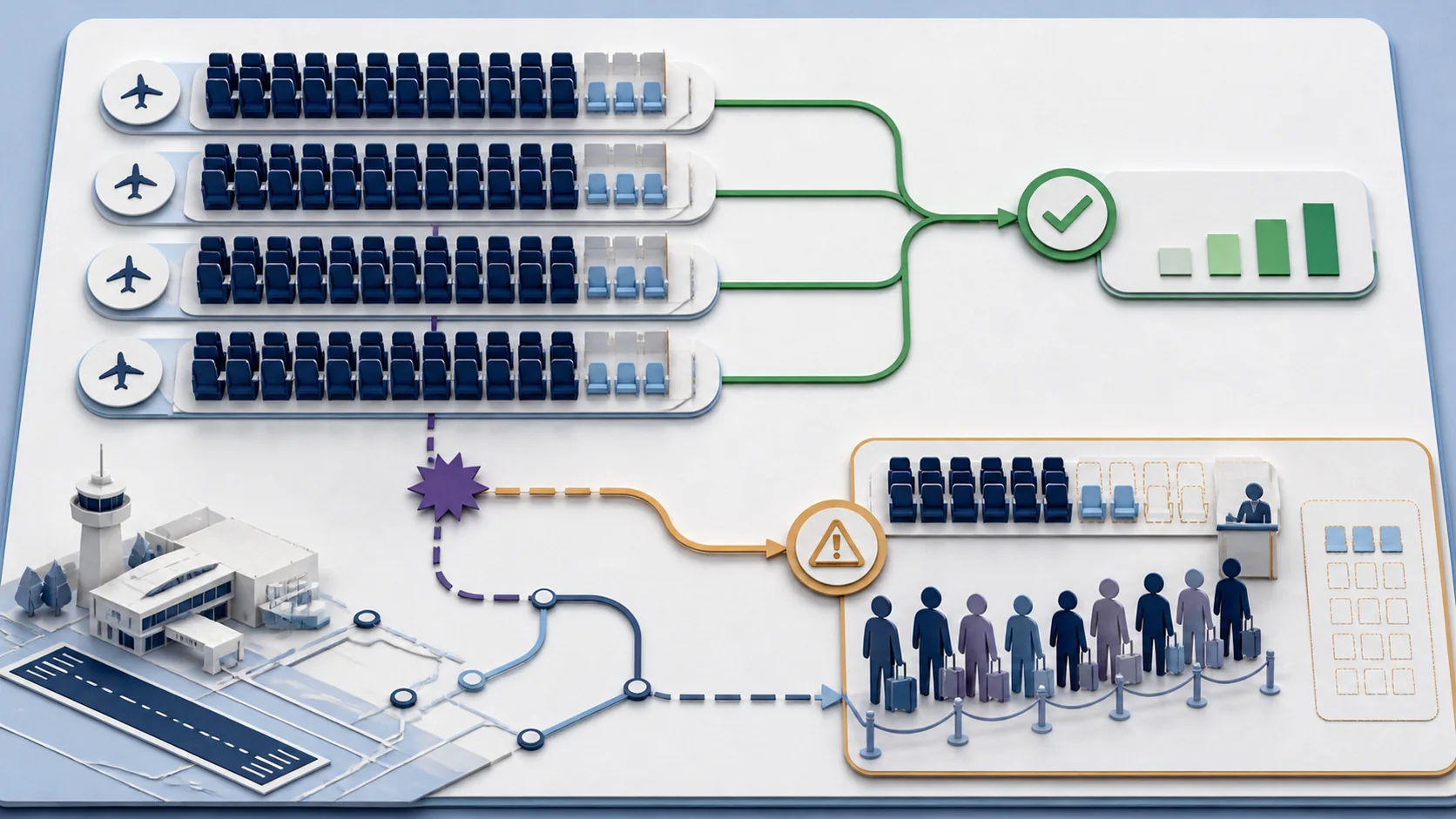
A load factor of 82% means, on average, roughly one in five seats across the global network is empty at any given time. That sounds like meaningful slack until it is placed against the reality of how disruptions actually propagate: a single weather event at a major hub can displace thousands of passengers who all need rebooking within a compressed window, on flights that are themselves already running close to full. The empty seats that exist are scattered across the network, not concentrated where the disruption happened, which makes them far less useful for absorbing that specific shock than the aggregate percentage suggests.
This is the structural tradeoff record load factors represent: strong demand and efficient capacity utilization under normal conditions, purchased at the cost of reduced flexibility exactly when flexibility matters most. Airlines do not choose this tradeoff maliciously; it is a natural consequence of running a capital-intensive business efficiently in a period of strong demand. But it is a real tradeoff, and treating a record load factor purely as good news skips past the operational risk sitting directly underneath it.
The regional divergence adds a second layer worth naming: growth concentrated in Latin America, Africa, the Middle East, and Europe means the infrastructure and disruption-response capacity in those specific regions is being tested by rising utilization faster than in the flatter US and China markets, even though the global average makes the pressure look evenly distributed.
Load Factor as Efficiency Metric vs. Load Factor as Resilience Metric
The same number, read two different ways, points to opposite conclusions.
As efficiency: higher load factor means better capacity utilization and stronger revenue per flight. As resilience: higher load factor means fewer available seats network-wide to absorb passengers displaced by any single disruption.

A record load factor is a record in two directions at once: a record in efficiency, and a record in how little room is left when something goes wrong.
The Leadership Move
The structural choice for airline network planning is whether to treat load factor purely as a revenue-efficiency metric, or to pair it with an explicit, separately tracked measure of disruption recovery capacity.
- Ownership
Network planning and revenue management own load factor optimization; operations and irregular operations teams own disruption recovery. When these functions do not share a common view of how rising load factor is reducing recovery capacity, capacity decisions get made without full visibility into the resilience tradeoff they carry.
- Tradeoff
Deliberately holding back some capacity as recovery buffer on high-risk routes or seasons costs real revenue in normal operating conditions. The alternative, running every route toward maximum load factor regardless of disruption risk, maximizes short-term revenue while compounding the passenger-visible cost of the next major disruption.
- Human consequence
Passengers displaced by a delay or cancellation on a high-load-factor route experience longer rebooking waits and fewer available options, directly because the network has less spare capacity to offer them. Frontline staff handling those passengers are working within a structural constraint set by network-wide capacity decisions made well before the disruption occurred.
Next Move
If your network or routes are running near record load factors: Model disruption recovery time specifically for your highest-utilization routes and compare it against lower-load-factor routes, to quantify how much resilience has actually been given up for the efficiency gain.
If you operate in one of the fastest-growing regions IATA identified: Treat rising regional load factor as an early signal to invest in disruption-response infrastructure now, before demand growth pushes utilization to a point where recovery capacity becomes a passenger-visible problem rather than an internal planning concern.
FAQ
How fast is global air travel demand growing in 2026?
IATA reported global demand, measured in revenue passenger kilometers, up 3.8% in January 2026 compared to January 2025, with the global load factor reaching 82.0%, a record high for the month. Growth was uneven by region: Latin America grew 11.4%, Africa 11.7%, the Middle East 7.2%, and Europe 6.3%, while the United States posted a 0.7% decline and China fell 3.8%.
Why is a record-high load factor not purely good news?
A load factor is the share of available seats actually filled. A record 82% means airlines are running close to capacity across the network, which is efficient under normal conditions but leaves very little slack to absorb weather delays, mechanical issues, or crew disruptions without those problems cascading into passenger-visible delays and cancellations, because there are few empty seats on later flights to rebook affected passengers into.
Which regions are driving global demand growth and which are lagging?
Latin America (11.4%), Africa (11.7%), the Middle East (7.2%), Europe (6.3%), and Asia-Pacific (4.4%) all posted solid year-over-year growth in January 2026. The United States (down 0.7%) and China (down 3.8%) were the notable exceptions, meaning global growth is currently being carried by regions outside the two largest historical aviation markets.
What should airlines do given record load factors?
Treat recovery capacity as a metric worth tracking on its own, separate from load factor and on-time performance, since a network running near full capacity has structurally less room to rebook disrupted passengers smoothly. Where a route or region is already near record utilization, disruption response planning matters more than it did when average load factors left more unsold seats to absorb the shock.
Sources & References
Original article archive
Original article published January 27, 2025: "The Big Trends In Air Travel 2025 ". Preserved here for provenance, historical context, and citation continuity.
As we continue our exploration of the evolving landscape of air travel, it's clear that the industry is undergoing a profound transformation. In Part 1 of our series, we discussed the technological advancements and personalized experiences reshaping airports and air travel. Part 2 turns our attention to five additional trends ranging from premium economy, collaboration, and accessibility.
Key 2025 Travel Trends - Part 2
From the rise of premium economy to the integration of wellness features, these innovations promise to make air travel more comfortable, accessible, and enjoyable for all.
Here are some exciting developments for air travelers that airports should not ignore in 2025 and beyond:
Premium Economy: The Rising Star of Air Travel
As air travel seeks to cater to a broader range of travelers, the premium economy class has emerged as a crucial middle ground between economy and business class for airlines. This category is gaining traction amongst travelers, offering enhanced comfort and services without the hefty price tag of business class. Unless these travelers often would like an elevated experience airport especially if they do not have access to airline lounges.
To curate for premium economy air travelers, airports can implement several strategies that cater to this growing segment of passengers who seek elevated air travel experience without the full cost of business class. Here are some ideas for airports to provide an improved experience for premium economy travelers:
- Dedicated check-in counters: Airlines can work with airports to offer separate check-in areas for premium economy passengers, reducing wait times and providing more personalized service.
- Fast-track security lanes: Airports can provide access to expedited security screening as a complimentary or add-on service, similar to what premium passengers receive, to save time and reduce stress.
- Enhanced lounge access: If airline lounge access is not available, airports can partner with specialists such as Premium Plaza Group and Airport Dimensions to build lounge options at a cost and improve comfort.
- Improved seating areas at gates: Design comfortable waiting areas with power outlets, USB ports, and complimentary Wi-Fi specifically for premium economy passengers.
- Personalized concierge services: Offer assistance with flight information, directions, expedited/personalized service, and other travel-related queries as an add-on.
- Premium dining options: Partner with local restaurants to provide exclusive meal deals or curate enhanced dining spaces with higher-quality food options.
- Enhanced retail experiences: Develop curated shopping areas or offer exclusive discounts on duty-free items for premium economy ticket holders.
- Partnerships: Work with vendors in and out of the airport to improve customer experience.
Wellness and Relaxation: Prioritizing Traveller Well-being
As air travel continues to evolve, airports are increasingly recognizing the importance of passenger well-being. The stress associated with travel, from security checks to long layovers, can significantly impact the overall travel experience. Over 1/3 of passengers surveyed by ACI World* noted demanded wellness-focused environments.
In response, airports worldwide are incorporating innovative wellness features designed to improve traveler comfort and reduce stress. These initiatives not only enhance passenger satisfaction but also contribute to increased dwell time and potential revenue generation. According to the Global Wellness Institute, wellness tourism is projected to reach US$1.4 trillion by 2027, highlighting the growing demand for such amenities in air travel.
- Singapore Changi Airport (SIN) has set the gold standard for airport wellness with its Jewel complex, featuring a stunning indoor waterfall, lush gardens, and nature trails. The airport also offers multiple themed gardens, including a Butterfly Garden and a Sunflower Garden, providing natural spaces for relaxation and rejuvenation.
- Frankfurt Airport (FRA) has embraced a comprehensive approach to passenger well-being by offering quiet zones, yoga rooms, and a full-service spa. These facilities allow travelers to destress and recharge during layovers, catering to the growing demand for wellness-focused amenities.
- Dallas Fort Worth International Airport (DFW) has introduced two dedicated yoga rooms where travelers can stretch and meditate on provided mats. The airport has also created "inspiring" walking paths and features an extensive art program, including multi-million dollar commissioned public art pieces, to enhance the overall airport experience.
- Helsinki Airport (HEL) has innovated with "GoSleep" pods, equipped with luggage storage and charging ports. These pods offer a private space for rest and relaxation, addressing the needs of transit passengers and those with long layovers.
- Munich Airport (MUC) offers Napcabs, which are private sleeping pods featuring adjustable lighting, charging ports, and privacy features. These amenities cater to long-distance travelers seeking comfort and rest during their journey.
Accessibility Improvements: Inclusive Travel for All
The aviation industry is making significant strides in ensuring that air travel is accessible to all passengers, regardless of their physical or cognitive abilities. This focus on inclusivity is not only improving the travel experience for those with disabilities but also setting new standards for airport design and services. With approximately 1.3 billion people, or one in six globally, experiencing some form of disability, these improvements are crucial for creating a more equitable travel environment.
- London Heathrow Airport (LHR) has introduced "passenger journey planners" specifically designed for travelers with reduced mobility or sensory challenges. These planners provide step-by-step guidance through the airport, enhancing independence and reducing stress for passengers with special needs.
- Vancouver International Airport (YVR) has implemented a comprehensive accessibility program, including a quiet room for individuals with autism and fully accessible restrooms. The airport's 2023-2025 Accessibility Plan outlines further improvements, such as introducing new technology to reduce wait times and create a more predictable experience for guests.
- Miami International Airport (MIA) has opened a multi-sensory room designed for travelers with cognitive and developmental disabilities. This space provides a calming environment for passengers who may feel overwhelmed by the busy airport atmosphere.
- Munich Airport (MUC) has installed tactile guidance systems and audio beacons to assist visually impaired travelers in navigating the airport independently. These features demonstrate the airport's commitment to creating an inclusive environment for all passengers.
- Glasgow Airport (GLA) has one of the highest percentages of passengers with disabilities and reduced mobility (PRM) in the UK. In 2024, the airport welcomed over 110,000 PRM passengers and has been working on innovative accessibility technology trials to further improve their experience.
While there are high-tech options to manage accessibility needs, operators can join more than 120+ global airports in improving accessiblity by enrolling into the sunflower program designed for passengers with autism.
Tailored Amenities for Different Travel Stages
Recognizing that air travelers have different needs at various stages of their journey, airports are customizing their offerings for departing, transiting, and arriving passengers. This approach not only enhances the overall travel experience but also contributes to increased passenger satisfaction and potentially higher non-aeronautical revenue. According to recent studies, 94% of airports are planning or implementing traveler self-service options in 2023, while 84% are considering investments in next-generation interactive signage.
Departure Areas
- Paris Charles de Gaulle Airport (CDG): Features a virtual reality gaming zone, offering entertainment for passengers waiting to board.
- Beijing Capital International Airport (PEK): Provides cultural workshops where departing travelers can learn traditional Chinese arts like calligraphy.
- Los Angeles International Airport (LAX): Offers a state-of-the-art gym and shower facilities for passengers looking to squeeze in a workout before their flight.
Transit Areas
- Singapore Changi Airport (SIN): Features a butterfly garden and movie theater, providing unique experiences for transit passengers.
- Dubai International Airport (DXB): Offers a sleep 'n fly lounge with private pods for transit passengers to rest between flights.
- Istanbul Airport (IST): Provides guided terminal tours, allowing transit passengers to explore the airport's art installations and cultural exhibits.

Arrival Areas
- Auckland Airport (AKL): Features a "Welcome Zone" with local cultural performances and information about New Zealand for arriving tourists.
- Copenhagen Airport (CPH): Offers a "Luggage Drop" service, allowing arriving passengers to explore the city without their bags.
- Helsinki Airport (HEL): Provides a "Taste of Finland" area where arriving passengers can sample local cuisine and products.
Collaborative Travel Experience: Integration Across Stakeholders
The future of air travel relies heavily on seamless collaboration between various stakeholders. Airports, airlines, and other service providers are working together to create a unified and personalized travel experience. This integration is crucial for improving efficiency, reducing stress for passengers, and potentially increasing revenue through better-targeted services. According to Amadeus' recent Travel Technology Investment Trends study, airport leaders recognize the pivotal role of technology in facilitating this collaboration.
- Amsterdam Schiphol Airport (AMS) has partnered with KLM to offer integrated baggage tracking services from check-in to final destination, providing passengers with real-time information about their luggage throughout their journey.
- Miami International Airport (MIA) has collaborated with U.S. Customs and Border Protection to implement biometric exit technology, streamlining the departure process and enhancing security measures.
- Hong Kong International Airport (HKG) has worked with local transportation providers to offer in-town check-in services at various city locations, allowing passengers to check in for their flights and drop off luggage before arriving at the airport.
- Denver International Airport (DEN) has partnered with ride-sharing services to create designated pick-up areas and integrate real-time flight information, improving the ground transportation experience for arriving passengers.
- London Heathrow Airport (LHR) has collaborated with British Airways to offer a seamless transfer experience for connecting passengers, including automated bag transfer and personalized digital assistance. This integration helps reduce connection times and improve the overall travel experience for transit passengers.
Sustainability: Better for Air Travelers and the Environment
Sustainability has become a cornerstone of airport operations and development in 2025. The aviation industry is making significant strides toward reducing its environmental impact for air travel, with airports leading the charge in implementing initiatives. According to the Airport Carbon Accreditation (ACA) program, 19 airports achieved level 5 status in 2024, demonstrating a strong commitment to environmental responsibility (Level 1 Mapping, Level 2 Reduction, Level 3 Optimization, Level 3+ Neutrality, Level 4 Transformation, Level 4+ Transition, Level 5).
Here are five examples of airports pioneering green initiatives:
- Denver International Airport (DEN): DEN is making significant strides in sustainability with its commitment to grow while prioritizing environmental responsibility. The airport has partnered with TerraCycle to recycle hard-to-recycle materials, including cigarettes, demonstrating innovative approaches to waste management.
- Los Angeles International Airport (LAX): LAX has established itself as a global leader in Sustainable Aviation Fuel (SAF) adoption. By partnering with airlines and fuel providers, the airport has facilitated the use of millions of gallons of SAF, significantly reducing lifecycle emissions from aircraft.
- San Francisco International Airport (SFO): SFO has implemented a comprehensive water conservation program that includes rainwater harvesting and wastewater treatment facilities. The recycled water is used for irrigation and toilet flushing, significantly reducing the airport's reliance on external water supplies. Additionally, SFO's All-Electric Concessions Initiative supports its goal of achieving net zero carbon emissions by 2030 by transitioning airport concessions to all-electric operations.
- Salt Lake City International Airport (SLC): SLC has embraced sustainability by mandating a 100% electric ground support equipment (eGSE) conversion. This initiative not only enhances operations but also significantly reduces emissions and improves air quality in the region.
- Indira Gandhi International Airport (DEL): DEL is one of the airports to achieve Level 4+ Transition in the Airport Carbon Accreditation program was recently recognized for its 'Center of Excellence – Biodiversity Center'. This center contributes significantly to environmental conservation, carbon offsetting, public education, aesthetic enhancement, and research innovation.
These examples showcase how airports are not just adapting to environmental challenges but are actively driving innovation in sustainability. From renewable energy adoption and efficient waste management to biodiversity conservation and electric vehicle integration, airports are setting new standards for environmental stewardship in the aviation industry.
Key Takeaways
- Premium economy is becoming a crucial offering, bridging the gap between economy and business class that airports should cater to.
- Wellness and relaxation features are no longer luxuries but essential components of the airport experience for all air travelers.
- Accessibility improvements are setting new standards for inclusive travel.
- Tailored amenities for different travel stages enhance the overall journey experience.
- Sustainability improvements will make for a better air travel experience and the environment.
Transform for the Better
As airports continue to evolve, we can expect to see further innovations in these areas. The integration of smart technologies will likely lead to even more efficient and enjoyable travel experiences. Additionally, as global concerns about climate change grow, airports will need to focus on reducing their environmental impact while maintaining high levels of air travel service.
The future of aviation is bright, with airports leading the way in creating experiences that are not just about getting from point A to point B, but about making the journey itself a memorable part of the adventure. As air travelers, we can look forward to airports that are more than just transit hubs – they are becoming destinations in their own right, offering comfort, convenience, and excitement at every step of our journey.
Next Steps
Transformidy is available to help you understand your brand, company, or agency’s value proposition and maximize your customer experience strategy for business growth, engagement, and satisfaction.
Contact us or set up a 30-minute complimentary consultation for more information on our services, insights, or showcases. We look forward to hearing from you.
*The ACI World Traveller Survey, conducted annually by Airports Council International (ACI), is a comprehensive global study that captures the pulse of air traveller preferences, behaviors, and expectations. With a history spanning over a decade, this survey has become a cornerstone for aviation industry insights, guiding airports, airlines, and policymakers in shaping the future of air travel. The 2024 edition of the survey is particularly significant, as it reflects the first full year of post-pandemic recovery and the evolving priorities of travellers in this new era.
Gathering data from thousands of passengers across diverse demographics and geographies, the 2024 survey explores critical areas such as technology adoption, sustainability concerns, retail preferences, and the increasing demand for personalized experiences. This year’s findings not only highlight current travel experience trends but also provide a roadmap for the aviation industry to innovate and adapt to the changing landscape of global travel.
FAQ
How fast is global air travel demand growing in 2026?
IATA reported global demand, measured in revenue passenger kilometers, up 3.8% in January 2026 compared to January 2025, with the global load factor reaching 82.0%, a record high for the month. Growth was uneven by region: Latin America grew 11.4%, Africa 11.7%, the Middle East 7.2%, and Europe 6.3%, while the United States posted a 0.7% decline and China fell 3.8%.
Why is a record-high load factor not purely good news?
A load factor is the share of available seats actually filled. A record 82% means airlines are running close to capacity across the network, which is efficient under normal conditions but leaves very little slack to absorb weather delays, mechanical issues, or crew disruptions without those problems cascading into passenger-visible delays and cancellations, because there are few empty seats on later flights to rebook affected passengers into.
Which regions are driving global demand growth and which are lagging?
Latin America (11.4%), Africa (11.7%), the Middle East (7.2%), Europe (6.3%), and Asia-Pacific (4.4%) all posted solid year-over-year growth in January 2026. The United States (down 0.7%) and China (down 3.8%) were the notable exceptions, meaning global growth is currently being carried by regions outside the two largest historical aviation markets.
What should airlines do given record load factors?
Treat recovery capacity as a metric worth tracking on its own, separate from load factor and on-time performance, since a network running near full capacity has structurally less room to rebook disrupted passengers smoothly. Where a route or region is already near record utilization, disruption response planning matters more than it did when average load factors left more unsold seats to absorb the shock.
Related intelligence
Article
A Domestic Airport Bet Its Rebrand on a Character the World Already Knew
Oita rebranded its airport, which primarily serves domestic flights, into Hello Kitty Airport for six months in 2025, betting Sanrio's global fame could redirect Tokyo and Osaka's Expo crowds toward Kyushu. Public results remain limited. The bet itself is the story.
Article
STARLUX's Fastest-Growing Business Is Not Passengers
STARLUX's cargo revenue grew 44% in November 2025, driven by the global AI server shipment boom. The airline's most interesting growth signal in 2025 was not a themed passenger campaign. It was air freight for data center hardware.
Article
One Fountain Stunt Became a 24-Race Season-Long Program
Disney's Fuel the Magic campaign with F1 started as one Mickey Mouse appearance at the Fountains of Bellagio. A year later it is a season-long program across all 24 races, WEBTOON comics, and multiple retail lines. That expansion rate is the actual story, not the fountain stunt.