
Article
Apple Is Turning Siri Into an Experience Manager
Apple's Siri AI and Apple Intelligence updates matter because they move AI from answer generation toward experience management. Personal context, on-screen awareness, health intelligence, shopping monitoring, and travel recovery can change where revenue and trust accumulate.
- Published
- September 9, 2026
- Updated
- September 9, 2026
- Reading time
- 8 min
The biggest Apple announcement may not be the foldable iPhone.
It may be what happens when Siri becomes more aware of the user's context.
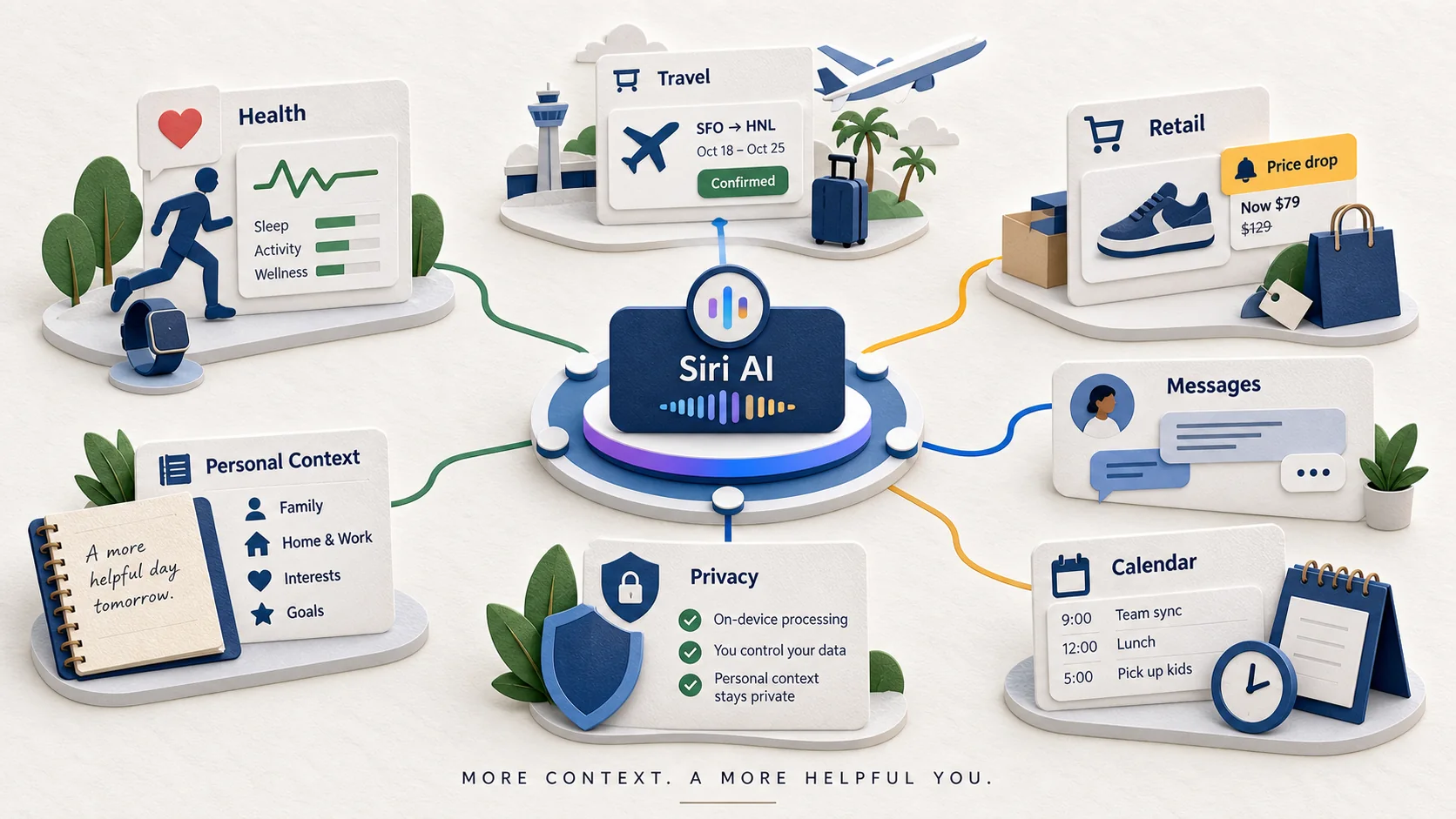
At Apple's September 9, 2026 keynote, the hardware story was easy to see: iPhone Duo, iPhone 18 Pro, iPhone 18 Pro Max, new premium positioning, and a larger device canvas. But the more durable experience signal sits inside iOS 27 and Apple Intelligence. Apple described Siri AI as moving into beta with more conversational understanding, personal context, on-screen awareness, app actions, and the ability to help users in the middle of what they are already doing.
That changes the strategic question.
For years, voice assistants were judged by whether they could answer a question, set a timer, play a song, route a message, or control a device. That was useful, but limited. The assistant waited for an explicit command and often behaved like a tool beside the experience.
If Siri can understand what is on screen, what the user is trying to do, what app is active, what reservation is relevant, what health signal changed, what message thread matters, or what web page should be monitored, it starts to become a manager of experience states. It does not only respond. It helps coordinate.
The Revenue Unknown is this:
How much new value can Apple create when intelligence moves from answering questions to managing context across health, shopping, travel, work, family, and daily decisions?
From Assistant To Experience Manager
The difference between an assistant and an experience manager is ownership of context.
An assistant can answer a prompt. An experience manager understands where the prompt sits inside a larger journey. That distinction matters because customers rarely experience problems as isolated tasks. A traveler does not need only a confirmation number. They need to know whether the confirmation solves the support call, boarding pass, hotel check-in, loyalty credit, or missed connection. A shopper does not need only a product page. They need to know whether the product is authentic, available, fairly priced, returnable, compatible, and worth buying now. A health user does not need only a chart. They need help interpreting whether a signal deserves attention, habit change, professional care, or simple reassurance.
This is where Apple's ecosystem position is unusually strong.
Siri can sit close to Messages, Mail, Calendar, Safari, Wallet, Health, Photos, Maps, App Store, subscriptions, devices, and notifications. Apple also controls the privacy promise surrounding that intelligence. If the company can make personal context useful without making it feel exposed, it can build trust in a part of AI where many competitors struggle.
The risk is equally clear. If Siri becomes more context-aware but remains inconsistent, late, or unable to act across the moments that matter, the promise will feel larger than the help. In experience terms, weak intelligence can create a new dead end: the customer believes the system knows enough to help, then discovers it cannot complete the handoff.
Health Is The Long Revenue Story
Health intelligence may be the most important long-term signal in the keynote.
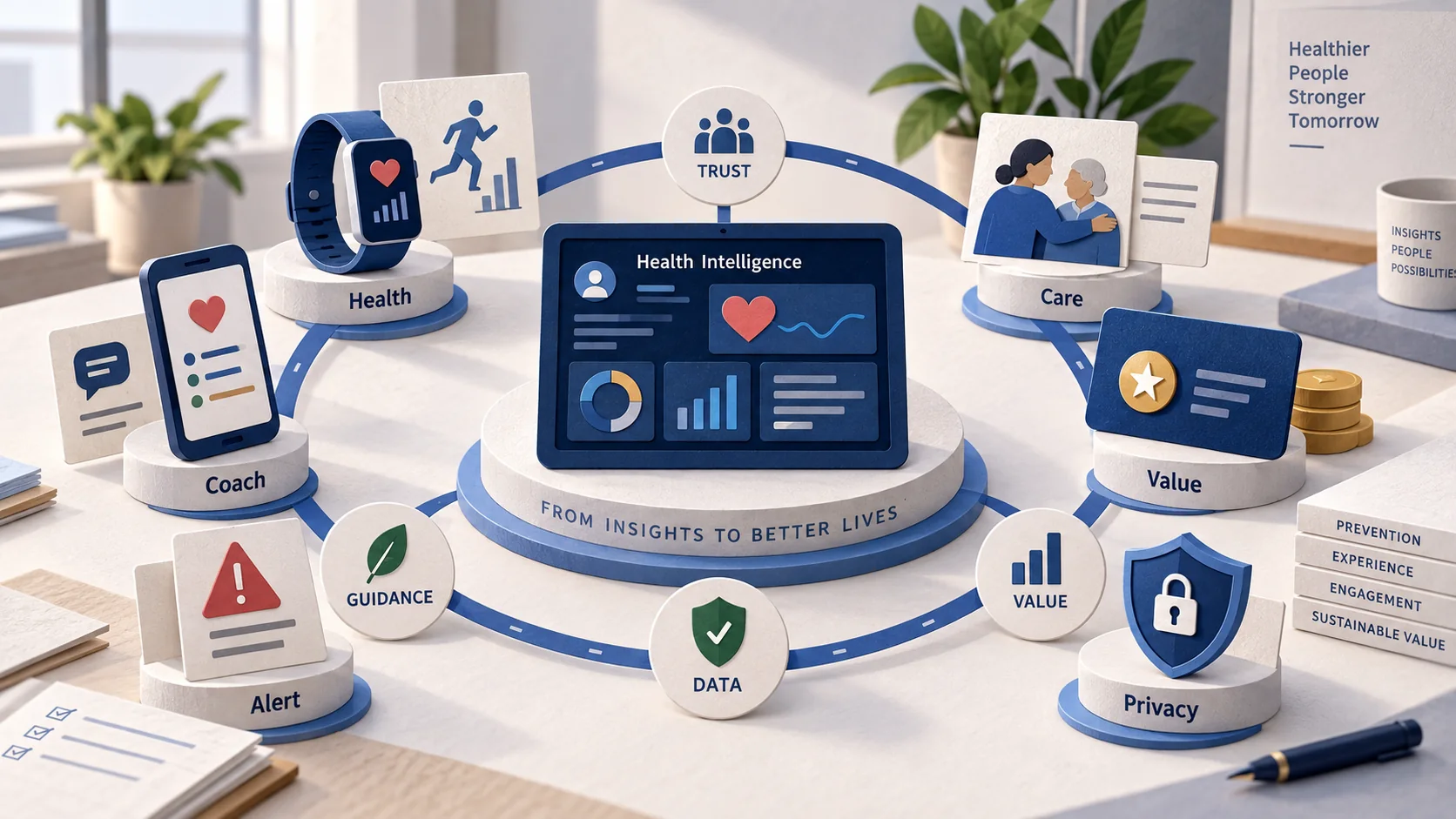
Apple has already built a health surface through iPhone, Apple Watch, AirPods, Fitness, Health, emergency features, sleep, activity, heart signals, and safety functions. The next step is interpretation. Raw health data has limited value if users cannot understand what changed, what matters, what is noise, and what action is appropriate.
Apple's health intelligence opportunity is not to become a doctor inside the phone. That would be the wrong frame. The stronger opportunity is to become a trusted layer for everyday health awareness, prevention, coaching, caregiver coordination, habit formation, and readiness.
Some are direct: subscriptions, coaching experiences, premium fitness and health services, device upgrades, and bundled Apple One-style services. Some are indirect: stronger Watch attachment, AirPods upgrades, iPhone retention, family device ecosystems, enterprise wellness, insurance-adjacent partnerships, and healthcare-provider integration. Some are trust-based: if users believe Apple helps them understand their lives without exploiting their data, they may give Apple more permission to remain close to sensitive signals.
But it must be earned. Health intelligence is a high-trust surface. It cannot be treated like a novelty feature. It needs clear boundaries, careful language, explainability, escalation paths, professional disclaimers, privacy controls, and a way for users to understand what the system knows and what it does not know.
The Revenue Unknown is not whether health intelligence can create revenue. It almost certainly can. The unknown is whether Apple can turn that revenue into trust rather than anxiety.
Retail Mashup: The Shopping Layer Moves
Retailers should pay attention to Siri AI because shopping is full of small, context-heavy decisions.
Customers compare products, check reviews, monitor prices, wait for restocks, message family members, look for coupons, verify images, check return policies, finance purchases, and move between online and store experiences. Most retailers measure the visible transaction. They often miss the decision work that happens before the cart.
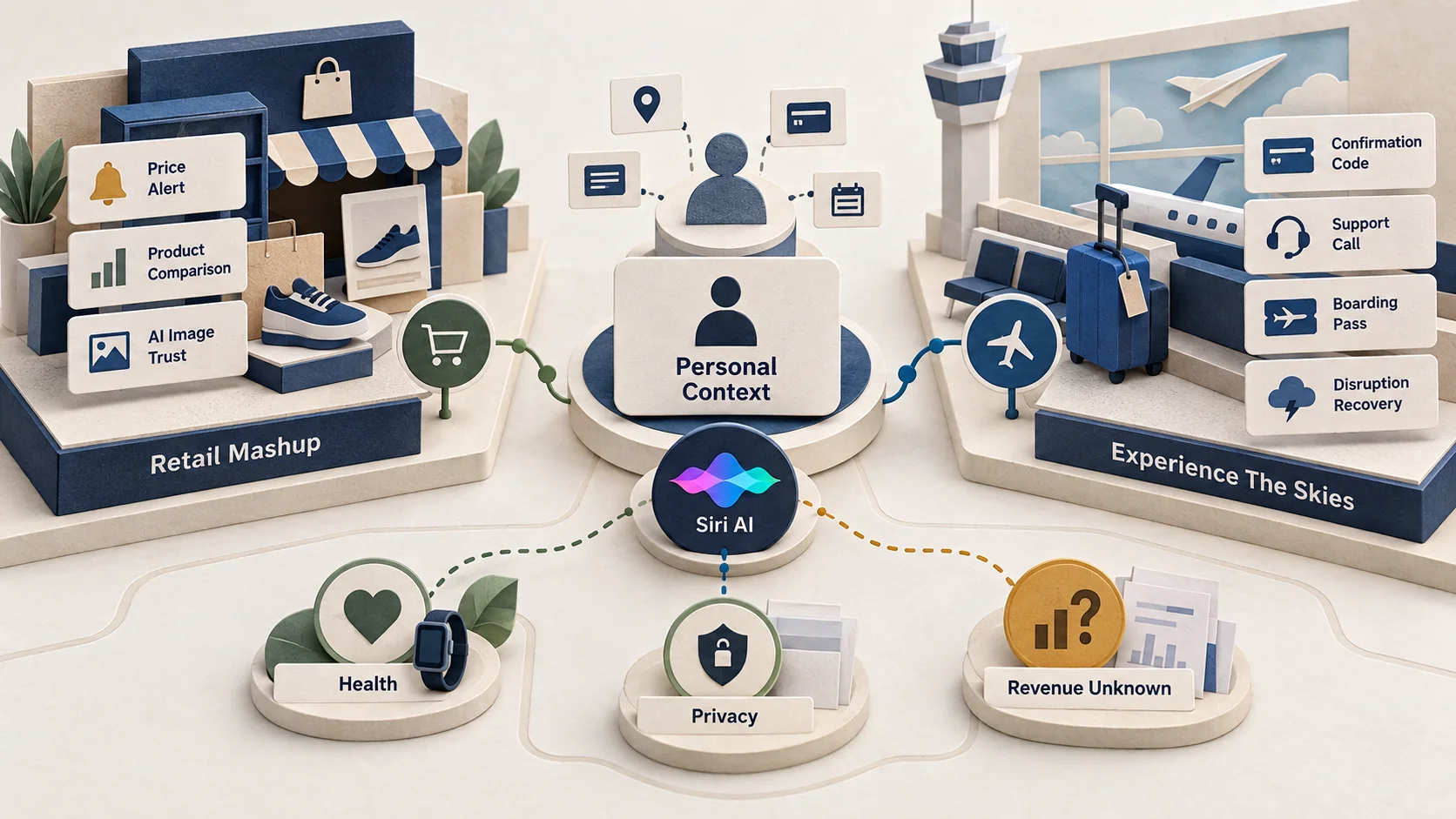
Safari Notify Me can make Apple a monitor for price drops, restocks, and changed web pages. On-screen awareness can let Siri understand what product, offer, policy, or image the user is looking at. Apple Reference Image and AI image trust features can shape how customers interpret product visuals. A more capable Siri can help customers compare, remember, summarize, and decide.
That creates a Retail Mashup warning.
If Apple becomes the layer that monitors and interprets shopping, merchants may lose visibility into the customer's intent. The retailer may know the customer bought the shoe, bag, phone, ticket, or appliance. Apple may know the customer waited for the price drop, compared three alternatives, asked whether an image was real, checked a trip date, and hesitated because of return anxiety.
The Revenue Unknown is the value sitting between discovery and purchase.
Retailers need to design for this reality. Product data, inventory accuracy, return clarity, review trust, image authenticity, offer timing, and post-purchase support all become more important when the customer's device can compare promises across brands.
Experience The Skies: Travel Context Becomes A Managed Surface
Travel may be the cleanest use case for Siri as an experience manager.
Travel is fragmented by design. Airlines, hotels, airports, lounges, cards, taxis, rideshare, border documents, loyalty accounts, weather, maps, calendars, email, and family messages all operate around the same trip. The traveler experiences one journey, but the systems experience many transactions.
Apple's context layer can reduce that gap.
Apple used examples such as surfacing confirmation codes or reservation numbers during calls. That is not a small convenience. In travel, it points to a larger design pattern: the system recognizes which piece of context the traveler needs at the moment of service.
During disruption, that matters even more. A delayed traveler may be holding a boarding pass, hotel reservation, rideshare plan, meeting calendar, family pickup, lounge access, bag status, and loyalty account at once. If Siri can connect on-screen awareness, personal context, Wallet, Maps, messages, and support calls, Apple can become the layer that helps the traveler recover coherence.
That is an opportunity for travel brands and a threat to them.
Airlines and hotels that expose clean, useful, permissioned context can participate in the experience layer. Brands that keep customers trapped in fragmented apps may find that Apple becomes the only system the traveler trusts during stress.
The Revenue Unknown for travel is not only app engagement. It is future preference protected through better context at the moment of anxiety.
The New Intelligence Boundary
Apple is not only making AI features. It is repositioning intelligence as an operating boundary between the person and the market.
That boundary can help the user decide what to buy, where to go, what to watch, when to act, who to call, what to monitor, what signal to trust, and what habit to change. Every one of those decisions has revenue attached to it. Every one also has trust attached to it.
For Transformidy, the lesson is straightforward.
The next competitive layer is not the app alone. It is the customer's managed context across apps. Companies that keep designing isolated digital tasks will increasingly lose the moments where value is created, delayed, protected, or lost.
Apple's Siri AI and health intelligence announcements make that future more visible.
The assistant is becoming less like a feature.
It is becoming the place where experiences are interpreted.
Reader Poll
Where would your customers trust an intelligence layer more than your brand's own app: shopping, travel, health, finance, support, or daily planning?
Sources
- Apple, "Apple unveils iPhone Duo," September 9, 2026, https://www.apple.com/newsroom/2026/09/apple-unveils-iphone-duo/
- Apple, "Apple debuts iPhone 18 Pro and iPhone 18 Pro Max," September 9, 2026, https://www.apple.com/newsroom/2026/09/apple-debuts-iphone-18-pro-and-iphone-18-pro-max/
- Apple, "Apple advances health and fitness capabilities using Apple Intelligence," September 9, 2026, https://www.apple.com/newsroom/2026/09/apple-advances-health-and-fitness-capabilities-using-apple-intelligence/
- Apple, "Apple Event," September 9, 2026, https://www.apple.com/apple-events/
Related Reading
FAQ
What is the main idea of Apple Is Turning Siri Into an Experience Manager?
Apple Is Turning Siri Into an Experience Manager explains a change leaders should not treat as background noise. It shows what evidence is visible, what may be changing underneath it, and which decision window remains open.
Why does Apple Is Turning Siri Into an Experience Manager matter for Experience Intelligence?
The article helps readers see how an experience, relationship, capability, or value condition may be changing before the consequence is fully visible.
What Revenue Unknown does this article help identify?
It frames the unresolved commercial or operating question created by the change: what value, risk, hidden demand, relationship movement, or capability gap may exist but has not yet been measured or decided.
How should leaders use this article in the Special Intelligence series?
Use it as a prompt to separate observed evidence from interpretation, name the decision that still has to be made, and identify what would validate whether the interpretation is right.
Related intelligence
Article
Accountable AI Delegation Is the New Operating Model
# Accountable AI Delegation Is the New Operating Model Production illustration: human-agent collaboration organized around evidence, authority, approval and learning. **Revenue Unknown:** Many organizations are preparing
Article
Apple Waited Until the Foldable iPhone Could Become an Experience Layer
Apple's iPhone Duo is not only a foldable phone announcement. It shows why waiting can be the right experience strategy when a category needs hardware, software, developers, intelligence, and premium economics to become one coherent system.
Article
Hyatt's Airline Loyalty Reset Shows Why Partnerships Become Dead-End Experiences
Hyatt is ending its enhanced American Airlines relationship while launching a new Delta collaboration and maintaining a newer Air Canada Aeroplan relationship. The Revenue Unknown is whether airline-hotel partnerships can become real experience systems instead of benefit tables customers only discover when they fail.