
Article
United Turns Standby Into a Disruption Recovery Signal
United says its app can now let disrupted travellers join standby lists for up to three earlier flights while keeping their confirmed rebooked itinerary. The innovation matters because it turns standby from a gate gamble into a managed recovery path.
- Published
- September 3, 2026
- Updated
- September 3, 2026
- Reading time
- 10 min
United Airlines has made a small product change that could matter more than most airline app announcements.
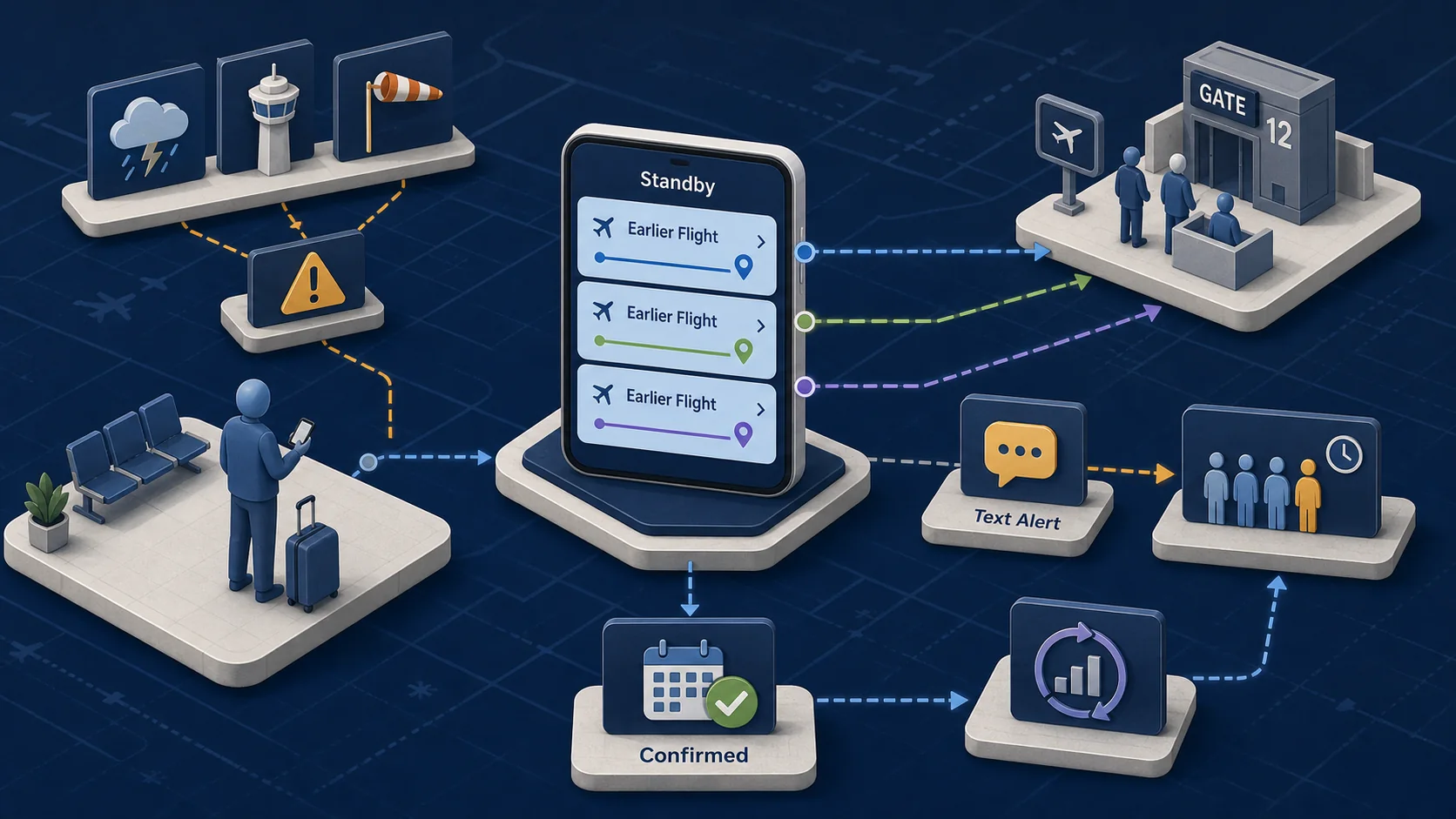
On September 1, 2026, United announced that customers affected by certain delays or cancellations can now use the United app to join standby lists for up to three earlier flights while keeping their confirmed rebooked itinerary. If United finds a seat, the customer receives a text message. The confirmed fallback remains in place unless an earlier standby option clears.
That distinction is the point.
Traditional standby often creates anxiety because the customer has to decide whether to gamble with time, attention, gate movement, queue position, and uncertainty. During disruption, that is exactly when travellers have the least emotional capacity to manage another ambiguous process. They may already be tracking a missed connection, a hotel night, a family pickup, a meeting, a cruise departure, an event, medication timing, child care, or an airport transfer. The airline may have technically rebooked the passenger, but the traveller's actual journey may still be unresolved.
United's new standby capability changes the shape of that moment. It does not eliminate disruption. It does not promise that every traveller will leave earlier. It does something more specific and more useful: it preserves the confirmed recovery path while opening optional earlier paths.
For Transformidy, that is the experience intelligence lesson.
The innovation is not standby. Standby is old. The innovation is reducing the customer's decision burden when the experience is already under stress.
The Revenue Unknown is this:
How much customer value can United protect when disrupted travellers can pursue earlier recovery without surrendering the certainty of an existing rebooking?
That question cannot be answered by counting downloads, app opens, or standby requests alone. It depends on which travellers use the feature, when it appears, how clearly it explains the tradeoff, how often earlier seats clear, whether the text alert arrives in time to act, whether gate teams understand the new flow, and whether customers remember United as having restored some control during a stressful moment.
The Product Design Move
The strongest part of United's update is that it respects the customer's need for a safe fallback.
In many airline disruption experiences, the traveller is asked to solve the airline's operational uncertainty from the outside. They are told a new flight, a new gate, a standby possibility, a customer-service queue, a weather delay, a hotel voucher, or a missed-connection option. Each element may be true. But truth does not automatically create usability.
The product design question is: what does the traveller have to hold in their head?
If the app says only that an earlier flight exists, the traveller has to infer the risk. Will joining standby cancel the confirmed rebooking? Will a cleared seat require sprinting across the airport? Does the standby request apply to one flight or several? Is the app more current than the gate agent? Will the customer be notified, or do they need to keep refreshing? What happens to bags? What happens to companions on the same reservation? What happens if the earlier option disappears?
United's announced design reduces one of the biggest questions: the customer can join standby for earlier flights without giving up the confirmed rebooked itinerary. That turns the feature from a risky substitution into an optional recovery layer.
That matters because disruption recovery is not only operational. It is cognitive and emotional. A traveller who understands the next viable option is less likely to treat the airline as absent, evasive, or indifferent. A traveller who sees a safe fallback and optional earlier paths may still be delayed, but the relationship state can stabilize because the experience has a visible owner.
This is the difference between an app showing information and an app restoring agency.
Why Standby Usually Feels Like a Dead End
Standby is familiar to frequent travellers, but it can still feel opaque.
A passenger may see a list but not understand their real probability of clearing. They may know an earlier flight exists but not whether their fare, status, party size, baggage, connection, or disruption reason affects priority. They may be close enough to consider moving gates but not close enough to risk missing their confirmed flight. They may not know whether a standby request helps or merely adds another uncertainty to an already uncertain day.
That is a dead-end experience pattern: the customer can see possibility, but the path is not owned clearly enough to support a better decision.
United's feature appears to address the pattern directly. It gives the traveller an action that does not destroy the fallback. It lets the system keep watching. It notifies the customer if a seat is found. Done well, that means the traveller does not have to refresh the app repeatedly, hover at the counter, interpret gate announcements, or choose between certainty and possibility without enough information.
The product is valuable because it recognizes that the customer is not simply trying to "get on standby." The customer is trying to recover time without creating a new failure.
That is a more precise design brief.
The Three States That Move
United's standby update can be read through three state movements: Relationship State, Capability State, and Value State.
Relationship State is the condition of continuity between actors. During disruption, the traveller-airline relationship is fragile. The customer may accept that weather, air traffic, crew positioning, or aircraft availability can disrupt a trip. What weakens the relationship is feeling abandoned after the disruption is known. A confirmed fallback plus monitored standby options can strengthen or stabilize the relationship because the airline is no longer only announcing a delay; it is helping the traveller pursue the next best outcome.
Capability State is the condition of United's ability to sense, decide, coordinate, communicate, deliver, recover, validate, and learn. This feature is a capability signal. It suggests United can connect rebooking logic, standby inventory, app experience, text notification, gate execution, and customer recovery into one operational path. The capability question is whether that path holds across real disruption complexity: full flights, family bookings, checked bags, last-minute aircraft swaps, rolling delays, and airport congestion.
Value State is the condition of value being created, protected, delayed, transferred, hidden, diminished, lost, or made newly possible. A delayed traveller may lose time, confidence, trip purpose, hotel value, meeting value, event value, and future preference. If standby monitoring recovers even some travellers earlier, value is protected. If it simply creates more hope without enough seat availability or clear notification, value may be delayed or diminished differently.
The feature's value is therefore not the number of standby requests. The value is whether the feature changes outcomes that matter.
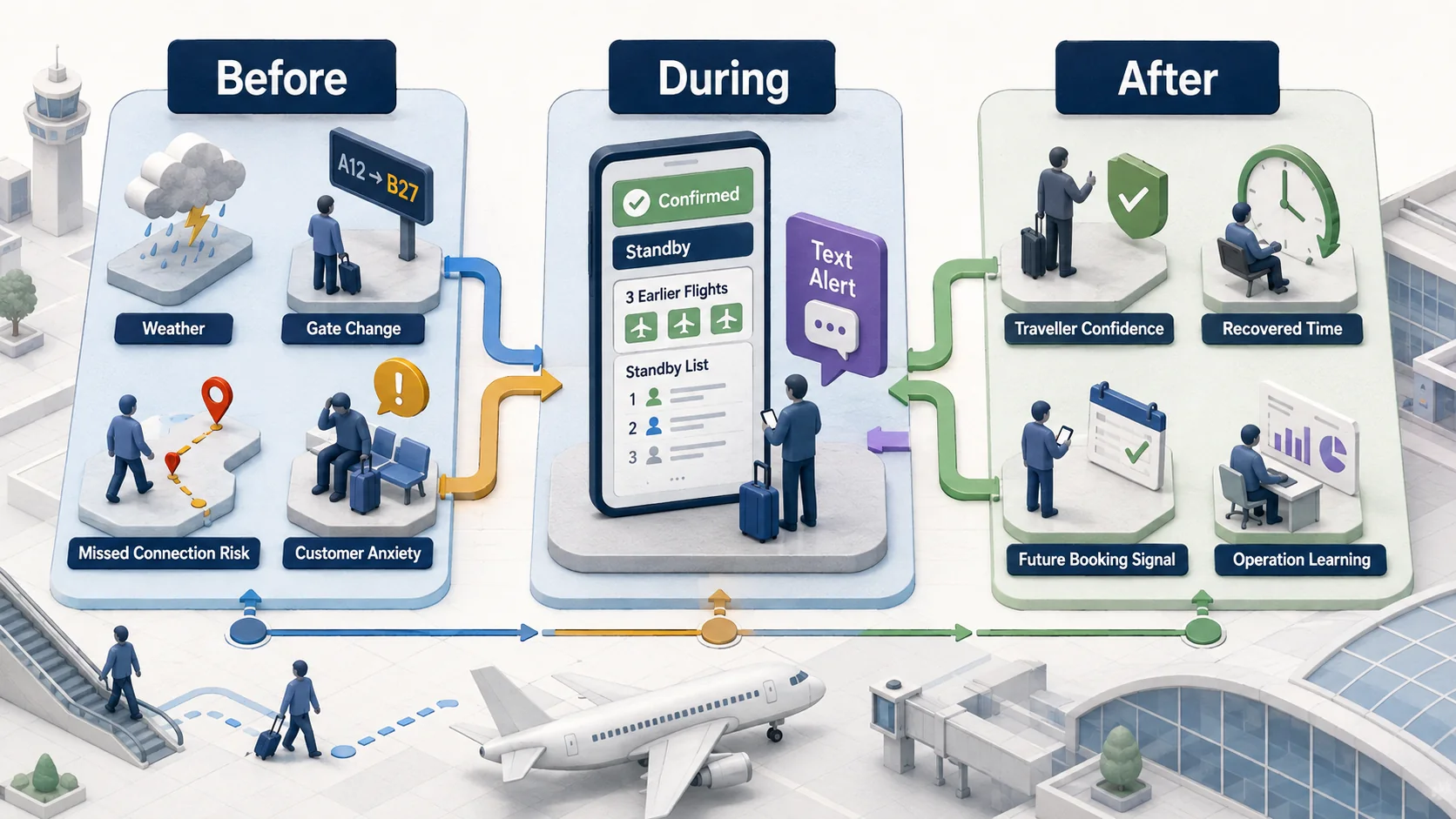
Before, During, And After The Disruption
This feature is most useful when read across three windows.
Before the disruption fully unfolds, the app can recognize that a traveller's original itinerary is becoming unstable. This is where the decision window opens. If an airline waits until the customer's confirmed flight is impossible, many alternatives have already narrowed. Earlier standby paths can create optionality while the customer still has time to move, decide, or prepare.
During the disruption, the app has to reduce confusion. The customer should know what is confirmed, what is optional, what is being monitored, what would trigger a text, and what action is required if a seat clears. This is the moment where interface language, timing, notification reliability, and airport handoffs decide whether the feature creates calm or creates another queue.
After the disruption, United should learn from the behaviour. Which travellers used standby? Which travellers ignored it? Which routes and airports produced useful clears? Which customers cleared but still complained? Which customers did not clear but still felt better because the fallback was protected? Which high-value travellers changed future booking behaviour? Which missed-connection patterns should have been anticipated earlier?
If the feature is treated only as an operational tool, the learning may stop at completion rate.
If it is treated as experience intelligence, the learning can improve the next disruption.
The Disruption Revenue Unknown
Most airlines measure disruption through delays, cancellations, completion factors, call volumes, compensation, reaccommodation cost, and recovery time. Those measures matter. They do not fully explain the commercial consequence.
The unresolved question is what happens to future choice.
A traveller may be rebooked legally and still decide not to choose the airline again. A traveller may arrive late but feel the airline did everything possible. A traveller may lose a meeting but value the transparency. A traveller may recover an earlier flight and become more loyal because the airline gave them back time when it mattered. Another traveller may see the same standby feature and feel frustrated because it raised hope without clearing.
The Revenue Unknown is the gap between operational recovery and future commercial behaviour.
For United, the questions include:
- Which disrupted travellers are most likely to shift future share of wallet when an earlier standby path works?
- Which travellers benefit most from protected fallback certainty even when standby does not clear?
- Which airports, routes, and disruption types create the strongest need for this capability?
- Does standby monitoring reduce support contacts or simply move customer attention into the app?
- Does the feature protect premium, family, business, and loyalty relationships differently?
- Which recovery messages create confidence, and which create false hope?
These are not abstract customer-experience questions. They are commercial questions created by state movement inside a real journey.
What Experience The Skies Should Watch
For Experience The Skies, this is a more interesting innovation than a new seat, meal, or loyalty bonus because it changes the recovery mechanics of travel.
Airlines often tell customers what happened. The stronger question is whether the airline helps customers decide what remains possible.
United's standby update points in that direction. It makes the app a decision surface during disruption, not just an itinerary display. It creates a path where the traveller can hold certainty and possibility at the same time. It can reduce gate-counter dependence. It can create a more useful form of service recovery because the system keeps looking while the traveller gets on with the journey.
The limitation is that the experience will only be as strong as the operating system behind it.
If the standby list is accurate, notifications are timely, gate teams understand the flow, baggage rules are clear, and companion reservations are handled coherently, the feature can protect trust. If any of those handoffs fail, the app may expose the airline's internal fragmentation more clearly.
That makes this a useful product-design case for the whole industry.
The innovation is not that a traveller can stand by. The innovation is that the airline may be learning how to make disruption less like a dead end.
What Other Organizations Can Learn
The broader lesson is not airline-specific.
Organizations often respond to disruption by replacing one broken path with another path. That can solve the immediate transaction while still leaving the customer uncertain, anxious, or commercially available to competitors.
The better design pattern is protected optionality.
Give the customer a confirmed fallback. Show what is being watched. Offer earlier or better paths without forcing the customer to abandon the safe path. Notify them when action is needed. Then learn from what actually happened.
That pattern applies to healthcare referrals, retail substitutions, hotel recovery, bank fraud reviews, concert rescheduling, government service appointments, software outages, and almost any high-stakes waiting experience.
Customers do not only need information. They need a useful next decision that does not make the situation worse.
United's standby update is valuable because it moves in that direction.
Reader Poll
When a customer is already disrupted, how reliably does your organization preserve a safe fallback while still looking for a better option?
Sources
- United Airlines, "United Customers Can Now Join the Standby List for an Earlier Flight in the United App Without Giving Up Their Confirmed Rebooked Flight," September 1, 2026, https://www.united.com/en/us/newsroom/announcements/cision-125434
- PRNewswire / United Airlines, "Another First for United: Mobile App Lets Customers Join Standby for Earlier Flights and Automatically Finds Open Seats During Disruptions," September 1, 2026, https://www.prnewswire.com/news-releases/another-first-for-united-mobile-app-lets-customers-join-standby-for-earlier-flights-and-automatically-finds-open-seats-during-disruptions-302866188.html
- Travel Weekly, "United app adds more self-service standby options," September 2026, https://www.travelweekly.com/Travel-News/Airline-News/United-app-standby-options
- The Points Guy, "United adds new app features for standby flights after disruptions," September 2026, https://thepointsguy.com/news/united-app-standby-flights-disruptions/
- United Airlines, "United app," https://www.united.com/en/us/fly/travel/trip-planning/united-app.html
Related Reading
After evidence is reviewed, how reliably does your organization assign an owner, deadline, and next action?
FAQ
What is the main idea of United Turns Standby Into a Disruption Recovery Signal?
United Turns Standby Into a Disruption Recovery Signal explains a change leaders should not treat as background noise. It shows what evidence is visible, what may be changing underneath it, and which decision window remains open.
Why does United Turns Standby Into a Disruption Recovery Signal matter for Experience Intelligence?
The article helps readers see how an experience, relationship, capability, or value condition may be changing before the consequence is fully visible.
What Revenue Unknown does this article help identify?
It frames the unresolved commercial or operating question created by the change: what value, risk, hidden demand, relationship movement, or capability gap may exist but has not yet been measured or decided.
How should leaders use this article in the Special Intelligence series?
Use it as a prompt to separate observed evidence from interpretation, name the decision that still has to be made, and identify what would validate whether the interpretation is right.
Related intelligence
Article
Accountable AI Delegation Is the New Operating Model
# Accountable AI Delegation Is the New Operating Model Production illustration: human-agent collaboration organized around evidence, authority, approval and learning. **Revenue Unknown:** Many organizations are preparing
Article
Apple Waited Until the Foldable iPhone Could Become an Experience Layer
Apple's iPhone Duo is not only a foldable phone announcement. It shows why waiting can be the right experience strategy when a category needs hardware, software, developers, intelligence, and premium economics to become one coherent system.
Article
Apple Is Turning Siri Into an Experience Manager
Apple's Siri AI and Apple Intelligence updates matter because they move AI from answer generation toward experience management. Personal context, on-screen awareness, health intelligence, shopping monitoring, and travel recovery can change where revenue and trust accumulate.