
Article
When Flight Disruption Becomes a Dead-End Experience
A cancellation notice ends the airline's obligation. It doesn't end the traveler's trip. Here's why disruption recovery so often stops too early — and what continuity would look like instead.
- Published
- August 20, 2026
- Updated
- August 12, 2026
- Reading time
- 8 min

Where the airline's job ends and the traveler's trip continues
When a flight is cancelled or significantly delayed, most airline processes are built to solve one problem: get the passenger onto another flight, or issue a refund. That's a real, necessary function, and airline operations teams are generally competent at executing it under real operational pressure.
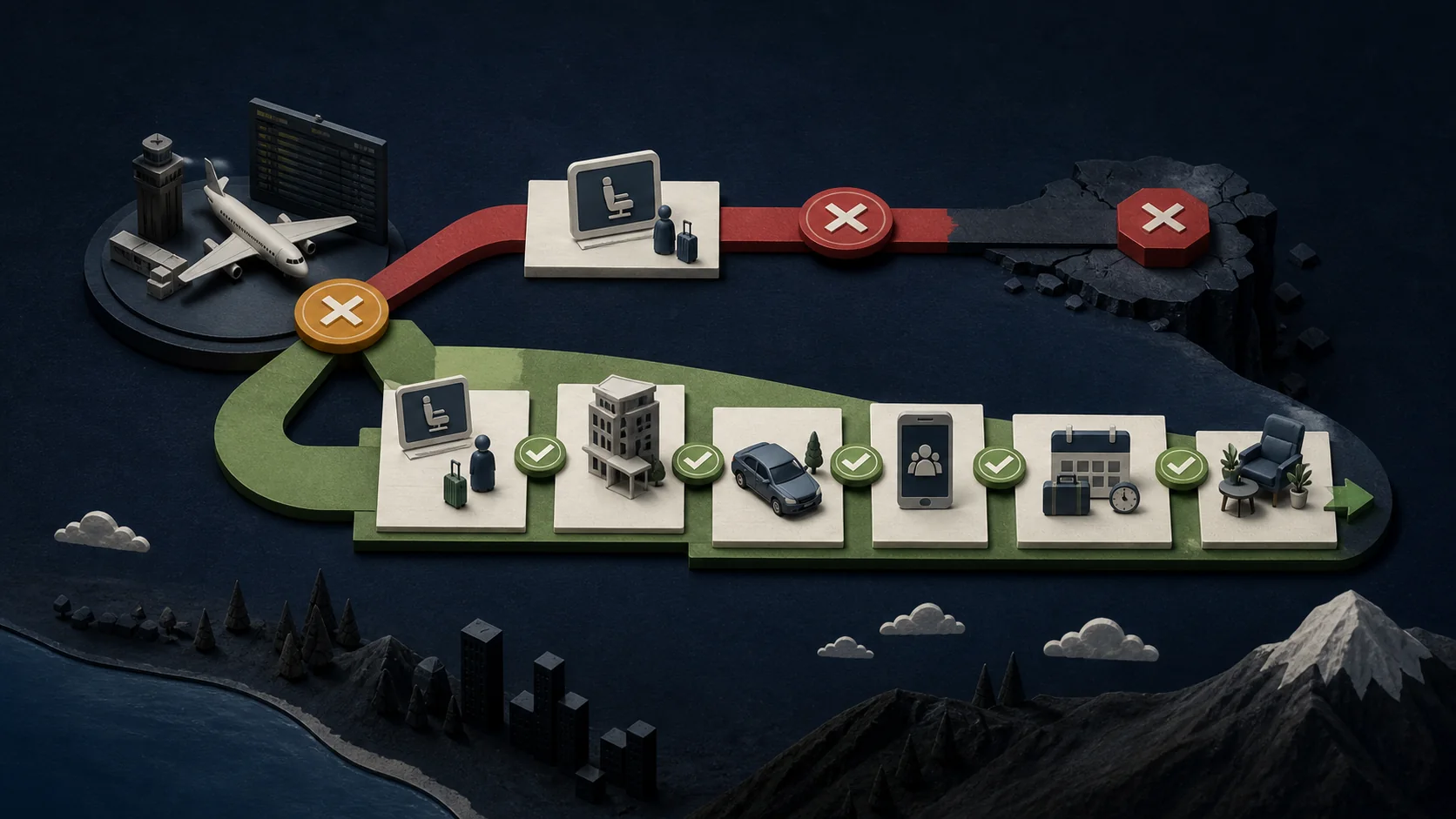
But a flight is rarely the traveler's actual goal. It's a means to a trip — a wedding, a conference, a connecting flight, a vacation with a hotel already booked and a schedule already built around the original arrival time. When the airline's process stops at "here is your new flight" or "here is your refund," it has solved its own operational problem while leaving the traveler's actual problem — the trip itself — unaddressed.
Why this is a dead end, not just bad luck
Disruption itself isn't the dead end — weather happens, mechanical issues happen, and no airline can promise zero disruption. The dead end is in what happens *after* disruption is acknowledged. Applying the four-question test:
- Is there a next step the traveler can see beyond a new flight or a refund? Often not — connecting hotel, ground transport, and downstream plans are the traveler's problem to solve alone.
- Is there an owner for the traveler's broader trip recovery, not just the flight segment? Rarely — airline, hotel, and ground transport are typically separate organizations with no shared handoff.
- Is there a recovery path if the new flight also creates new problems (missed connections, expired hotel bookings, changed event timing)? Usually not proactively offered.
- Is there an activation path for what the airline already knows — loyalty status, trip purpose if disclosed, prior disruption history? Often lost, because status and context recognized at booking frequently disappear during irregular operations, when systems and staff are under the most pressure.
The trip-recovery question
Which travellers can still be retained if the airline (or the broader travel ecosystem) protects the broader trip purpose, not just the flight segment?
This is an open question. It's plausible that travelers experiencing well-handled disruption recovery are more loyalty-resilient than those left to solve their own downstream problems, but the actual retention effect — and whether it's large enough to justify specific operational investment — depends on data no generic industry claim can responsibly substitute for.
A related, narrower Revenue Unknown from the loyalty angle: which benefits genuinely protect future traveler choice during disruption, versus existing only as a booking-time perk that disappears exactly when it would matter most?
A third, narrower Revenue Unknown from the corporate-travel angle: which corporate travelers, and the companies managing their travel policy, would place more business with a supplier that demonstrably protects the employee's recovery, not just reimburses the disrupted trip?
How travel continuity could work
- Purpose continuity — recovery processes that account for *why* the traveler needed to arrive when they originally planned, where that information is available and disclosed.
- Status continuity — loyalty status and prior relationship history staying visible and actionable through irregular operations, not just at booking.
- Ecosystem continuity — coordination (even informal or partner-based) between airline, hotel, ground transport, and insurance, so the traveler isn't the only party stitching their trip back together.
- Communication continuity — proactive updates as the situation evolves, rather than requiring the traveler to repeatedly check status themselves.
- Post-recovery continuity — a genuine follow-up after the trip, rather than treating the disruption as closed the moment the traveler boards a replacement flight.
Why this matters commercially, not just for traveler goodwill
Airlines already collect enormous amounts of relevant evidence — loyalty status, booking history, sometimes trip purpose — and disruption is exactly the moment that evidence is most valuable and most likely to be ignored, because disruption response is built for speed and volume, not personalization. The Revenue Unknown here isn't a request for airlines to be more generous. It's a question about whether existing evidence is being used at the moment it matters most.
The recovery-close test
The clearest diagnostic question for any organization touching travel disruption: when your process successfully rebooks or refunds someone, does anything happen next — or does the case simply close? If it closes, the traveler's actual trip recovery is happening entirely outside your visibility, and so is any signal about whether you kept their trust.
Before, during and after the dead end
This pattern should be managed across three decision windows, not only after the failure becomes visible. Before the dead end, the organization should watch for the signals that intent, trust, value or responsibility is starting to stall. During the dead end, the priority is to preserve context, name an owner, keep a useful next step visible and protect whatever value can still be recovered. After the immediate moment passes, the organization should measure what changed, identify which Revenue Unknown remains unresolved and redesign the experience so the next cycle starts earlier.
Transformidy infographic
Dead-end experience vs friction
Friction slows movement. A dead-end experience blocks recognition, decision, recovery, or continuity.
- 01
Friction
The person can continue, but with extra effort, delay, or confusion.
- 02
Dead end
The person cannot complete, recover, escalate, or know what happens next.
- 03
Recognition gap
The organization sees activity, but misses the blocked experience condition.
- 04
Decision needed
Someone must own the path, exception, handoff, or recovery rule.
When your service goes down, how quickly do you detect it and notify customers?
FAQ
Why does flight disruption recovery often stop at rebooking?
This article addresses the question through the lens of experience continuity, the unresolved Revenue Unknown, and the decision window leaders still have before the pattern repeats.
What is the difference between flight recovery and trip recovery?
This article addresses the question through the lens of experience continuity, the unresolved Revenue Unknown, and the decision window leaders still have before the pattern repeats.
What is the Revenue Unknown created by flight disruption dead ends?
This article addresses the question through the lens of experience continuity, the unresolved Revenue Unknown, and the decision window leaders still have before the pattern repeats.
How can airlines and travel partners improve disruption continuity?
This article addresses the question through the lens of experience continuity, the unresolved Revenue Unknown, and the decision window leaders still have before the pattern repeats.
Related intelligence
Article
How to Find Dead-End Experiences Before Customers Defect
Dead-end experiences don't announce themselves — they hide inside metrics that look fine. Here's a practical way to find them before they show up as defection.
Article
Hotel Recovery Is Not Finished When the Apology Is Sent
A sincere apology closes a complaint. It doesn't necessarily rebuild the confidence a guest needs to book that hotel again. Here's why service recovery often stops one step too early.
Article
Healthcare Referrals Leave Patients Stranded Between Providers
A referral is a handoff between two providers who don't share a single system or, often, direct communication. Here's why that handoff is a common point where care intent quietly stops.