
Article
Alumni Engagement Fades Because No One Owns What Comes After Graduation
Graduation is a genuine milestone and also, for most institutions, the point where a deeply engaged relationship starts to fade. Here's why that fade is a design gap, not an inevitability.
- Published
- July 14, 2026
- Updated
- August 12, 2026
- Reading time
- 7 min

The most engaged relationship an institution has, ending on schedule
For the years someone is enrolled, an educational institution typically knows a great deal about them and has many structured touchpoints for reaching them. At graduation, most of that structure disappears at once — not because the relationship stopped mattering, but because it was built around enrollment status, and enrollment status is what just ended. What replaces it is usually a general alumni newsletter and, eventually, a donation ask, neither of which resembles the depth of the relationship that existed a few months earlier.
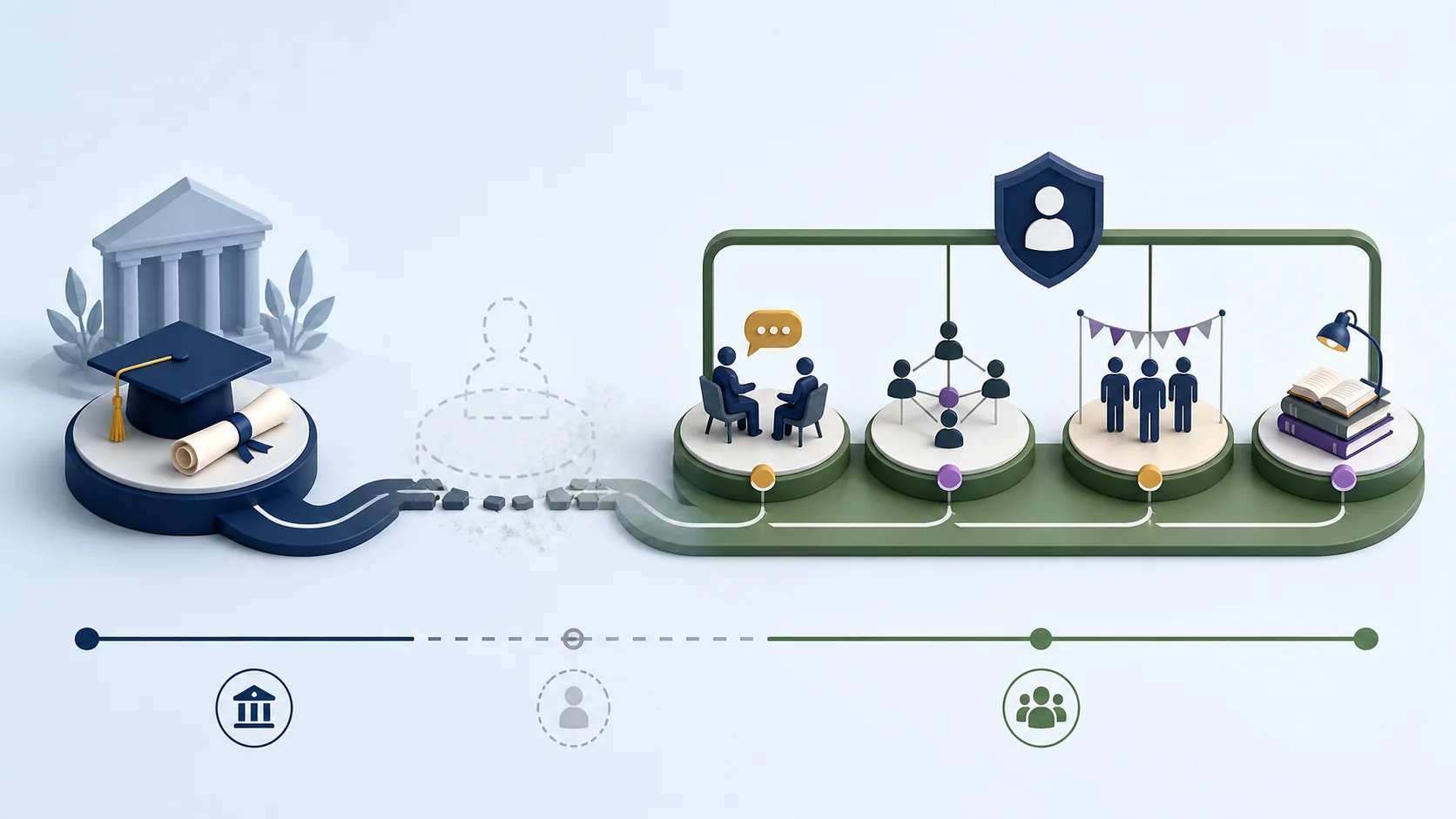
Graduation is a real transition, and institutions are right to mark it as one. The gap is what happens to the relationship on the other side of that transition — whether it's treated as a continuation, redesigned for a new phase, or effectively allowed to fade because nothing was built for it.
Where the actual break sits
Enrollment ending isn't the dead end — it's the correct, expected conclusion of one phase. The dead end is a program architecture with no equivalent structure for the next phase. Checked against a visible next step, an owner, a recovery path, and an activation path: there's often no meaningful next step offered at graduation beyond generic alumni-network enrollment; ownership of alumni relationships frequently sits with an advancement or development office focused primarily on fundraising, not the fuller relationship (career, mentorship, community) the person had during enrollment; there's no recovery path for alumni who drift out of contact; and the institution's deep knowledge of who this person is and what they cared about rarely activates anything beyond periodic, generic outreach.
Who is affected on both sides
Recent graduates, who go from a high-touch relationship to a low-touch one almost overnight, at exactly the life stage (early career, life transitions) where continued institutional connection could matter most. Also affected: the institution itself, which loses visibility into career outcomes, mentorship potential, and community-building opportunities that a more continuous relationship would surface.
What graduation doesn't carry forward
Context doesn't travel across the transition. What the institution knew about a person's interests, program, and goals during enrollment rarely informs how it engages them afterward — post-graduation outreach is usually generic (a newsletter, a donation ask) rather than shaped by what was actually known about that specific person.
The question worth asking
Which alumni relationships — career connections, mentorship potential, giving capacity, community value — are lost because no one owns continuity across the graduation transition, specifically?
This is deliberately unanswered here. It is plausible that a meaningful share of alumni disengagement is a design gap (no one built the next-phase relationship) rather than genuine disinterest, but the actual scale requires institution-specific engagement data, not a general assumption.
What continuity across the transition would require
This means treating graduation as a relationship redesign point rather than an endpoint — carrying forward what's known about a graduate's interests and goals into more relevant, tiered outreach (career-stage-appropriate, interest-specific) rather than one generic alumni channel, and building genuine two-way value (mentorship opportunities, career-relevant connections) rather than outreach that reads primarily as fundraising.
The point is not to turn every graduate into an immediate donor. That is usually the wrong horizon. The nearer question is whether the institution can remain useful while the graduate is making early career, location, identity, and network decisions. If the only visible relationship after graduation is a broad newsletter or a fundraising appeal, the institution may be asking for value before it has preserved the conditions that make future value possible.
The decision institutional leaders still have to make
The decision is whether alumni relationships are owned primarily by advancement/development, with a fundraising-first mandate, or treated as a continuation of the broader institutional relationship that development is one part of — which affects whether the first several years post-graduation are designed around relationship-building or primarily around eventual giving capacity.
A cross-check worth running
A useful test: pick a cohort of recent graduates and check how personalized their post-graduation outreach actually is, compared to what the institution knew about them during enrollment. If outreach became generic the moment enrollment ended, the relationship's context didn't travel with it.
Before, during and after the dead end
This pattern should be managed across three decision windows, not only after the failure becomes visible. Before the dead end, the organization should watch for the signals that intent, trust, value or responsibility is starting to stall. During the dead end, the priority is to preserve context, name an owner, keep a useful next step visible and protect whatever value can still be recovered. After the immediate moment passes, the organization should measure what changed, identify which Revenue Unknown remains unresolved and redesign the experience so the next cycle starts earlier.
Transformidy infographic
Dead-end experience vs friction
Friction slows movement. A dead-end experience blocks recognition, decision, recovery, or continuity.
- 01
Friction
The person can continue, but with extra effort, delay, or confusion.
- 02
Dead end
The person cannot complete, recover, escalate, or know what happens next.
- 03
Recognition gap
The organization sees activity, but misses the blocked experience condition.
- 04
Decision needed
Someone must own the path, exception, handoff, or recovery rule.
FAQ
Why does alumni engagement typically decline sharply after graduation?
This article addresses the question through the lens of experience continuity, the unresolved Revenue Unknown, and the decision window leaders still have before the pattern repeats.
What is the difference between the enrollment relationship and the alumni relationship?
This article addresses the question through the lens of experience continuity, the unresolved Revenue Unknown, and the decision window leaders still have before the pattern repeats.
What is the Revenue Unknown-equivalent risk created by unmanaged alumni continuity?
This article addresses the question through the lens of experience continuity, the unresolved Revenue Unknown, and the decision window leaders still have before the pattern repeats.
How can institutions carry relationship context across the graduation transition?
This article addresses the question through the lens of experience continuity, the unresolved Revenue Unknown, and the decision window leaders still have before the pattern repeats.
Related intelligence
Article
How to Find Dead-End Experiences Before Customers Defect
Dead-end experiences don't announce themselves — they hide inside metrics that look fine. Here's a practical way to find them before they show up as defection.
Article
Hotel Recovery Is Not Finished When the Apology Is Sent
A sincere apology closes a complaint. It doesn't necessarily rebuild the confidence a guest needs to book that hotel again. Here's why service recovery often stops one step too early.
Article
Healthcare Referrals Leave Patients Stranded Between Providers
A referral is a handoff between two providers who don't share a single system or, often, direct communication. Here's why that handoff is a common point where care intent quietly stops.