
Article
Healthcare Referrals Leave Patients Stranded Between Providers
A referral is a handoff between two providers who don't share a single system or, often, direct communication. Here's why that handoff is a common point where care intent quietly stops.
- Published
- September 1, 2026
- Updated
- August 12, 2026
- Reading time
- 8 min
A note on why this article requires extra care
Healthcare referrals sit directly adjacent to patient safety and clinical outcomes, and this topic carries higher stakes than most patterns in this series. This article deliberately stays at the level of the structural, administrative pattern — how a referral handoff can lose continuity between two separately operating providers — and makes no claim about clinical outcomes, standards of care, or any specific provider's practice. Any future revision must be reviewed by someone with healthcare-domain and compliance expertise before publication, given the direct patient-safety adjacency.

A referral made, and no confirmation it arrived anywhere
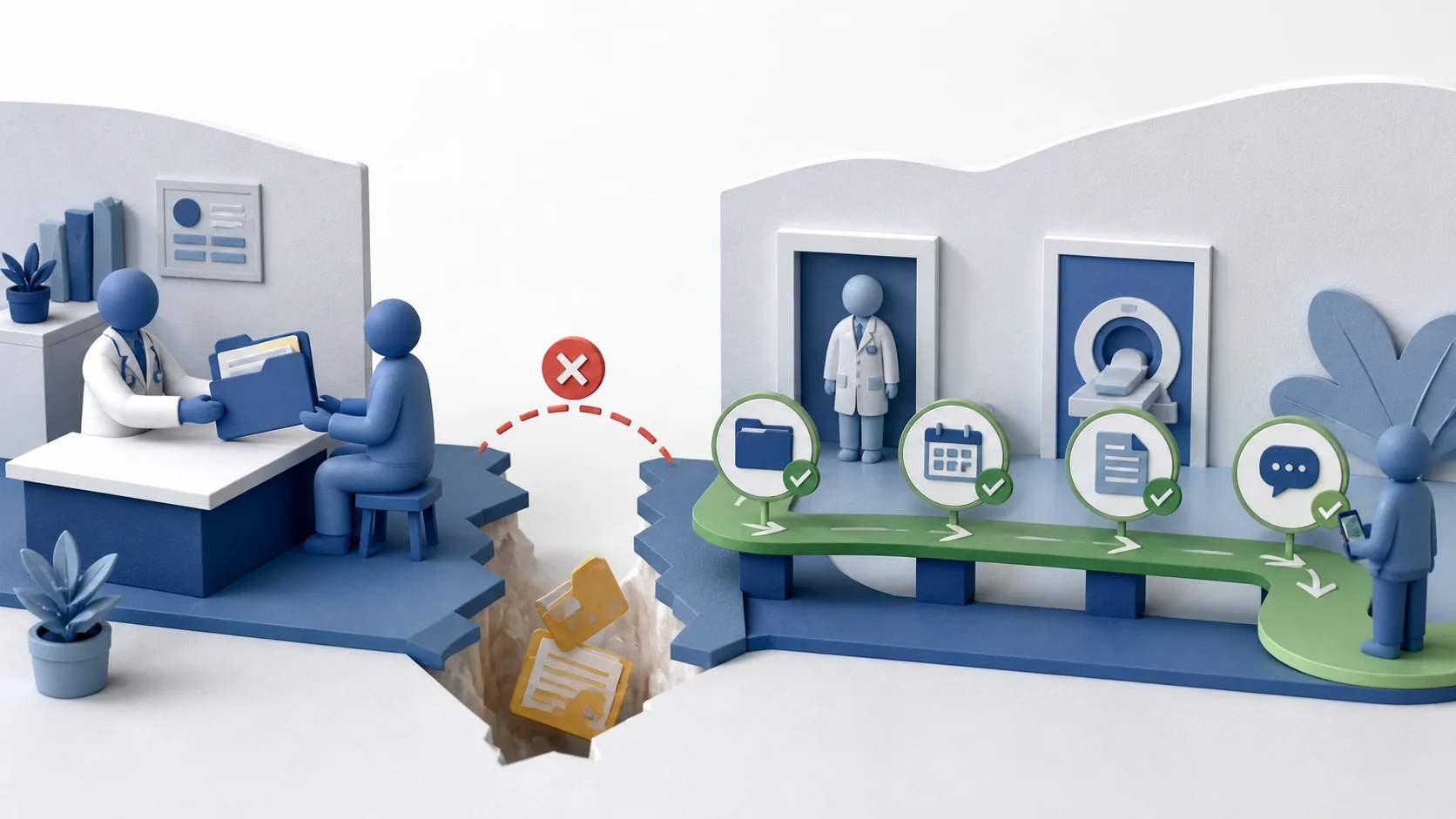
A provider refers a patient to a specialist or another point of care. The referral itself — the recommendation and, often, some paperwork or an electronic order — is generated. What frequently isn't confirmed, from the referring provider's side, is whether the patient actually scheduled an appointment, whether the relevant records reached the receiving provider, or whether the referral was completed at all. The referring provider's role, in many current workflows, effectively ends at the point of making the referral, not at the point of confirming it was acted on.
This gap exists because referring and receiving providers are frequently separate organizations, sometimes using different record systems, with no shared, reliable mechanism for confirming a referral's completion status back to the originating provider.
Why an unconfirmed referral is a dead end, not an administrative detail
Making a referral is a necessary clinical judgment — that alone isn't the dead end. The dead end is a process with no reliable confirmation loop back to the referring provider or clear ownership of whether the referral was completed. Checked against a visible next step, an owner, a recovery path, and an activation path: there's often no next step visible to the referring provider once the referral is made, beyond hoping the patient follows through; ownership of "did this referral result in an appointment" frequently isn't clearly assigned to either the referring or receiving side; there's no recovery path if the patient doesn't schedule, or if records didn't transfer correctly, unless the patient themselves raises the issue; and referral-completion data, where it exists at all, often isn't reviewed systematically to catch patterns of drop-off.
Who this touches most directly
Patients, who may face genuine practical barriers to completing a referral (scheduling difficulty, cost, confusion about next steps) with no one checking in on whether those barriers were overcome. Referring providers are affected too — they may believe a clinical concern is being addressed by a specialist when, in fact, the referral never resulted in an appointment, creating a gap in care that isn't visible to the provider who identified the original concern.
What the referral doesn't carry forward
Confirmation doesn't travel back to where it's needed. The referring provider generated the referral based on a clinical concern; whether that concern is now being addressed by someone else is information that, in many current workflows, doesn't reliably make its way back to them, leaving a clinical thread that started with genuine concern with no confirmed resolution.
The commercial question underneath
Which referred patients never complete the referral — never reach the next provider — specifically because no one owned the handoff between the referring and receiving sides, as distinct from patients who chose not to pursue the referral for their own reasons?
This is deliberately unanswered here. It is plausible that referral non-completion is significantly affected by handoff and coordination gaps, not solely by patient choice, but making that claim specific — a rate, a cause breakdown — without a verified, authoritative clinical or health-services-research source would cross from pattern observation into an unsupported and potentially harmful assertion. This article does not attempt that leap.
What referral continuity would require
This means a confirmation mechanism that closes the loop back to the referring provider — even a simple signal that the appointment was scheduled, or wasn't, within a defined window — and a clearly assigned point of ownership for following up when a referral hasn't been completed within an expected timeframe, rather than leaving that follow-up entirely to the patient's own initiative.
The decision care-coordination leaders still have to make
The decision is whether referral completion is treated as the referring provider's responsibility to confirm, the receiving provider's responsibility to report, a shared responsibility requiring coordination infrastructure between systems, or effectively no one's responsibility, which is the default outcome when the question isn't explicitly decided.
The completion test
For any healthcare organization, the relevant internal test is not "how many referrals were made" but "can we currently tell, systematically, which referrals were completed and which weren't." If that visibility doesn't exist, referral continuity is currently dependent on the patient's own follow-through, with no organizational backstop.
Before, during and after the dead end
This pattern should be managed across three decision windows, not only after the failure becomes visible. Before the dead end, the organization should watch for the signals that intent, trust, value or responsibility is starting to stall. During the dead end, the priority is to preserve context, name an owner, keep a useful next step visible and protect whatever value can still be recovered. After the immediate moment passes, the organization should measure what changed, identify which Revenue Unknown remains unresolved and redesign the experience so the next cycle starts earlier.
FAQ
Why do healthcare referrals sometimes fail to result in a completed appointment?
This article addresses the question through the lens of experience continuity, the unresolved Revenue Unknown, and the decision window leaders still have before the pattern repeats.
What is the difference between making a referral and confirming it was completed?
This article addresses the question through the lens of experience continuity, the unresolved Revenue Unknown, and the decision window leaders still have before the pattern repeats.
What is the Revenue Unknown-equivalent risk created by unconfirmed healthcare referrals?
This article addresses the question through the lens of experience continuity, the unresolved Revenue Unknown, and the decision window leaders still have before the pattern repeats.
How can healthcare providers close the loop on referral completion?
This article addresses the question through the lens of experience continuity, the unresolved Revenue Unknown, and the decision window leaders still have before the pattern repeats.
Related intelligence
Article
Frontline Warnings Become Dead Ends Without Decision Ownership
A frontline employee raises a warning — a workload problem, a recurring customer issue, a capacity strain. It reaches a manager. Whether it reaches anyone who can actually decide something is a different question.
Article
Form Submission Is Often Where Intent Disappears
A form submission is a moment of expressed intent — and often the exact point where an organization loses track of it. Here's why forms become dead ends, and what continuity looks like instead.
Article
When Flight Disruption Becomes a Dead-End Experience
A cancellation notice ends the airline's obligation. It doesn't end the traveler's trip. Here's why disruption recovery so often stops too early — and what continuity would look like instead.