
Article
B2B Demos That End Without a Decision Path Are Dead Ends
A qualified prospect finishes a demo, genuinely interested, and receives a generic follow-up email instead of a defined path toward an actual decision. Here's why that gap loses more pipeline than "no" does.
- Published
- July 23, 2026
- Updated
- August 12, 2026
- Reading time
- 7 min

A good demo, and then a generic email
A prospect completes a demo. It went well — genuine engagement, real questions, clear interest in solving the problem the product addresses. What often follows is a standard follow-up email: a thank-you, some collateral, a soft "let me know if you have questions." What doesn't follow, in a large share of cases, is a specific conversation about what actually has to happen for this prospect to reach a decision — who else needs to be involved, what the internal approval process looks like, what timeline is realistic.
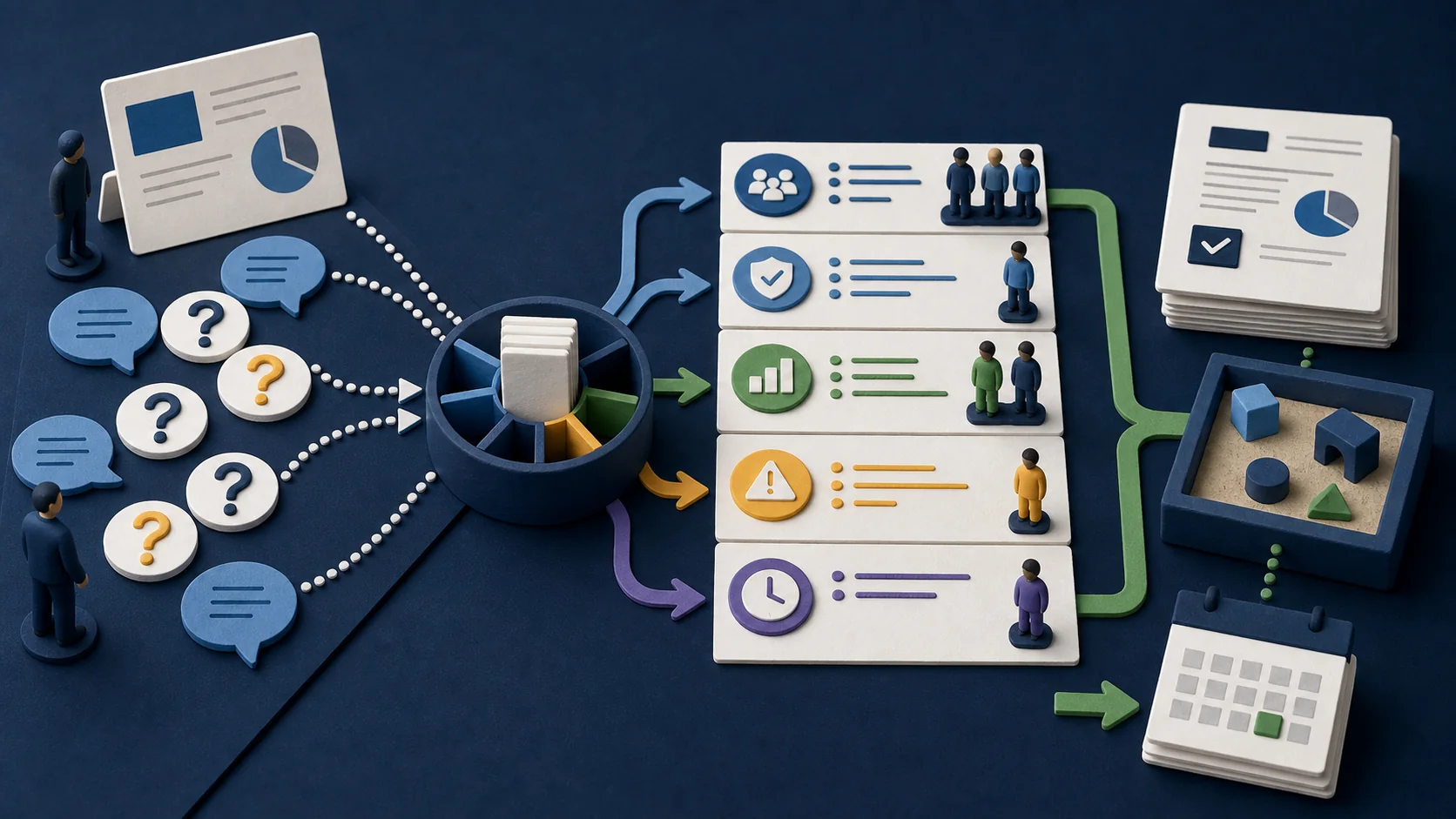
This gap matters because B2B buying decisions are rarely made by the person in the demo alone, and rarely happen without a defined process. A demo that ends without addressing that process leaves genuine interest with no structure to travel through, and structure, not enthusiasm, is usually what B2B deals actually run on.
Why a well-received demo can still be a dead end
The demo succeeding at generating interest isn't the dead end — that's the demo doing its job. The dead end is what happens, or doesn't, immediately after: whether interest gets translated into a defined path toward a decision. Checked against a visible next step, an owner, a recovery path, and an activation path: the "next step" is often a generic follow-up rather than a specific plan tied to that prospect's actual decision process; ownership of moving from interest to decision structure typically falls to the individual salesperson's own initiative and skill, rather than being a defined, repeatable step in the sales process; there's no recovery path for a deal that goes quiet after a good demo, distinct from generic re-engagement sequences; and the demo itself generates real evidence — what resonated, what concerns came up, who else was mentioned as a stakeholder — that frequently isn't captured in a form that shapes the follow-up.
Who carries the cost
Prospects who were genuinely interested and ready to move forward but didn't have a clear structure offered to help them navigate their own internal decision process — meaning the deal doesn't die from a "no," it dies from drift, as competing priorities fill the space where a defined next step should have been. Sales organizations are affected too: pipeline attributed to "went cold" often includes deals that were never actually given a structured path forward, meaning the loss is attributed to the prospect's lack of interest rather than to the seller's own process gap.
What the demo's momentum doesn't carry forward
Specificity doesn't carry forward. A demo can surface real, specific information (a mentioned budget cycle, a named other stakeholder, a described internal process) that should directly shape the follow-up, and often doesn't — the follow-up defaults to generic messaging regardless of what was actually learned during the demo itself.
The question underneath this pattern
Which demo-stage B2B pipeline is lost not to an active "no," but to the absence of any defined next step ever being offered — deals that could have progressed if someone had structured the path forward?
This is deliberately unanswered here. It is plausible that a meaningful share of stalled B2B pipeline reflects a missing decision-path structure rather than genuine disinterest, but the actual scale depends on the specific sales organization and process, not a general industry assumption.
What a decision-path continuity step would require
This means treating the moments right after a demo as a distinct, structured step — not just a follow-up email, but a specific conversation about what has to happen next: who else is involved, what the internal process looks like, what a realistic timeline is — and capturing what the demo itself revealed (stakeholders mentioned, concerns raised) so the follow-up is shaped by it rather than generic.
The decision sales leaders still have to make
The decision is whether "post-demo next steps" is left to individual seller initiative and skill, which produces uneven results, or built as a defined, repeatable part of the sales process — which requires deciding this is worth standardizing, rather than treating it as something good salespeople just naturally do.
A cross-check worth running on your own pipeline
A useful test: pick a sample of deals marked "went cold" after a demo, and check whether each one actually had a specific, structured next step offered, or just a generic follow-up. If the honest answer is mostly the latter, some of that "lost to disinterest" pipeline may actually be lost to an absent process.
Before, during and after the dead end
This pattern should be managed across three decision windows, not only after the failure becomes visible. Before the dead end, the organization should watch for the signals that intent, trust, value or responsibility is starting to stall. During the dead end, the priority is to preserve context, name an owner, keep a useful next step visible and protect whatever value can still be recovered. After the immediate moment passes, the organization should measure what changed, identify which Revenue Unknown remains unresolved and redesign the experience so the next cycle starts earlier.
Transformidy infographic
Dead-end experience vs friction
Friction slows movement. A dead-end experience blocks recognition, decision, recovery, or continuity.
- 01
Friction
The person can continue, but with extra effort, delay, or confusion.
- 02
Dead end
The person cannot complete, recover, escalate, or know what happens next.
- 03
Recognition gap
The organization sees activity, but misses the blocked experience condition.
- 04
Decision needed
Someone must own the path, exception, handoff, or recovery rule.
FAQ
Why do promising B2B demos sometimes fail to progress to a decision?
This article addresses the question through the lens of experience continuity, the unresolved Revenue Unknown, and the decision window leaders still have before the pattern repeats.
What is the difference between a deal lost to "no" and a deal lost to drift?
This article addresses the question through the lens of experience continuity, the unresolved Revenue Unknown, and the decision window leaders still have before the pattern repeats.
What is the Revenue Unknown created by undefined post-demo next steps?
This article addresses the question through the lens of experience continuity, the unresolved Revenue Unknown, and the decision window leaders still have before the pattern repeats.
How can sales teams structure a decision path after a successful demo?
This article addresses the question through the lens of experience continuity, the unresolved Revenue Unknown, and the decision window leaders still have before the pattern repeats.
Related intelligence
Article
How to Find Dead-End Experiences Before Customers Defect
Dead-end experiences don't announce themselves — they hide inside metrics that look fine. Here's a practical way to find them before they show up as defection.
Article
Hotel Recovery Is Not Finished When the Apology Is Sent
A sincere apology closes a complaint. It doesn't necessarily rebuild the confidence a guest needs to book that hotel again. Here's why service recovery often stops one step too early.
Article
Healthcare Referrals Leave Patients Stranded Between Providers
A referral is a handoff between two providers who don't share a single system or, often, direct communication. Here's why that handoff is a common point where care intent quietly stops.