
Article
Hotel Recovery Is Not Finished When the Apology Is Sent
A sincere apology closes a complaint. It doesn't necessarily rebuild the confidence a guest needs to book that hotel again. Here's why service recovery often stops one step too early.
- Published
- September 3, 2026
- Updated
- August 12, 2026
- Reading time
- 8 min
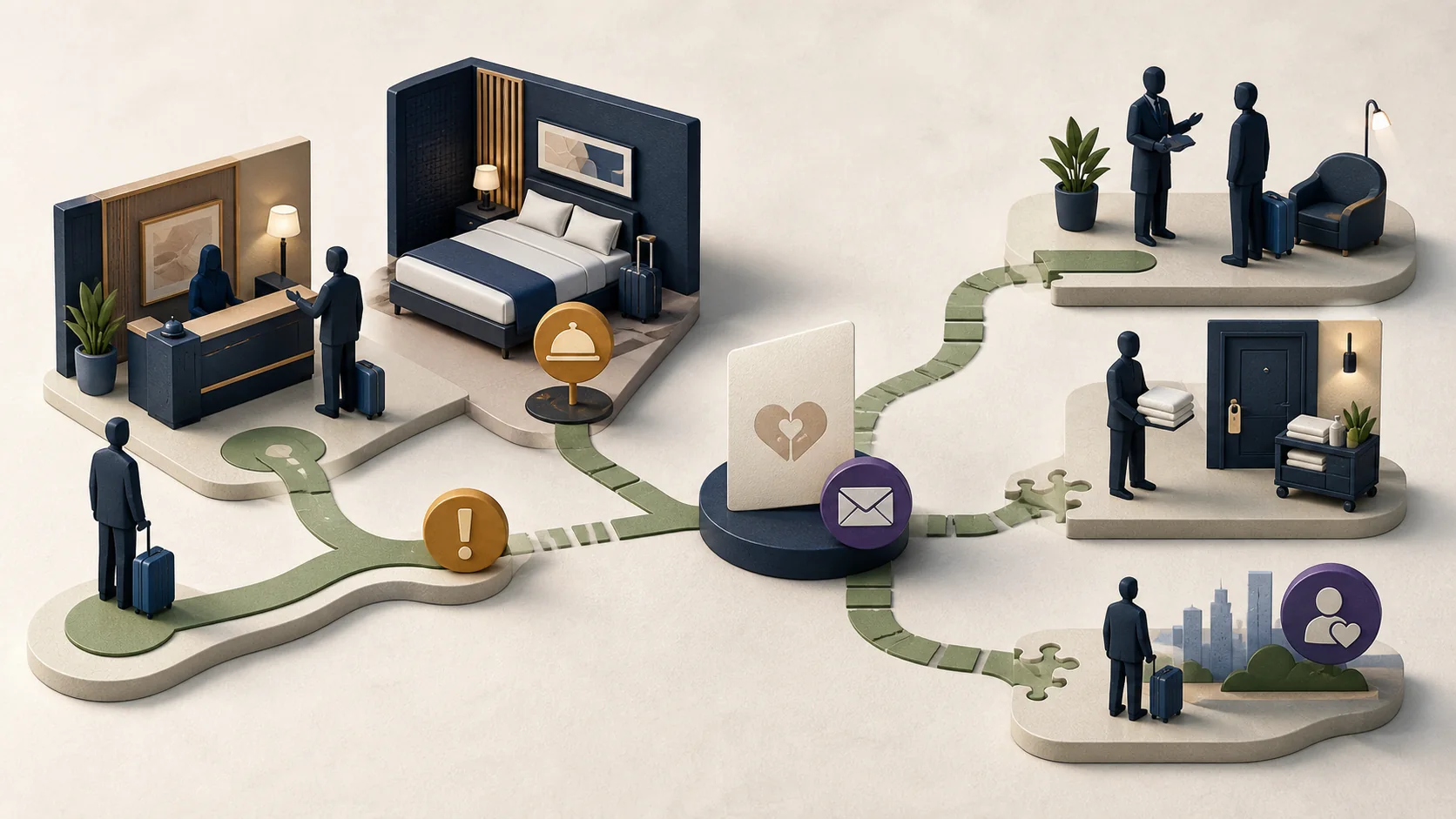
The moment the complaint closes and the relationship doesn't
A guest's stay goes wrong — a noisy room, a maintenance issue, a booking error. They raise it. Staff respond, apologize, and offer something: a discount on the folio, a room change, a small gesture. The complaint is now closed in whatever system tracks guest issues. What isn't closed, and often isn't even asked about, is whether the guest now has any more confidence than before that their next stay at this property — or this brand — would go better.

Hotel service recovery is frequently measured by resolution speed and guest sentiment at the moment of the interaction. Both of those can look good — a fast, polite, generous response — while the actual question that determines whether the guest returns goes unanswered.
Where the dead end actually is
An apology and a gesture are a real and often appropriate response to a service failure. The dead end isn't the apology — it's stopping there. Checked against a next step, an owner, a recovery path, and an activation path: closing the complaint is a next step for the *complaint*, not for the *relationship*; the person who handled the complaint is rarely the same person accountable for whether the guest returns; there is usually no recovery path aimed specifically at rebuilding future-stay confidence, as distinct from resolving the immediate issue; and the evidence generated by the failure (what went wrong, whether it's likely to recur, what would actually reassure this guest) rarely activates anything beyond the individual interaction.
Who the gesture leaves unconvinced
The guest most directly — but also property-level staff, who may have limited authority to do more than the standard recovery script allows, and brand-level teams, who often have no visibility into individual recovery interactions unless a complaint escalates far enough to reach them, meaning the same underlying issue can recur across many guests without anyone connecting the pattern.
What the apology doesn't cover
Confidence is what stops moving. A guest's willingness to book the same property or brand again depends on more than the resolution of a single incident — it depends on whether they believe the underlying cause is unlikely to repeat, and a standard recovery gesture (apology plus discount) doesn't address that belief one way or the other. The evidence generated by the failure itself — what specifically went wrong, and why — often stops at the property level rather than informing anything beyond the individual case.
The question the gesture doesn't answer
Which recovery actions actually change a guest's future-stay intent, as distinct from the actions that simply close the complaint in whatever system tracks it?
This is deliberately unanswered here. It is plausible that certain recovery elements — a manager follow-up, a demonstrated fix rather than just an apology, a connection to the guest's actual trip purpose — matter more to future intent than the size of a discount, but establishing which elements actually move future booking behavior requires hospitality-specific research this draft does not attempt to substitute for.
What a fuller recovery would include
A recovery aimed at future confidence, not just complaint closure, would connect the specific failure to the guest's actual reason for traveling (was this a business trip where the issue affected a meeting, a special occasion where it affected an experience they were unlikely to repeat), would involve a manager-level follow-up distinct from the front-desk resolution, and would include some signal to the guest — even a simple one — that the underlying cause is being addressed, not just compensated for.
The decision hospitality leaders still have to make
The decision is whether service recovery is measured by resolution speed and immediate sentiment, or by whether it demonstrably protects future booking intent — which requires tracking guests past the moment of resolution, something most recovery workflows are not currently built to do.
A quick diagnostic
A useful test: pick a sample of guests who received a service-recovery gesture in the past several months, and check whether the organization has any visibility into whether they rebooked. If the honest answer is "we don't track that," the recovery process is optimized for closing the complaint, not for the outcome the complaint was actually about.
The neighboring pattern
This pattern sits alongside the returns and claim-handling patterns elsewhere in this series — different industries, same underlying mechanism: an organization resolves the transaction in front of it while leaving the relationship-level question unanswered.
Before, during and after the dead end
This pattern should be managed across three decision windows, not only after the failure becomes visible. Before the dead end, the organization should watch for the signals that intent, trust, value or responsibility is starting to stall. During the dead end, the priority is to preserve context, name an owner, keep a useful next step visible and protect whatever value can still be recovered. After the immediate moment passes, the organization should measure what changed, identify which Revenue Unknown remains unresolved and redesign the experience so the next cycle starts earlier.
Transformidy infographic
Dead-end experience vs friction
Friction slows movement. A dead-end experience blocks recognition, decision, recovery, or continuity.
- 01
Friction
The person can continue, but with extra effort, delay, or confusion.
- 02
Dead end
The person cannot complete, recover, escalate, or know what happens next.
- 03
Recognition gap
The organization sees activity, but misses the blocked experience condition.
- 04
Decision needed
Someone must own the path, exception, handoff, or recovery rule.
FAQ
Why is a hotel apology not the same as full service recovery?
This article addresses the question through the lens of experience continuity, the unresolved Revenue Unknown, and the decision window leaders still have before the pattern repeats.
What is the difference between closing a complaint and restoring future-stay confidence?
This article addresses the question through the lens of experience continuity, the unresolved Revenue Unknown, and the decision window leaders still have before the pattern repeats.
What is the Revenue Unknown created by recovery gestures that don't track future intent?
This article addresses the question through the lens of experience continuity, the unresolved Revenue Unknown, and the decision window leaders still have before the pattern repeats.
How can hotels measure whether service recovery actually worked?
This article addresses the question through the lens of experience continuity, the unresolved Revenue Unknown, and the decision window leaders still have before the pattern repeats.
Related intelligence
Article
How to Find Dead-End Experiences Before Customers Defect
Dead-end experiences don't announce themselves — they hide inside metrics that look fine. Here's a practical way to find them before they show up as defection.
Article
Healthcare Referrals Leave Patients Stranded Between Providers
A referral is a handoff between two providers who don't share a single system or, often, direct communication. Here's why that handoff is a common point where care intent quietly stops.
Article
Frontline Warnings Become Dead Ends Without Decision Ownership
A frontline employee raises a warning — a workload problem, a recurring customer issue, a capacity strain. It reaches a manager. Whether it reaches anyone who can actually decide something is a different question.