
Article
The Fault That Shut Heathrow Was Flagged Seven Years Earlier
A moisture reading flagged a failing transformer bushing at Heathrow's power substation in 2018. Nobody replaced it. Seven years later, that exact part failed, shut the airport for 18 hours, and disrupted 270,000 passengers. The warning was not missing. It was ignored.
- Published
- March 21, 2025
- Updated
- June 18, 2026
- Reading time
- 8 min
2026 updated analysis
What changed since the original article
This page keeps the original Transformidy article as the canonical record and leads with the current interpretation, source notes, and Revenue Unknown framing.
A 2018 Warning and a 2025 Fire
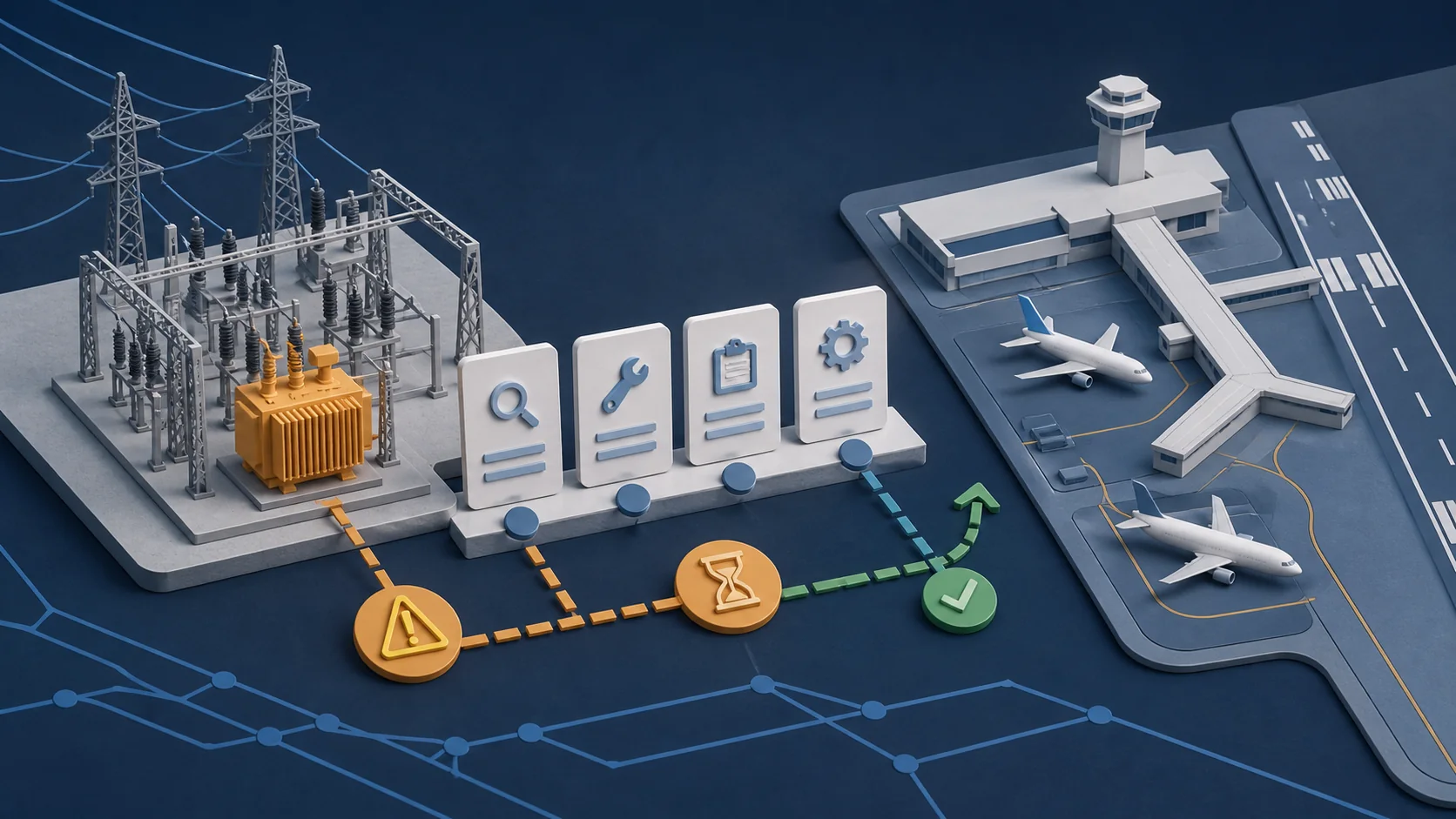
An official investigation found an "elevated moisture reading" had been identified in oil samples at the North Hyde substation in July 2018, but no action was taken to replace the affected electrical insulators, known as bushings. The March 2025 fire resulted from a "catastrophic failure" in one of the transformers, most likely caused by moisture entering the bushing and causing a short circuit that ignited the oil, the same failure mode the 2018 reading had flagged nearly seven years earlier.
The resulting shutdown was severe by any measure: Heathrow closed for approximately 18 hours, disrupting more than 270,000 passenger journeys and cancelling more than 1,300 flights. Energy Secretary Ed Miliband described the investigation's findings as "deeply concerning," and Ofgem, the UK energy regulator, opened an investigation into whether National Grid Electricity Transmission breached its license conditions in connection with the incident.
The seven-year gap between the warning and the failure is the detail that changes how this incident should be read. A fire caused by a component nobody had reason to suspect would fail is a story about bad luck. A fire caused by a component that had already been flagged, with no subsequent action taken, is a story about a maintenance and follow-up process that broke down well before the fire itself started.
Passenger journeys disrupted, traced to a fault flagged seven years earlier
More than 1,300 flights cancelled during the approximately 18-hour shutdown.
The Power Was There. The Design Was Not.
A second finding compounds the story beyond the unaddressed 2018 warning. Britain's National Grid stated Heathrow had enough power available to avoid a full shutdown after the fire. The investigation explains why the airport still went fully dark: Heathrow "significantly underestimated the likelihood of losing one of its three power sources," and as a result, "its internal electrical distribution network was not designed or configured to take advantage of having multiple supply points to provide quick recovery following such a loss."
That is a second, distinct failure sitting alongside the unaddressed maintenance flag. Even granting that the fire itself happened, the full 18-hour shutdown was not the only possible outcome; it was the outcome that resulted from a network architecture built around an assumption, that all three power sources would rarely if ever be simultaneously needed, that the actual incident proved wrong. A more resilient internal network design, one built to route around a single lost source quickly, could plausibly have kept the airport at least partially operational.
Together, the two findings describe a compounding failure pattern worth generalizing beyond this specific incident: a known, unaddressed component risk, layered on top of a redundancy design that assumed the risk would never materialize. Either failure alone might have been contained. Both together produced a shutdown disrupting a quarter-million passengers.
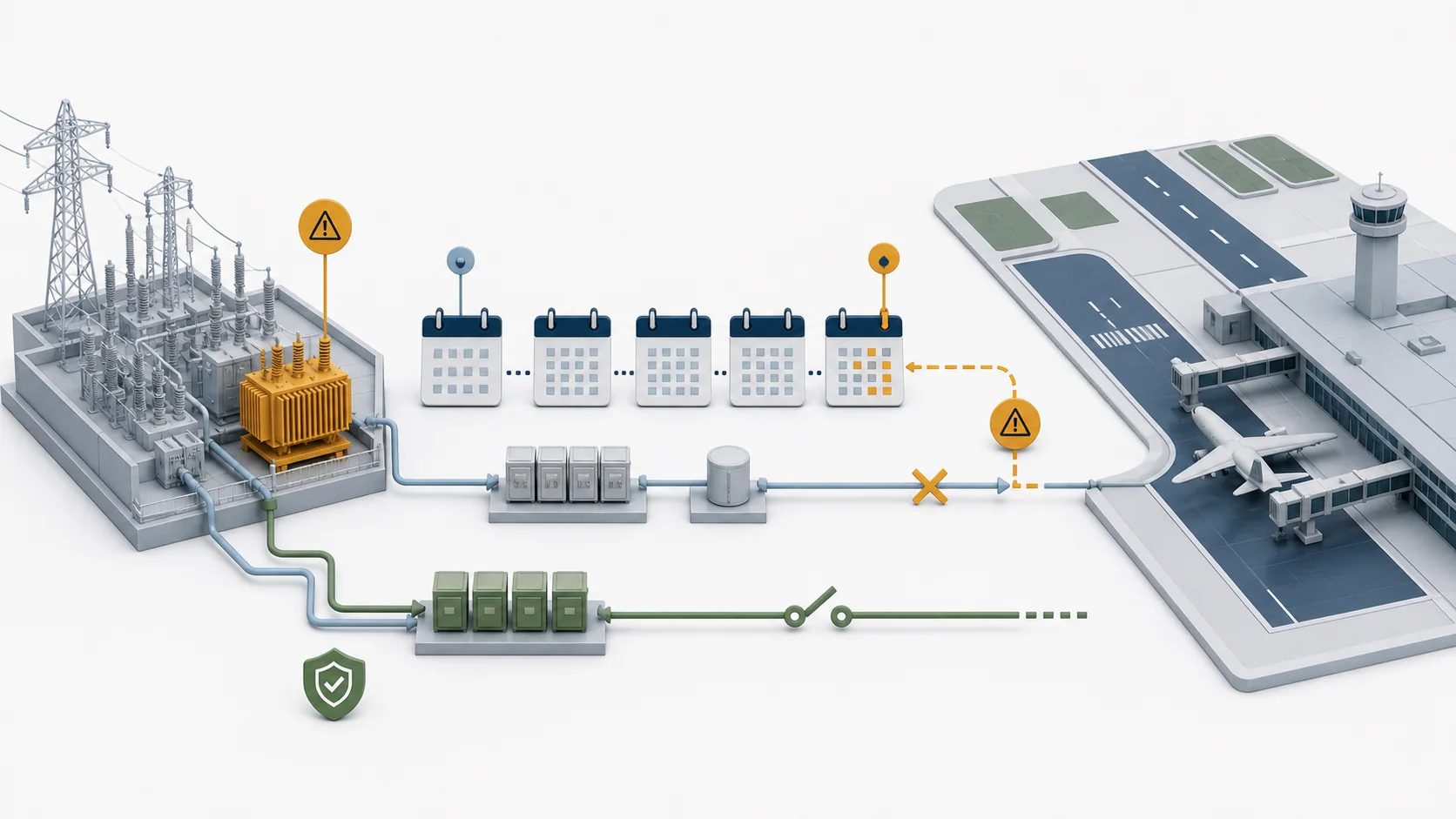
A Flagged Risk Alone vs. a Flagged Risk Plus a Fragile Design
One failure can often be contained. Two compounding failures rarely are.
Flagged risk alone: an unaddressed 2018 maintenance warning eventually causes a component failure, a serious but potentially containable event if backup systems can absorb it. Flagged risk plus fragile design: the same component failure meets an electrical network never designed to route around a single lost power source, converting a containable failure into a full, 18-hour shutdown.
The Leadership Move
The structural choice for any organization operating critical infrastructure is whether flagged maintenance risks are tracked through to closure as a standing discipline, and whether redundancy systems are actually designed and tested to handle the specific failure modes they are meant to protect against.
- Ownership
Infrastructure and facilities leadership own the responsibility to close the loop between a flagged maintenance risk and corrective action, treating an identified-but-unaddressed issue as an active, tracked liability rather than a closed or forgotten data point once the initial inspection is filed.
- Tradeoff
Replacing flagged components proactively, and designing redundancy systems to genuinely handle a single-source loss, costs real money and operational disruption in the near term. The tradeoff against that investment, illustrated directly by this incident, is a catastrophic failure whose cost, in disrupted passengers, cancelled flights, and regulatory investigation, dwarfs the deferred maintenance expense many times over.
- Human consequence
More than 270,000 travelers experienced a sudden, unexplained disruption to travel plans that, per the investigation, traced back to a preventable maintenance gap rather than a genuinely unforeseeable accident, a distinction that shapes how fairly the incident is likely to be judged by the public and regulators alike.
Next Move
If your organization maintains critical infrastructure: Audit maintenance records specifically for flagged-but-unresolved issues, and establish a tracked, time-bound closure process for any risk identified through inspection.
If your organization relies on redundant systems for resilience: Test whether your backup infrastructure actually performs as designed under a realistic single-source-loss scenario, rather than assuming redundancy alone guarantees continuity.
FAQ
How large was the disruption from the Heathrow fire?
The March 2025 fire at the Hayes/North Hyde substation shut Heathrow Airport for approximately 18 hours, disrupting more than 270,000 passenger journeys and cancelling more than 1,300 flights.
Was the fire a genuinely unforeseeable accident?
No. An official investigation found the fire resulted from a catastrophic failure in a transformer bushing, most likely caused by moisture entering the component and causing a short circuit. An elevated moisture reading had been identified in oil samples at the same substation in July 2018, nearly seven years before the fire, but no action was taken to replace the affected insulators.
Could the airport have avoided a full shutdown even after the fire happened?
Britain's National Grid stated Heathrow had enough power available to avoid a full shutdown after the fire. The investigation found Heathrow had significantly underestimated the likelihood of losing one of its three power sources, and as a result its internal electrical distribution network was not designed or configured to take advantage of having multiple supply points for quick recovery.
What is the practical lesson from this incident for other infrastructure operators?
That a documented early-warning signal, the 2018 moisture reading, sitting unactioned for years is a distinct and separately correctable failure from the physical fire itself. An organization can audit its own maintenance and monitoring records specifically for flagged-but-unresolved issues, since those represent known, named risk rather than unknowable uncertainty.
Sources & References
Original article archive
Original article published March 21, 2025: "Heathrow Airport Fire Shutdown Invites Better Customer Experience". Preserved here for provenance, historical context, and citation continuity.
Experience The Skies reported that London's Heathrow Airport (LHR) closed unexpectedly until 1159p on March 21, 2025 due to a fire at a nearby electrical substation located in Hayes. This disruption affects up to 300,000 passengers and grounding over 1,300 flights globally for the day. This event highlights the critical need for airlines and airports to prioritize customer experience (CX) in recovery efforts. This Transformidy insight explores deeper into the incident, the customer experience implications, and management.
Update
As at 7pm local time, Heathrow Airport stated that operations are returning to normal. Departing and arrival flights will be able to use the airport.
Key Takeaways
- A fire at an electrical substation near Heathrow Airport caused a major power outage, leading to the airport's closure on March 21, 2025. Flights were diverted to nearby airports or cancelled. The closure was expected to last until 1159pm local time.
- The closure affected approximately 300,000 passengers and over 1,300 flights globally with British Airways (BA), Virgin Atlantic (VS), and American Airlines (AA) being affected the most.
- The economic impact is estimated to be in the hundreds of millions of pounds for airlines and the airport as operations recover over the next two weeks.
- Effective customer experience (CX) management is crucial during such disruptions, including transparent communication, enhanced support channels, partnership management, and leveraging technology (for feedback, flight management, and passenger management, etc.)
- Collaboration between airlines, airports, and other vendors will be essential for managing passenger expectation/transfers/transportation, providing alternative services, and gaining trust
- The incident highlights the need for improved infrastructure resilience and crisis management training in the aviation industry.

What Caused the London's Heathrow Airport Shutdown?
London's Heathrow Airport located 23km (14mi) from Central London is the fifth busiest airport in the world by passenger count (83 million+ in 2024). The airport serves as a key hub for oneWorld airline alliance's British Airways (BA), and SkyTeam alliance's Virgin Atlantic (VS). Combined, these two airlines control more than 60% of the daily passenger traffic.
On March 20, 2025 night, a fire broke out involving a transformer containing 25,000 liters of cooling oil near Hayes (northeast of Heathrow Airport) which fully engulfed in flames. The blaze resulted in a major power outage for the area, forcing Heathrow Airport and surrounding businesses to shut down for the entire day on Friday, March 21, 2025. While the airport has secondary power sources available, they need the power grid to maintain operational over time.

The London Fire Brigade deployed 10 fire engines and 70 firefighters to combat the fire, evacuating approximately 150 nearby residents as a precaution. A 200-meter safety cordon was established due to significant smoke. The fire was brought under control by early Friday morning London time. Residents reported hearing a loud explosion followed by a fireball and smoke billowing into the sky.
The Heathrow Airport closure impacted over 1,300 flights and up to 300,000 global passengers. Flights enrolee were redirected to alternate airports such as London's Gatwick Airport (LGW), Charles de Gaulle International Airport (CDG), and Shannon Airport (SNN). Authorities are investigating the cause of the fire, with counterterrorism police involved due to its impact on critical infrastructure. However, there is currently no evidence of malicious intent.
Customer Experience Implications on Passengers
- Flight Cancellations and Diversions:
- Over 145,000 travelers faced immediate disruptions, with flights rerouted to Gatwick, Charles de Gaulle, Shannon Airport, and other hubs.
- Airlines like British Airways canceled 700 flights, while Air France and KLM canceled multiple routes. This not only affects passengers but also impacts crew rotations and aircraft positioning.
- Stranded Travelers:
- Passengers reported difficulties accessing refunds or rebooking options due to overwhelmed airline helplines.
- Many were left navigating deserted roads or seeking alternative transportation after the closure announcement, highlighting the need for better ground support during such crises.
- Ripple Effects:
- Aircraft and crew displacement will likely lead to prolonged delays over the weekend.
- Tourism and trade disruptions are expected globally due to the logistical chaos caused by out-of-position aircraft. For instance, perishable goods and pharmaceuticals may be delayed, impacting businesses reliant on timely deliveries.
Economic Consequences
The shutdown is projected to cost airlines and Heathrow hundreds of millions of pounds. For comparison, a similar air traffic control malfunction in 2023 resulted in losses exceeding $127 million. Beyond airlines, stakeholders like cargo companies, retailers, and local businesses reliant on airport operations will also suffer. The economic impact extends beyond immediate losses, as consumer confidence in air travel may be shaken.
CX Strategies for Recovery
To mitigate passenger frustration and rebuild trust, airlines and airports must implement robust CX strategies:
1. Transparent Communication
- Regular updates via social media platforms like Instagram, X (formerly Twitter), and Facebook are essential. Heathrow’s initial statement provided clarity but lacked detailed contingency plans.
- Airlines should proactively inform passengers about rebooking options, refunds, and alternative routes. This can be achieved through automated SMS and email notifications or through their mobile application and websites.
2. Enhanced Support Channels
- Deploy additional customer service agents to handle increased call volumes or website inquiries.
- Offer multilingual support for international travelers stranded by cancellations. This ensures that all passengers, regardless of language barriers, receive adequate assistance.
3. Collaboration with Other Airports
- Coordinate with nearby hubs like Gatwick or Stansted to streamline passenger transfers.
- Arrange ground transportation (e.g., buses) for diverted passengers heading to London. This collaboration can significantly reduce travel stress for affected passengers.
4. Compensation Packages
- Airlines should offer vouchers or refunds promptly to affected passengers.
- Provide complimentary accommodations for stranded travelers on long-haul routes. This not only mitigates immediate discomfort but also shows a commitment to customer satisfaction.
- Beyond compensation, it is important for airlines to transport affected passengers to their final destination in a reasonable manner.
5. Leveraging Technology
- Utilize AI-driven tools to automate rebooking processes and send real-time notifications.
- Implement mobile apps for passengers to track flight status and access support. Technology can streamline communication and reduce the workload on customer service teams.
Examples of Effective CX Management
- British Airways’ Response:
Despite being heavily impacted with 341 scheduled flights at Heathrow on Friday, British Airways committed to updating customers swiftly about travel options. This demonstrates the importance of prioritizing passenger communication during crises. The airline kept its website updated in real time.

- Collaborative Efforts:
Some airlines arranged buses for diverted passengers across Europe—a practical solution that eased travel challenges for many stranded individuals. This kind of collaboration showcases how airlines can work together to mitigate passenger distress. - Airlines Proactive Approach:
During past disruptions, major airlines such as Delta Air Lines, Air Canada, Emirates, United Airlines, and Singapore Airlines, etc. used their mobile applications and online assets to offer passengers personalized rebooking options and travel updates. This proactive approach can be a model for other airlines in managing passenger expectations.
Lessons for Future Preparedness
- Infrastructure Resilience:
The fire exposed vulnerabilities in Heathrow’s power resilience/backup systems and programs. Energy Minister Ed Miliband stressed the need for improved redundancy mechanisms to prevent similar failures in the future. Investing in robust infrastructure can reduce the likelihood of such disruptions. - Crisis Management Training:
Heathrow Airport established a service quality framework to ensure consistent delivery. The airport train staff in handling large-scale disruptions efficiently while maintaining empathy toward distressed passengers. This includes training on communication skills and conflict resolution. - Data-Driven Insights:
Analyzing passenger feedback post-crisis can help refine CX strategies for future incidents. By understanding what worked well and what didn’t, airlines can improve their response mechanisms. - Annual Assessment:
Both airports and airlines can benefit with an annual disaster recovery assessment to determine how to manage crisis or disruptions such as weather issues, industrial actions, fire, and indeterminable operational issues, etc.
Transform for the Better
The Heathrow Airport closure underscores the interconnected nature of global aviation and the importance of robust CX strategies during crises. By focusing on transparent communication, technological solutions, and collaborative efforts, airlines, airports, hospitality and other vendors can not only recover swiftly but also strengthen passenger loyalty in the long term. As the aviation industry continues to evolve, prioritizing CX will be crucial for maintaining customer trust and ensuring resilience in the face of unexpected disruptions.
Frequently Asked Questions (FAQs) - Heathrow Airport Disruption
Q: What caused the closure of Heathrow Airport?
A: A fire at an electrical substation in Hayes, west London, near the airport, caused a major power outage, forcing the closure.
Q: How long was Heathrow Airport closed?
A: Heathrow Airport was closed for the entire day on Friday, March 21, 2025. Check the airport's website for the most updated information.
Q: How many passengers were affected by the closure?
A: Up to 300,000 passengers were affected globally.
Q: What actions did the London Fire Brigade take?
A: They deployed 10 fire engines and 70 firefighters, evacuated 150 nearby residents, and established a 200-meter safety cordon.
Q: How are airlines compensating affected passengers?
A: Airlines may offer waivers for ticket changes, refunds, and in some cases, complimentary accommodations for stranded travelers. Contact airlines for more information and next steps.
Q: What alternative airports were used during the closure?
A: Flights were redirected to airports such as London Gatwick Airport, London City Airport, Charles de Gaulle International Airport, Shannon Airport, and Amsterdam Airport Schiphol.
Q: How are airlines and airports managing customer communication during this crisis?
A: They are using social media platforms, mobile apps, SMS, and email notifications to provide regular updates and rebooking options.
Q: Is there any suspicion of foul play in the fire incident?
A: While counterterrorism police are involved due to the impact on critical infrastructure, there is currently no evidence of malicious intent.
Q: What long-term impacts might this incident have on the aviation industry?
A: It may lead to improved infrastructure resilience, enhanced crisis management training, and a greater focus on customer experience during disruptions.
Q: How can passengers stay informed about their flight status and options during such incidents?
A: Passengers should monitor airline and airport social media accounts, check their email for notifications, use airline mobile apps, and contact customer service for personalized assistance.
How Can Transformidy Help?
At Transformidy, we specialize in helping brands navigate the complex world of maximizing customer experience for improved engagement, satisfaction, and business growth. Our team of experts can assist you in assessing, tailoring, and implementing the right customer experience strategy for your company.
Contact us or set up a 30-minute complimentary consultation for more information on our services, insights, or showcases. We look forward to hearing from you.
FAQ
How large was the disruption from the Heathrow fire?
The March 2025 fire at the Hayes/North Hyde substation shut Heathrow Airport for approximately 18 hours, disrupting more than 270,000 passenger journeys and cancelling more than 1,300 flights.
Was the fire a genuinely unforeseeable accident?
No. An official investigation found the fire resulted from a catastrophic failure in a transformer bushing, most likely caused by moisture entering the component and causing a short circuit. An elevated moisture reading had been identified in oil samples at the same substation in July 2018, nearly seven years before the fire, but no action was taken to replace the affected insulators.
Could the airport have avoided a full shutdown even after the fire happened?
Britain's National Grid stated Heathrow had enough power available to avoid a full shutdown after the fire. The investigation found Heathrow had significantly underestimated the likelihood of losing one of its three power sources, and as a result its internal electrical distribution network was not designed or configured to take advantage of having multiple supply points for quick recovery.
What is the practical lesson from this incident for other infrastructure operators?
That a documented early-warning signal, the 2018 moisture reading, sitting unactioned for years is a distinct and separately correctable failure from the physical fire itself. An organization can audit its own maintenance and monitoring records specifically for flagged-but-unresolved issues, since those represent known, named risk rather than unknowable uncertainty.
Related intelligence
Article
AI in Hospitality: Personalization and Guest Experience Risk
Hotels deployed AI for personalization and staff augmentation. But automation that removes human touch from high-stakes moments (room issues, service recovery) creates guest frustration. Successful properties used AI to enable staff, not replace judgment.
Article
Loyalty Programs as Business Model: Strategy Over Retention Tactics
Loyalty programs matured from retention tactics to business model drivers. Industry data shows 90% of programs report positive ROI, but the returns are concentrated among members who actually redeem and engage—not the full enrolled base.
Article
Connected TV: The Budget Line That's Actually Moving
The IAB projects Connected TV ad spend up 13.8% in 2026 while linear TV declines 1.7%. That's not two channels drifting apart at similar speed—it's one budget line actively moving from one to the other, and most brands are still measuring CTV like it's a media placement instead of a data channel.