
Article
Revenue Unknowns in the Agentic Economy
Autonomous agents turn broken context, unclear accountability, and fragmented decision systems into unresolved commercial implications.
- Published
- July 2, 2026
- Updated
- August 11, 2026
- Reading time
- 5 min
Key takeaways
- Revenue friction is a signal. The Revenue Unknown is the unresolved question leaders must investigate before deciding.
- AI agents will make unresolved commercial implications more visible because they compare alternatives and execute switching faster.
- The practical question is which condition changed and which decision can still influence the next outcome.
- Revenue Unknowns help leaders investigate commercially meaningful uncertainty without pretending evidence is already proof.
Revenue Unknowns in the Agentic Economy
What Actually Changed
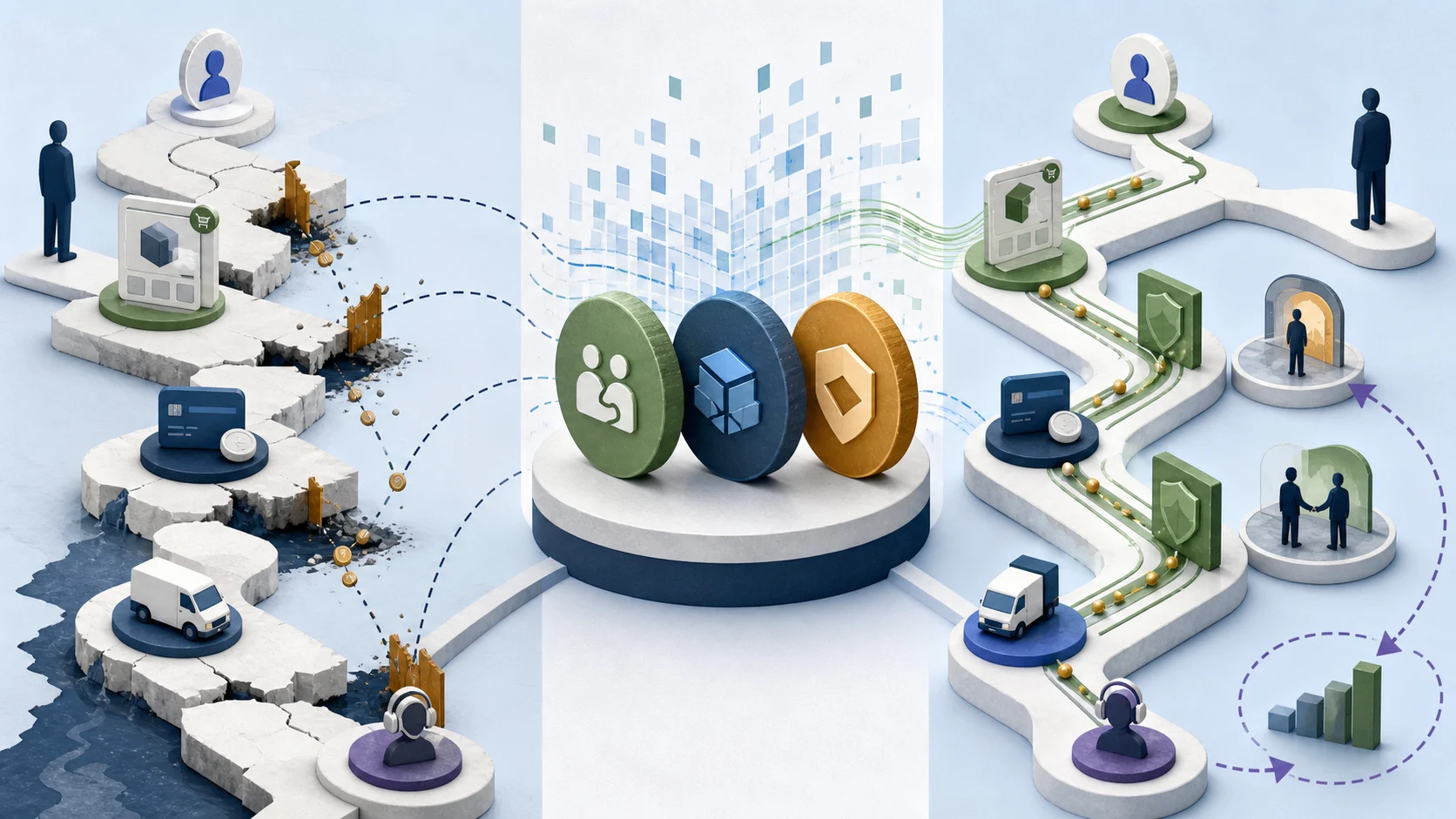
Revenue used to move through visible channels: campaigns, sales conversations, stores, service desks, renewals, and referrals. Those channels still matter, but they no longer contain the whole decision. Customers compare options across platforms. Employees route work through tools. Partners influence fulfillment. AI agents summarize, recommend, filter, and sometimes act before a person evaluates every step.
This creates a new kind of commercial problem. The organization may still see traffic, orders, renewals, and service volume, but it may not see why value slowed down, moved elsewhere, or never became visible. The customer journey looks active. The commercial implication remains unresolved.
Transformidy calls that unresolved implication a Revenue Unknown. Friction is the signal. The Revenue Unknown is the decision-grade question created when changing experience conditions expose value movement, risk, hidden demand, relationship movement, or capability gaps.
Why Revenue Unknowns Are Getting Harder To See
Traditional metrics often report consequences after the decision window has passed. Conversion falls. Cost to serve rises. Renewal slows. Complaint volume increases. Demand shifts to another channel. A partner absorbs recovery work. A competitor captures the next purchase.
By the time the metric appears, the condition change may already be well underway. Relationship condition may have weakened because the customer no longer trusts the promise. Capability condition may have become constrained because teams cannot coordinate the exception. Value condition may have transferred because another actor solved the problem first.
In an agentic economy, this can happen earlier and faster. A customer does not have to personally compare every option if a tool filters the market for them. A procurement team does not need to repeat a bad buying process if an agent can identify friction in the supplier experience. A traveller does not need to wait through repeated disruption if alternatives are easier to rebook.
What Recognition Should Ask
A Revenue Unknown should not trigger arbitrary ideation. It should trigger Recognition. What happened? Which Experience Systems were involved? Which actors were affected? Which relationship, capability, or value conditions may have changed? Was the movement observed, inferred, or hypothesized? What evidence supports the interpretation? Which alternative explanations remain credible?
These questions matter because visible friction is not always negative. A slower purchase may signal anxiety, a pricing issue, a new requirement, a better-informed customer, a channel mismatch, or a hidden demand the current offer does not answer. A drop in one channel may be a loss, a transfer, or a healthier rerouting. Without Recognition, leaders may fix the wrong thing.
The Revenue Unknown
The Revenue Unknown is the unresolved commercial implication created by condition change. It is not simply the fact that revenue went up or down. It is the question that determines what should be decided next.
If value is delayed, which capability would shorten the delay? If value is hidden, what evidence would reveal it? If value transferred, which actor captured it and why? If relationship continuity weakened, what recovery action would protect future preference? If a partner absorbed the cost, what shared intervention would protect the broader experience system?
Revenue Unknowns turn messy evidence into decision-grade inquiry. They prevent the organization from calling every trend an opportunity and every complaint a failure.
Decision Windows
The point is not to eliminate all friction. Some friction protects trust, safety, fairness, or margin. The point is to know which unresolved implication is commercially meaningful and still influenceable.
Before value moves, leaders can change policy, communication, product design, pricing, partner coordination, or recovery authority. During friction, they can prioritize affected actors and protect the highest-risk relationships. After friction, they can test which interventions changed future behavior rather than simply recording satisfaction.
Reactive evidence should still produce proactive decision windows. A missed sale can teach the next sale. A failed handoff can redesign the next handoff. A costly recovery can reveal a capability gap before it becomes a pattern.
How To Use The Signal
Leaders should treat friction as a routing signal before treating it as a campaign problem. The first question is not which message will recover the number. The first question is which condition changed. If value is delayed, the decision may be about speed, coordination, or authorization. If value is hidden, the decision may be about evidence collection or demand discovery. If value transferred, the decision may be about partner coordination, offer design, or recovery.
The second question is whether the organization still has time to act. Some Revenue Unknowns have long windows, such as emerging category demand or a slow shift in preference. Others close quickly, such as a travel disruption, a failed launch, a public service bottleneck, or a competitor offer that changes expectations. A useful intelligence system should separate both.
The third question is what outcome would prove the interpretation. Leaders should not accept a persuasive explanation until it can be tested through behavior, operational performance, relationship recovery, or value movement.
Related Original Archive Reading
These earlier Transformidy articles provide source context for this flagship and show how the thinking developed across real examples:
- 5 Ways Southwest Improves Revenue With Best In Class Customer Experience
- Tariff Resilience Framework Solves Challenges with CX
- Amazon Predictive Delivery - Great Experience Award Mar 2025
- Southwest Airlines Balanced Choice And Business With Assigned Seating
What To Watch Next
The agentic economy will reward organizations that make their experiences easier to recognize, decide, and recover. It will punish organizations that rely on lagging metrics and disconnected accountability. Friction may be the early signal. The work is to recognize the Revenue Unknown before the value has already moved.
FAQ
What is Experience Intelligence?
Experience Intelligence is the discipline of recognizing changing experience, relationship, capability, and value conditions early enough to make better decisions.
How is this different from customer experience management?
Customer experience management often focuses on journeys and touchpoints. Experience Intelligence asks what condition changed, which actors are affected, what remains undecided, and which decisions can still protect or create value.
Why does Transformidy focus on Revenue Unknowns?
Revenue Unknowns name commercially meaningful questions that appear when changing experience conditions expose hidden value, risk, demand, relationship movement, or capability gaps.
Does this replace the public Transformidy framework?
No. The public framework remains Evidence, Recognition, Revenue Unknowns, Decisions, Activation, Outcomes, and Learning. The internal reasoning model makes Recognition more precise.
Is a Revenue Unknown the same as revenue decline?
No. Revenue decline is an outcome. A Revenue Unknown is the unresolved commercial question that appears when evidence suggests value may be slowing, moving, disappearing, or becoming newly possible.
Related intelligence
Article
Transformidy: Transforming Into An Experience Intelligence Company
Experience is the visible outcome of organizational systems. Transformidy is becoming an Experience Intelligence Company built around coherence, Revenue Unknowns, BEUP, and Experience Infrastructure.
Article
Google Universal Commerce Protocol: What Experience Infrastructure Looks Like in Commerce
Google's Universal Commerce Protocol points to a larger shift: commerce advantage increasingly depends on the infrastructure connecting discovery, data, fulfillment, partners, and recovery.
Article
When Availability Signals Are Not Aligned: The Hidden Inventory-Demand Mismatch
In stock somewhere in the network is not the same as available to this customer, in this format, in time. That gap does not show up in the out-of-stock rate.