
Article
Claude Commerce Turns Shopping Into a Revenue Unknown
Claude Commerce and Shopify's agentic commerce work could move ecommerce from search-and-click shopping toward AI-mediated buying. The opportunity is large, but privacy, proprietary data access, merchant dependency, and OpenAI's uneven commerce path show why commerce intelligence now matters.
- Published
- September 3, 2026
- Updated
- September 3, 2026
- Reading time
- 10 min
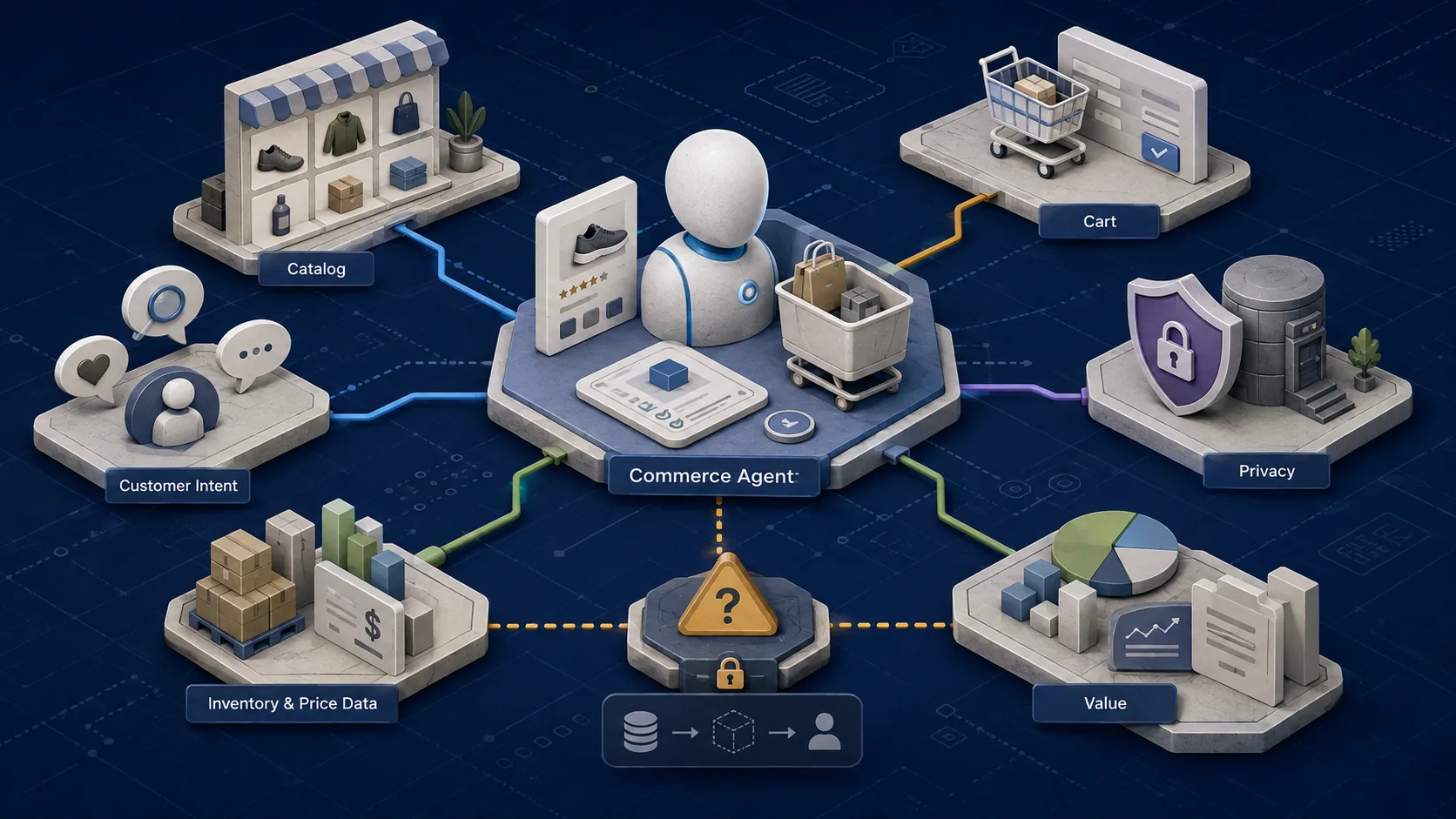
Claude Commerce is not just another shopping feature.
It is a sign that ecommerce is moving from pages, carts, recommendations, and retargeting toward an environment where AI agents may help customers discover, compare, decide, and buy. That shift creates a new Revenue Unknown for merchants, marketplaces, banks, loyalty programs, payment networks, search engines, and brands.
The question is no longer only whether shoppers can find a product.
The question is whether an AI-mediated commerce experience can understand intent, preserve trust, protect merchant data, complete the purchase, and still leave the customer and merchant better off after the transaction.
Anthropic has been building toward this with a commerce-agent blueprint that treats shopping agents as systems requiring tool use, product understanding, policy constraints, memory, safeguards, and evaluation. Claude also has a Shopify connector that can let users work with Shopify store data inside Claude when the merchant authorizes it. Shopify, for its part, has been preparing for agentic commerce through merchant-facing tooling and developer infrastructure such as catalogs, checkout surfaces, and emerging cart protocols.
That is the observable direction.
The Transformidy question is sharper:
Which commerce value will move from storefronts, search engines, marketplaces, and apps into AI-mediated decision environments before merchants understand what changed?
That is the Revenue Unknown.
It is not automatically good news or bad news. It is a decision window.
What Actually Changed
Traditional ecommerce assumes the shopper remains the primary operator. The shopper searches, clicks, filters, compares, reads reviews, evaluates shipping, checks return policies, enters payment information, and decides whether to complete the purchase.
AI commerce changes that operating model.
The shopper may still own the decision, but the agent may increasingly perform the work around the decision. It may summarize options, filter merchants, compare features, remember preferences, check constraints, evaluate reviews, generate product shortlists, and route the customer toward one checkout path instead of another.
That creates a new layer between merchant evidence and customer action.
In old ecommerce, a merchant could watch site search, product-page views, cart abandonment, checkout conversion, ad performance, email engagement, return rates, and repeat purchase. Those signals were incomplete, but at least many of them happened inside systems the merchant controlled.
In agentic commerce, some of the most important pre-purchase reasoning may happen outside the storefront.
A customer may never visit the product page that lost the sale. A brand may never see the comparison question that excluded it. A merchant may not know which policy, delivery promise, price, review pattern, inventory status, privacy concern, or compatibility issue caused the agent to recommend someone else.
That is why Claude Commerce matters.
It does not merely add another channel. It changes where commerce intent is interpreted.
The Commerce Intelligence Upside
The upside is real.
Most ecommerce experiences still ask customers to do too much translation. A shopper often has a job to be done, a budget, a timing constraint, a size or compatibility concern, a privacy concern, a gift context, a return-risk concern, or a household requirement. The storefront usually turns that into product tiles, filters, reviews, promotions, and checkout steps.
That is not always enough.
An agent can potentially make the experience more continuous. It can ask clarifying questions, preserve context, compare options across merchants, explain tradeoffs, remember constraints, and reduce the number of dead-end experiences where the customer has intent but no useful next step.
For a merchant, that could create better demand recognition. Instead of optimizing only for clicks and conversion, the merchant may learn which customer questions are forming before purchase, which doubts block commitment, which attributes matter in context, which bundles are useful, which support content actually affects choice, and which product gaps are causing customers to leave.
This is where commerce intelligence becomes more valuable than commerce reporting.
Commerce reporting explains what happened.
Commerce intelligence asks what changed, which actors were affected, what remains undecided, which value can still be protected or created, and what should be learned before the next cycle.
Claude Commerce and Shopify's agentic commerce direction may help merchants recognize the moments that classic dashboards miss:
- a customer who wanted the product but could not trust the delivery window;
- a gift buyer who needed confidence, not a discount;
- a shopper whose privacy concern blocked account creation;
- a returning customer whose loyalty was weakened by a return policy;
- a product researcher who left because the comparison evidence was unclear;
- a buyer whose agent chose a competitor because the merchant's data was incomplete or hard to interpret.
Those are not simply UX issues.
They are Revenue Unknowns.
The Privacy And Proprietary Data Risk
The same mechanism that creates the opportunity creates the risk.
Agentic commerce works better when the agent has context. It may need product data, inventory data, price data, policies, customer preferences, order history, loyalty status, return eligibility, shipping options, customer-service commitments, and merchant-specific rules.
That raises a practical question:
Who gets to see enough to decide well?
If the agent sees too little, the customer gets a shallow recommendation. If the agent sees too much, the merchant or customer may expose proprietary, competitive, personal, or operational data in ways they did not intend.
For merchants, the proprietary-data issue is not abstract. Product margins, inventory constraints, fulfilment capacity, promotional plans, conversion signals, customer cohorts, return-risk patterns, and service issues may all become commercially sensitive if they are fed into an external AI environment without clear boundaries.
For customers, the privacy issue is equally concrete. A shopping agent may infer budget, household composition, health-adjacent needs, life events, location patterns, gifting relationships, financial constraints, or identity preferences from ordinary shopping behaviour.
That does not mean AI commerce should be avoided.
It means commerce intelligence must include consent, data minimization, access controls, auditability, source lineage, and explicit separation between what the agent knows, what it infers, what it recommends, and what it is allowed to do.
The strongest version of Claude Commerce would help merchants and customers make better decisions without turning every shopping moment into uncontrolled behavioural extraction.
The weakest version would make commerce feel easier while making data governance less visible.
Why The OpenAI Commerce Path Matters
OpenAI has already shown how difficult commerce can be for general-purpose AI platforms.
ChatGPT can support product discovery and shopping research, and OpenAI has worked on merchant and shopping experiences. Shopify's current guidance for merchants, however, has also made clear that merchants cannot simply force their products to appear in ChatGPT shopping results. Shopify merchants can improve crawlability, product data, and discoverability, but the recommendation environment is not the same as buying an ad placement, controlling a storefront, or owning the customer journey.
That is the important lesson.
OpenAI did not prove that AI commerce is impossible. It proved that commerce is not solved by adding product cards to a chat interface.
Commerce requires trust, inventory accuracy, checkout continuity, merchant consent, customer privacy, payments, policy interpretation, product truth, brand safety, and post-purchase accountability. The agent cannot merely answer. It has to operate inside a system where consequences matter.
That is where Claude and Shopify may be taking a different route.
Anthropic's approach appears more infrastructure-conscious: commerce agents need tools, evaluation, permissioning, and reliability. Shopify's incentive is also different from a general search or answer platform. Shopify has to protect merchant participation because merchants are not just content sources. They are the commerce system.
The Revenue Unknown is whether that difference matters enough to change merchant outcomes.
Will Claude-Commerce-style agentic shopping create better demand recognition and purchase continuity for merchants, or will it simply become another layer where platforms mediate access to customers?
That answer is not known yet.
The Three State Movements To Watch
Transformidy would watch three state movements.
Relationship State changes when the customer begins to trust an agent as part of the shopping relationship. The relationship may no longer be only customer-to-merchant. It may become customer-to-agent-to-merchant, with the platform shaping confidence before the merchant ever speaks.
That can strengthen the relationship if the agent reduces confusion and routes the customer to a better match. It can weaken the relationship if customers feel manipulated, if recommendations are opaque, or if merchants cannot explain why certain options were shown.
Capability State changes when merchants need to become legible to agents. Product data must be structured. Policies must be clear. Inventory must be accurate. Support content must be useful. Fulfilment promises must match reality. Privacy rules must be enforceable. Merchant systems must be coherent enough for an agent to interpret them without inventing certainty.
Many merchants are not ready for that. Their data is built for websites, feeds, ads, and reporting, not for external agents trying to reason through a customer decision.
Value State changes when value becomes created, protected, hidden, transferred, or lost before the storefront visit. A merchant may gain new customers because an agent recognizes fit earlier. It may lose customers because a competitor's data is clearer. It may protect value by reducing returns. It may lose value if agent recommendations commoditize the product and shift attention to price, delivery, or policy.
These state movements are where commerce intelligence should focus.
The article is not "Claude will win commerce" or "Shopify will control agentic shopping."
The article is: commerce intent is moving, and merchants need to recognize the movement before the dashboard explains it too late.
The Merchant Decision Window
The practical decision window is already open.
Merchants should not wait for a fully mature AI shopping standard before acting. They should begin by asking whether their commerce evidence is interpretable outside their own storefront.
Can an agent understand what the product is, who it is for, what problem it solves, what constraints matter, what alternatives exist, what the return policy means, whether inventory is available, whether delivery promises are credible, and what happens after purchase?
Can the merchant decide what data should be exposed, what should remain private, what requires customer consent, what can be summarized, and what should never leave controlled systems?
Can the merchant tell the difference between a customer who did not want the product and a customer whose agent never saw enough evidence to recommend it?
That last question is the commercial issue.
When agentic commerce grows, some lost demand may become invisible unless merchants build new recognition capability.
What Retail Leaders Should Do Now
Retail leaders should treat Claude Commerce as an early signal, not a final answer.
First, audit product and policy legibility. If a human shopper struggles to understand fit, availability, delivery, returns, warranty, use cases, compatibility, and post-purchase support, an AI agent may also struggle or may simplify the wrong thing.
Second, define data boundaries. Decide which merchant data is public, partner-visible, agent-visible, customer-authorized, internally confidential, or never shareable. Agentic commerce will punish vague data governance.
Third, create commerce-intelligence feedback loops. Merchants need to know which questions agents and customers are asking, which signals influence recommendations, which products are excluded, which policies create hesitation, and which post-purchase outcomes validate or contradict the agent's recommendation.
Fourth, protect brand meaning. AI agents can flatten choice. If the merchant's value is not explicit, structured, and evidenced, the agent may reduce the decision to price, convenience, or review summaries.
Fifth, prepare for post-purchase accountability. A successful agentic transaction still has to be fulfilled, serviced, returned, repaired, explained, and learned from. Commerce does not end when the agent completes the cart.
That is why this is a Retail Mashup story.
Stores, ecommerce, loyalty, payments, customer service, privacy, product data, inventory, and AI are no longer separate domains. They are one experience system.
Reader Poll
Question: Where is your commerce data least ready for AI-mediated shopping?
- Product and catalog accuracy
- Inventory and fulfilment promises
- Privacy and consent controls
- Post-purchase support and returns
Sources
- Anthropic: Building effective agents
- Claude: Shopify connector
- Shopify: AI and agentic commerce
- Shopify: Universal Cart Kit
Related Reading
Global examples
Global experience signals in this article
Mapped examples are grouped by theme and evidence basis. Hypotheses stay visibly labelled so the map does not turn interpretation into claimed fact.
- North AmericaReported
San Francisco, United States
Anthropic's Claude Commerce changes where product discovery and checkout intent can begin.
- Theme
- AI shopping interface
- Revenue Unknown
- Which shopping moments move from owned commerce surfaces into AI-mediated interactions?
- Decision window
- Before agentic shopping becomes a default discovery path.
- North AmericaReported
Ottawa, Canada
Shopify sits inside the same operating question: how merchants stay visible when the interface changes.
- Theme
- Commerce infrastructure
- Revenue Unknown
- How much merchant demand becomes invisible when the storefront is no longer the first interface?
- Decision window
- While platform partners can still shape standards, attribution, and recovery paths.
- GlobalInferred
Global merchants
The pattern matters across markets because AI-referred intent may not look like traditional search, referral, or ad traffic.
- Theme
- Revenue attribution
- Revenue Unknown
- What value is being created, lost, or misread when agent referrals do not fit existing measurement models?
- Decision window
- Before measurement gaps become routine reporting blind spots.
Transformidy infographic
What is a Revenue Unknown?
The unresolved value question that becomes visible when evidence is recognized early enough to still change the decision.
- 01
Evidence
A visible event, behaviour, gap, cost, or relationship change.
- 02
Recognition
The interpretation that names what may be changing underneath the evidence.
- 03
Revenue Unknown
The unresolved question about value, risk, demand, trust, cost, or capability.
- 04
Decision window
The period where leaders can still protect value or create a better outcome.
How concentrated is your revenue across your top customers? If your largest customer left, how would it impact annual revenue?
FAQ
What is Claude Commerce?
Claude Commerce refers to Anthropic's emerging commerce-agent direction, including Claude's ability to work with commerce tools and Shopify-connected store contexts where authorized. It points toward AI systems that can support shopping decisions rather than only answer product questions.
Why does the Shopify partnership matter?
Shopify matters because its merchant ecosystem, catalog infrastructure, checkout capability, and agentic commerce work could make AI-mediated shopping more operationally realistic. The key question is whether merchants gain better demand recognition or lose more control over customer access.
What is the biggest risk of AI commerce?
The biggest risk is uncontrolled context. AI commerce needs data to be useful, but customer privacy, merchant proprietary data, pricing, inventory, policies, and post-purchase accountability require clear permissioning, audit trails, and governance.
How is this different from normal ecommerce?
Normal ecommerce assumes the shopper navigates the storefront. Agentic commerce may let an AI system interpret intent, compare options, and route the customer before the merchant sees the visit. That changes where evidence is created and where Revenue Unknowns form.
Why does Transformidy call this a Revenue Unknown?
It is a Revenue Unknown because the commercial implication is unresolved. AI commerce may create new demand, protect value, transfer value to platforms, hide lost demand, weaken merchant relationships, or improve decision quality. The result depends on evidence that has not fully appeared yet.
Related intelligence
Article
Accountable AI Delegation Is the New Operating Model
# Accountable AI Delegation Is the New Operating Model Production illustration: human-agent collaboration organized around evidence, authority, approval and learning. **Revenue Unknown:** Many organizations are preparing
Article
Apple Waited Until the Foldable iPhone Could Become an Experience Layer
Apple's iPhone Duo is not only a foldable phone announcement. It shows why waiting can be the right experience strategy when a category needs hardware, software, developers, intelligence, and premium economics to become one coherent system.
Article
Apple Is Turning Siri Into an Experience Manager
Apple's Siri AI and Apple Intelligence updates matter because they move AI from answer generation toward experience management. Personal context, on-screen awareness, health intelligence, shopping monitoring, and travel recovery can change where revenue and trust accumulate.