
Article
Why Customer Experience Became an Operating System Problem
Customer experience failure is no longer a touchpoint problem. It is a system problem that reveals how the organization is designed.
- Published
- July 23, 2026
- Updated
- August 11, 2026
- Reading time
- 5 min
Key takeaways
- The journey is the visible arena, not the full system.
- Most customer-facing failures begin in hidden operating conditions.
- Experience Intelligence connects evidence from the visible experience to condition change underneath it.
- The goal is not more journey maps. It is earlier decisions, better recovery, and validated learning.
Why Customer Experience Became an Operating System Problem
What Actually Changed
Customer experience used to be easier to locate. A store, website, contact center, loyalty program, or service interaction could be improved by the team closest to the touchpoint. That is no longer enough. The customer now experiences the organization as a connected system, even when the organization still manages itself as separate functions.
A delayed flight is not only an airline operations issue. It affects airport queues, hotels, ground transportation, corporate travel, family plans, loyalty preference, and future booking confidence. A retail stockout is not only an inventory issue. It affects search, store labor, marketing promises, supplier coordination, substitution behavior, and brand trust. A failed digital identity check is not only a technology issue. It affects access, fairness, service recovery, and public confidence.
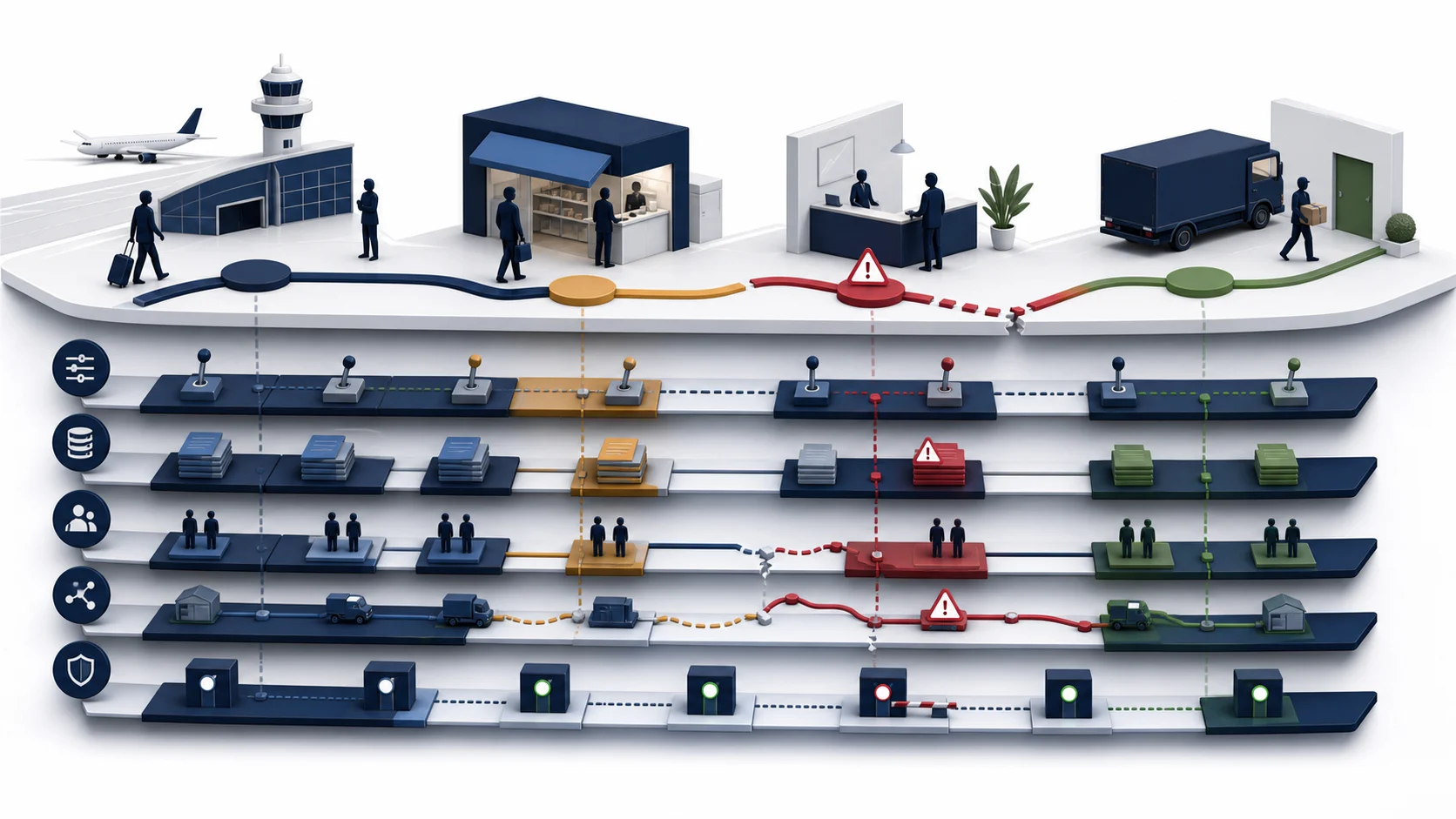
The visible experience is the arena. The operating system underneath determines what happens next.
The Hidden Layers
Most organizations still diagnose customer problems from the top layer. They review satisfaction, complaints, conversion, call volume, abandonment, or sentiment. Those signals matter, but they often arrive after the conditions have already changed. The customer relationship may have weakened. The employee capability may have become constrained. Value may have transferred to a competitor or become hidden inside a workaround.
The deeper causes usually sit below the journey. Policy may prevent recovery. Data may be incomplete. Teams may not share the same definition of success. Partners may not receive timely information. Systems may not allow the employee to solve the problem. Leadership may measure legal compliance while the customer evaluates responsibility.
That is why customer experience became an operating system problem. The experience cannot be fixed only where it appears.
What Recognition Should Ask
A stronger diagnosis begins by separating evidence from interpretation. Evidence is the observable indication. It may show a complaint, a delay, a queue, a failed handoff, a refund request, a negative review, a conversion drop, or a repeated exception. Recognition asks which relationship, capability, or Value condition may have changed and which alternative interpretations remain credible.
Did relationship condition weaken because trust fell? Did capability condition become constrained because the organization could not coordinate? Did value condition move because value was delayed, transferred, hidden, diminished, or lost? Which actor experienced the change: customer, employee, partner, regulator, investor, community, or brand?
This is a different discipline from journey optimization. It is experience intelligence.
The Revenue Unknown
The Revenue Unknown appears when the organization cannot yet quantify the commercial implication of condition change. How many customers will return after the disruption? Which recovery interventions protect future preference? Which employees are losing confidence in the system? Which partners absorbed cost that should be shared? Which hidden demand is appearing because the current journey no longer fits how people behave?
These questions are not abstract. They decide where leaders should invest, which decisions need deadlines, and which outcomes should be validated.
Decision Windows
Even when the organization is already reacting, there is usually still a proactive window. A service failure can still become a recovery decision. A queue can still become a capacity signal. A partner complaint can still become an ecosystem redesign. A public frustration can still become a learning loop before the next cycle repeats.
Reactive evidence should still produce proactive decision windows. The organization should ask what can still be protected, recovered, tested, or learned before the next consequence arrives.
The Experience Intelligence Shift
The shift is subtle but important. Customer experience asks what the customer went through. Experience Intelligence asks what the experience revealed about the system. That includes customers, employees, partners, suppliers, regulators, communities, and the brand. The same evidence may create different condition change for each actor. A flexible policy may stabilize customers while constraining operations. A strict policy may protect margin while weakening trust. A faster digital path may improve convenience while excluding people who need assisted service.
That is why experience work now needs stronger reasoning. The organization must hold multiple interpretations at once, decide what matters, and validate the outcome. A single score cannot do that. A single journey map cannot do that.
The operating system view gives leaders a practical way forward. Find the evidence. Interpret the condition change. Name the Revenue Unknown. Decide who owns the next move. Activate the smallest useful intervention. Measure whether the outcome changed the next cycle.
Related Original Archive Reading
These earlier Transformidy articles provide source context for this flagship and show how the thinking developed across real examples:
- 4 Big Differences Between Customer Experience and Customer Service That Every Brand Should Know
- Business Success: The Customer and Employee Experience Way
- Airports: Design Human Experiences Powerfully in 2026
- Travel Disruptions - How The Right Customer Experience Can Build Loyalty
What Leaders Should Do
Leaders should stop asking customer experience teams to compensate for operating fragmentation they do not control. The work belongs across functions. Experience Intelligence gives those functions a shared way to reason from evidence to condition change, Revenue Unknowns, decisions, activation, outcomes, and learning.
The journey still matters. But the organization must learn to manage the operating system that creates the journey.
FAQ
What is Experience Intelligence?
Experience Intelligence is the discipline of recognizing changing experience, relationship, capability, and value conditions early enough to make better decisions.
How is this different from customer experience management?
Customer experience management often focuses on journeys and touchpoints. Experience Intelligence asks what condition changed, which actors are affected, what remains undecided, and which decisions can still protect or create value.
Why does Transformidy focus on Revenue Unknowns?
Revenue Unknowns name commercially meaningful questions that appear when changing experience conditions expose hidden value, risk, demand, relationship movement, or capability gaps.
Does this replace the public Transformidy framework?
No. The public framework remains Evidence, Recognition, Revenue Unknowns, Decisions, Activation, Outcomes, and Learning. The internal reasoning model makes Recognition more precise.
Why are journey maps not enough?
Journey maps show what the customer experiences, but they often do not show the operating conditions that create or constrain the experience.
Related intelligence
Article
Transformidy: Transforming Into An Experience Intelligence Company
Experience is the visible outcome of organizational systems. Transformidy is becoming an Experience Intelligence Company built around coherence, Revenue Unknowns, BEUP, and Experience Infrastructure.
Article
Google Universal Commerce Protocol: What Experience Infrastructure Looks Like in Commerce
Google's Universal Commerce Protocol points to a larger shift: commerce advantage increasingly depends on the infrastructure connecting discovery, data, fulfillment, partners, and recovery.
Article
SharePoint's Real 2025-2026 Story Was Nation-State Attacks, Not CX Strategy
Nation-state hackers exploited on-premises SharePoint servers in 2025, confirmed by Shadowserver at over 300 victims worldwide. In 2026, a new vulnerability rated 9.8 out of 10 severity emerged in the same product line. SharePoint did not quietly rewire anyone's CX strategy. It became a sustained target.