
Article
Two Verified Studies Disagree by 20 Points on What Biometrics Actually Save
SITA found biometric adoption produces a 60% reduction in airport wait times. IATA's own pilot only reached 40%. The gap between the two verified numbers is worth more attention than either figure alone, because it tells you where the extra 20% is actually coming from.
- Published
- January 28, 2026
- Updated
- June 18, 2026
- Reading time
- 7 min
2026 updated analysis
What changed since the original article
This page keeps the original Transformidy article as the canonical record and leads with the current interpretation, source notes, and Revenue Unknown framing.
60% Projected, 40% Measured
IATA's One ID pilot program, referenced within the same reporting, found a 40% reduction in passenger processing times, a figure worth distinguishing carefully from SITA's 60% wait-time projection. IATA's number comes from a directly measured pilot deployment at defined locations, an observed result rather than an industry-wide forecast aggregated across survey responses and vendor projections.
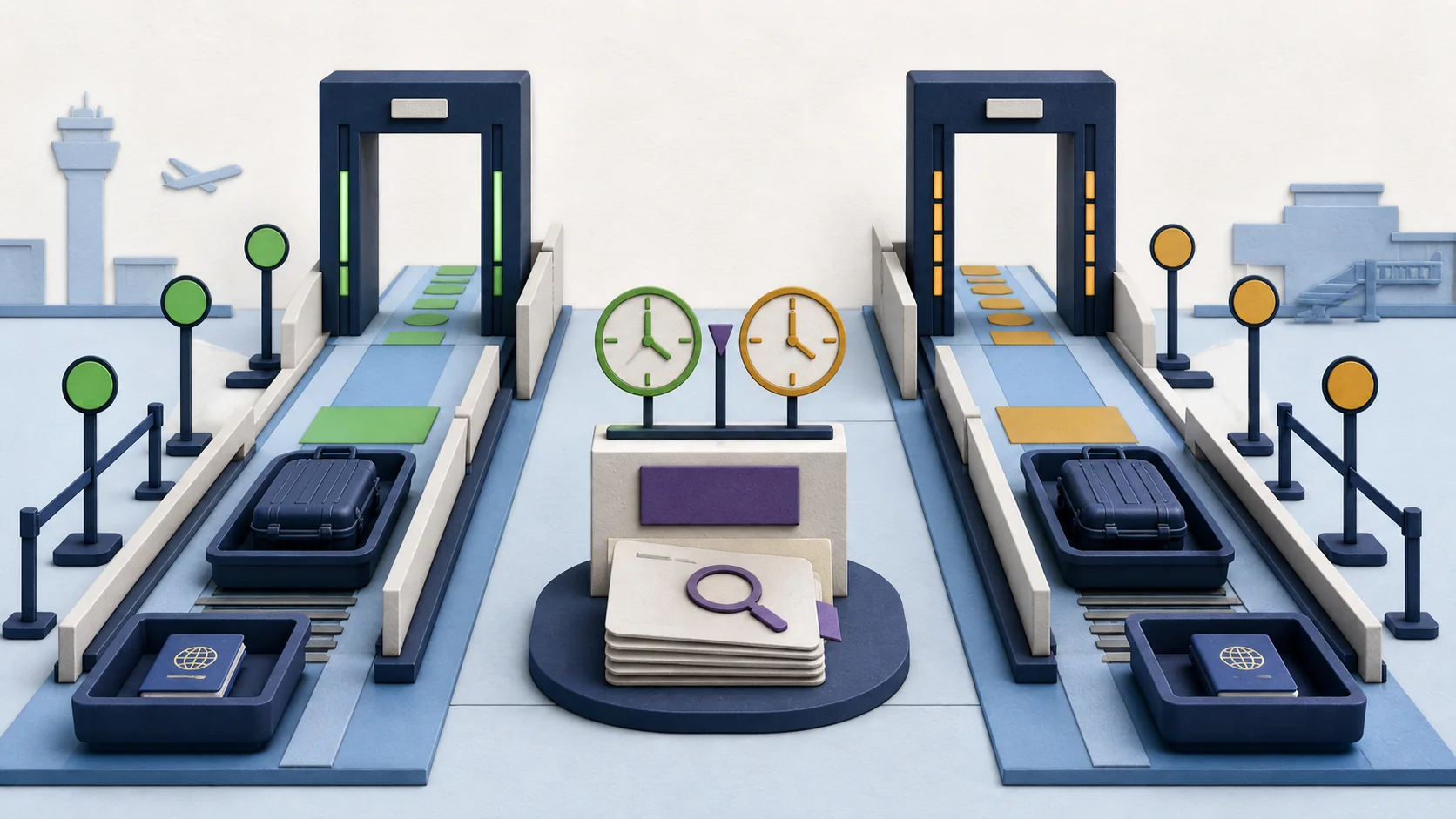
Both figures are legitimately sourced and neither should be dismissed. But they are answering different questions: SITA's 60% describes what the industry broadly expects biometric adoption to eventually deliver, based on projections and stated intentions across many airports and airlines. IATA's 40% describes what one specific, controlled pilot actually measured. Treating the two as interchangeable, using the more impressive 60% figure while implicitly relying on the credibility of IATA's measured pilot, would misrepresent what is actually known.
Projected industry-wide wait-time reduction against a directly measured pilot result
SITA projects 30% faster processing overall; more than half of global airports are expected to offer biometrics by 2026.
Why the Gap Itself Is the Useful Number
Industry statistics circulating around a fast-moving technology adoption story tend to converge on whichever figure is most impressive, regardless of its underlying evidentiary strength. SITA's 60% wait-time reduction figure is more likely to appear in headlines and vendor marketing than IATA's more modest, but more directly evidenced, 40% processing-time reduction, simply because the larger number makes a better pitch.
That dynamic creates a specific risk for any airport operator or business planning around biometric adoption: relying on the more impressive, less directly evidenced figure to set internal expectations, passenger communications, or investment justifications. If actual results land closer to IATA's measured 40%, a business case built on the higher figure has effectively overpromised, a credibility cost that a more conservative planning baseline would have avoided.
The broader discipline this case illustrates applies well beyond airports: when two credible sources report different figures for the same general claim, the productive response is not to pick the more favorable number, but to identify what kind of evidence each figure represents, industry-wide projection versus directly measured result, and to plan around the more conservative, evidence-grounded figure while treating the optimistic one as a ceiling, not a baseline.
Citing the Projection vs. Citing the Measured Result
One makes a better headline. The other makes a more defensible business case.
Citing the projection: using SITA's 60% industry-wide figure in planning and marketing, a genuinely credible number but one describing aggregate expectation, not a specific deployment's proven outcome. Citing the measured result: using IATA's directly measured 40% pilot figure as the planning baseline, a more conservative but better-evidenced number to build commitments and budgets against.
The Leadership Move
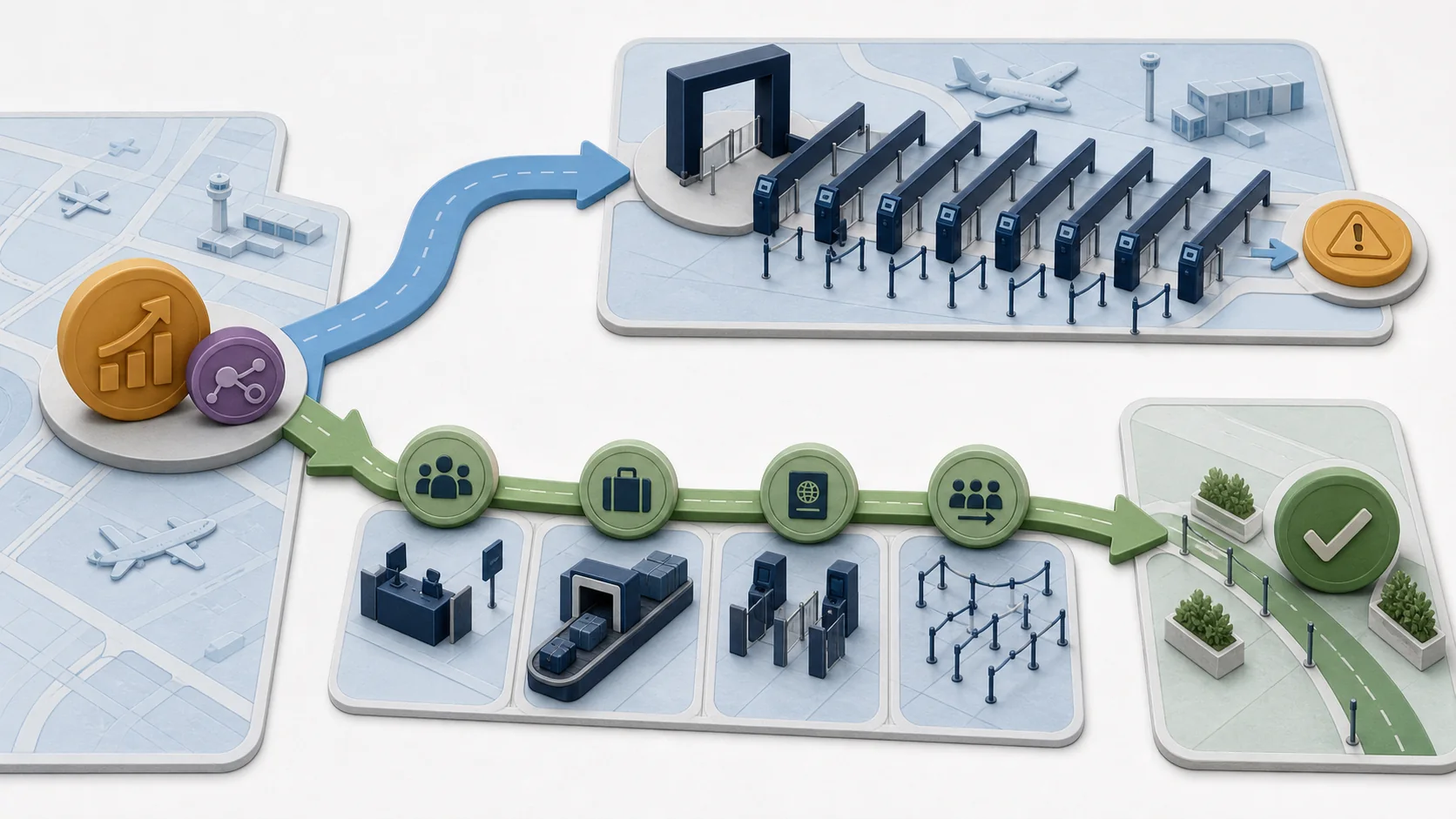
The structural choice for airport and airline leadership evaluating biometric investment is whether to build business cases and passenger communications around the more impressive industry-wide projection, or around the more conservative, directly measured pilot result.
- Ownership
Airport technology and passenger experience leadership own the responsibility to distinguish between industry-wide projections and directly measured results when building internal business cases or external passenger-facing commitments around biometric adoption timelines and benefits.
- Tradeoff
Planning around the more conservative, measured 40% figure produces a less impressive headline number for internal or public communications than SITA's 60% projection. The tradeoff against using the higher figure is the credibility risk of overpromising a passenger-facing benefit that a directly measured pilot has not yet confirmed at that scale.
- Human consequence
Passengers experiencing a biometric-enabled airport process will judge the improvement against whatever expectation was set, whether the more optimistic 60% figure or the more conservative 40% one, meaning the choice of which statistic to communicate directly shapes whether the actual experience feels like it met or missed expectations.
Next Move
If you are building a business case for biometric airport technology investment: Use IATA's measured 40% processing-time reduction as your conservative planning baseline, and treat SITA's 60% wait-time projection as an optimistic ceiling rather than an expected outcome.
If you encounter conflicting statistics from credible sources on any technology adoption topic: Identify whether each figure represents a projection or a measured result before citing either, and default to the measured figure for planning purposes.
FAQ
How much do biometric systems reduce airport wait times, according to industry data?
SITA's 2024 Air Transport IT Insights report projects a 30% improvement in passenger processing times and a 60% reduction in wait times from biometric adoption. IATA's own One ID pilot program, a directly measured field result rather than an industry-wide projection, found a 40% reduction in passenger processing times.
How widespread is biometric adoption expected to be by 2026?
SITA's report projects more than 50% of global airports will offer biometric check-in and bag drop by 2026. Among airlines specifically, 7 in 10 planned to adopt biometric identity management systems, with 32% already having implemented biometric-enabled digital identity technology and 66% planning to deploy touchless technologies.
Why is there a gap between the SITA projection and the IATA pilot result?
The two figures measure different things. SITA's 60% reduction figure is an industry-wide projected benefit drawn from survey and forecasting data across many airports and vendors. IATA's 40% figure is a specific, directly measured result from its own One ID pilot program at defined locations. Projections aggregated across an optimistic industry-wide sample can run higher than a single, rigorously measured pilot's actual observed outcome.
What should an airport operator take from the gap between these two figures?
Treat the IATA pilot's measured 40% reduction as the more conservative, evidence-grounded planning baseline, and treat SITA's 60% projection as an optimistic industry-wide ceiling rather than a guaranteed outcome for any specific implementation. Budgeting and passenger-experience commitments built on the higher, projected figure risk overpromising relative to what a directly measured deployment has actually demonstrated.
Sources & References
Original article archive
Original article published January 28, 2026: "Elevate Airports: Design Human Experiences Powerfully in 2026". Preserved here for provenance, historical context, and citation continuity.
Airports stand at a pivotal moment where passenger expectations demand more than efficient processing; they crave meaningful human experiences. The ACI webinar "From Passenger Expectations to Airport Priorities" captures this shift through expert insights on innovation for 2026.
Key Takeaways
- Airports must shift from processing passengers to serving people through empathetic, human experience-focused design that reduces stress and fosters emotional connections.
- Seamless end-to-end journeys start pre-arrival, using digital tools like biometrics and apps to enable ready-to-fly concepts across stakeholders.
- Personalization goes beyond frequent vs. infrequent flyers, leveraging ACI's five personas for tailored experiences matching behaviors and needs.
- Collaboration breaks silos, with unified platforms like Plaza Premium's OneTiko consolidating services from parking to retail in one ecosystem.
- Sustainability integrates visibly, as in Lima's terminal with solar panels and local art, boosting both environmental and social impact.
- Emotional peaks at arrivals, gates, and sense-of-place moments drive loyalty more than uniform improvements, per behavioral science.
- ACI ASQ data links a 1-point satisfaction gain to 1.55% non-aeronautical revenue growth, making CX a direct financial lever.
- Automation frees staff for empathy, balancing tech like Singapore's queue-less borders with human support for exceptions.
- 2026 forecasts show 10.2 billion passengers globally, amplifying needs for frictionless flows and capacity via AI and data sharing.
- Multidisciplinary integration from master planning ensures CX success, blending engineering, architecture, and empathy early
Overview
Dimitri Coll, Senior Vice President & Chief Products and Services Officer, ACI World, moderated a dynamic discussion featuring industry leaders. Panelists included Nicolas Phan, Head, Market Development, Travel & Transport Business Line, IDEMIA, Dr. Marije Teerling, Customer Experience Lead, NACO, and Jonathan Song, Chief Commercial Officer (CCO), Plaza Premium Group.
They dissected trends from the ACI Airport Service Quality (ASQ) survey, emphasizing human-centered design in massive environments, seamless journeys, sustainability, digital tools, and immersive experiences. The conversation moved beyond theory to concrete examples, highlighting how airports evolve from transit hubs into destinations that prioritize emotional connections.
This session built on prior ACI reports, revealing passengers' growing desire for control, predictability, and personalization. ACI's ASQ benchmark, used by 425 airports worldwide, shows cleanliness and wayfinding as must-haves, but true drivers lie in ambiance, security stress reduction, and sense of place. Panelists agreed that 2026 marks a year for end-to-end processes that blend empathy with efficiency, serving diverse travelers from families to frequent flyers.
Human Experience Design
Human experience design is the practice of intentionally shaping every aspect of an airport so it works first and foremost for people as humans, not just as “passengers” to be processed. It combines psychology, service design, architecture, technology, and operations to reduce stress, support wellbeing, and create meaningful emotional moments across the journey.
In an airport context, Human experience design means seeing the end‑to‑end journey through travellers’ eyes rather than from the perspective of airport processes. It focuses on making spaces intuitive to navigate, accessible to all, and emotionally reassuring, especially at high‑stress touchpoints like check‑in and security. It uses tools such as clear wayfinding, human‑centred layouts, self-service and biometrics, and experiential media to simplify decisions and remove friction while keeping the human touch visible.
Crucially, Human experience design also connects function with identity: it embeds local culture, sensory cues, and a strong sense of place so the terminal feels like a meaningful gateway to a city, not a generic processing hall. When done well, it balances safety, efficiency, and revenue needs with empathy and inclusion, turning airports into human hubs that are efficient, equitable, and emotionally engaging at the same time.
Human Experience Design Airport Example (Cincinnati/Northern Kentucky International Airport (CVG))
Cincinnati/Northern Kentucky International Airport (CVG) is a strong example that often flies under the radar compared with Singapore, Dubai, or Paris.
CVG has leaned into human experience design in three important ways. First, it treats accessibility as a core design principle, not an accommodation at the margins. The airport has deployed autonomous mobility vehicles, AI-powered American Sign Language digital signage, and wayfinding tools like GoodMaps to support independent, dignified navigation for travelers with visible and invisible disabilities. This positions the airport as a living lab for inclusive, scalable solutions that can transfer into cities, healthcare, and logistics environments.
Second, CVG is actively building what its leadership calls an integrated “spatial intelligence and autonomy framework.” Rather than a static digital twin, they are aligning LiDAR, infrared, cameras, and sensors into a real-time operational map of the entire campus. That enables predictive planning, smoother passenger flows, and faster responses to disruption, all of which passengers feel as reduced stress and clearer, more reliable journeys.
Third, CVG’s roadmap highlights hyper-personalized AI concierges and walk-through biometrics as near-term priorities. The vision is that passengers receive context-aware guidance, personalized offers, and stress-reducing route suggestions directly on their devices, while physical processing points become more “invisible” in the background. Taken together, those moves show an airport using technology to enhance autonomy, empathy, and emotional comfort, rather than just to drive throughput.
Core Trends Discussed
Human experience design emerged as the cornerstone of the discussion, focusing on empathy to reduce stress for passengers and staff alike. Dr. Teerling stressed designing for emotion, noting behavioral science principles where people recall peaks, lows, and transitions like arrivals or gates. Examples included NACO's work at Jorge Chávez International Airport in Lima, Peru, now handling 40 million passengers annually after a new terminal opened, integrating solar panels, shorter walks, and local art from Peru's coast, rainforest, and mountains regions.
Sustainability intertwined with human experience design, extending to social impacts like community trust. Plaza Premium Group's Song highlighted segmented hospitality, from Aerotel hotels for long transits to quiet workspaces and premium lounges like Plaza Premium First, adapting to local markets across 600 airports. IDEMIA's Phan advocated balancing automation with human experience through touch, as seen in Singapore Changi Airport's queue-less border control for all travelers, including families and those with reduced mobility.
Digital and immersive elements served as enablers. ACI data reveals a 1.5% satisfaction increase correlates to 1.55% non-aeronautical revenue growth, underscoring investments in full-journey management. Panelists pushed for frictionless flows, like free-flow biometrics, to free staff for value-added empathy.
Airports that will win in 2026 are not the ones that process passengers the fastest, but the ones that design journeys where technology disappears, stress dissolves, and every stakeholder collaborates to serve a single outcome: a more human experience. (Transformidy)
Passenger Expectations
Travelers expect airports to anticipate needs, offering clarity on wait times and personalized paths. ACI personas—five detailed segments based on behaviors, wants, and burdens, reject binary frequent vs. infrequent flyer views, demanding nuanced support for business, leisure, families, and more. Stress peaks at security and gates, yet biophilic designs like natural light and plants in Singapore Changi Airport reduce anxiety while guiding flows.
Emotional engagement trumps transactions. Passengers remember authentic sense-of-place moments, such as Gelephu International Airport's Gyalupo Terminal with its Himalayan wooden mosaics by Bjarke Ingels Group (BIG), paired with seamless check-in to amplify awe. Loyalty programs like Plaza Premium's Smart Traveller consolidate services across 1,600 outlets, empowering choice from parking to retail.
Predictability builds trust, with digital companions piloted at Lyon-Saint Exupéry Airport notifying users of traffic en route, pre-booking parking, and guiding home-to-boarding. Surveys show cultural backgrounds shape expectations with Middle Eastern opulence differs from Scandinavian minimalism affecting service and infrastructure.
Airport Priorities
Airports prioritize capacity growth amid resource limits, using automation for efficiency without losing humanity. ACI promotes human experience-first design from greenfield planning, like star-shaped terminals in Beijing Daxing Airport for intuitive navigation. Non-aeronautical revenue drives focus on dwell time, with security as a stress manager rather than a delight point.
Regional nuances vary: Europe optimizes under GDPR and emission pressures, as at Geneva Airport with reconfigured check-in and intermodal hubs; Asia builds national icons like Bangkok's Suvarnabhumi Airport satellite (215,000 sqm, 15 million extra passengers); Middle East extends journeys beyond airports, integrating UAE biometrics for face-only processing. Sustainability visibility matters through communicating waste management and carbon accreditation visibly.
Baggage remains an overlooked item that creates friction. IDEMIA's biometric tags are live at France's Paris Aéroport (including Paris–Charles de Gaulle, Paris–Orly and Paris–Le Bourget), enable tagless reunions and slashing lost-luggage stress.
Opportunities and Challenges
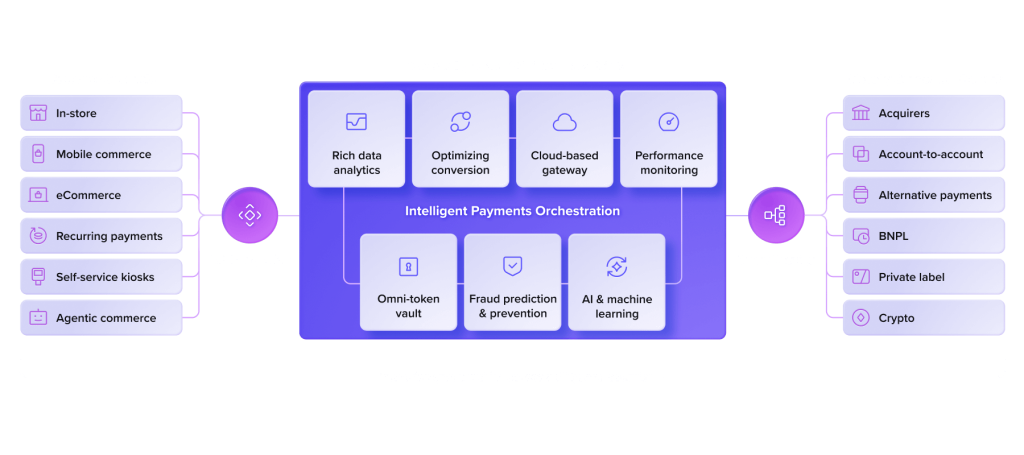
Opportunities abound in unified platforms breaking silos. Plaza Premium's oneTECO (One Travel Experience Ecosystem) white-label e-commerce links lounges, fast-track, retail, and parking in one cart, extensible across airports like Sydney-Singapore-London. ACI Payments Orchestration Platform envisions booking airport services with flights, expanding the pie via shared ecosystems.
Challenges include stakeholder silos between airports, airlines, governments and want to be sole custodian of data and regulatory hurdles like different global biometric and digital passport requirements. Additionally, cultural and demographic diversity complicates one-size-fits-all.
For example, families need different automation features than solo travellers. The same can be said on leisure and business travellers and those who require great accessibility access. Invisible sustainability efforts demand proactive communication to meet willingness-to-pay trends.
Stakeholder Collaboration
Involving IT/AI means deploying biometrics and data-sharing for frictionless flows, as in Zayed International Airport in Abu Dhabi, UAE's national database. Operations gain from predictive tools optimizing flows, like NACO's Changi climate resilience via data points for better operations.
Employee experience tie-ins are more important than ever. Human experience-based services could include automation features to freed up staff for empathy, boosting morale in human-centered spaces. Regulations require trust-building and minimizing sensitive data shares. Airlines collaborate on ready-to-fly concepts and hospitality groups can integrate trinities of retail-brands-lounges, as Song's whiskey bar-to-duty-free vision.
Multidisciplinary teams collaboration from master planning to IT to operations ensure CX integration from scratch. This allows for stakeholders to think about travellers every step of their journey and allows for better overall travel experience.
Transform for Better
Airports poised for 2026 success will champion human experience design as their north star, harmonizing passenger emotions with operational excellence. This ACI webinar illuminates a clear path: prioritize empathetic personalization, forge stakeholder alliances, and leverage data for frictionless journeys that turn transit into transformation.
Seize this moment to redefine your airport as a destination that inspires loyalty and revenue growth. Partner with Transformidy for tailored audits, cross-stakeholder ecosystem strategies, and AI-powered CX roadmaps suited to Canadian and global demands. Schedule your complimentary strategy session today at transformidy.com/contact and elevate human experiences that drive results.
HOW CAN TRANSFORMIDY HELP?
Airports ready to pioneer human experience design in 2026 must act now on collaboration and personalization.Transformidy can audit your travel journeys, craft stakeholder ecosystems, and deploy AI-driven personalization strategies tailored for global travels needs, improve stakeholder satisfaction/engagement and maximize revenue generation.
Contact us or set up a 30-minute complimentary consultation for more information on our services, insights, or showcases. We look forward to hearing from you.
FAQ
How much do biometric systems reduce airport wait times, according to industry data?
SITA's 2024 Air Transport IT Insights report projects a 30% improvement in passenger processing times and a 60% reduction in wait times from biometric adoption. IATA's own One ID pilot program, a directly measured field result rather than an industry-wide projection, found a 40% reduction in passenger processing times.
How widespread is biometric adoption expected to be by 2026?
SITA's report projects more than 50% of global airports will offer biometric check-in and bag drop by 2026. Among airlines specifically, 7 in 10 planned to adopt biometric identity management systems, with 32% already having implemented biometric-enabled digital identity technology and 66% planning to deploy touchless technologies.
Why is there a gap between the SITA projection and the IATA pilot result?
The two figures measure different things. SITA's 60% reduction figure is an industry-wide projected benefit drawn from survey and forecasting data across many airports and vendors. IATA's 40% figure is a specific, directly measured result from its own One ID pilot program at defined locations. Projections aggregated across an optimistic industry-wide sample can run higher than a single, rigorously measured pilot's actual observed outcome.
What should an airport operator take from the gap between these two figures?
Treat the IATA pilot's measured 40% reduction as the more conservative, evidence-grounded planning baseline, and treat SITA's 60% projection as an optimistic industry-wide ceiling rather than a guaranteed outcome for any specific implementation. Budgeting and passenger-experience commitments built on the higher, projected figure risk overpromising relative to what a directly measured deployment has actually demonstrated.
Related intelligence
Article
A Third of Walmart's Operating Income Now Comes From Ads and Memberships
Advertising and membership fees now account for a third of Walmart's operating income. Walmart Connect grew 41% in a quarter when retail sales grew about 5%, eight times faster. Retail media margins exceed 70%. Walmart is no longer just a retailer that also sells ads.
Article
13 Automakers Signed On to CarPlay Ultra. One Shipped It.
Standard CarPlay is in effectively every new car sold in America. CarPlay Ultra, announced with 13 automaker partners, is shipping in exactly one brand a year later. Mercedes, Audi, Volvo, and Renault walked back their commitments. Ford's CEO explained why in one sentence.
Article
Department Store Strategy: Identity vs. Omnichannel
Department stores pursued omnichannel integration to compete with specialists and e-commerce. But integration without identity eroded customer loyalty. Successful stores rebuilt around curation and experience, not channel consolidation.