
Article
Google Universal Commerce Protocol: What Experience Infrastructure Looks Like in Commerce
Google's Universal Commerce Protocol points to a larger shift: commerce advantage increasingly depends on the infrastructure connecting discovery, data, fulfillment, partners, and recovery.
- Published
- June 9, 2026
- Updated
- June 9, 2026
- Reading time
- 8 min
Key takeaways
- Universal commerce succeeds when the operating architecture is coherent, not when individual channels are merely connected.
- The BEUP lens helps leaders test whether brand promise, employee capability, user reality, and partner execution can support the same commerce promise.
- Revenue Unknowns appear when customers move faster than the organization's handoffs, data, policies, or fulfillment logic.
- UCP-style architectures should be governed as Experience Infrastructure, not treated as another front-end commerce feature.
What UCP signals
Google's Universal Commerce Protocol matters less as a single product announcement and more as a signal about where commerce is moving. Commerce is no longer only a storefront, checkout, inventory system, marketplace integration, or loyalty program surface. It is becoming an infrastructure problem.
When customers discover, compare, buy, fulfill, return, and recover across different surfaces, the brand experience is only as coherent as the systems beneath it. UCP points toward a future where the connective layer becomes strategic.
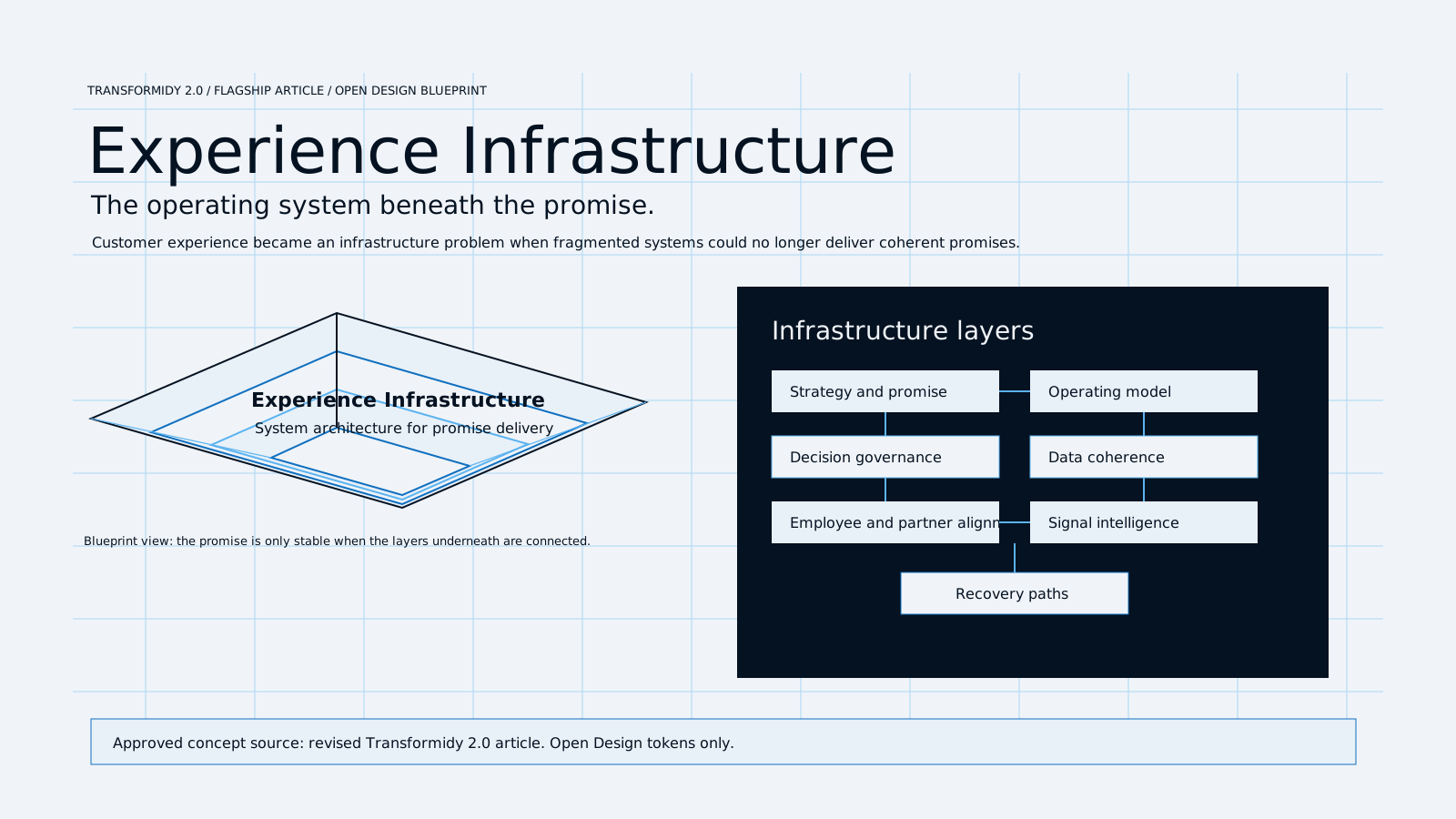
That is why Transformidy reads UCP through Experience Infrastructure. The visible customer journey is not the whole system. The experience depends on data continuity, decision rights, partner coordination, recovery pathways, and governance.
Why it matters
Most commerce transformation still starts at the visible layer. Teams improve the website, add marketplace integrations, launch personalization, test AI shopping tools, or redesign checkout. Those changes can help, but they do not fix the operating reality if the underlying system remains fragmented.
The strategic value of UCP-style thinking is that it makes the handoffs visible. It asks whether the commerce system can carry context across discovery, order logic, fulfillment, support, and partner execution without forcing the customer to absorb the gap.
The question for executives is direct: can the organization deliver one promise across many surfaces, or is it asking the customer to stitch the system together?
BEUP analysis
BEUP gives leaders a practical test for whether universal commerce is ready to become a real experience system.
The framework is not a decorative lens. It asks whether the promise, employee enablement, user reality, and partner system all support the same outcome.
Where Revenue Unknowns appear
Revenue Unknowns appear when the commerce promise moves faster than the organization's infrastructure. Customers may discover the right offer but encounter inventory uncertainty. They may receive personalization that does not match fulfillment capability. They may buy through one surface and recover through another system with no shared context.
These are not only experience problems. They create unanswered commercial questions: which demand is hidden, which value is delayed, which partner capability is missing, which recovery investment would protect future preference, and which decision window is still open.
What leaders should do next
Leaders should treat UCP-style commerce as an Experience Infrastructure question before treating it as a technology adoption question.
Start with the operating map: what promise is being made, what systems carry that promise, what employees can resolve, what partners must deliver, what data must remain coherent, and where recovery breaks when the happy path fails.
The strongest commerce systems will not be the ones with the most visible automation. They will be the ones where the customer can move across surfaces without feeling the organization change shape underneath them.
FAQ
What is Google Universal Commerce Protocol?
Google Universal Commerce Protocol is treated here as a commerce architecture signal: a move toward more coordinated commerce experiences across discovery, data, transactions, partners, and fulfillment.
Why does UCP matter for customer experience?
It matters because customer experience increasingly depends on whether commerce infrastructure can preserve context and trust across surfaces, not only whether each individual touchpoint looks good.
How does BEUP apply to universal commerce?
BEUP tests whether the brand promise, employee capability, user reality, and partner system all support the same commerce outcome.
Related intelligence
Article
Transformidy: Transforming Into An Experience Intelligence Company
Experience is the visible outcome of organizational systems. Transformidy is becoming an Experience Intelligence Company built around coherence, Revenue Unknowns, BEUP, and Experience Infrastructure.
Article
Why Customer Experience Became an Operating System Problem
Customer experience failure is no longer a touchpoint problem. It is a system problem that reveals how the organization is designed.
Article
Southwest Just Made the Airport Lounge a Revenue Unknown
Southwest Airlines will open its first airport lounges with Chase in late 2027. The move creates a Revenue Unknown: can a low-cost carrier add premium airport continuity without weakening the brand simplicity that made it distinctive?