
Article
When Availability Signals Are Not Aligned: The Hidden Inventory-Demand Mismatch
In stock somewhere in the network is not the same as available to this customer, in this format, in time. That gap does not show up in the out-of-stock rate.
- Published
- July 23, 2026
- Updated
- August 19, 2026
- Reading time
- 9 min

The Global Signal
IHL Group, an independent retail and hospitality technology research firm, published a widely cited analysis estimating that empty shelves alone cost retailers approximately $238 billion annually worldwide, one component of a larger $634 billion total loss the firm attributes to out-of-stock situations across the industry (Chain Store Age). McKinsey has separately argued that retailers increasingly need real-time, cross-channel inventory visibility precisely because daily-updated stock counts create a specific, avoidable failure: a retailer effectively sells the same unit of inventory twice across different channels, once to an online customer and once to an in-store customer, because neither channel had a live view of what the other had already claimed (McKinsey, omnichannel supply chain).
Both sources point at the same underlying gap from different angles: a retailer's own inventory system can report a number that is technically accurate and still fail to describe whether a specific customer, in a specific channel, can actually get the product.
Estimated annual retailer losses tied specifically to empty shelves
One component of IHL's larger $634B figure; the channel-visibility argument is qualitative.
What changes when fulfillment accuracy is measured separately from stock rate
Out-of-stock rate answers whether a product exists somewhere, not whether this customer could get it.
Adding a channel-level fulfillment accuracy measure alongside aggregate stock count surfaces the gap between system inventory and customer availability.
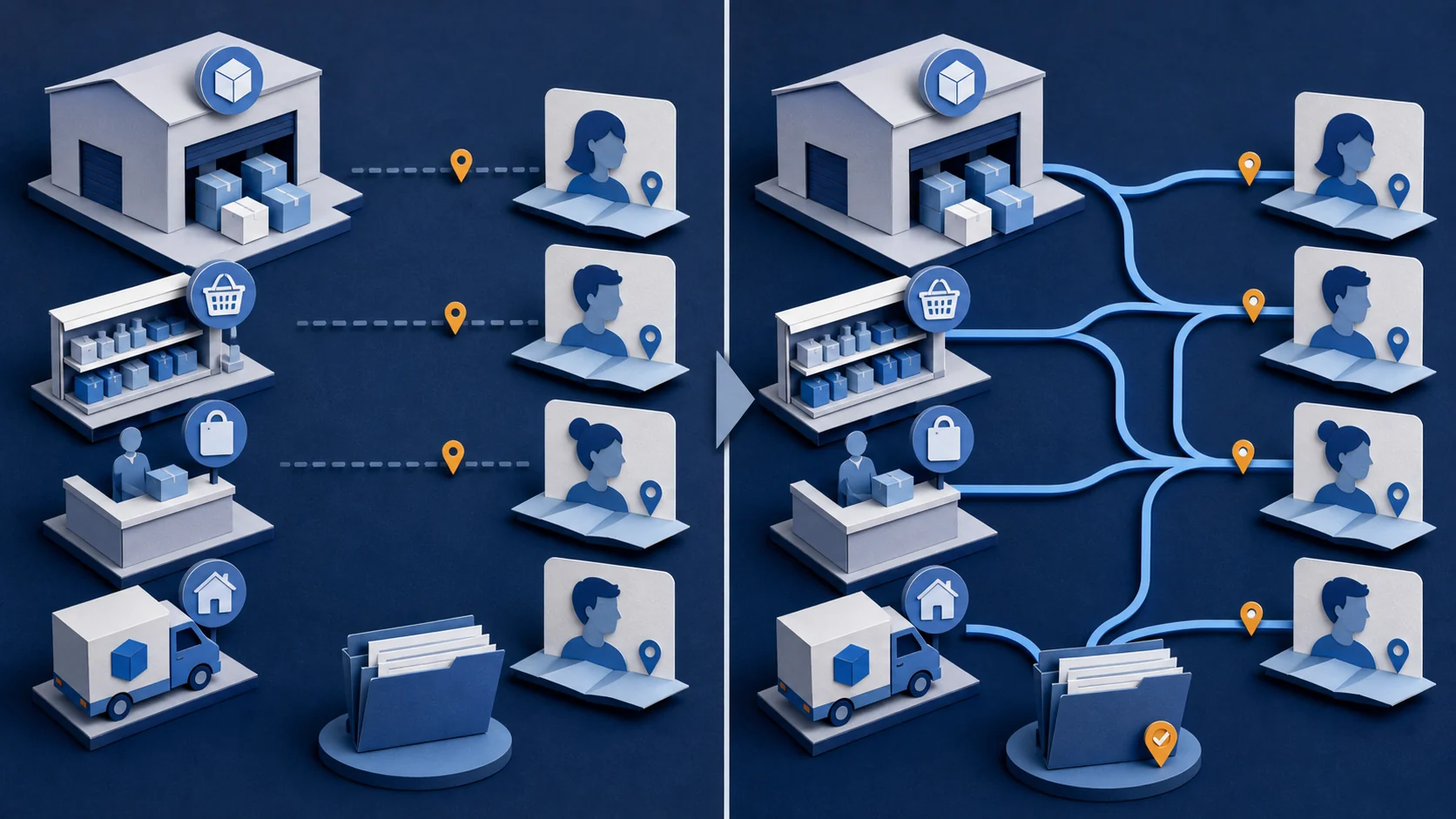
Why the Visible Metric Misleads
Out-of-stock rate answers a narrow question: does the product exist somewhere in the network. It says nothing about whether a specific customer, in a specific channel and location, could actually access it in time. McKinsey's argument about channel-level inventory visibility describes exactly why this gap persists: without a live, shared view of stock across channels, a retailer's own systems can report full availability while simultaneously creating the kind of double-selling and fulfillment failure that customers experience as absence, not abundance.
The more useful measure sits beside the raw stock count: how often a customer's specific channel and format request could actually be fulfilled, not just whether the product existed somewhere in the broader network.
A retailer's inventory system says a product is in stock. A customer in one region cannot get it in time.
The Leadership Move
The right move is not to chase a zero percent out-of-stock rate, which is neither achievable nor economically sensible. It is to add a second measure alongside it: whether inventory is actually positioned to meet demand where and how it occurs, which IHL's and McKinsey's research both suggest is a distinct and currently under-measured problem.
- Ownership
Supply chain and inventory planning own stock positioning. Merchandising owns format and assortment decisions. Customer experience holds visibility into what customers actually encounter when their first choice is unavailable. McKinsey's own argument for real-time cross-channel visibility requires all three functions working from a shared view, which most retailers do not yet have.
- Tradeoff
Improving genuine availability sometimes means holding more inventory across more locations, a real cost that competes with the efficiency gains of centralized stock. The point is not to eliminate that tradeoff but to make it a deliberate decision weighed against the specific revenue IHL's research suggests is currently being lost, rather than an unexamined byproduct of optimizing for the aggregate out-of-stock number alone.
- Human consequence
A customer who could not get a product in the format or timeframe she needed does not experience this as an inventory-management nuance. She experiences it as the retailer simply not having what she needed, and she rarely files a complaint about it; she buys from whoever did have it.
Implication for Operators
IHL's $238 billion empty-shelf figure and McKinsey's omnichannel visibility argument together describe a gap that is large, well documented, and still mostly invisible inside standard retail reporting. The practical shift is treating channel-level fulfillment accuracy as a distinct measure from aggregate stock levels, since McKinsey's own research suggests the two can diverge significantly without either number, on its own, revealing the problem.
A retailer's inventory system says a product is in stock. A customer in one region cannot get it in time; a customer elsewhere does not want the only format available locally. By every measure that retailer tracks, nothing is wrong. IHL's research quantifies how expensive that gap already is industry-wide, and McKinsey's argument explains precisely why it persists: without shared, real-time visibility across channels, a retailer can be technically correct and still functionally unavailable to the customer standing in front of it.
The revenue unknown is not in the stock count. It is in the distance between where inventory sits and where the customer actually is, and both IHL's and McKinsey's research suggest that distance is larger, and more expensive, than most retail reporting reveals.
Transformidy infographic
What is a Revenue Unknown?
The unresolved value question that becomes visible when evidence is recognized early enough to still change the decision.
- 01
Evidence
A visible event, behaviour, gap, cost, or relationship change.
- 02
Recognition
The interpretation that names what may be changing underneath the evidence.
- 03
Revenue Unknown
The unresolved question about value, risk, demand, trust, cost, or capability.
- 04
Decision window
The period where leaders can still protect value or create a better outcome.
How well integrated is your omnichannel experience—can customers move seamlessly between online and in-store?
FAQ
How large is the retail industry's out-of-stock problem according to independent research?
IHL Group's widely cited analysis estimates retailers lose approximately $634 billion annually worldwide to out-of-stock situations, with roughly $238 billion of that tied specifically to genuinely empty shelves.
What is the specific mechanism McKinsey describes for the omnichannel version of this problem?
McKinsey argues that without real-time, cross-channel inventory visibility, retailers can effectively sell the same inventory twice, once online and once in-store, because neither channel has a live view of what the other has already claimed, even though each channel's own stock count is technically accurate at the moment it was last updated.
Is there a single industry-standard statistic for the gap between reported stock and actual customer-level availability?
Not a single, universally cited figure. IHL's research quantifies the empty-shelf portion of the problem specifically; McKinsey's argument for the omnichannel dimension is well documented but framed qualitatively rather than as one precise industry-wide percentage, and that distinction is worth preserving rather than collapsing into a single invented statistic.
How can a retailer measure this gap without a major systems investment?
Compare promised delivery timing against actual delivery by channel and region, and track how often a customer's first-choice format or location was actually fulfillable, not just whether the product existed somewhere in the network.
Who should own closing the gap between reported stock and actual availability?
Supply chain and inventory planning control stock positioning; merchandising controls format and assortment; customer experience holds visibility into what customers actually encounter. McKinsey's own case for shared, real-time visibility requires these functions to work from one view rather than three separate ones.
Related intelligence
Article
Beyond Abandonment: The Validation Moment When Customers Make Final Commitment
Not all cart abandonment is the same behavior. Device friction, first-time-buyer trust gaps, and genuine indecision each need a different recovery tactic.
Article
Work Redesign and Experience Redesign Must Happen Together
A faster-feeling interface attached to an unredesigned back-end process does not create a faster experience. It creates a specific, quiet disappointment.
Article
The Early Closure Signal: When Business Distress Shows Up in Operations Before It Shows Up in Closure
Small businesses show operational distress months before closure. Suppliers see the evidence directly and usually file it under normal variation.