
Article
A 100-Year Airline Is A Revenue System, Not A Museum
Delta, Lufthansa and United show why airline anniversaries should be judged by the next revenue base, not only the founding story.
- Published
- September 14, 2026
- Updated
- September 14, 2026
- Reading time
- 8 min
Article Body
Three of the world's most recognized airline brands are now moving through a rare milestone window.
Delta celebrated its 100th anniversary in 2025. Lufthansa is celebrating 100 years in 2026, tracing the first Luft Hansa to January 6, 1926 and its maiden flight to April 6 of that year. United is also using 2026 to frame its first century, with its history tracing through the Varney Air Lines airmail operation that began flying in April 1926.
The easy article would be about nostalgia.
The more useful article is about survival.
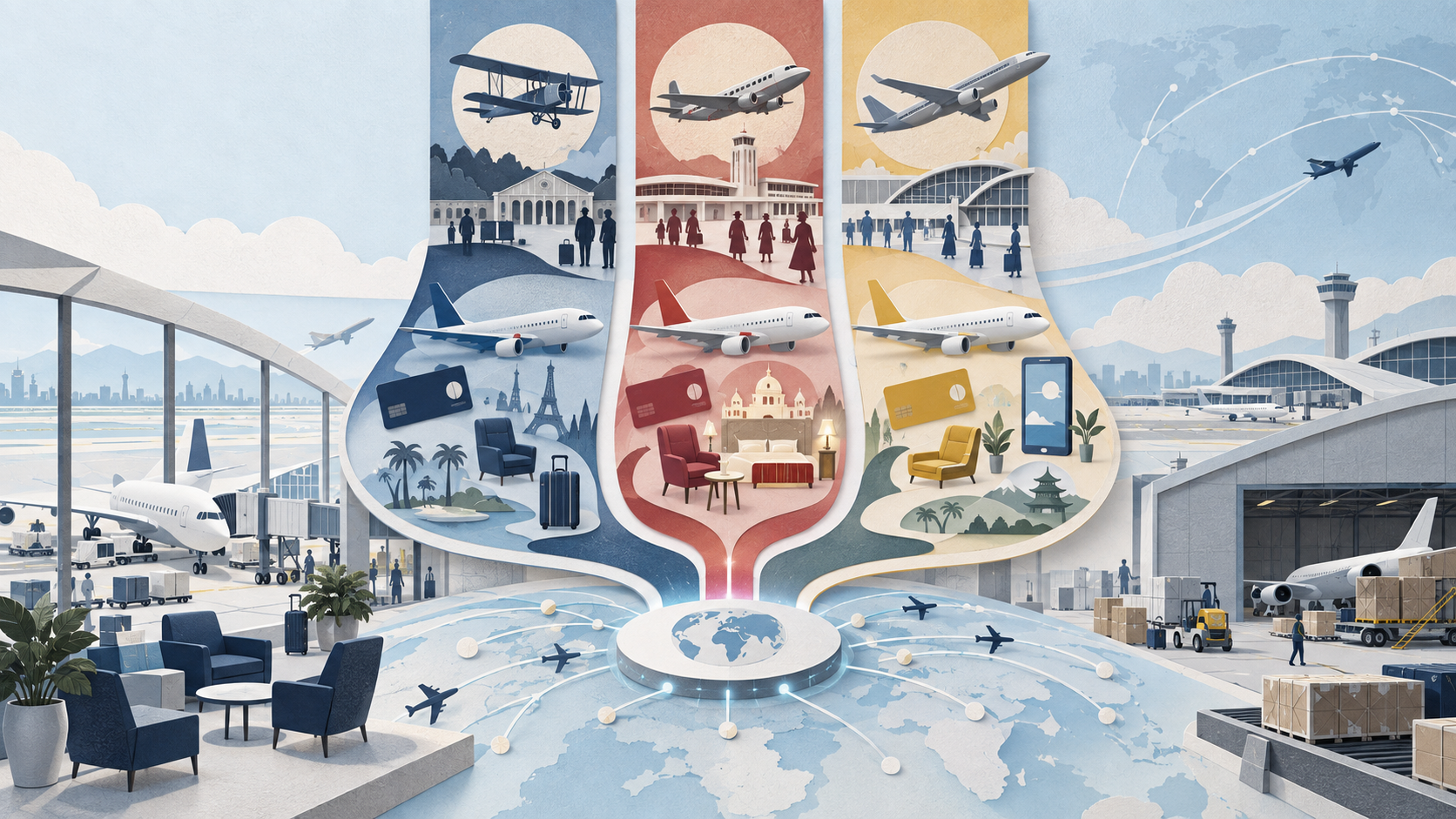
An airline that lasts 100 years has not merely preserved an aircraft livery, a logo, a route map or a founding story. It has repeatedly rebuilt the systems that make people believe flight is worth buying again: safety, network, trust, service, reliability, status, memory, recovery, work, family, cargo, tourism and national connection.
That makes the centennial moment an Experience Intelligence problem.
The Revenue Unknown is:
Which parts of the airline relationship can create durable revenue beyond the seat, and which anniversary, loyalty, partner, app, lounge, media or premium-product extensions become dead-end experiences that customers forget, misunderstand or fail to use?
The centennial matters because airlines are no longer competing only through seats between airports. They are competing through the full relationship around movement: loyalty programs, credit cards, hotel partners, retail stores, vacation packages, corporate travel, inflight connectivity, premium cabins, lounges, apps, service recovery, media, cargo and destination partnerships.
A 100-year airline is therefore not a museum.
It is a living revenue system.
What 100 Years Really Measures
A centennial can measure age. It can also measure adaptation.
Delta's public centennial material emphasizes its origin in Huff Daland Dusters, incorporated on March 2, 1925, and its movement from crop-dusting to passenger service, global airline, people-centered service culture, museum refresh, documentary, centennial livery and merchandise. Lufthansa's centennial campaign uses "We are the Journey" to connect history, employees, customers, the crane brand symbol, anniversary aircraft, iconic destinations, culinary history, product campaigns and an anniversary magazine. United's 2025 Corporate Impact Report says the company is celebrating its first 100 years while pointing to customer experience, new aircraft, onboard technology, an award-winning app and a large global network.
Each airline is doing what century-old brands naturally do: using heritage to make continuity visible.
But the executive question is not whether heritage is emotionally useful. It is whether heritage helps management recognize what the next business model requires.
Airlines have survived because they repeatedly changed what the customer was really buying.
In the earliest era, the promise was speed and reliability around mail and essential movement. Later, it became national connection, jet-age aspiration, business travel productivity, international status, global alliance access, loyalty accumulation, premium service, digital self-service, co-branded financial value and disruption recovery.
The aircraft remained central, but the value moved around it.
That is the pattern Transformidy should name.
Airline value migrates whenever the customer begins judging the journey through a different evidence set.
The evidence set today is no longer only fare, route, schedule and seat. It now includes:
- Whether the app reduces uncertainty before the customer asks for help.
- Whether the airline can keep a traveller connected in the air.
- Whether loyalty can be used beyond flight.
- Whether hotel, rideshare and destination partners actually remove friction.
- Whether premium cabins justify yield when corporate travel budgets tighten.
- Whether recovery works when infrastructure fails.
- Whether the airline makes the trip purpose visible.
- Whether the brand can convert memory into future preference.
That is why Delta, Lufthansa and United are useful together. They are not identical case studies. They represent three different ways an airline can turn a centennial into a test of the next revenue base.
Delta: Service Memory Becoming A Wider Relationship
Delta's centennial package leans heavily into people, service, memory and continuity. Its public centennial page includes customer connection stories, a documentary, a centennial livery, museum activity and centennial merchandise. Delta's News Hub also connects the anniversary to an Assouline coffee-table book, trading cards, a safety video with historical references and retail collaborations such as a Spanx centennial collection.
That is not merely commemoration.
It is a relationship strategy.
Delta's commercial strength has often been connected to reliability, premium positioning, loyalty, co-branded credit economics and perceived service quality. The centennial gives Delta a way to make those strengths feel historical rather than tactical.
The current Hyatt relationship adds another layer. Hyatt and Delta have publicly described a new collaboration for SkyMiles and World of Hyatt members, while Hyatt is ending its enhanced American Airlines relationship. That creates a clear airline-hotel Revenue Unknown: how much value is created when loyalty partnerships become understandable, timely and useful across the actual trip?
The risk is that customers experience partnerships as terms, not as journey support.
If a traveller cannot tell when a benefit applies, how to use it, what changes after a partnership reset, or why the airline-hotel relationship matters beyond points, the partnership can become a dead end. Delta's next 100-year opportunity is to make partner value feel like a managed travel relationship instead of a small print benefit.
Lufthansa: Group Architecture Becoming Customer Relevance
Lufthansa's centennial is structurally different.
The airline has an unusually complex identity problem because Lufthansa is both a flagship airline brand and part of a larger multi-airline group. Its anniversary material explicitly treats the crane, routes, history, onboard food, employees, aircraft and advertising as part of a long brand system. At the same time, Miles & More is being repositioned as Lufthansa Group Miles & More by the end of 2026, with the public stated aim of making the loyalty program more clearly part of the group architecture and more relevant across customer touchpoints.
That matters.
The Revenue Unknown for Lufthansa is not simply whether customers recognize the centennial. It is whether Lufthansa Group can make a multi-brand travel system feel coherent without erasing the distinct identities of its airlines.
The loyalty relaunch language points toward experiences, relevance, personalization, content and "Moments that move you." That is the right territory. But the test will be operational, not poetic.
Can the customer understand how the group works when booking, earning, redeeming, connecting, recovering, using partners, receiving content, or moving across different Lufthansa Group carriers? Can the loyalty program help the traveller see a useful next step across airlines and partners? Can the group use its scale to reduce journey ambiguity instead of adding another layer of brand architecture?
For Lufthansa, the next century depends on making the group more usable.
United: Connectivity, App Control And Partner Utility
United's public 2026 story is heavily forward-looking. The airline's Corporate Impact Report points to its first 100 years while highlighting new aircraft, customer experience, onboard technology, app capability and network scale. United has also been aggressively building a connected journey: Starlink Wi-Fi, seatback screens, app self-service, TSA wait-time visibility, Touchless ID expansion, MileagePlus benefits, Lyft redemption and a long-standing RewardsPlus relationship with Marriott Bonvoy.
United is useful because it shows a different centennial question:
What happens when the airline tries to become the operating system for the trip?
United's Starlink rollout is not only about internet access. United says more than 400 aircraft had Starlink by June 2026, with close to 1,000 expected before year-end, and it frames the product around streaming, work collaboration, multi-device connectivity, shopping and travel planning in flight. United's app release notes and public materials also emphasize structuring travel tools around the full journey before, during and after the airport.
That is the right ambition. The danger is that more functions can still produce fragmentation if they are not governed by a clear journey logic.
A customer does not need another menu. A customer needs earlier Recognition, useful authorization, recovery that preserves options, and partner value that appears at the moment of need.
United's next Revenue Unknown is whether connectivity and app control create new revenue streams or simply raise expectations for constant service.
The Next Revenue Base
The next airline revenue base will not come from one product.
It will likely come from a portfolio of connected relationships:
- Premium cabins that justify yield through privacy, work, sleep, food, reliability and status.
- Loyalty programs that move from points accounting to relationship management.
- Hotels, rideshare and destination partners that remove travel dead ends.
- Inflight connectivity that turns time in the air into usable work, entertainment, shopping and planning time.
- Retail and media that convert airline memory into tangible objects and stories.
- Cargo and logistics that diversify revenue when passenger demand shifts.
- Apps that reduce uncertainty before the passenger reaches a counter.
- Recovery products that protect future preference when operations fail.
The executive mistake is to treat each as a separate initiative.
The customer does not experience them that way.
The customer experiences one journey. The airline monetizes many pieces of it. The gap between those two truths is where Revenue Unknowns appear.
An airline may know how much revenue a seat, bag, credit card or lounge pass produces. It may not know how much value is lost because the customer did not understand a partner benefit, missed a useful offer, abandoned a trip after a disruption, failed to connect loyalty to a hotel stay, or considered inflight connectivity unreliable at the one moment it mattered.
The Milestone Board
Transformidy should treat airline centennials as a live intelligence object.
The first version of the Airline Milestone Intelligence Board should track:
- Airline.
- Founding or predecessor milestone year.
- Current anniversary status.
- Current revenue expansion moves.
- Loyalty ecosystem.
- Hospitality and mobility partners.
- App and digital journey moves.
- Premium cabin and lounge moves.
- Retail, museum, media or heritage products.
- Dead-end risk.
- Revenue Unknown.
- Next 100 Years Readiness score.
This is not a ranking for applause. It is a diagnostic.
The point is to identify whether a milestone is becoming a future revenue system or staying as commemorative content.
What This Means For Leaders
Most executives do not run airlines. The centennial lesson still travels.
Any mature organization can mistake longevity for resilience. A company may have survived for decades while its next customer relationship is quietly being rebuilt by apps, partners, intermediaries, infrastructure and shifting expectations.
The question is not "What made us successful?"
The stronger question is:
Which past advantage is still creating value, which has become memory, and which new relationship layer must be built before customers move elsewhere?
That is why anniversaries should not end with campaigns. They should trigger an Intelligence Readiness Assessment.
Sources
- Delta, "Centennial Overview," https://www.delta.com/us/en/about-delta/centennial/overview
- Delta News Hub, "Delta's Centennial," https://news.delta.com/mediakit/deltas-centennial
- Lufthansa, "100 years of Lufthansa," https://www.lufthansa.com/us/en/100-years
- Lufthansa Group Newsroom, "Lufthansa turns 100!", https://newsroom.lufthansagroup.com/en/lufthansa-turns-100/
- Miles & More, "Miles & More is becoming Lufthansa Group Miles & More," https://www.miles-and-more.com/at/en/program/news/global_m_m_rebranding_press_2607.html
- United Airlines Corporate Impact Report 2025, https://corporateimpact.united.com/
- United, "United Accelerates Starlink Wi-Fi Rollout with First Widebody Transatlantic Flight," https://united.mediaroom.com/2026-06-22-United-Accelerates-Starlink-Wi-Fi-Rollout-with-First-Widebody-Transatlantic-Flight
- United MileagePlus and Marriott Bonvoy RewardsPlus, https://marriottbonvoy.unitedmileageplus.com/
- Hyatt Airline Update, https://newsroom.hyatt.com/AirlineUpdate
Related Reading
FAQ
What is the main idea of A 100-Year Airline Is A Revenue System, Not A Museum?
A 100-Year Airline Is A Revenue System, Not A Museum explains a change leaders should not treat as background noise. It shows what evidence is visible, what may be changing underneath it, and which decision window remains open.
Why does A 100-Year Airline Is A Revenue System, Not A Museum matter for Experience Intelligence?
The article helps readers see how an experience, relationship, capability, or value condition may be changing before the consequence is fully visible.
What Revenue Unknown does this article help identify?
It frames the unresolved commercial or operating question created by the change: what value, risk, hidden demand, relationship movement, or capability gap may exist but has not yet been measured or decided.
How should leaders use this article in the Special Intelligence series?
Use it as a prompt to separate observed evidence from interpretation, name the decision that still has to be made, and identify what would validate whether the interpretation is right.
Related intelligence
Article
A 100-Year Airline Is A Living Journey System
The Experience The Skies companion compares how Delta, Lufthansa and United can make centennial heritage useful to travellers.
Article
Faster Flight Will Still Fail If The Journey Around It Is Slow
Boom Supersonic shows why faster aircraft need airports, airlines, regulators, fuel providers, hotels and corporate travel to work as one experience system.
Article
LEGO Has The IP. The Revenue Unknown Is Whether The Moment Is Connected.
LEGO's Marvel, F1 and LEGO House examples show why licensed products need moment activation, not only availability.