
Article
Faster Flight Will Still Fail If The Journey Around It Is Slow
Boom Supersonic shows why faster aircraft need airports, airlines, regulators, fuel providers, hotels and corporate travel to work as one experience system.
- Published
- September 14, 2026
- Updated
- September 14, 2026
- Reading time
- 6 min
Article Body
Boom Supersonic is trying to bring back something aviation has missed for more than two decades: faster-than-sound passenger travel.
That is the obvious story.
The more important Experience Intelligence story is that faster flight does not automatically create a faster journey.
Boom says its Overture airliner is designed for Mach 1.7 cruise, an all-premium cabin, sustainable aviation fuel compatibility, 64 to 80 passengers, more than 600 potential global routes, and orders or pre-orders from United Airlines, American Airlines and Japan Airlines. The company also announced that its XB-1 demonstrator achieved supersonic flight in January 2025.
Those are important technical and commercial signals.
But they are not the whole customer experience.
The Revenue Unknown is:
How much value does faster flight create if the airport, airline, booking, loyalty, corporate travel, fuel, regulatory, hotel, ground transport and recovery systems around it still behave like today's fragmented premium travel journey?
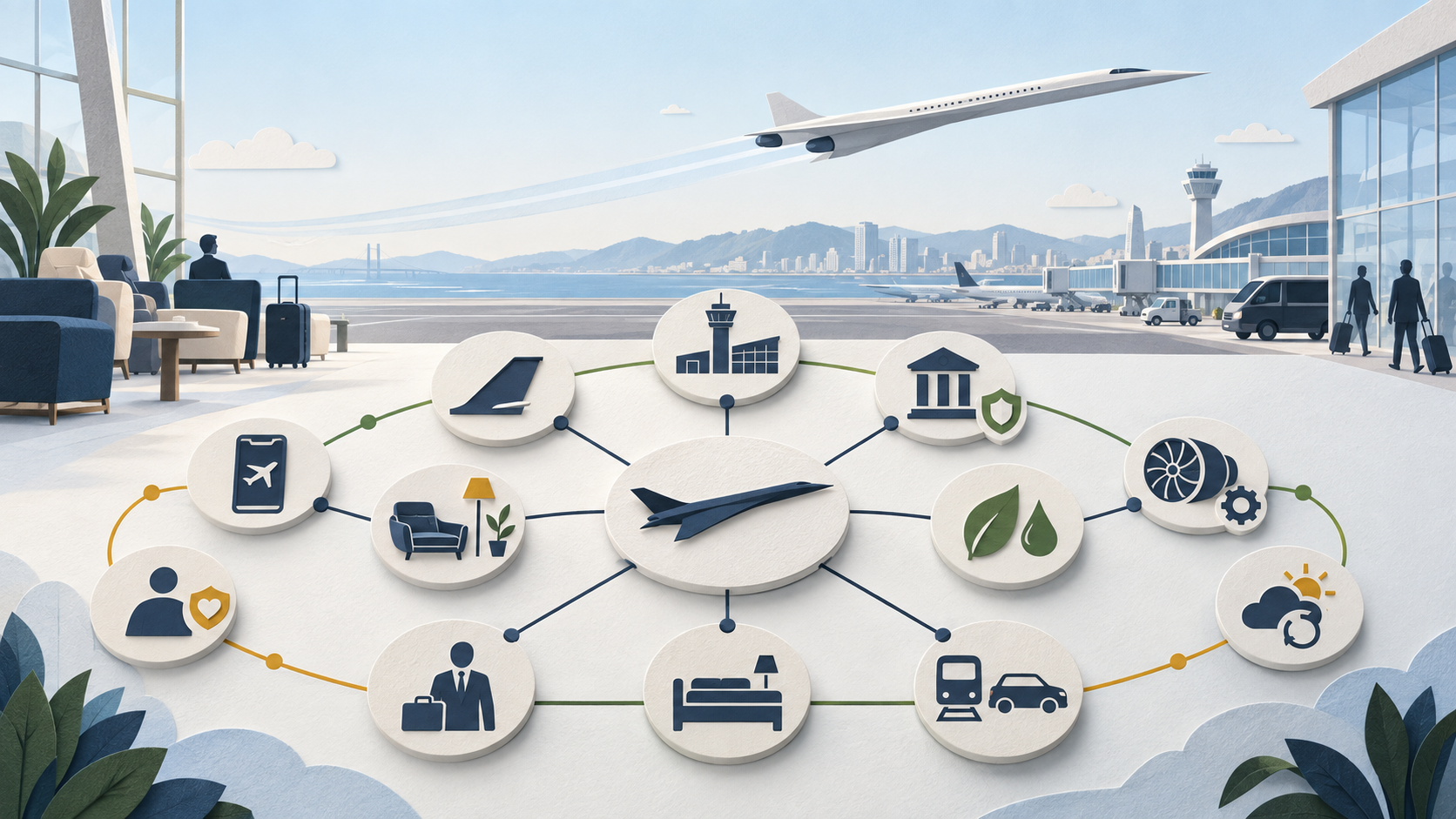
The Aircraft Is Only The Center
Overture can be technically impressive and still face an experience problem.
The customer buying supersonic travel is unlikely to be buying only a shorter block time. They are buying an outcome: recover a working day, attend a meeting, preserve a weekend, connect markets, make an event, reduce fatigue, or turn distance into something more manageable.
That means the value proposition starts before boarding and continues after landing.
If the traveller saves hours in the air but loses them at security, immigration, lounge crowding, late ground transport, hotel check-in, baggage, schedule uncertainty or recovery, the perceived value weakens. The flight may be faster, but the trip may still feel slow.
This is the same problem airlines face in disruption recovery, but with a higher-value customer and a more explicit promise.
The more premium the promise, the less tolerance the traveller has for unmanaged friction.
The Vendor Ecosystem Matters
Boom's own public story already makes clear that supersonic travel depends on more than Boom.
The aircraft needs airlines to order, configure, schedule and sell it. It needs regulators to certify the aircraft and define operating boundaries. It needs airports to support the right gates, turns, premium flows and noise-sensitive operations. It needs fuel partners and credible SAF supply. It needs maintenance, parts, engine and manufacturing capacity. It needs booking systems to explain the product. It needs corporate travel platforms to authorize the spend. It needs hotels and ground transport to adjust around earlier arrivals or same-day returns. It needs loyalty programs to decide whether supersonic travel earns, burns or signals status differently.
That is an integration problem.
The experience can break anywhere the promise crosses an organizational boundary.
For Transformidy, the useful concept is the supersonic integration layer:
Opportunity -> certification -> schedule -> booking -> permission -> airport flow -> flight -> arrival -> hotel or meeting -> recovery -> learning.
The aircraft enables the promise. The integration layer determines whether the promise becomes reliable value.
Faster Creates A New Decision Window
Supersonic travel also changes decision windows.
If New York to London or San Francisco to Tokyo becomes materially shorter, the customer's planning logic changes. A trip that once required overnight travel may become a same-day or next-day decision. Corporate travel approval may need faster authorization. Hotels may see changed check-in and meeting patterns. Airports may see different dwell expectations. Lounges may need to become work transition spaces, not just waiting rooms.
Speed compresses the time available to recognize intent.
That connects Boom to the broader Transformidy work on Decision Window Compression. When systems move faster, Recognition must move faster too.
For supersonic travel, the airline may need to recognize:
- who is buying time, not luxury;
- which routes create incremental demand rather than premium substitution;
- which travellers need hotel, office, lounge or ground support immediately on arrival;
- which corporate accounts treat speed as productivity rather than indulgence;
- which disruptions destroy the value proposition most quickly;
- which partner experiences must be pre-authorized because there is no time to solve them later.
The product is not "faster plane."
The product is protected time.
The Sustainability Trust Test
Boom's Overture materials emphasize SAF compatibility. That matters because supersonic travel will face a legitimacy question.
A faster premium flight can be positioned as innovation. It can also be criticized as a high-emissions convenience for a small segment of travellers. The commercial future will depend partly on whether airlines, corporate travel buyers and passengers believe the sustainability story is credible, measurable and worth the tradeoff.
This is not a communications issue alone.
It is an Experience Intelligence issue because trust becomes part of the purchase decision. If the traveller, employer or public believes the category lacks environmental credibility, the product may carry reputational friction even when the aircraft performs.
The Revenue Unknown is how much potential demand is blocked not by price or speed, but by the customer's discomfort with the legitimacy of the category.
What Airlines Should Design Now
Airlines evaluating supersonic service should avoid treating it as a cabin product with a route map.
They should design the whole journey:
- premium booking language that explains time value, not only aircraft novelty;
- app flows that show total journey time saved, including airport and arrival steps;
- airport partnerships for accelerated but trusted processing;
- lounge products that behave like work-transition spaces;
- hotel and ground-transport partnerships tied to arrival timing;
- corporate-travel evidence that supports productivity approval;
- loyalty rules that make the product aspirational without confusing value;
- recovery paths that protect the purpose of the trip when a premium short-time journey fails.
The risk is a very expensive dead end: a customer pays for speed, then discovers the rest of the system was not redesigned.
Sources
- Boom Supersonic, "Overture," https://boomsupersonic.com/overture
- Boom Supersonic, "Boom Achieves Supersonic Flight," https://boomsupersonic.com/press-release/boom-achieves-supersonic-flight
- Boom Supersonic, "Symphony," https://boomsupersonic.com/symphony
- United, "United Accelerates Starlink Wi-Fi Rollout with First Widebody Transatlantic Flight," https://united.mediaroom.com/2026-06-22-United-Accelerates-Starlink-Wi-Fi-Rollout-with-First-Widebody-Transatlantic-Flight
Related Reading
FAQ
What is the main idea of Faster Flight Will Still Fail If The Journey Around It Is Slow?
Faster Flight Will Still Fail If The Journey Around It Is Slow explains a change leaders should not treat as background noise. It shows what evidence is visible, what may be changing underneath it, and which decision window remains open.
Why does Faster Flight Will Still Fail If The Journey Around It Is Slow matter for Experience Intelligence?
The article helps readers see how an experience, relationship, capability, or value condition may be changing before the consequence is fully visible.
What Revenue Unknown does this article help identify?
It frames the unresolved commercial or operating question created by the change: what value, risk, hidden demand, relationship movement, or capability gap may exist but has not yet been measured or decided.
How should leaders use this article in the Special Intelligence series?
Use it as a prompt to separate observed evidence from interpretation, name the decision that still has to be made, and identify what would validate whether the interpretation is right.
Related intelligence
Article
Automation Is Only As Good As Its Failure State
The CBSA airport kiosk outage shows why organizations must design fallback capacity, communication and recovery as part of automation itself.
Article
United Turns Standby Into a Disruption Recovery Signal
United says its app can now let disrupted travellers join standby lists for up to three earlier flights while keeping their confirmed rebooked itinerary. The innovation matters because it turns standby from a gate gamble into a managed recovery path.
Article
A 100-Year Airline Is A Revenue System, Not A Museum
Delta, Lufthansa and United show why airline anniversaries should be judged by the next revenue base, not only the founding story.