
Article
Why AI Fails in Fragmented Organizations
AI does not resolve fragmented operating models. It exposes missing context, weak governance, and contradictory incentives at greater speed.
- Published
- June 25, 2026
- Updated
- August 11, 2026
- Reading time
- 5 min
Key takeaways
- AI amplifies the operating system it is placed inside.
- Fragmented evidence creates conflicting interpretations, not better decisions.
- Leaders need decision ownership, validation rules, and recovery capability before scaling AI into live experiences.
- The Revenue Unknown is not whether AI can work. It is where AI changes value, risk, trust, and capability before the organization notices.
Why AI Fails in Fragmented Organizations
What Actually Changed
AI has moved from a technology initiative to an operating condition. It now influences service, pricing, search, recommendations, employee workflows, content, fraud decisions, and customer support. That shift matters because AI does not sit politely beside the organization. It reads the organization, follows its incentives, and exposes its contradictions.
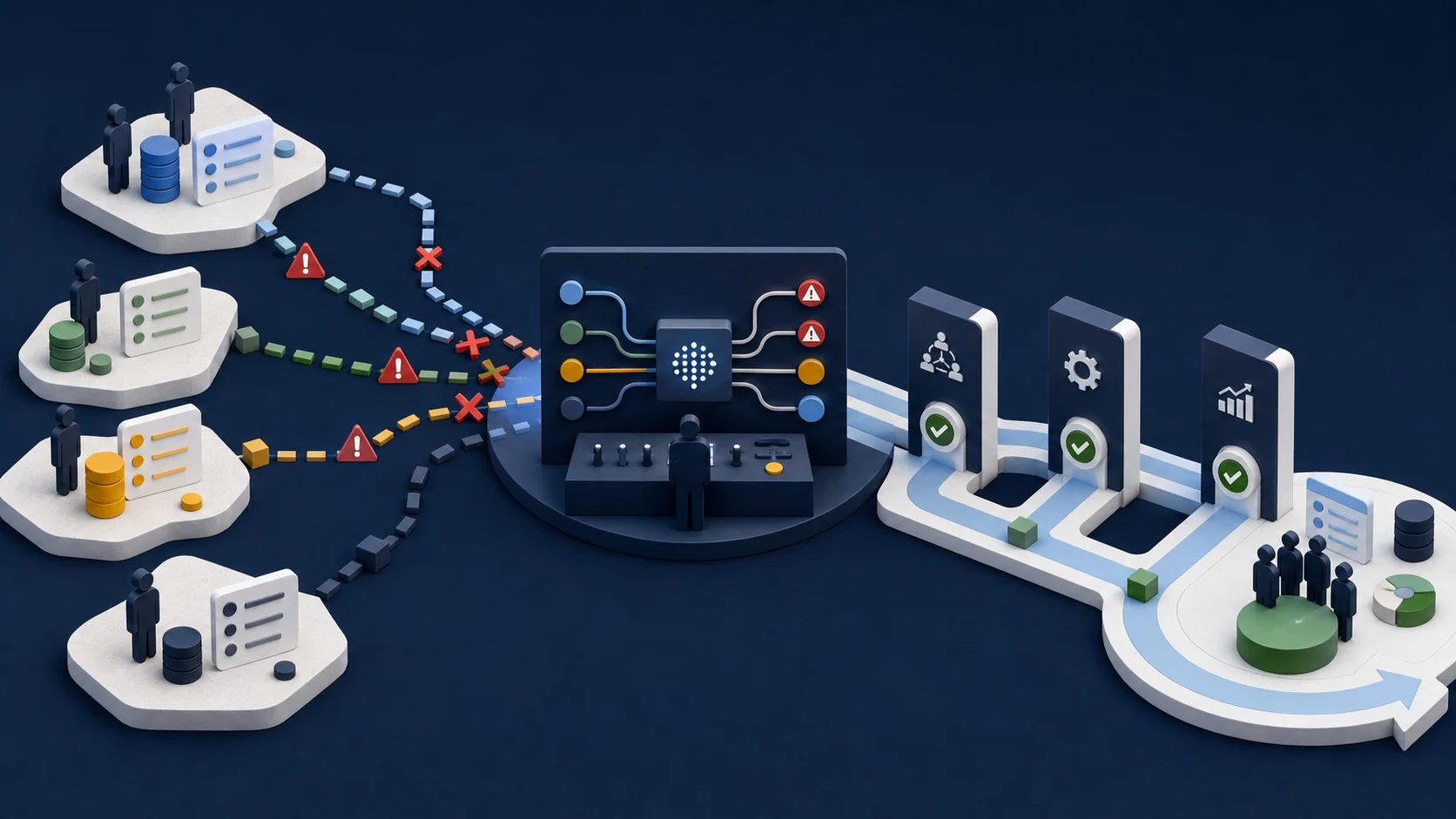
When an organization is fragmented, AI does not magically create coherence. It accelerates whatever logic already exists. If marketing promises speed, operations protects capacity, finance protects margin, legal limits discretion, service owns recovery, and product owns the data model, the AI system inherits the conflict. The customer experiences the conflict as delay, misclassification, irrelevant personalization, inconsistent recovery, or a decision nobody can explain.
That is why many AI programs disappoint even when the underlying models are impressive. The issue is not only model quality. The issue is whether the organization has the experience infrastructure required to interpret evidence, make decisions, authorize action, and validate outcomes.
The Fragmentation Pattern
Fragmentation usually shows up before the AI failure becomes public. Evidence exists, but it lives in separate systems. A service team sees repeated exceptions. A sales team hears changing objections. A digital team sees abandonment. A finance team sees rising cost to serve. A compliance team sees edge cases. Each group may be correct, but the organization lacks a shared reasoning layer.
AI enters that environment and turns separate partial truths into automated decisions. The model may optimize one measure while weakening another. It may resolve a support ticket while damaging the relationship. It may increase conversion while creating value leakage downstream. It may enforce a policy that was never designed for the scenario now in front of the customer.
The failure becomes visible as an AI failure, but the deeper problem is organizational. The experience changed. At least one relationship, capability, or value condition changed. The organization did not recognize the movement early enough to decide.
What Recognition Should Ask
A stronger AI operating model begins with Recognition. Before asking what the AI can do, leaders should ask what changed in the experience and which actors are affected. Did the customer relationship strengthen or weaken? Did employee capability improve or become constrained? Was value created, protected, delayed, transferred, hidden, or lost?
This matters because evidence is not proof by itself. A spike in complaints may indicate a broken AI workflow. It may also indicate higher adoption, better detection, unclear communication, a policy conflict, or customer anxiety created by a visible change. Recognition must hold competing interpretations long enough to avoid acting on the easiest story.
That is the discipline most AI programs skip. They move from evidence to optimization. Transformidy's view is different: evidence should move through Recognition before it becomes a Revenue Unknown, a decision, or an activation.
The Revenue Unknown
The most important commercial question is rarely, Can AI reduce cost? It is more specific: Where is AI changing value before the organization can see the full consequence?
AI may create revenue by reducing friction, improving discovery, extending service capacity, or identifying hidden demand. It may also leak value by misrouting customers, weakening trust, suppressing legitimate exceptions, increasing escalation cost, or shifting demand to a competitor with a more coherent experience.
The Revenue Unknown is the unresolved implication. Which customer groups will accept the AI-mediated experience? Which employees will lose confidence in the system? Which partners need clearer handoffs? Which decisions still require human authorization? Which recovery paths protect future preference rather than merely close the ticket?
Decision Windows
The organization does not need to wait for a failed rollout to learn. It can create earlier decision windows. Before launch, leaders can define which evidence will trigger review, which interpretations are plausible, who owns the decision, and what outcome would validate the choice. During launch, they can monitor condition change rather than only adoption or containment. After launch, they can compare predicted movement with actual outcomes.
This is how reactive evidence becomes proactive. Even when a problem is already visible, there are still decisions left to make: pause, narrow scope, improve explanation, add recovery authority, change routing, activate partners, protect vulnerable customers, or redesign the workflow before the next consequence arrives.
Related Original Archive Reading
These earlier Transformidy articles provide source context for this flagship and show how the thinking developed across real examples:
- The Search Function And Artificial Intelligence Powers Better Customer Experience
- Transforming Contact Centers: Harnessing AI for Superior CX
- OpenAI o1 Model and Its Impact on CX
- 7 Ways SharePoint Quietly Rewired Customer Experience Strategy
What To Watch Next
The next wave of AI failure will not look like one spectacular model error. It will look like thousands of small decisions made inside unclear operating conditions. The organizations that improve fastest will not be the ones with the most demos. They will be the ones that can recognize changing experience conditions, separate evidence from interpretation, and decide before automation turns ambiguity into scale.
FAQ
What is Experience Intelligence?
Experience Intelligence is the discipline of recognizing changing experience, relationship, capability, and value conditions early enough to make better decisions.
How is this different from customer experience management?
Customer experience management often focuses on journeys and touchpoints. Experience Intelligence asks what condition changed, which actors are affected, what remains undecided, and which decisions can still protect or create value.
Why does Transformidy focus on Revenue Unknowns?
Revenue Unknowns name commercially meaningful questions that appear when changing experience conditions expose hidden value, risk, demand, relationship movement, or capability gaps.
Does this replace the public Transformidy framework?
No. The public framework remains Evidence, Recognition, Revenue Unknowns, Decisions, Activation, Outcomes, and Learning. The internal reasoning model makes Recognition more precise.
Why does AI expose fragmentation?
AI exposes fragmentation because it executes against the data, rules, incentives, permissions, and handoffs that already exist. If those inputs conflict, the customer sees the conflict faster.
Related intelligence
Article
Transformidy: Transforming Into An Experience Intelligence Company
Experience is the visible outcome of organizational systems. Transformidy is becoming an Experience Intelligence Company built around coherence, Revenue Unknowns, BEUP, and Experience Infrastructure.
Article
Why Customer Experience Became an Operating System Problem
Customer experience failure is no longer a touchpoint problem. It is a system problem that reveals how the organization is designed.
Article
Google Universal Commerce Protocol: What Experience Infrastructure Looks Like in Commerce
Google's Universal Commerce Protocol points to a larger shift: commerce advantage increasingly depends on the infrastructure connecting discovery, data, fulfillment, partners, and recovery.