
Article
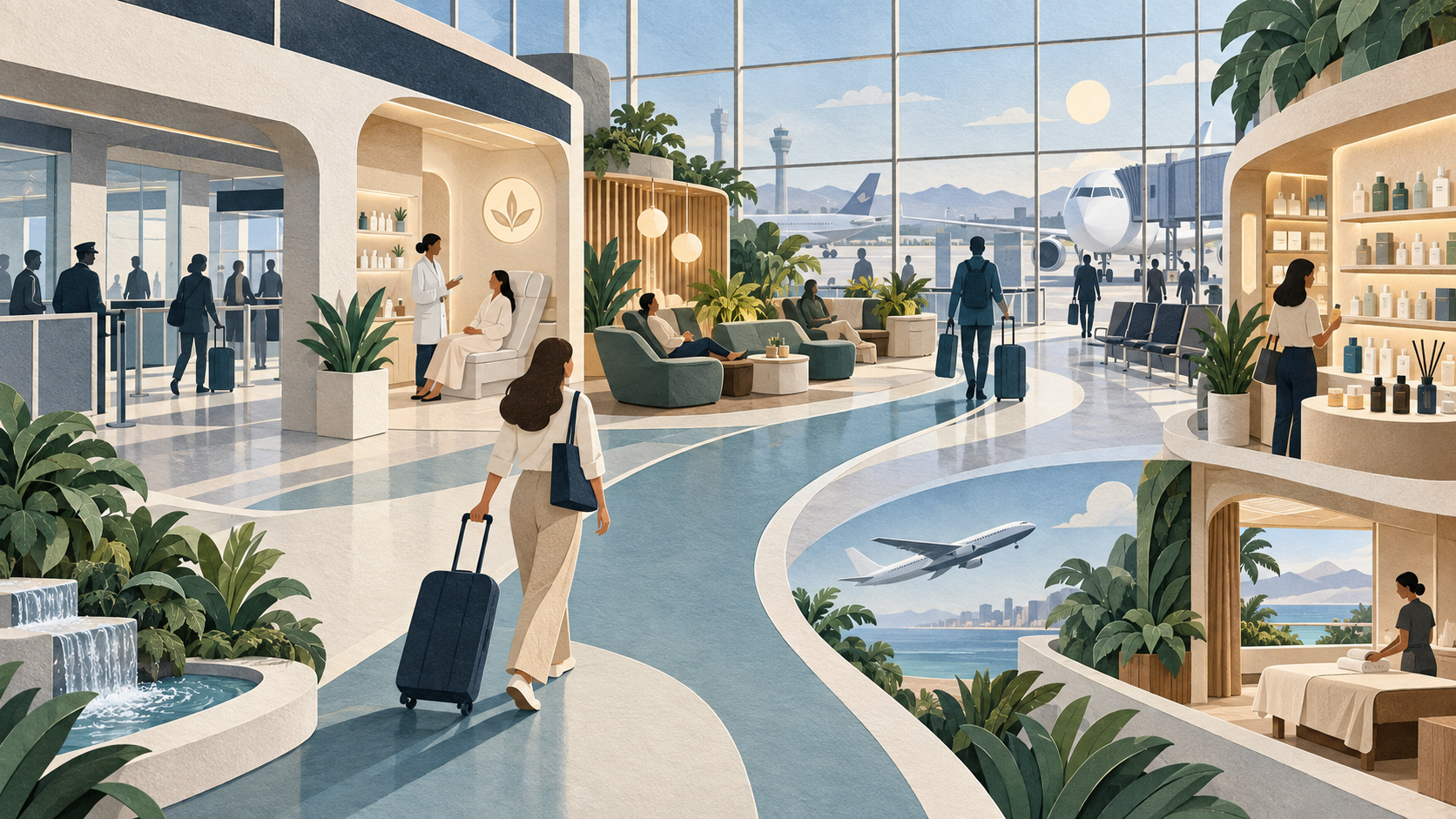
The Airport Is Becoming A Wellness Platform
Suvarnabhumi Airport's aesthetic clinic signal shows why transfer dwell can become wellness, skincare, recovery, retail and airline experience infrastructure.
- Published
- September 14, 2026
- Updated
- September 14, 2026
- Reading time
- 8 min
Article Body
Airport dwell time has usually been treated as a commercial problem.
Passengers wait. Airports sell.
That model is becoming too small.
The opening of Aura Bangkok Clinic inside Suvarnabhumi Airport's international departure area should be read as a catalyst for a larger Experience Intelligence question. Aura describes the branch as an aesthetic clinic located after immigration in Concourse G near Gate G01, with daily operating hours listed on its branch page. A related Nation Thailand release calls it the first aesthetic clinic inside an international departure hall, although the public dating should be handled carefully: the page is dated September 10, 2026, while the body carries a Bangkok dateline of September 15.
The exact wording matters. Airports already have medical centres, pharmacies, wellness rooms, spas, lounges and recovery amenities. The stronger claim is not that healthcare has never existed in an airport. The stronger signal is that beauty, wellness and medical-adjacent services are being positioned inside the post-immigration passenger journey, close to transfer dwell, premium retail and the gate.
That changes what airport time can become.
The Revenue Unknown is:
How much airport and airline revenue is trapped in passenger dwell because wellness is treated as an amenity rather than an experience system?
Dwell Time Is Not One Thing
Airports often describe dwell time as if it were one asset.
It is not.
A passenger waiting 45 minutes before boarding is not the same as a transfer passenger with five hours between flights. A leisure traveller heading home is not the same as a medical-tourism visitor leaving Thailand after treatment. A business traveller with lounge access is not the same as a family trying to keep children calm before a long-haul flight. A disrupted passenger is not experiencing time the same way as a passenger who planned the wait.
The same hour can be useful, stressful, profitable, wasted or risky depending on context.
That is why wellness matters.
Wellness services can turn waiting into recovery, preparation, self-care, confidence, replenishment or destination memory. But they can also create hesitation if passengers do not know whether they have enough time, whether a service is suitable before flying, whether aftercare matters, whether language support is available, whether airline or lounge status changes access, or whether the service has a reliable next step after landing.
An airport clinic may create demand.
It may also expose how poorly airports understand different kinds of time.
Wellness Is A Trust Surface
Food, retail and lounges already require trust, but wellness raises the threshold.
A passenger can make a low-risk impulse purchase in duty free. A skincare consultation, treatment, recovery service, hydration product, sleep pod, massage, aesthetic service or medical-adjacent offer carries more personal judgment. The customer has to trust the provider, the timing, the advice, the service boundary and the airport environment.
That is why the experience cannot be designed like another store.
The passenger needs to know:
- whether the service fits the available time;
- whether it is appropriate before a flight;
- whether aftercare affects sun exposure, cabin dryness, sleep or movement;
- whether there is a simple recovery path if something goes wrong;
- whether payment, language and consent are clear;
- whether products can be carried through travel restrictions;
- whether the experience continues after arrival.
Without those answers, wellness becomes another dead-end experience.
The airport may technically offer the service, but the passenger may not feel safe enough, informed enough or timed correctly enough to act.
Experience The Skies: Wellness As Journey Infrastructure
This is primarily an Experience The Skies story because airports and airlines are no longer only moving passengers.
They are managing readiness.
The passenger enters the travel system with a body, schedule, anxiety level, hydration state, sleep deficit, skin condition, work obligation, family responsibility and destination purpose. Airlines already recognize pieces of this through lounges, amenity kits, sleep products, meal design, cabin humidity discussions, premium bedding, onboard wellness content and partnerships. Airports recognize pieces through spas, quiet rooms, gardens, showers, sleep spaces and medical services.
The opportunity is to connect those pieces.
A long-haul passenger flying through Bangkok may need rest, hydration, skincare, a shower, a calm work zone, a reliable meal, a product replenishment path and a clear boarding transition. A transfer passenger may need confidence that a 90-minute service will not jeopardize the connection. A delayed passenger may need a different wellness offer than a premium traveller who planned a long stopover.
Airlines can participate without trying to become clinics.
They can use wellness as a continuity layer:
pre-flight guidance, lounge recovery, onboard skin and hydration support, arrival hotel partnerships, destination spa offers, retail replenishment, and loyalty recognition.
The recent Air Canada skincare/wellness discussion fits here. The value is not only the product placed in the cabin or amenity kit. The value is whether the airline can connect care before, during and after the flight in a way passengers understand.
That creates a sharper airline Revenue Unknown:
Which wellness moments increase traveller confidence, loyalty and willingness to pay, and which simply add another optional perk passengers forget?
Retail Mashup: Beauty Becomes Travel Commerce
Wellness in airports also belongs in Retail Mashup.
Beauty and skincare already travel well. They are small, giftable, replenishable, personal and connected to identity. Airports already understand beauty as a duty-free category. But an airport clinic changes the retail logic.
The journey can move from:
product shelf -> purchase
to:
need state -> consultation -> service -> product -> aftercare -> replenishment -> loyalty -> destination memory
That is a much richer commerce system.
For Thailand, the signal is especially interesting because beauty, wellness, hospitality and tourism already reinforce one another. A traveller may associate Bangkok or Thailand with care, service, hospitality, aesthetic capability, spa culture, skincare and destination value. An airport clinic can become a final touchpoint in that perception, or a first touchpoint for a future trip.
But the retail system has to be designed.
If a passenger receives a consultation but cannot buy the right products, the path breaks. If they buy products but cannot carry them, the path breaks. If they want to continue care after returning home but there is no follow-up, the path breaks. If the clinic has no consented relationship path, the airport may capture one transaction while losing the longer customer.
Retail Mashup should treat airport wellness as a product-service-continuity case.
The question is not simply whether the clinic sells treatments or skincare.
The question is whether beauty, travel, airline loyalty, duty free, hotels, destination marketing and post-trip replenishment can become one coherent experience.
Transfer Airports Have The Strongest Case
The wellness platform opportunity is strongest at airports with meaningful transfer dwell.
Bangkok, Singapore, Doha, Dubai, Istanbul, Seoul and other long-haul hubs compete not only through flight connectivity, but through the quality of the time passengers spend between flights. Changi has long treated airport time as experience infrastructure through gardens, attractions, lounges, sleep, retail and hospitality. Gulf hubs use scale, lounges, premium retail and connectivity. Incheon has connected airport experience to Korean culture, beauty and medical-tourism ambition. Bangkok has the advantage of a tourism brand already associated with hospitality, spa, beauty and wellness.
The strategic question is whether the airport can convert that association into operationally safe, trusted, timed experiences.
Long dwell is not automatically valuable. It can become fatigue.
That is why the best wellness use cases may not be generic. They may be context-specific:
- recovery for long-haul transfer passengers;
- skincare and hydration for cabin dryness;
- sleep and shower pathways for overnight connections;
- stress reduction during disruption;
- beauty retail connected to trusted consultation;
- hotel spa or clinic continuation after arrival;
- loyalty offers that recognize passenger status and itinerary timing.
An airport that understands these contexts can design offers around the traveller's actual condition.
An airport that does not understand them will simply add another amenity to a concourse.
The Dead-End Risks
Wellness can fail in more sensitive ways than retail.
If a passenger misses a product, the cost is low. If a passenger feels misled about a treatment, timing, suitability or aftercare, trust damage can be much larger.
There are also practical constraints:
- gate changes;
- boarding deadlines;
- language gaps;
- uncertain wait times;
- flight delays;
- carry-on liquid rules;
- medical disclosure boundaries;
- post-treatment comfort in dry cabin air;
- unclear airline responsibility if the passenger is late.
These are not reasons to avoid airport wellness. They are reasons to design it properly.
The airport wellness platform needs a decision system:
itinerary -> available dwell -> passenger intent -> service suitability -> consent -> activation -> boarding recovery -> post-trip continuation -> learning
That is where Transformidy's Experience Intelligence work matters. The service is visible. The value system is mostly invisible.
What To Measure
Airport wellness should not be measured only by store sales or appointment volume.
The useful measures are more connected:
- conversion by passenger dwell window;
- consultation-to-product attachment;
- service completion without missed boarding risk;
- language and payment completion;
- lounge or airline referral conversion;
- duty-free product follow-on;
- hotel spa or clinic continuation;
- post-trip replenishment;
- passenger trust and repeat use;
- recovery after delays or service exceptions.
For airports, the larger question is whether wellness increases the quality and commercial value of dwell without making the journey feel harder.
For airlines, the question is whether wellness helps protect premium experience, long-haul comfort, loyalty preference and partner value.
For retailers, the question is whether travel context increases trust and conversion, or whether passengers hesitate because the offer is too personal for the airport environment.
The Executive Lesson
The airport is no longer only a place passengers pass through.
For major hubs, it can become a platform for wellness, retail, hospitality, destination identity, recovery and loyalty. But that platform only works if it recognizes the difference between a customer who has time, a customer who has stress, a customer who has clinical questions, a customer who has product intent and a customer who simply wants to reach the gate.
Suvarnabhumi's Aura Bangkok Clinic signal matters because it makes that question visible.
If airports can turn dwell into trusted care, they can create new revenue and better experience. If they treat wellness as another concession category, they may create another dead end: interesting to notice, difficult to act on, and disconnected from what happens next.
The future airport wellness platform will be judged less by whether it exists than by whether passengers can understand when it is right for them.
Sources
- Nation Thailand, "Aura Bangkok Clinic opens world's first airport aesthetic clinic at Suvarnabhumi," September 2026: https://www.nationthailand.com/pr-news/40070857
- Aura Bangkok Clinic branch page, Suvarnabhumi Airport branch: https://aurabangkokclinic.com/en/branch/
- Suvarnabhumi Airport shop and service listing, Aura Bangkok Clinic: https://suvarnabhumi.airportthai.co.th/explore/attration/detail/aura_bangkok_clinic_bkk
Related Reading
FAQ
What is the main idea of The Airport Is Becoming A Wellness Platform?
The Airport Is Becoming A Wellness Platform explains a change leaders should not treat as background noise. It shows what evidence is visible, what may be changing underneath it, and which decision window remains open.
Why does The Airport Is Becoming A Wellness Platform matter for Experience Intelligence?
The article helps readers see how an experience, relationship, capability, or value condition may be changing before the consequence is fully visible.
What Revenue Unknown does this article help identify?
It frames the unresolved commercial or operating question created by the change: what value, risk, hidden demand, relationship movement, or capability gap may exist but has not yet been measured or decided.
How should leaders use this article in the Special Intelligence series?
Use it as a prompt to separate observed evidence from interpretation, name the decision that still has to be made, and identify what would validate whether the interpretation is right.
Related intelligence
Article
LEGO Has The IP. The Revenue Unknown Is Whether The Moment Is Connected.
LEGO's Marvel, F1 and LEGO House examples show why licensed products need moment activation, not only availability.
Article
TIFF Has The Audience. It Still Needs The Continuity System.
A second TIFF Special Intelligence piece uses field observations and Always Lalisa to show why premium festival attention needs better continuation.
Article
Festival Attention Needs Somewhere To Go
TIFF concentrates films, sponsors, travel, hotels, retail and audience reaction into one attention system, but the value depends on whether the next relationship is designed.