
Article
Payments Are Not a Cost. They Are an Operating System.
Payment operations determine whether a committed customer actually completes. Managed as a vendor cost instead of a revenue system, that moment stays invisible.
- Published
- June 30, 2026
- Updated
- August 19, 2026
- Reading time
- 10 min

The Global Signal
Baymard Institute, an independent web usability research firm, maintains one of the most cited datasets on checkout abandonment: a compiled average across roughly fifty separate studies conducted between 2006 and 2025, currently sitting at 70.22 percent (Baymard Institute). That figure is not a single finding; it is Baymard's own aggregation of other researchers' work, which is worth naming honestly rather than presenting as one clean statistic.
What is Baymard's own primary research, gathered through a 2024 survey of just over a thousand United States adults, is more specific and more useful: 48 percent of respondents named extra costs, shipping, taxes, or fees appearing late in the checkout process as their reason for abandoning a cart (eMarketer, February 2024). Baymard's broader checkout usability research, built from benchmarking 334 sites and reviewing more than 30,000 individual checkout elements, found that only 2 percent of the sites studied achieved what Baymard classifies as a genuinely good checkout experience.
Read together, these numbers describe something specific: checkout is not failing because customers change their minds. It is failing, disproportionately, at the moment a business reveals a cost or a requirement it had not surfaced earlier in the process. That is not a demand problem. It is a sequencing problem, and it sits inside a part of the business most executives never personally look at.
Shoppers citing late-revealed costs as their reason for abandoning
Baymard's own first-party 2024 finding, not the 70%+ multi-study aggregate.
What changes when payments are read as an operating system
Processing cost and decline rate describe operational health, not customer intent.
The useful signal is completion rate, retry-recoverable declines, and the decline-versus-fraud-rate gap, read together instead of processing cost alone.
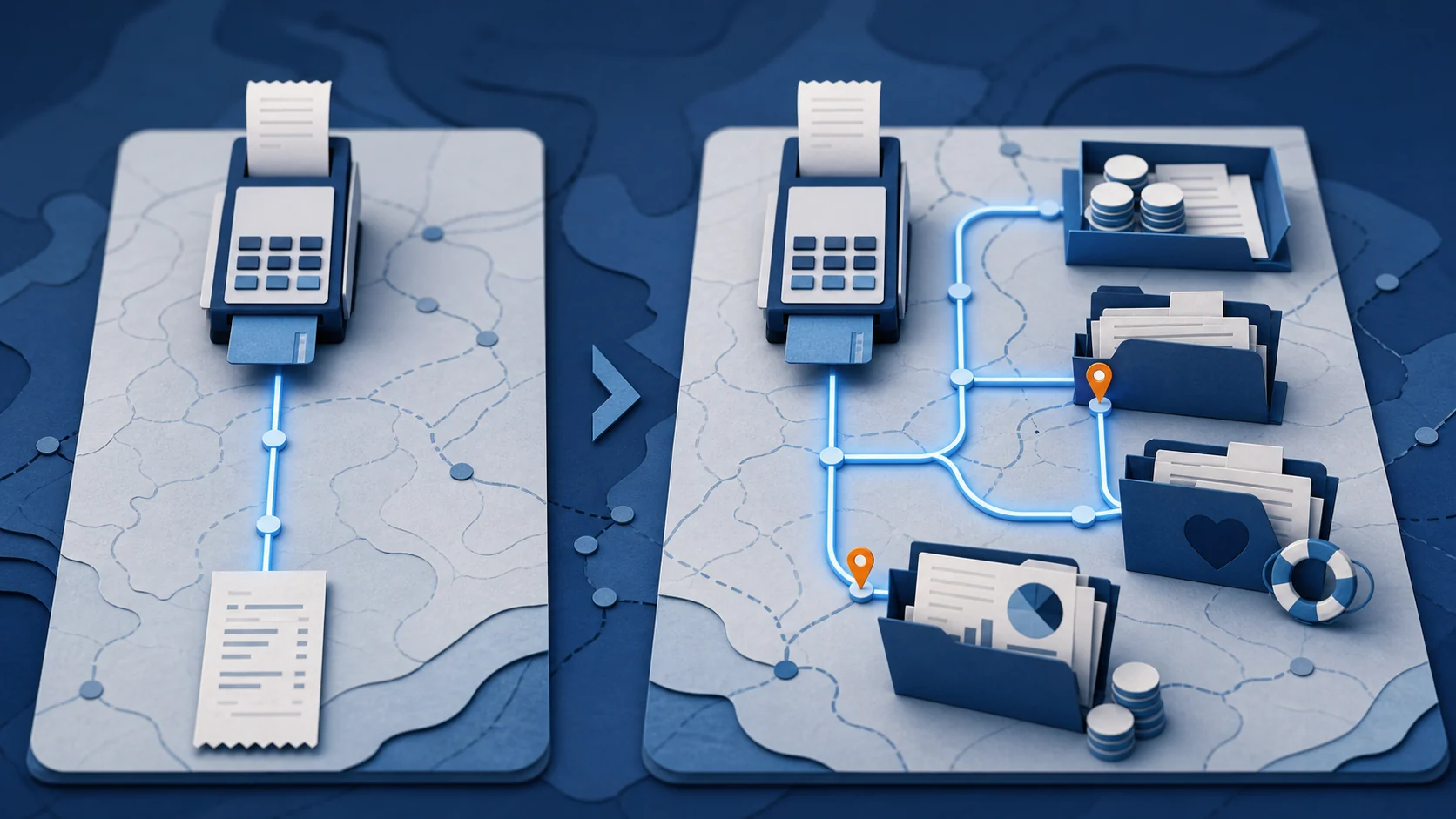
Why the Visible Metric Misleads
Processing cost and decline rate measure operational efficiency, not business impact. They can look completely healthy while a meaningful share of committed customers never actually complete their purchase, for reasons that have nothing to do with whether they wanted the product. The more revealing measures sit one layer deeper: actual completion rate, defined as initiated transactions divided by successfully settled ones rather than simple decline rate; the share of declined transactions that would complete on retry or an alternative method; and the gap between an organization's fraud rate and its decline rate, which, when the decline rate runs far above the fraud rate, is a strong signal that fraud rules are filtering out legitimate customers along with bad actors.
None of this shows up by watching cost alone. It requires treating payment operations as a place where strategy decisions get made, not a vendor relationship to be renewed once a year.
Payment is where a business finds out whether customer intent survives friction.
The Leadership Move
The right move is not to bring payment processing entirely in house. It is to manage payment operations as a commercial system with clear owners and visible tradeoffs, rather than a cost line that gets reviewed once a year and otherwise left alone.
- Ownership
Payment strategy crosses finance, growth, risk and fraud teams, customer experience, and the operations group that actually manages the processor relationship. Because it touches all of them, it tends to belong fully to none of them, and that gap is where the friction Baymard's research documents tends to live unexamined.
- Tradeoff
Fraud prevention competes directly with customer friction; cost per transaction competes with completion rate; a simpler checkout competes with accommodating local payment preferences. These tradeoffs are real and rarely made consciously. Most organizations default to whatever the processor's settings ship with, rather than deciding deliberately where they want to sit on each tradeoff.
- Human consequence
When friction is high, a customer abandons quietly and the transaction never reaches the company's own data. The abandonment is invisible to the business. The friction that caused it was entirely real to the customer, and she may simply not come back to explain why.
Implication for Operators
Organizations that treat payment operations as a revenue system, not a cost center, tend to find margin that was never visible in the standard reporting: completion rates rise when retry logic and fraud rules are tuned deliberately rather than left at default settings, and customer experience improves in ways that show up later in repeat purchase rather than in the payments dashboard itself. The practical shift is asking, at least once, whether the gap between decline rate and actual fraud rate has ever been measured directly, because for most organizations it has not.
Payment is not where a customer's journey ends. It is where a business finds out whether intent survives friction. For a long time, treating payments as infrastructure was a reasonable choice; payment operations have changed faster than the management models built around them. Baymard's research shows how much of checkout abandonment traces back to costs and requirements surfaced too late, a sequencing failure rather than a demand failure, and one that is entirely visible once someone decides to look at it directly.
The revenue unknown is not in the fee schedule. It is in the margin that goes uncaptured because payment operations are still treated as infrastructure rather than as a place where real business decisions get made.
Transformidy infographic
What is a Revenue Unknown?
The unresolved value question that becomes visible when evidence is recognized early enough to still change the decision.
- 01
Evidence
A visible event, behaviour, gap, cost, or relationship change.
- 02
Recognition
The interpretation that names what may be changing underneath the evidence.
- 03
Revenue Unknown
The unresolved question about value, risk, demand, trust, cost, or capability.
- 04
Decision window
The period where leaders can still protect value or create a better outcome.
What is your checkout abandonment rate (cart value lost without purchase), and do you understand the primary reason customers do not complete payment?
FAQ
Is payment processing simply a commodity?
At the level of a single transaction, largely yes. At the operational level, fraud rules, retry strategy, settlement terms, and payment method mix, no. Baymard's own research on checkout abandonment shows meaningful, measurable variation in how well businesses handle exactly these decisions.
Does a payment processor handle this optimization automatically?
A processor optimizes for its own business: volume and its own risk exposure. A merchant needs to optimize for its own margin and completion rate, which are not the same objective, and that decision cannot be fully outsourced.
What is the real difference between fraud rate and decline rate?
Fraud rate measures chargebacks as a share of transactions. Decline rate measures all declined transactions, including legitimate ones blocked by overly cautious rules. When decline rate runs well above fraud rate, an organization is very likely filtering out real customers along with bad actors.
How reliable is the commonly cited 70 percent cart abandonment figure?
It is a compiled average across roughly fifty separate studies that Baymard Institute maintains, not a single first-party finding. Baymard's own 2024 survey data, showing 48 percent of shoppers citing late-appearing extra costs as their reason for abandoning, is a more specific and directly attributable data point.
What should organizations measure instead of processing cost alone?
Actual completion rate, the share of declines that would succeed on retry, and the gap between decline rate and true fraud rate together describe business impact in a way that processing cost alone cannot.
Related intelligence
Article
When Availability Signals Are Not Aligned: The Hidden Inventory-Demand Mismatch
In stock somewhere in the network is not the same as available to this customer, in this format, in time. That gap does not show up in the out-of-stock rate.
Article
Beyond Abandonment: The Validation Moment When Customers Make Final Commitment
Not all cart abandonment is the same behavior. Device friction, first-time-buyer trust gaps, and genuine indecision each need a different recovery tactic.
Article
Work Redesign and Experience Redesign Must Happen Together
A faster-feeling interface attached to an unredesigned back-end process does not create a faster experience. It creates a specific, quiet disappointment.