
Article
The Validation Gap: Why Retailers Lose Sales Before Checkout
Some cart abandonment is not indecision. It is a customer who already decided, stopped at a validation gate, and never came back.
- Published
- July 2, 2026
- Updated
- August 19, 2026
- Reading time
- 8 min

The Global Signal
Baymard Institute, an independent web usability research firm, surveyed just over a thousand United States adults in early 2024 and found that 48 percent named extra costs, shipping, taxes, or fees revealed late in checkout, as their reason for abandoning a purchase (eMarketer, February 2024). That is Baymard's own primary survey finding, distinct from the more commonly quoted 70 percent abandonment figure, which is actually a compiled average across roughly fifty separate third-party studies that Baymard maintains rather than a single first-party result (Baymard Institute).
Baymard's broader checkout research, drawn from benchmarking 334 sites and reviewing more than 30,000 individual checkout elements, found that only 2 percent of the sites studied delivered what the firm classifies as a genuinely good checkout experience. Read together, these figures describe a specific and correctable failure: checkout is not primarily losing customers who were never going to buy. It is losing customers at the exact moment a business reveals something it had not disclosed earlier, after that customer had already done the work of choosing a product and starting to pay for it.
Shoppers citing late-appearing costs as their reason for abandoning
A first-party Baymard finding, not the multi-study aggregate.
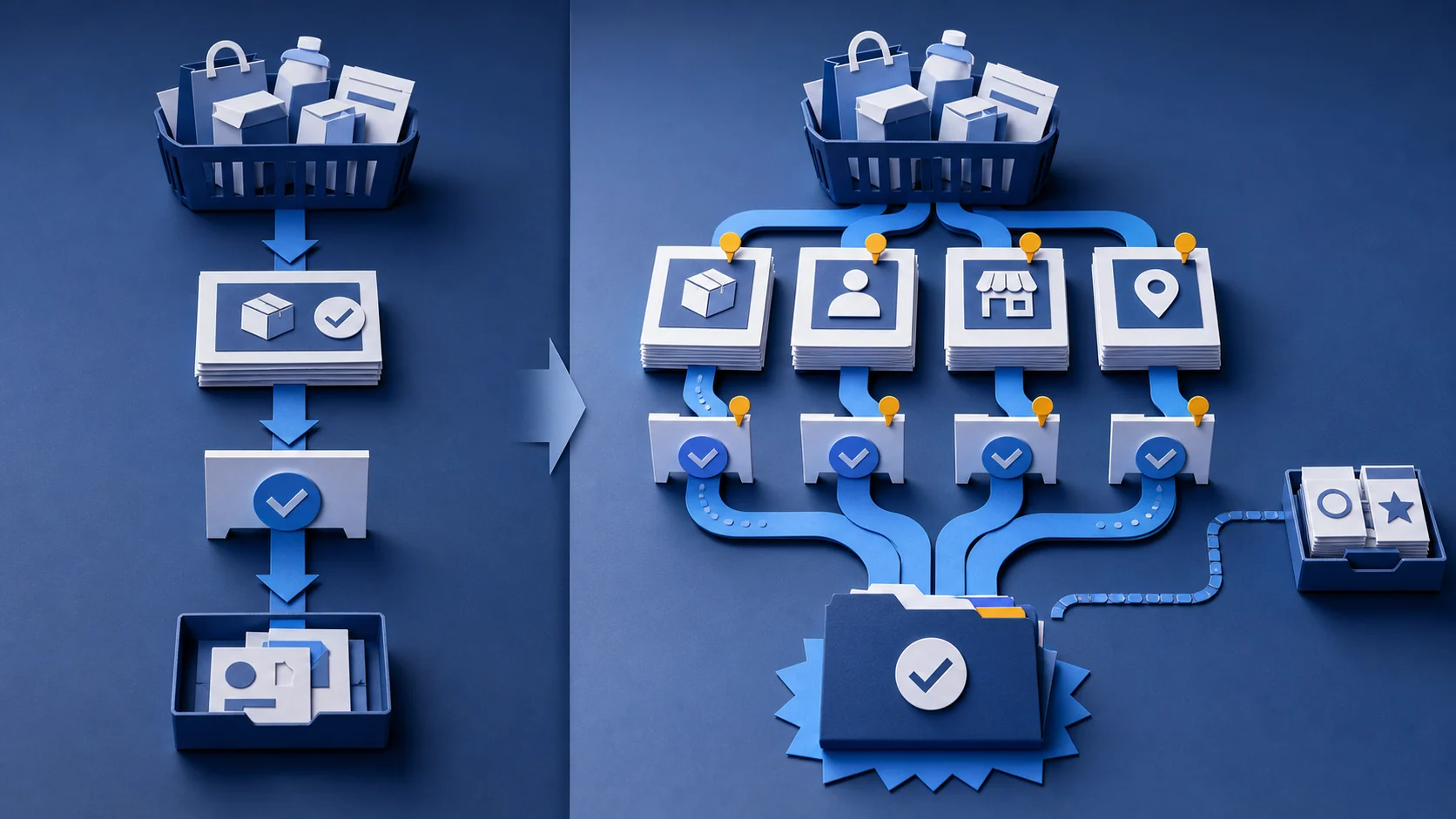
What changes when abandonment is read by stage
One aggregate number treats every departure as the same customer.
A stage-level breakdown, checking whether abandonment clusters at cost or requirement disclosure, separates validation-gap abandonment from indecision.
Why the Visible Metric Misleads
A single aggregate abandonment rate cannot distinguish between a customer who was never serious and one who was a single disclosed shipping cost away from completing a purchase. The more useful cut is stage-level: at which point in checkout does abandonment concentrate, and does it cluster specifically around the moment costs or requirements first appear. Baymard's 48 percent figure suggests that, industry-wide, this is not a minor factor; it is the single most commonly cited reason customers give for leaving.
Device and channel data add a further layer. Mobile abandonment tends to concentrate at data-entry steps rather than at pricing steps, which points to a convenience problem rather than a price problem, and it calls for a different fix entirely: simpler forms, saved addresses, and clearer upfront cost estimates, not a lower price.
The sale is not lost before the cart exists. It is lost after the customer has already decided to buy.
The Leadership Move
The right move is not to eliminate discounting. It is to stop routing every abandoned cart through the same recovery tactic, since validation-stage abandonment and genuine price hesitation are different problems that call for different solutions.
- Ownership
Marketing typically owns the recovery program and its discount budget. Product and checkout design own the interface where the friction actually occurs. Logistics owns the shipping cost and timing data that gets disclosed, or fails to get disclosed, early enough. None of them alone can fix a problem that spans all three.
- Tradeoff
Investing in checkout simplification competes directly with investing in retargeting spend, and the two solve genuinely different losses. The point is to size each investment against the specific loss it is meant to address, rather than defaulting to whichever is easier to fund.
- Human consequence
A customer who abandons at a late-revealed shipping cost has not changed her mind about the product. She hit a wall she did not expect, and many customers simply do not come back once their attention moves elsewhere, not because the desire faded, but because the friction outlasted it.
Implication for Operators
The organizations that recover the most abandoned revenue are the ones that stop treating checkout abandonment as a single, undifferentiated number. Breaking it down by stage, and specifically checking whether abandonment clusters around the moment costs or requirements are first disclosed, tends to reveal a recoverable share of lost sales that a discount campaign alone was never designed to reach.
The sale is not lost before the cart exists. It is lost after the customer has already decided to buy, at the exact moment a business asks them to confirm one more detail they did not expect. This is a checkout design problem wearing a demand problem's costume, and Baymard's research is specific about where the confusion originates: costs and requirements revealed too late in a process the customer had already committed to finishing.
The revenue unknown is not in the abandonment rate. It is in the stage where abandonment happens, and that stage tells a business exactly what to fix.
Transformidy infographic
What is a Revenue Unknown?
The unresolved value question that becomes visible when evidence is recognized early enough to still change the decision.
- 01
Evidence
A visible event, behaviour, gap, cost, or relationship change.
- 02
Recognition
The interpretation that names what may be changing underneath the evidence.
- 03
Revenue Unknown
The unresolved question about value, risk, demand, trust, cost, or capability.
- 04
Decision window
The period where leaders can still protect value or create a better outcome.
What is your checkout abandonment rate (cart value lost without purchase), and do you understand the primary reason customers do not complete payment?
FAQ
What is the difference between validation-gap abandonment and ordinary cart abandonment?
Ordinary abandonment includes browsers and genuinely undecided shoppers. Validation-gap abandonment refers to customers who had already completed product selection and shipping details but left at a later gate, most often when an unexpected cost or requirement appeared. Baymard's research identifies this as the single most cited reason shoppers give for abandoning a purchase.
How much of total abandonment does this actually represent?
Baymard's 2024 survey found 48 percent of respondents cited late-appearing extra costs specifically, which suggests it is not a marginal factor but the leading one, though the exact share will vary by business and is worth measuring directly.
Does fixing this replace the need for retargeting altogether?
No. Discount-led retargeting still works for genuinely undecided, price-sensitive customers. Validation-gap fixes, clearer shipping costs earlier in the flow, saved-cart options, address it as a separate population that a discount was never designed to reach.
Who should own fixing the validation gap inside a retail organization?
It sits between checkout design, logistics, and marketing, none of which typically owns the full path from abandonment to recovery alone, which is exactly why the gap tends to persist even in otherwise well-run organizations.
How rare is a genuinely good checkout experience?
Baymard's benchmarking of 334 sites and more than 30,000 checkout elements found that only 2 percent achieved what the firm classifies as good checkout usability, which suggests this is a widespread, industry-level problem rather than an isolated one.
Related intelligence
Article
When Availability Signals Are Not Aligned: The Hidden Inventory-Demand Mismatch
In stock somewhere in the network is not the same as available to this customer, in this format, in time. That gap does not show up in the out-of-stock rate.
Article
Beyond Abandonment: The Validation Moment When Customers Make Final Commitment
Not all cart abandonment is the same behavior. Device friction, first-time-buyer trust gaps, and genuine indecision each need a different recovery tactic.
Article
Work Redesign and Experience Redesign Must Happen Together
A faster-feeling interface attached to an unredesigned back-end process does not create a faster experience. It creates a specific, quiet disappointment.