
Article
Digital Account Opening Fails When Recovery Has No Owner
A digital account application can stall for reasons entirely outside the applicant's control — identity verification, document review, compliance checks — with no human path back into the process. Here's why that's a dead end.
- Published
- August 13, 2026
- Updated
- August 12, 2026
- Reading time
- 8 min

A note on why this article requires extra care
Account opening sits at the intersection of identity verification, compliance obligations, and regulated financial processes. This article deliberately stays at the level of the structural pattern — a digital flow stalling with no human recovery path — and does not state any specific regulatory requirement, verification standard, or institution's practice. Any future revision must verify claims about compliance obligations or applicant rights against current, jurisdiction-specific regulator guidance before publication.
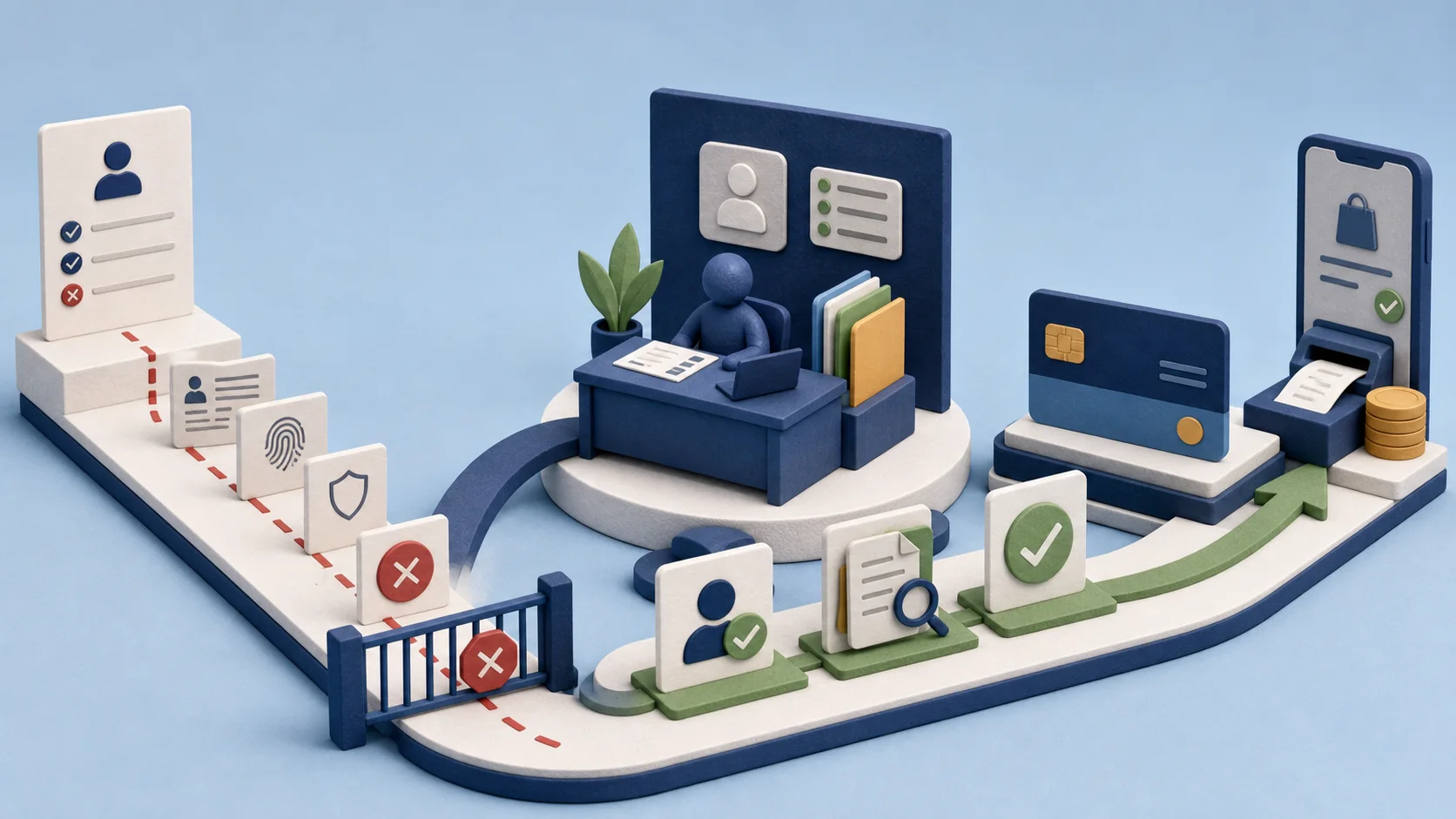
An application that goes quiet at exactly the wrong moment
Someone begins opening an account online — a bank account, a brokerage account, a fintech product — and the process stalls partway through: an identity-verification step that can't confirm a match, a document that won't upload correctly, a compliance check that takes longer than the interface suggested it would. The applicant, who was moments from completing something they'd already committed time and personal information to, is left staring at an unclear status with no obvious way to move forward.
This is a different failure than a legitimate decline. A stalled digital flow doesn't necessarily mean the applicant was disqualified — it often means the automated process couldn't complete cleanly, and no human recovery step exists to pick up where the automation stopped.
Why a stalled flow is a dead end, not just a technical hiccup
Automated verification failing on some share of legitimate applicants is a known limitation of any identity-verification system — that alone isn't the dead end. The dead end is a stalled flow with no accessible human path back in. Checked against a visible next step, an owner, a recovery path, and an activation path: there's often no specific next step beyond a vague "we'll be in touch" or a dead end in the interface itself; ownership of stalled applications frequently isn't clear — compliance, operations, and customer service may each have partial visibility without anyone owning the applicant's full experience; there's no defined recovery path (a branch visit, a call, a document resubmission process) proactively offered; and the applicant's accumulated effort and disclosed information — everything they've already provided — doesn't reliably carry forward if they have to start again through a different channel.
Who this leaves stranded
Applicants who are, in most cases, legitimately trying to open an account and are stopped by a process limitation rather than a genuine disqualification — and who may not know which of the two happened, since the interface rarely distinguishes "you don't qualify" from "our system couldn't verify you automatically." Financial institutions are affected too: qualified customers abandoning mid-application represents lost business the institution may not even be tracking as a distinct category from genuine declines.
What the stalled flow doesn't carry forward
Everything the applicant has already provided — identity documents, personal details, the time invested — often doesn't travel cleanly into whatever recovery path exists, if one exists at all. An applicant forced to start over through a branch or phone channel may have to re-provide information the digital flow already collected.
The question nobody's answered yet
Which qualified applicants abandon account opening entirely because the digital flow stalled and no human recovery path was offered, as distinct from applicants who were correctly and appropriately declined?
This is deliberately unanswered here. It is plausible that a meaningful share of digital account-opening abandonment reflects process failure rather than genuine disqualification, but making that claim specific — a rate, a dollar figure — without a verified, authoritative source would cross from pattern observation into an unsupported assertion. This article does not attempt that leap.
What recovery continuity would require
This means a clear, proactive path back into the process when a digital flow stalls — a specific contact channel, a defined timeline, and a way for the applicant's already-provided information to carry forward rather than requiring a full restart. It also means the interface itself distinguishing, where possible, between "we need more from you" and "we cannot proceed," so applicants aren't left guessing which situation they're in.
The decision financial-institution leaders still have to make
The decision is whether digital-first account opening is treated as complete once the interface is built, with stalled applications considered an acceptable edge case, or whether the human recovery path is treated as a required, resourced part of the digital process — since a digital channel with no human backstop for its own failure modes is incomplete by design, not by accident.
A check worth running against your own flow
For any organization offering digital account opening, the relevant internal test is not "how many applications complete" but "what happens, specifically, to the ones that don't — and can that applicant tell the difference between a decline and a system limitation." If the honest answer is unclear, the dead end this article describes is currently live in your own funnel.
Before, during and after the dead end
This pattern should be managed across three decision windows, not only after the failure becomes visible. Before the dead end, the organization should watch for the signals that intent, trust, value or responsibility is starting to stall. During the dead end, the priority is to preserve context, name an owner, keep a useful next step visible and protect whatever value can still be recovered. After the immediate moment passes, the organization should measure what changed, identify which Revenue Unknown remains unresolved and redesign the experience so the next cycle starts earlier.
Transformidy infographic
Dead-end experience vs friction
Friction slows movement. A dead-end experience blocks recognition, decision, recovery, or continuity.
- 01
Friction
The person can continue, but with extra effort, delay, or confusion.
- 02
Dead end
The person cannot complete, recover, escalate, or know what happens next.
- 03
Recognition gap
The organization sees activity, but misses the blocked experience condition.
- 04
Decision needed
Someone must own the path, exception, handoff, or recovery rule.
FAQ
Why do digital account-opening applications sometimes stall with no clear resolution?
This article addresses the question through the lens of experience continuity, the unresolved Revenue Unknown, and the decision window leaders still have before the pattern repeats.
What is the difference between a declined application and a stalled one?
This article addresses the question through the lens of experience continuity, the unresolved Revenue Unknown, and the decision window leaders still have before the pattern repeats.
What is the Revenue Unknown created by unrecovered digital account-opening failures?
This article addresses the question through the lens of experience continuity, the unresolved Revenue Unknown, and the decision window leaders still have before the pattern repeats.
How can financial institutions build a human recovery path into digital onboarding?
This article addresses the question through the lens of experience continuity, the unresolved Revenue Unknown, and the decision window leaders still have before the pattern repeats.
Related intelligence
Article
How to Find Dead-End Experiences Before Customers Defect
Dead-end experiences don't announce themselves — they hide inside metrics that look fine. Here's a practical way to find them before they show up as defection.
Article
Hotel Recovery Is Not Finished When the Apology Is Sent
A sincere apology closes a complaint. It doesn't necessarily rebuild the confidence a guest needs to book that hotel again. Here's why service recovery often stops one step too early.
Article
Healthcare Referrals Leave Patients Stranded Between Providers
A referral is a handoff between two providers who don't share a single system or, often, direct communication. Here's why that handoff is a common point where care intent quietly stops.