
Article
Concert and Stadium Accessibility Breaks Are Dead Ends No One Owns
Accessibility accommodations are usually promised at the point of ticket purchase. Whether they're actually delivered through entry, seating, and venue services is a separate, less reliable question.
- Published
- August 11, 2026
- Updated
- August 12, 2026
- Reading time
- 8 min

A note on why this article requires extra care
Accessibility accommodation at live events is a sensitive, high-stakes subject where inaccurate information could misinform a reader making real plans around expected accommodations. This draft deliberately stays at the level of the structural pattern — how accommodations can fail to carry through a multi-organization event chain — and does not state any specific accessibility right, venue obligation, or regulatory requirement. Any future revision must verify such claims against current, jurisdiction-specific accessibility and disability-rights regulator guidance before publication.
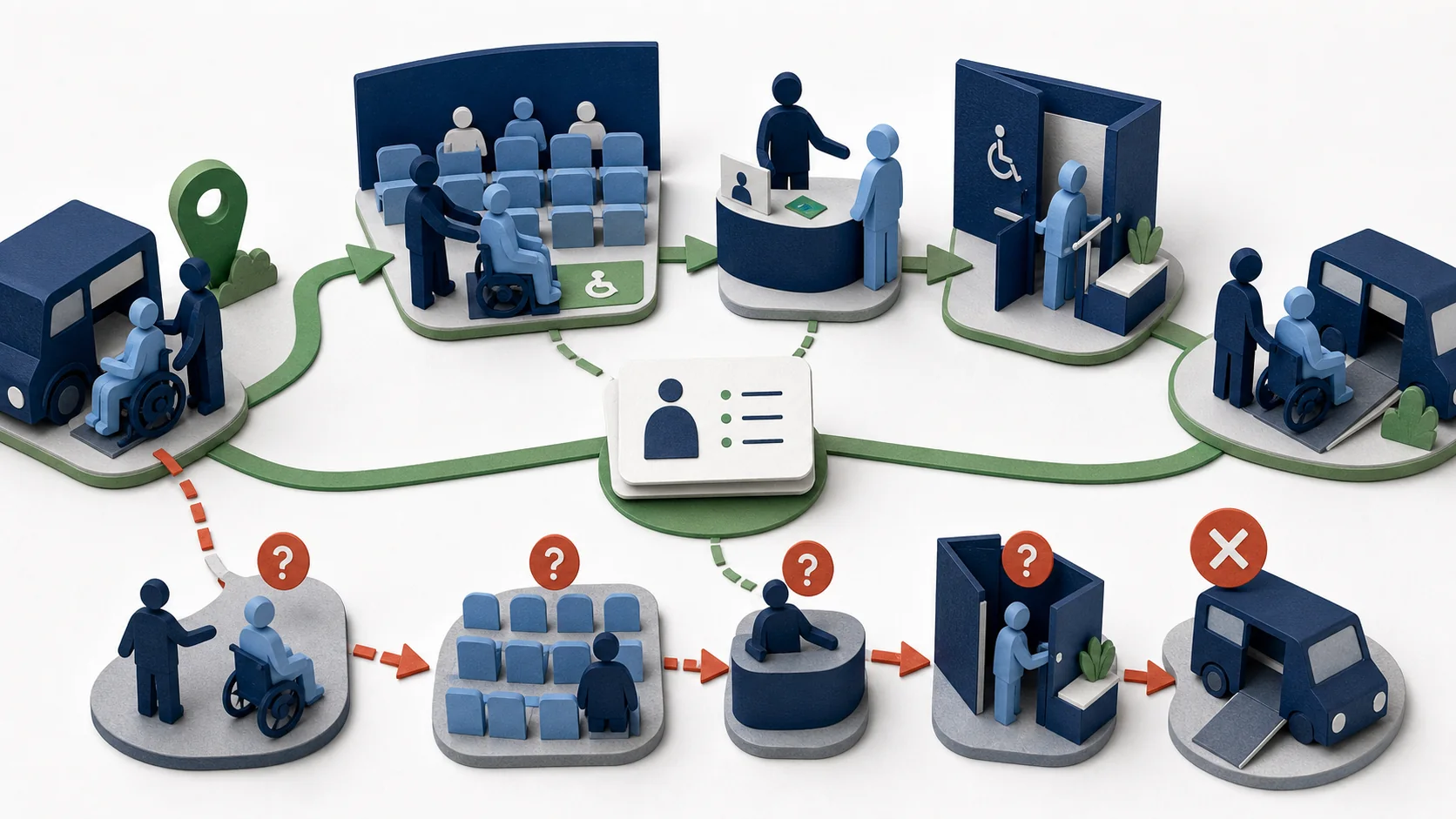
A promise made at purchase, and a separate reality on event day
A concertgoer or fan purchases accessible seating or requests an accommodation at the point of ticketing — often through a specific process distinct from general ticket sales. That request represents a real commitment: the venue has, at least administratively, agreed to provide something specific. Whether that commitment is reliably delivered on event day — accessible entry actually functioning, the promised seating actually being available and appropriate, staff actually being prepared to assist — depends on coordination between ticketing, venue operations, and event-day staffing that isn't always tightly connected.
This is a genuinely structural gap: the organization that sells the accessible ticket, the organization that operates the venue, and the staff actually present on event day may have limited real-time coordination, even though the accommodation, from the attendee's perspective, is a single continuous promise.
Why this counts as a dead end, not an isolated staffing issue
An individual staffing shortfall on a given night isn't itself the dead end — that can happen in any operation. The dead end is the absence of any owner accountable for the accommodation actually carrying through from ticketing to the attendee's real experience. Checked against a visible next step, an owner, a recovery path, and an activation path: there's often no clear next step for an attendee whose promised accommodation isn't available on arrival, beyond escalating in the moment, at the event itself, when options are most limited; ownership of accommodation delivery is frequently split between the ticketing organization (which made the promise) and the venue (which has to deliver it), with no single accountable party; there's no recovery path once the event has started; and evidence of accommodation failures — a specific complaint, a specific unmet need — often doesn't reach ticketing, meaning the organization that made the original promise may never learn it wasn't kept.
Who stands to lose
Attendees who requested and were promised an accommodation, and who discover — often at the worst possible moment, at the event itself — that the promise wasn't reliably delivered. This affects trust not just in the specific venue but in the accommodation-request process generally, since an attendee who's had this experience once may reasonably distrust the promise the next time they consider purchasing accessible tickets anywhere.
What ticketing doesn't carry forward to the venue floor
The specific commitment made at ticketing doesn't reliably travel to the staff and systems actually present on event day. A seating accommodation confirmed in a ticketing system doesn't automatically mean venue staff, on the night, have clear, actionable information about what was promised and to whom.
What's still unresolved here
Which accessibility-dependent attendees are lost as repeat customers — of the venue, the team, the artist — because accommodation continuity failed at the exact point of actual need, on event day, rather than at the point of initial promise?
This is deliberately unanswered here. It is plausible that accommodation-delivery failures disproportionately affect long-term attendance and loyalty among accessibility-dependent fans, given how directly they experience the gap between promise and delivery, but establishing that requires accessibility-specific research this draft does not attempt to substitute for.
What accommodation continuity would require
This means a reliable, real-time link between what's promised at ticketing and what venue staff know and are prepared to deliver on event day — not a system that exists only administratively at the point of sale — and a defined, reachable point of contact if an accommodation isn't available as promised, ideally before the event, not only once the attendee has already arrived and discovered the gap.
The decision venue and ticketing leaders still have to make
The decision is whether accessibility accommodation is treated as a ticketing-system feature, considered complete once the request is logged, or as an operational commitment requiring coordination all the way through to event-day delivery — which requires ticketing and venue operations to share real, actionable information, not just a completed transaction record.
What to check against your own accommodation process
A useful test: for your next event, check whether venue staff on the ground have specific, actionable information about accommodation requests made through ticketing, or whether that information exists only in a system they don't have access to during the event itself. If the latter, the promise made at ticketing has no reliable path to being kept.
Before, during and after the dead end
This pattern should be managed across three decision windows, not only after the failure becomes visible. Before the dead end, the organization should watch for the signals that intent, trust, value or responsibility is starting to stall. During the dead end, the priority is to preserve context, name an owner, keep a useful next step visible and protect whatever value can still be recovered. After the immediate moment passes, the organization should measure what changed, identify which Revenue Unknown remains unresolved and redesign the experience so the next cycle starts earlier.
Transformidy infographic
Dead-end experience vs friction
Friction slows movement. A dead-end experience blocks recognition, decision, recovery, or continuity.
- 01
Friction
The person can continue, but with extra effort, delay, or confusion.
- 02
Dead end
The person cannot complete, recover, escalate, or know what happens next.
- 03
Recognition gap
The organization sees activity, but misses the blocked experience condition.
- 04
Decision needed
Someone must own the path, exception, handoff, or recovery rule.
FAQ
Why do accessibility accommodations promised at ticketing sometimes fail to carry through to the event itself?
This article addresses the question through the lens of experience continuity, the unresolved Revenue Unknown, and the decision window leaders still have before the pattern repeats.
What organizations are typically involved in delivering venue accessibility accommodations?
This article addresses the question through the lens of experience continuity, the unresolved Revenue Unknown, and the decision window leaders still have before the pattern repeats.
What is the Revenue Unknown-equivalent risk created by inconsistent accommodation delivery?
This article addresses the question through the lens of experience continuity, the unresolved Revenue Unknown, and the decision window leaders still have before the pattern repeats.
How can venues and ticketing systems improve accommodation continuity?
This article addresses the question through the lens of experience continuity, the unresolved Revenue Unknown, and the decision window leaders still have before the pattern repeats.
Related intelligence
Article
How to Find Dead-End Experiences Before Customers Defect
Dead-end experiences don't announce themselves — they hide inside metrics that look fine. Here's a practical way to find them before they show up as defection.
Article
Hotel Recovery Is Not Finished When the Apology Is Sent
A sincere apology closes a complaint. It doesn't necessarily rebuild the confidence a guest needs to book that hotel again. Here's why service recovery often stops one step too early.
Article
Healthcare Referrals Leave Patients Stranded Between Providers
A referral is a handoff between two providers who don't share a single system or, often, direct communication. Here's why that handoff is a common point where care intent quietly stops.