
Article
Bank Onboarding Doesn't End When the Account Opens
A successfully opened account is a milestone, not a finish line. Many new accounts sit unfunded and unused, and most banks measure onboarding success at exactly the point that stops mattering.
- Published
- July 28, 2026
- Updated
- August 12, 2026
- Reading time
- 7 min

The account opens, and the finish line moves without anyone noticing
A new customer successfully opens an account — identity verified, terms accepted, account created. In most banking metrics, this is the moment onboarding is considered complete. What happens next — whether the customer actually funds the account, makes a first transaction, and develops any ongoing relationship with it — is a separate question that "account opened" doesn't answer, and in many institutions, isn't tracked with the same rigor as the opening funnel itself.
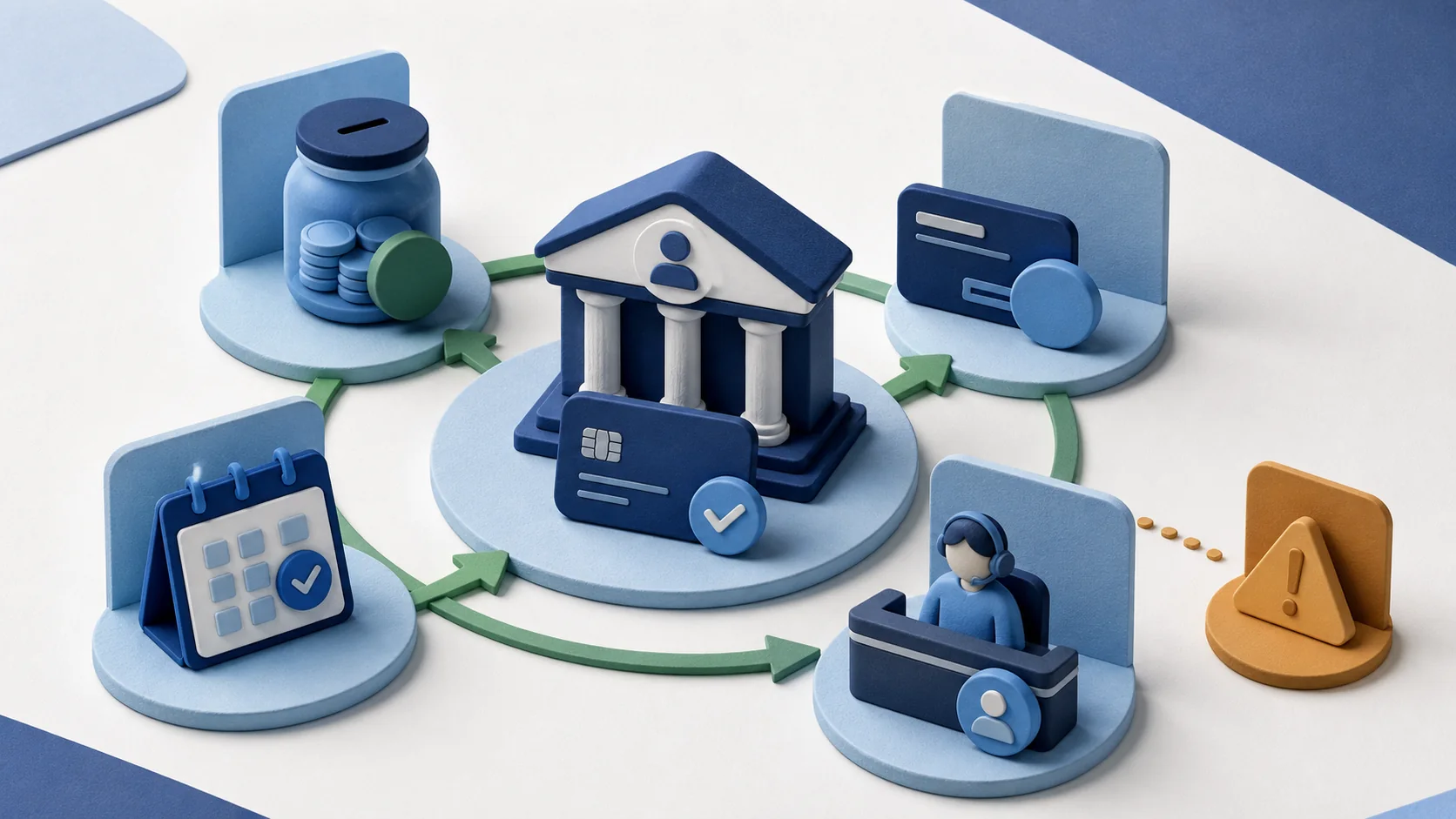
An opened, unfunded, unused account represents a customer who cleared every step the bank asked of them and then never actually became a functioning customer. That's a different outcome than either a completed onboarding or a failed one, and it often goes unmeasured as its own category.
Why "account created" isn't the same as "customer acquired"
Successfully opening an account is a real and necessary milestone — it isn't the dead end. The dead end is treating that milestone as equivalent to genuine customer acquisition when a meaningful gap can exist between the two. Checked against a visible next step, an owner, a recovery path, and an activation path: there's often no proactive next step after account opening beyond generic welcome messaging; ownership of "did this account ever get used" typically sits somewhere between marketing (focused on acquisition) and operations (focused on account maintenance), with no clear owner of the specific transition from opened to active; there's no recovery path targeted at unfunded or unused accounts, distinct from general customer communication; and account-activity data — which would clearly show dormancy — often isn't reviewed as an onboarding-funnel signal, only as a downstream account-management metric, if at all.
Who this shapes
New customers who completed account opening with genuine intent and then, for whatever reason (a delayed funding step, an unclear next action, competing priorities) never took the next step to actually use the account — a group the bank has already invested acquisition cost in, without realizing that investment hasn't yet produced a functioning customer. The bank is affected too: acquisition metrics can look strong while a meaningful share of "acquired" customers never generate any account activity.
What account creation doesn't confirm
Genuine use doesn't get confirmed by account creation. The bank knows an account exists; it doesn't necessarily know, without deliberate tracking, whether that account has ever been funded or used, because the acquisition funnel's own success metric stops at creation.
What this leaves unanswered
Which newly opened accounts go dormant specifically because onboarding stopped at account creation instead of extending to funding and first genuine use?
This is deliberately unanswered here. It is plausible that a meaningful share of "successful" account openings never convert into active accounts, but the actual dormancy rate and its causes depend on the specific institution and product, not a general assumption this article should not supply.
What onboarding-to-activation continuity would require
This means extending the onboarding funnel's own definition of success past account creation to include funding and a first transaction, with a proactive follow-up path (a check-in, a simplified funding step, a clear next action) for accounts that opened but haven't yet reached that point — rather than treating account creation as the funnel's natural endpoint.
The important distinction is between a compliant account-opening process and a useful first relationship. A bank may have completed the required steps correctly and still have left the customer's intent unused. Continuity does not mean pressuring the customer into activity; it means recognizing that an unfunded account is still an unresolved experience, with a decision window before the customer forgets why they opened it or moves the relationship elsewhere.
The decision retail-banking leaders still have to make
The decision is whether onboarding success is measured by account-opening completion (the easier, earlier milestone) or by evidence of genuine first use (the milestone that actually indicates a functioning customer relationship) — and whether the organization is willing to extend accountability for onboarding past the point where the account-opening team's traditional responsibility ends.
What to check against your own account-opening funnel
A useful test: pick a cohort of accounts opened in the past few months, and check what share have ever been funded or used. If that number is meaningfully lower than the account-opening completion rate, a real gap exists between what your onboarding metric measures and what it's assumed to represent.
Before, during and after the dead end
This pattern should be managed across three decision windows, not only after the failure becomes visible. Before the dead end, the organization should watch for the signals that intent, trust, value or responsibility is starting to stall. During the dead end, the priority is to preserve context, name an owner, keep a useful next step visible and protect whatever value can still be recovered. After the immediate moment passes, the organization should measure what changed, identify which Revenue Unknown remains unresolved and redesign the experience so the next cycle starts earlier.
Transformidy infographic
Dead-end experience vs friction
Friction slows movement. A dead-end experience blocks recognition, decision, recovery, or continuity.
- 01
Friction
The person can continue, but with extra effort, delay, or confusion.
- 02
Dead end
The person cannot complete, recover, escalate, or know what happens next.
- 03
Recognition gap
The organization sees activity, but misses the blocked experience condition.
- 04
Decision needed
Someone must own the path, exception, handoff, or recovery rule.
FAQ
Why do newly opened bank accounts sometimes go unfunded or unused?
This article addresses the question through the lens of experience continuity, the unresolved Revenue Unknown, and the decision window leaders still have before the pattern repeats.
What is the difference between account creation and genuine account activation?
This article addresses the question through the lens of experience continuity, the unresolved Revenue Unknown, and the decision window leaders still have before the pattern repeats.
What is the Revenue Unknown created by unmanaged post-opening dormancy?
This article addresses the question through the lens of experience continuity, the unresolved Revenue Unknown, and the decision window leaders still have before the pattern repeats.
How can banks extend onboarding accountability past account creation?
This article addresses the question through the lens of experience continuity, the unresolved Revenue Unknown, and the decision window leaders still have before the pattern repeats.
Related intelligence
Article
How to Find Dead-End Experiences Before Customers Defect
Dead-end experiences don't announce themselves — they hide inside metrics that look fine. Here's a practical way to find them before they show up as defection.
Article
Hotel Recovery Is Not Finished When the Apology Is Sent
A sincere apology closes a complaint. It doesn't necessarily rebuild the confidence a guest needs to book that hotel again. Here's why service recovery often stops one step too early.
Article
Healthcare Referrals Leave Patients Stranded Between Providers
A referral is a handoff between two providers who don't share a single system or, often, direct communication. Here's why that handoff is a common point where care intent quietly stops.