
Article
B2B Account Health Signals Arrive Too Late to Act On
Order volume, payment timing, and engagement patterns often tell you an account is at risk months before churn confirms it. Most organizations only look at that data after the relationship is already lost.
- Published
- July 21, 2026
- Updated
- August 12, 2026
- Reading time
- 8 min

The data existed. No one was looking at it in time.
A B2B relationship ends — a churned account, a lost contract, a partnership that quietly dissolved. In the aftermath, it's often possible to look back at the account's own data and see a pattern: order volume declining over several months, payment terms slipping, engagement with the account team thinning out, support contacts becoming more frequent or more frustrated. This pattern was there, in the organization's own systems, the entire time. It simply wasn't reviewed as a distinct, actionable signal until the relationship had already reached a point where reversal was much harder.
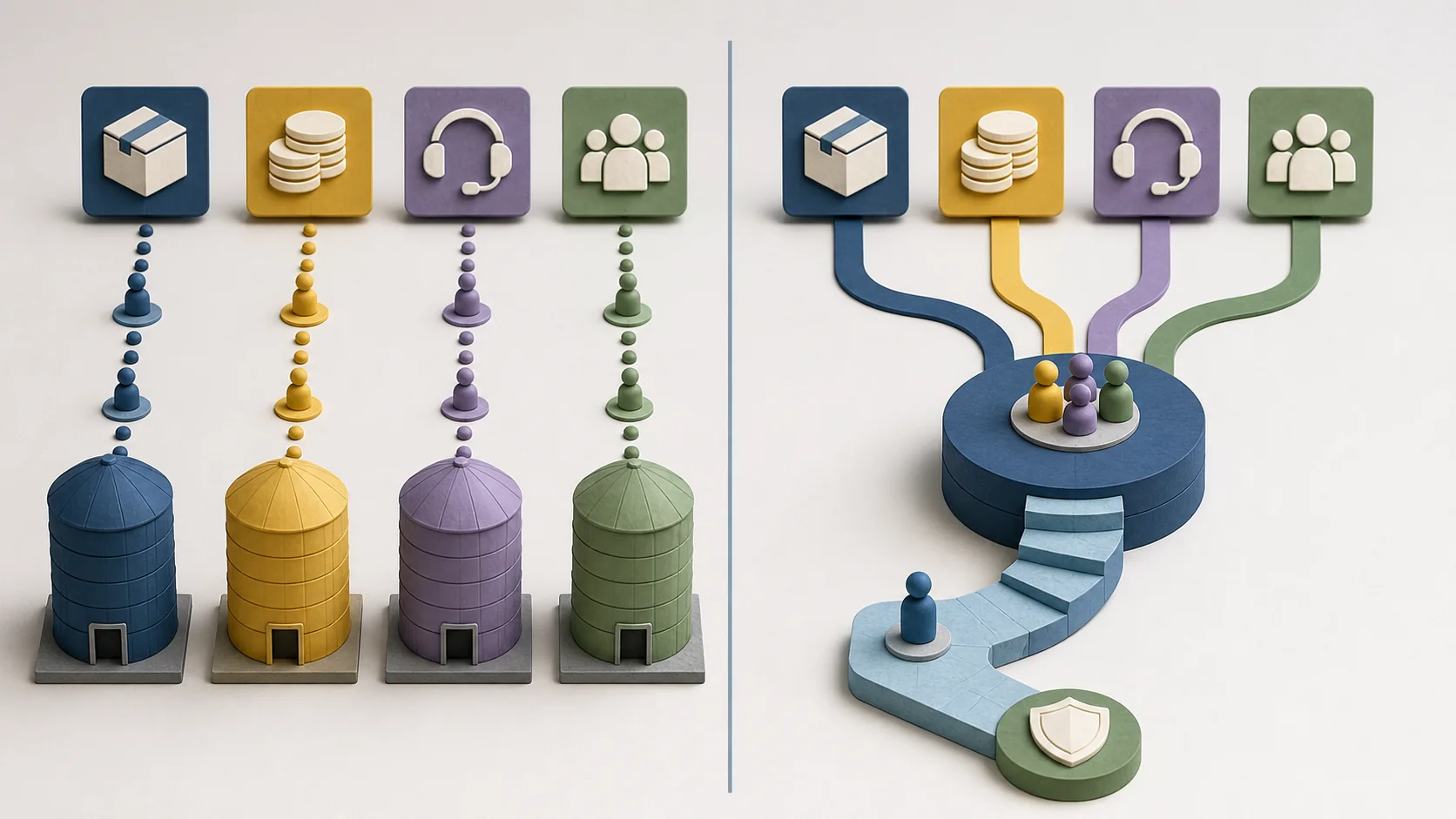
The data existing and the data being used are different things. Most B2B organizations have some version of this account-health information somewhere in their CRM, billing, and support systems. Far fewer have a defined process reviewing it together, on a cadence that would allow intervention before the relationship is effectively already decided.
Why this is a dead end, not just hindsight
Account relationships naturally fluctuate, and not every dip in engagement signals real risk — that alone isn't the dead end. The dead end is having no defined process for reviewing these signals together, so that genuine risk patterns aren't distinguished from normal fluctuation until it's too late to matter. Checked against a visible next step, an owner, a recovery path, and an activation path: there's often no next step triggered by a declining-signal pattern, since no one is looking at the combination of signals together; ownership of account-health monitoring is frequently split across sales, finance (payment data), support (contact patterns), and success, none of whom may have visibility into the others' data; there's no recovery path until the account is already visibly at risk, by which point options are more limited; and the signals themselves — while individually tracked in their respective systems — usually aren't combined into a single account-level view anyone reviews routinely.
Who feels this most
Account teams who could have intervened earlier with the right visibility, and didn't have it — meaning the loss, when it happens, may look sudden from their perspective even though the underlying data suggested it wasn't. The B2B customer is affected too, in a less obvious way: an account genuinely worth saving, experiencing friction the vendor could have addressed, instead drifts toward departure because no one on the vendor side connected the signals in time to reach out.
What separate systems don't combine into
A single account-health view doesn't happen automatically. Order data lives in one system, payment data in another, support history in a third, and engagement patterns possibly nowhere formally tracked at all — each individually visible to whoever owns that system, but rarely combined into the kind of composite view that would make a genuine risk pattern visible before it's severe.
A question worth sitting with
Which B2B relationships showed early distress signals the organization already had access to, across systems, but never combined and reviewed in time to intervene before the account was effectively already lost?
This is deliberately unanswered here. It is plausible that a meaningful share of B2B churn is preceded by a detectable, multi-signal pattern that simply wasn't reviewed as a composite view, but establishing the actual scale requires organization-specific data connecting account-health signals to eventual outcomes.
What signal-review continuity would require
This means combining order, payment, support, and engagement data into a single account-level view, reviewed on a defined cadence — not necessarily sophisticated predictive modeling, but simply the discipline of looking at these signals together rather than separately, and a clear owner responsible for acting when the combined view crosses a concerning threshold, rather than each function noticing its own piece in isolation.
The decision B2B leaders still have to make
The decision is whether account health is treated as something each function monitors independently within its own system, or as a cross-functional responsibility with a single owner accountable for the combined signal — which requires deciding this coordination is worth building deliberately, rather than assuming any one function will naturally notice a pattern that only becomes visible when their data is combined with someone else's.
A test worth running against your own account base
A useful check: pick an account that churned in the past year, and see whether combining its order, payment, support, and engagement data in hindsight would have shown a detectable pattern before the churn became obvious. If it would have, that same combined-view discipline, applied prospectively rather than retrospectively, is the gap this article describes.
Before, during and after the dead end
This pattern should be managed across three decision windows, not only after the failure becomes visible. Before the dead end, the organization should watch for the signals that intent, trust, value or responsibility is starting to stall. During the dead end, the priority is to preserve context, name an owner, keep a useful next step visible and protect whatever value can still be recovered. After the immediate moment passes, the organization should measure what changed, identify which Revenue Unknown remains unresolved and redesign the experience so the next cycle starts earlier.
Transformidy infographic
Dead-end experience vs friction
Friction slows movement. A dead-end experience blocks recognition, decision, recovery, or continuity.
- 01
Friction
The person can continue, but with extra effort, delay, or confusion.
- 02
Dead end
The person cannot complete, recover, escalate, or know what happens next.
- 03
Recognition gap
The organization sees activity, but misses the blocked experience condition.
- 04
Decision needed
Someone must own the path, exception, handoff, or recovery rule.
FAQ
Why does B2B account churn often look sudden when data suggested it wasn't?
This article addresses the question through the lens of experience continuity, the unresolved Revenue Unknown, and the decision window leaders still have before the pattern repeats.
What is the difference between account-health data existing and being reviewed?
This article addresses the question through the lens of experience continuity, the unresolved Revenue Unknown, and the decision window leaders still have before the pattern repeats.
What is the Revenue Unknown created by unreviewed, siloed account-health signals?
This article addresses the question through the lens of experience continuity, the unresolved Revenue Unknown, and the decision window leaders still have before the pattern repeats.
How can B2B organizations build a combined account-health review process?
This article addresses the question through the lens of experience continuity, the unresolved Revenue Unknown, and the decision window leaders still have before the pattern repeats.
Related intelligence
Article
How to Find Dead-End Experiences Before Customers Defect
Dead-end experiences don't announce themselves — they hide inside metrics that look fine. Here's a practical way to find them before they show up as defection.
Article
Hotel Recovery Is Not Finished When the Apology Is Sent
A sincere apology closes a complaint. It doesn't necessarily rebuild the confidence a guest needs to book that hotel again. Here's why service recovery often stops one step too early.
Article
Healthcare Referrals Leave Patients Stranded Between Providers
A referral is a handoff between two providers who don't share a single system or, often, direct communication. Here's why that handoff is a common point where care intent quietly stops.