
Article
AI Chatbot Containment Is Not the Same as Resolution
"Contained" means a conversation ended without reaching a human agent. It doesn't mean the user's problem was actually solved. Here's why that distinction gets lost in a widely-used metric.
- Published
- July 7, 2026
- Updated
- August 12, 2026
- Reading time
- 7 min

A number that measures the wrong thing precisely
Containment rate — the share of chatbot conversations that end without escalating to a human agent — is a common way organizations measure conversational-AI performance. It's a precise, easily trackable number. It's also, on its own, silent about the question that actually matters: did the person's issue get resolved. A conversation can be "contained" because the chatbot solved the problem, or because the user gave up, got frustrated, or found a workaround outside the chat entirely. All three look identical in a containment-rate dashboard.
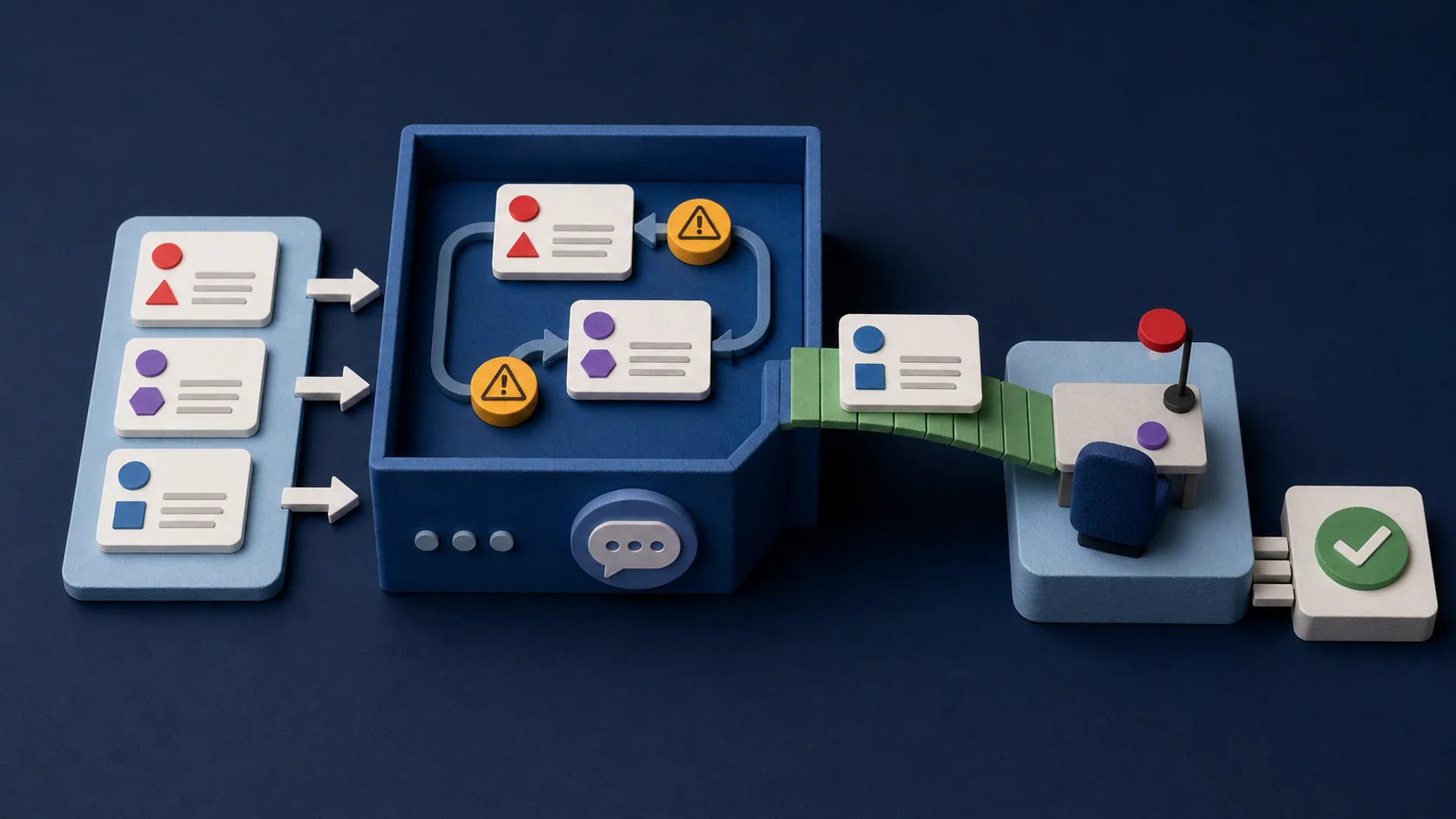
This gap exists because containment is genuinely easy to measure (did escalation happen, yes or no) while resolution is genuinely hard to measure (did the underlying issue actually get solved, from the user's perspective) — and organizations, understandably, gravitate toward the metric that's easier to track, even when it isn't the one that answers the real question.
Why high containment can hide a real problem
Containment itself isn't the dead end — many contained conversations genuinely are resolved, and reducing unnecessary human escalation is a legitimate goal. The dead end is a measurement system that can't distinguish a resolved conversation from an abandoned one, and defaults to counting both as success. Checked against a visible next step, an owner, a recovery path, and an activation path: a contained conversation ending in silent abandonment offers no next step to the user, who has simply stopped engaging; ownership of the difference between "contained" and "resolved" often doesn't exist as a distinct responsibility, since containment is the number that gets reported; there's no recovery path for a user who left the chatbot conversation without their issue solved, since the system has no signal that anything went wrong; and the conversation data itself — what the user actually needed, whether it was delivered — often isn't reviewed for the abandoned cases specifically.
Who is affected
Users whose issue wasn't actually resolved but whose conversation still counts as a success in the organization's own reporting — meaning their unresolved problem is structurally invisible to the team that could fix it. Also affected: the teams making decisions based on containment rate as a proxy for chatbot effectiveness, who may be over-crediting a system that's succeeding at ending conversations without succeeding at solving problems.
What containment doesn't confirm
Resolution doesn't get confirmed by the absence of escalation. A user who closes a chat window in frustration and a user who closes it because their issue is genuinely solved produce, in most systems, the identical signal: conversation ended, no escalation. Nothing in that signal distinguishes the two.
The measurement question underneath
Which contained chatbot conversations represent silent abandonment — a user who gave up — rather than genuine resolution, and how many issues does that hide from the teams who could fix the underlying cause?
This is deliberately unanswered here. It is plausible that a meaningful share of contained conversations in many deployments are abandonment rather than resolution, but the actual split requires conversation-level analysis specific to a given deployment, not a general industry estimate.
What resolution-anchored measurement would require
This means adding a confirmation signal distinct from containment — even something as simple as a direct check-in ("did this solve your issue?") that produces a genuine resolution signal, rather than inferring success from the absence of escalation. It also means routing low-confidence or explicitly-unresolved conversations to a real recovery path (a human, a different channel) rather than letting them close silently.
The decision technology and customer-service leaders still have to make
The decision is whether containment rate continues to serve as the primary success metric for conversational AI, or is explicitly paired with a resolution-confirmation metric that can actually distinguish the two outcomes it currently conflates — which requires investing in measurement that's harder to build than containment tracking, but answers a fundamentally different and more important question.
What to check against your own containment number
A useful test: pick a sample of "contained" conversations and manually review whether the user's actual issue appears to have been resolved. If a meaningful share look like abandonment rather than resolution, your containment rate is measuring something other than what it's usually assumed to represent.
Before, during and after the dead end
This pattern should be managed across three decision windows, not only after the failure becomes visible. Before the dead end, the organization should watch for the signals that intent, trust, value or responsibility is starting to stall. During the dead end, the priority is to preserve context, name an owner, keep a useful next step visible and protect whatever value can still be recovered. After the immediate moment passes, the organization should measure what changed, identify which Revenue Unknown remains unresolved and redesign the experience so the next cycle starts earlier.
Transformidy infographic
Dead-end experience vs friction
Friction slows movement. A dead-end experience blocks recognition, decision, recovery, or continuity.
- 01
Friction
The person can continue, but with extra effort, delay, or confusion.
- 02
Dead end
The person cannot complete, recover, escalate, or know what happens next.
- 03
Recognition gap
The organization sees activity, but misses the blocked experience condition.
- 04
Decision needed
Someone must own the path, exception, handoff, or recovery rule.
FAQ
Why is chatbot containment rate not the same as resolution rate?
This article addresses the question through the lens of experience continuity, the unresolved Revenue Unknown, and the decision window leaders still have before the pattern repeats.
What does a "contained" conversation actually measure?
This article addresses the question through the lens of experience continuity, the unresolved Revenue Unknown, and the decision window leaders still have before the pattern repeats.
What is the Revenue Unknown-equivalent risk created by conflating containment with resolution?
This article addresses the question through the lens of experience continuity, the unresolved Revenue Unknown, and the decision window leaders still have before the pattern repeats.
How can organizations measure whether a chatbot conversation actually resolved a user's issue?
This article addresses the question through the lens of experience continuity, the unresolved Revenue Unknown, and the decision window leaders still have before the pattern repeats.
Related intelligence
Article
How to Find Dead-End Experiences Before Customers Defect
Dead-end experiences don't announce themselves — they hide inside metrics that look fine. Here's a practical way to find them before they show up as defection.
Article
Hotel Recovery Is Not Finished When the Apology Is Sent
A sincere apology closes a complaint. It doesn't necessarily rebuild the confidence a guest needs to book that hotel again. Here's why service recovery often stops one step too early.
Article
Healthcare Referrals Leave Patients Stranded Between Providers
A referral is a handoff between two providers who don't share a single system or, often, direct communication. Here's why that handoff is a common point where care intent quietly stops.