
Article
Abandoned Carts Are a Dead End Without Recovery Intelligence
Most abandoned-cart recovery sends the same email to everyone who leaves. Here's why that treats a specific, unresolved reason as generic hesitation — and what it misses.
- Published
- June 25, 2026
- Updated
- August 12, 2026
- Reading time
- 7 min

One trigger, one message, many different reasons
A shopper fills a cart and leaves without buying. Somewhere behind the scenes, a marketing-automation rule fires: a reminder email, sometimes a discount, sent a day or two later. This happens regardless of why the shopper left — whether they were price-checking, got stopped by an unexpected shipping cost, hesitated over a return policy they couldn't find, or simply got interrupted and forgot. One trigger, one message, applied uniformly to a genuinely varied set of reasons.
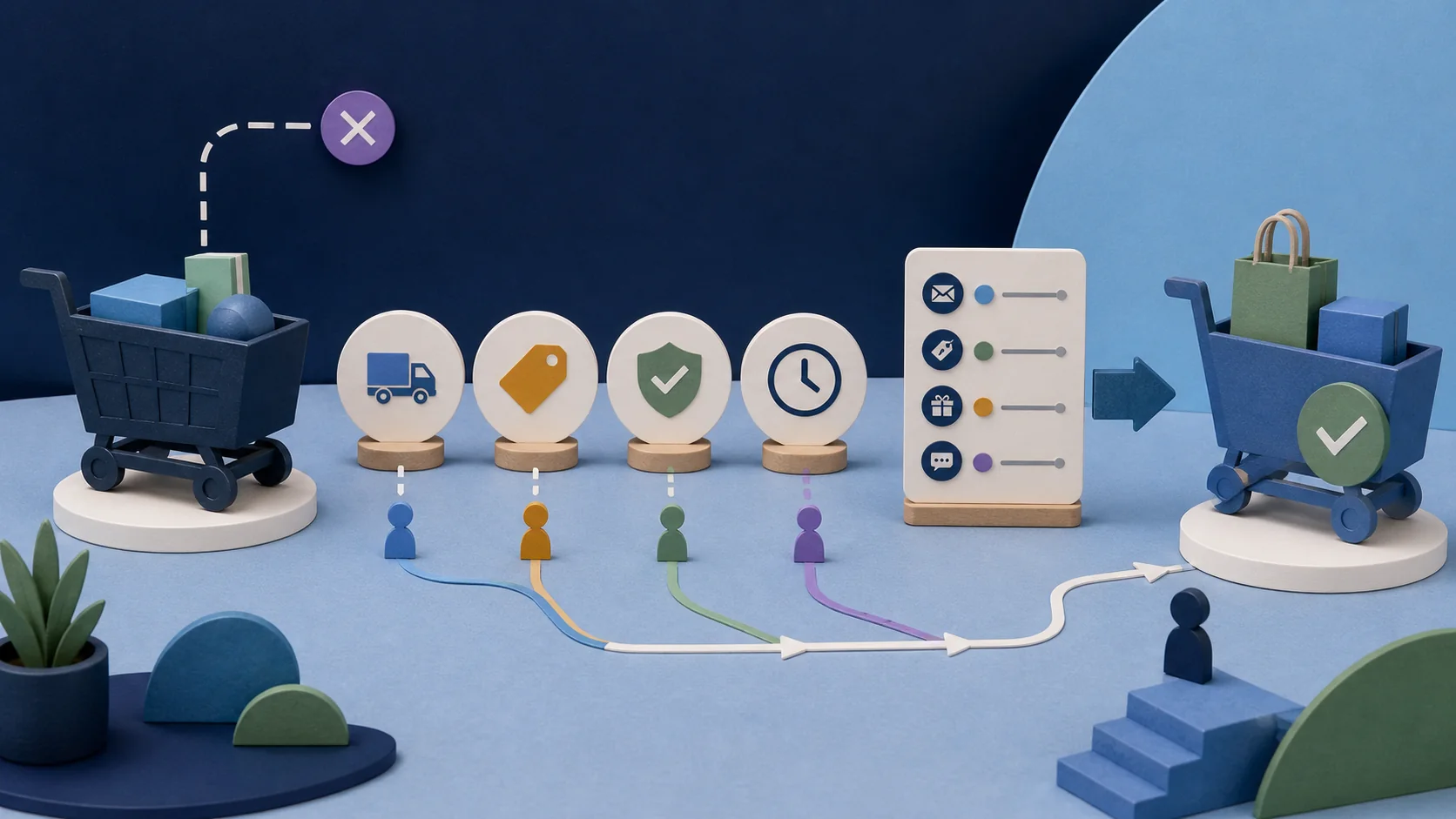
The abandonment itself isn't unusual — most browsing sessions don't end in purchase, and that's a normal feature of retail. What's worth examining is what happens to the specific evidence a cart abandonment generates: a real, timestamped signal of what someone wanted and why they stopped short of buying it, discarded in favor of a single generic recovery message that doesn't ask, or use, the "why."
The difference between a recovery email and recovery intelligence
A recovery email is not nothing — it's a genuine attempt to bring someone back. But it treats abandonment as an undifferentiated event rather than a specific, diagnosable moment. Checked against a visible next step, an owner, a recovery path, and an activation path: the next step (a reminder email) exists, but isn't shaped by the actual reason for abandonment; ownership sits with a marketing-automation workflow, not anyone reviewing whether the recovery approach fits the abandonment cause; the "recovery path" is uniform rather than tailored; and the richest evidence generated — where in the checkout flow the shopper stopped, what they saw right before leaving — usually never reaches anyone positioned to fix the underlying cause.
The people this shapes, and the ones who never see it
The shopper, who receives a generic nudge that may or may not address whatever actually stopped them. Also affected: the people inside the organization — checkout UX, pricing, logistics — who would benefit most from abandonment-cause data and typically never see it, because that data lives inside a marketing tool optimized for sending messages, not diagnosing checkout friction.
What the reminder email doesn't carry forward
The specific reason for hesitation doesn't travel anywhere. A shopper who abandoned because of an unexpected shipping cost and a shopper who abandoned because they got distracted receive the same message, because the system triggering that message doesn't distinguish between them — it only knows a cart was left behind, not why.
The question worth separating from cart-recovery tactics
Which abandoned-cart intent reflects a genuine, addressable reason — price, shipping, trust, a confusing step — that a generic recovery email never actually resolves, as opposed to intent that was never going to convert regardless of the message sent?
This is deliberately unanswered here. It is plausible that a meaningful share of "failed" cart recoveries are failing because the recovery approach doesn't match the abandonment cause, not because the shopper was never a real prospect, but the actual split requires checkout-funnel data specific to a given retailer.
What recovery intelligence would require
Distinguishing abandonment causes doesn't require guessing — checkout systems typically already record where in the flow a shopper stopped (before or after seeing shipping cost, before or after a validation step, before or after account creation). Using that existing data to shape the follow-up — a shipping-cost-specific message for a shipping-triggered abandonment, a trust signal for someone who stalled at a security step — is a different kind of recovery than a single templated reminder, and it depends on someone deciding the checkout-analytics data and the marketing-automation trigger should talk to each other.
The decision ecommerce leaders still have to make
The decision is whether cart abandonment is owned purely by marketing, measured on recovery-email open and click rates, or treated as a checkout-diagnostics problem that marketing, product, and logistics all have a stake in — since the actual fix for a given abandonment cause often sits outside marketing's control entirely.
A test worth running against your own funnel
A useful check: pick a sample of recent abandoned carts, and see whether your checkout analytics can tell you where each one stopped. If that data exists but has never been cross-referenced against what the recovery email said, the intelligence is sitting unused, not absent.
Before, during and after the dead end
This pattern should be managed across three decision windows, not only after the failure becomes visible. Before the dead end, the organization should watch for the signals that intent, trust, value or responsibility is starting to stall. During the dead end, the priority is to preserve context, name an owner, keep a useful next step visible and protect whatever value can still be recovered. After the immediate moment passes, the organization should measure what changed, identify which Revenue Unknown remains unresolved and redesign the experience so the next cycle starts earlier.
Transformidy infographic
Dead-end experience vs friction
Friction slows movement. A dead-end experience blocks recognition, decision, recovery, or continuity.
- 01
Friction
The person can continue, but with extra effort, delay, or confusion.
- 02
Dead end
The person cannot complete, recover, escalate, or know what happens next.
- 03
Recognition gap
The organization sees activity, but misses the blocked experience condition.
- 04
Decision needed
Someone must own the path, exception, handoff, or recovery rule.
FAQ
Why do generic cart-abandonment emails often fail to recover sales?
This article addresses the question through the lens of experience continuity, the unresolved Revenue Unknown, and the decision window leaders still have before the pattern repeats.
What is the difference between a recovery email and recovery intelligence?
This article addresses the question through the lens of experience continuity, the unresolved Revenue Unknown, and the decision window leaders still have before the pattern repeats.
What is the Revenue Unknown created by undiagnosed cart abandonment?
This article addresses the question through the lens of experience continuity, the unresolved Revenue Unknown, and the decision window leaders still have before the pattern repeats.
How can retailers use checkout data to shape cart-recovery messages?
This article addresses the question through the lens of experience continuity, the unresolved Revenue Unknown, and the decision window leaders still have before the pattern repeats.
Related intelligence
Article
How to Find Dead-End Experiences Before Customers Defect
Dead-end experiences don't announce themselves — they hide inside metrics that look fine. Here's a practical way to find them before they show up as defection.
Article
Hotel Recovery Is Not Finished When the Apology Is Sent
A sincere apology closes a complaint. It doesn't necessarily rebuild the confidence a guest needs to book that hotel again. Here's why service recovery often stops one step too early.
Article
Healthcare Referrals Leave Patients Stranded Between Providers
A referral is a handoff between two providers who don't share a single system or, often, direct communication. Here's why that handoff is a common point where care intent quietly stops.