
Article
SMS Marketing: The 7.6% Doing 45% of the Work
Klaviyo's 2026 data shows automated SMS flows are just 7.6% of sends but drive 45.2% of total SMS revenue—eight times the revenue-per-recipient of blast campaigns. Meanwhile, a single non-compliant campaign to 10,000 people can expose a business to $5 million or more under the TCPA. Most brands are still optimizing the wrong 92%.
- Published
- February 5, 2025
- Updated
- June 18, 2026
- Reading time
- 8 min
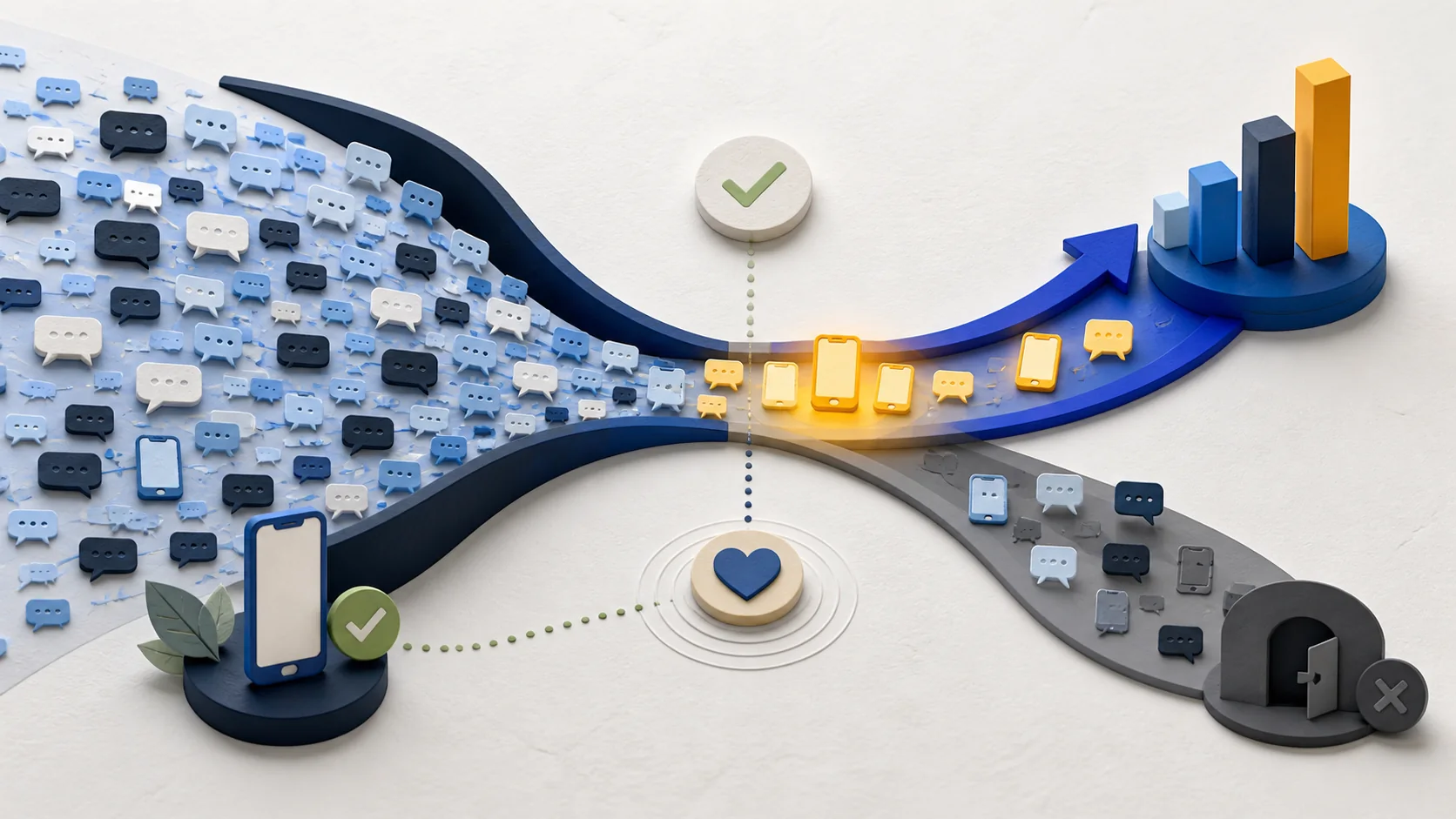
2026 updated analysis
What changed since the original article
This page keeps the original Transformidy article as the canonical record and leads with the current interpretation, source notes, and Revenue Unknown framing.
The Revenue Concentration
Klaviyo's 2026 SMS benchmarks, drawn from its own customer base, isolate a structural pattern that channel-level averages hide: SMS flows account for just 7.6% of sends, yet drive 45.2% of total SMS revenue. The same data set shows SMS flows generate roughly 8 times higher revenue per recipient than campaigns on average, with the top 10% of flows achieving revenue per recipient above $5.
The distinction between the two message types is the entire explanation. A campaign is a scheduled broadcast sent to a list regardless of what any individual recipient is doing at that moment. A flow is triggered by a specific, demonstrated action—an abandoned cart, a completed purchase, a browse without a buy. The flow message arrives exactly when purchase intent is highest. The campaign message arrives on a marketing calendar's schedule, hoping intent happens to align.
Share of SMS sends that are automated flows, vs. share of SMS revenue they generate
Flows generate roughly 8x higher revenue per recipient than blast campaigns; the top 10% of flows exceed $5 revenue per recipient.
The Compliance Side of the Ledger
The other 92.4% of send volume is not just lower-yield—it is also where nearly all of the channel's legal exposure lives, because campaigns are the broad, list-wide sends most likely to reach someone whose consent has lapsed or was never properly documented. TCPA violations carry statutory damages of $500 per text, tripled to $1,500 per text if a court finds the violation willful, and a single class-action lawsuit involving 10,000 recipients can expose a business to $5 million or more in liability.
Put the two data points together and the shape of a well-run SMS program becomes clear: a small, high-consent, behavior-triggered flow program that carries most of the revenue and most of the compliance discipline (because each flow is scoped to a specific, documented trigger), and a broad campaign program that carries most of the legal risk while contributing a smaller revenue share per message sent.
That is not an argument against campaigns. It is an argument for treating campaign volume as something to govern carefully rather than maximize by default—since every additional campaign send adds legal exposure at a rate the revenue data does not justify chasing for its own sake.
Optimizing the Channel Average vs. Optimizing Flow Coverage
Same total send volume. Different place the effort goes.
Channel average: marketing effort spreads evenly across campaigns and flows, following the volume. Flow-first: marketing effort concentrates on expanding and refining flow triggers first, since flows deliver roughly 8x the revenue per recipient at a fraction of the compliance risk.
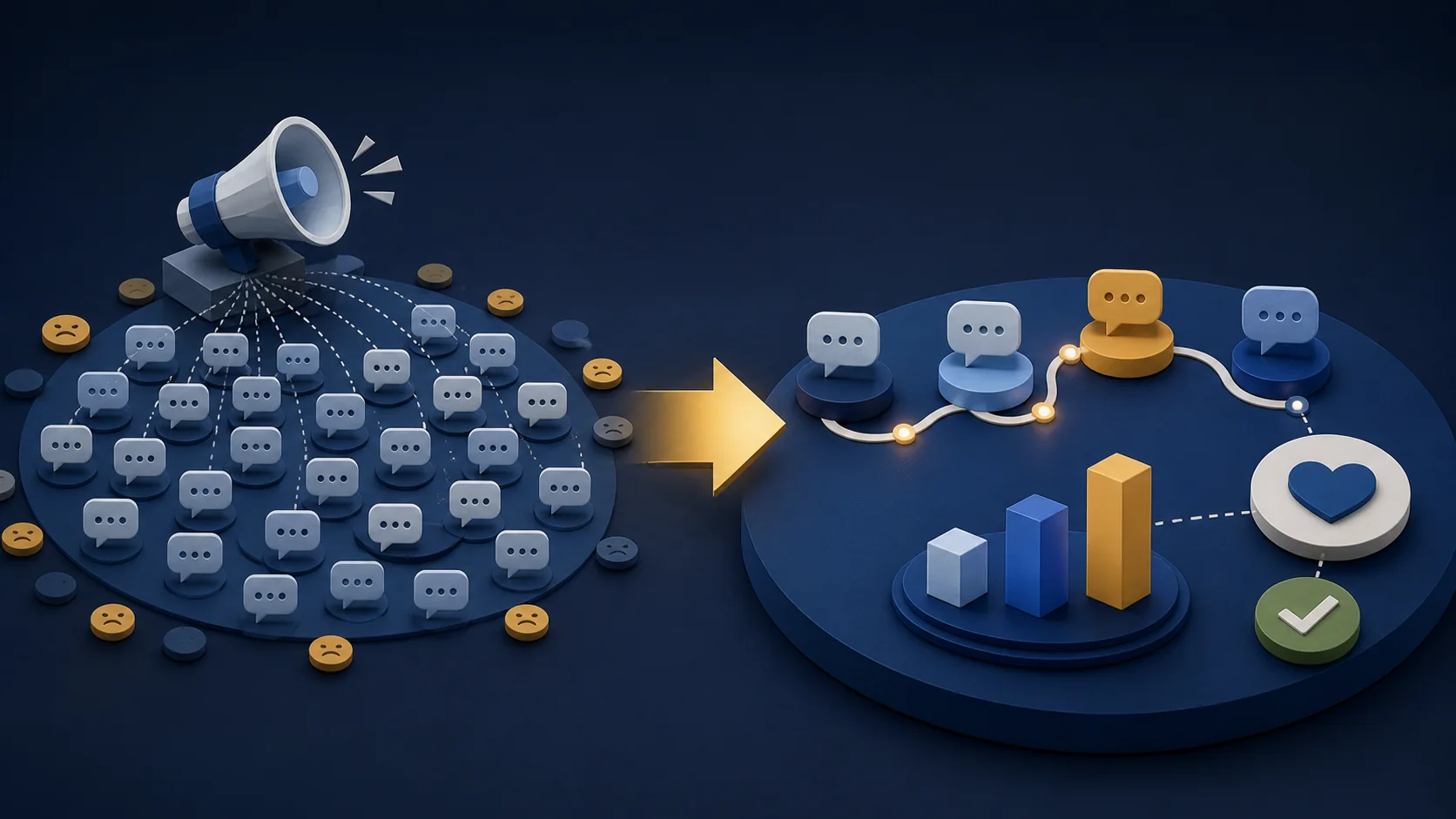
The channel average tells you SMS is working. It will never tell you which 7.6% of it is actually doing the work.
The Leadership Move
The structural choice is whether SMS strategy is set by channel-level averages (open rate, overall revenue, total sends) or by the revenue-per-message breakdown between flows and campaigns specifically.
- Ownership
Lifecycle or CRM marketing owns flow expansion and quality; brand or growth marketing owns campaign cadence and consent governance. When one team owns "SMS" as an undifferentiated channel, flow expansion competes for attention against campaign volume without either function having a clear mandate to prioritize the higher-yield, lower-risk work.
- Tradeoff
Building out additional flow triggers (browse abandonment, post-purchase follow-up, win-back sequences) requires engineering and creative investment concentrated on a smaller audience per trigger. Campaigns are faster to produce and reach more people per send. The tradeoff is between speed and reach on one side, and revenue-per-message and compliance safety on the other—and the 2026 data weights that tradeoff more heavily toward flows than most programs currently reflect.
- Human consequence
Customers experience a well-timed flow message as helpful—a reminder about the exact item they were just considering. They experience an untargeted, poorly-consented campaign blast as intrusive, and a customer who never properly opted in and receives one becomes a legal claimant, not just an annoyed unsubscriber. The gap between those two experiences is not about SMS as a medium; it is entirely about targeting and consent discipline.
Next Move
If your SMS program is mostly campaign-driven today: Audit what percentage of your sends are flows versus campaigns and compare it to Klaviyo's 7.6%/45.2% benchmark split. If flows are underrepresented relative to that benchmark, prioritize expanding trigger coverage (cart abandonment, browse abandonment, post-purchase, win-back) before adding more campaign volume.
If you send SMS campaigns at meaningful list-wide volume: Confirm your consent documentation is airtight for every recipient on that list, not just for recent opt-ins. At $500-$1,500 per non-compliant text and $5 million-plus exposure for a single 10,000-recipient class action, the compliance review costs far less than the risk it prevents.
FAQ
What's the difference between an SMS flow and an SMS campaign?
A campaign is a one-time blast sent to a broad list at a chosen moment—a sale announcement, a new product launch. A flow is an automated message triggered by a specific customer action: an abandoned cart, a completed purchase, a browse without buying. Flows are personalized to behavior; campaigns are broadcast to everyone on the list at once.
Why do SMS flows generate so much more revenue per message than campaigns?
Because a flow message arrives at a moment of demonstrated intent—someone just abandoned a cart, just bought something, just browsed a category—while a campaign message arrives regardless of what the recipient was doing at that moment. Klaviyo's 2026 data shows flows generate roughly 8 times higher revenue per recipient than campaigns, because the trigger itself does the targeting work a campaign has to do through guesswork.
How risky is TCPA non-compliance for SMS marketing?
Statutory damages run $500 per text message sent without proper consent, tripled to $1,500 per text if a court finds the violation willful. A single class-action lawsuit covering 10,000 recipients can expose a business to $5 million or more in liability—for one non-compliant campaign send, not a pattern of abuse.
Where should a marketing team focus its SMS effort in 2026?
On flow coverage and flow quality first. If flows are already 7.6% of sends and 45.2% of revenue, expanding flow triggers (browse abandonment, post-purchase, win-back) and refining flow copy has a larger revenue ceiling than optimizing campaign send times or subject-line-equivalent hooks. Campaign volume should be governed primarily by consent and compliance discipline, not maximized for reach.
Sources & References
Original article archive
Original article published February 5, 2025: "SMS: Revolutionize Customer Engagement And Unlock New Opportunities". Preserved here for provenance, historical context, and citation continuity.
In today’s fast-paced digital world, where attention spans are shorter than ever, businesses need a way to cut through the noise and connect with their customers instantly. Imagine reaching someone directly in their pocket—no app downloads, no login required—just a simple message that gets opened within minutes.
That’s the power of SMS. With an open rate exceeding 98%, SMS has emerged as one of the most effective tools for customer engagement. Whether it’s sending personalized offers, appointment reminders, or critical updates, SMS bridges the gap between brands and consumers like no other medium. But how did this humble technology evolve into such a powerhouse? And what does its future hold in the era of omnichannel communication?
Key Takeaways
- SMS enjoys a staggering 98% open rate, making it one of the most effective channels for customer engagement.
- Personalization and timeliness are crucial to maximizing the impact of SMS campaigns.
- Businesses must balance innovation with ethical considerations, especially regarding data privacy.
- Integrating SMS with other tools creates a unified, frictionless customer journey.
- The future of SMS lies in its ability to complement—and enhance—emerging technologies within omnichannel ecosystems.
Introduction
Customer engagement is the lifeblood of any successful business. From building brand loyalty to driving sales, engaging with your audience effectively can make all the difference. While social media, email, and chatbots dominate the conversation around modern marketing strategies, SMS remains a hidden gem—a reliable, high-performing channel that continues to deliver results year after year. In fact, according to Mobilesquared, over 2 trillion text messages were sent globally in 2022 alone. Despite being one of the oldest forms of mobile communication, SMS has proven itself time and again as a versatile tool capable of transforming customer experiences (CX).
History of SMS, Key Milestones, and Its Role in Customer Engagement
Short Message Service (SMS) was first conceptualized in 1984 by Friedhelm Hillebrand and Bernard Ghillebaert, who envisioned a system allowing users to send short texts via GSM networks. The first-ever SMS—"Merry Christmas"—was sent on December 3, 1992, by Neil Papworth, a British engineer, to Richard Jarvis of Vodafone. Little did they know that this modest beginning would pave the way for a global phenomenon.
Over the decades, SMS evolved from a novelty to a necessity. By the early 2000s, businesses began recognizing its potential as a direct line to consumers. Airlines started sending flight notifications; banks introduced transaction alerts; retailers experimented with promotional campaigns. Fast forward to today, and SMS is now integral to customer engagement strategies across industries. According to Twilio, 90% of consumers prefer receiving SMS communications from businesses compared to other channels.
The rise of two-way messaging platforms further expanded SMS capabilities, enabling interactive conversations rather than one-sided broadcasts. For example, Domino’s Pizza allows customers to place orders via SMS, creating a seamless user experience. Similarly, healthcare providers use SMS to remind patients about appointments, reducing no-show rates significantly. These innovations underscore why SMS remains relevant despite newer technologies vying for attention.
SMS Benefits and Drawbacks - A Discussion
Benefits
Simplicity, Efficiency and Accessibility
SMS offers a unique combination of simplicity, efficiency, and accessibility that makes it an invaluable tool for customer engagement. One of its most significant advantages is its unparalleled reach. With over 5 billion mobile phone users globally, SMS ensures that businesses can connect with nearly anyone, regardless of their access to smartphones or high-speed internet. This universal compatibility eliminates barriers often associated with other digital channels, such as app downloads or email logins.
Immediacy and Urgency
Another standout benefit is the immediacy of SMS. Unlike emails, which may sit unopened in crowded inboxes, SMS messages are typically read within minutes of receipt. According to Sender.net, the average open rate for SMS hovers around 98%, with 90% of messages being opened within three seconds.
This rapid response time makes SMS ideal for time-sensitive communications, such as flash sales. For example, a study by CodeBroker found that 75% of research participants are willing to provide their name and address in exchange for a mobile coupon for sales.
Personalization and Attribution
Personalization further amplifies the effectiveness of SMS. Modern platforms allow businesses to segment audiences based on demographics, purchase history, or behavior patterns, enabling highly targeted campaigns. A retailer might send tailored discount codes to frequent shoppers or notify loyal customers about exclusive events. Such personalized interactions not only increase engagement but also foster emotional connections, driving long-term loyalty. It also improves engagement vs sales attribution which often plagued marketers.
Cost Efficient Compared To Other Marketing Methods
From a cost perspective, SMS is remarkably economical compared to traditional advertising methods like TV commercials or billboards. Bulk messaging services offer competitive pricing models, making it feasible even for small businesses to implement SMS strategies. Additionally, two-way communication capabilities have expanded its utility beyond one-sided broadcasts. Customers can reply directly to messages, creating opportunities for real-time feedback and problem resolution.
Technology Seamlessness
Finally, SMS integrates seamlessly with other technologies, such as AI-driven chatbots and CRM systems. For instance, a financial institution could use messages to alert customers about suspicious account activity while simultaneously triggering an automated chatbot to assist with inquiries. This synergy enhances operational efficiency and enriches the overall customer experience.

Drawbacks
Capacity Challenges
Despite its many strengths, SMS does come with limitations that businesses must carefully navigate. One notable drawback is the character restriction inherent to standard messages. Each message is capped at 160 characters, which can pose challenges when trying to convey complex information or detailed instructions. While concatenated messages (longer texts split into multiple parts) exist, they risk fragmentation and reduced clarity, potentially frustrating recipients.
Privacy Concerns
Privacy concerns represent another significant hurdle. Collecting and storing phone numbers necessitates strict adherence to data protection regulations like GDPR (General Data Protection Regulation) in Europe or TCPA (Telephone Consumer Protection Act) in the United States. Failure to comply with these laws can result in hefty fines and reputational damage. Moreover, unsolicited messages—commonly referred to as spam—can alienate customers and erode trust. A survey by Statista revealed that 45% of consumers consider promotional SMS intrusive if sent too frequently or without prior consent.
Limited Support For Rich Media Content
Limited support for rich media is another limitation of traditional SMS. Unlike MMS (Multimedia Messaging Service) or newer platforms like WhatsApp, this messaging technology cannot natively embed images, videos, or clickable links. While shortened URLs can be included, they require additional steps from the recipient, potentially reducing click-through rates. Furthermore, formatting options are minimal, restricting creativity in message design.
Consistency and Reliability
Lastly, over-reliance on SMS without integrating it into broader communication strategies can lead to disjointed experiences. For example, if a customer receives conflicting information via SMS and email, it creates confusion and diminishes confidence in the brand. Therefore, businesses must ensure coherence across all touch points to maintain consistency and reliability. Additionally, they relies on internet access or mobile service provider interaction. Breakdowns on these technologies could slow them time sensitive SMS promotion from being delivered or activated.
Key Metrics to Evaluate Success
To measure the success of SMS campaigns, companies could focus on the following metrics:
Response Rate: If you’re using two-way SMS for customer support or surveys, monitor response rates to assess customer engagement and satisfaction.
Open Rate: Since messages are typically opened immediately, a high open rate is a positive sign of engagement.
Click-Through Rate (CTR): If your messages contain links, monitor how many recipients click on those links. This will help gauge the effectiveness of your call-to-action.
Conversion Rate: Track how many recipients complete the desired action, whether that’s making a purchase, signing up for an event, or redeeming a discount.
Opt-Out Rate: Keep an eye on how many customers are unsubscribing from your campaigns. A high opt-out rate may indicate that your messages are too frequent or irrelevant.
Companies could also assess attribution by sending promotional messages to various targeted segments to determine how well they react and take actions.
Recommendations: Overview
To maximize the value of SMS as a customer engagement tool, companies must adopt a strategic approach that balances human-centric inputs with technological innovation. Recommendations should address privacy concerns, leverage advanced testing methodologies, and align SMS efforts with overarching business goals. By incorporating AI and automation into development and testing phases, organizations can streamline processes, reduce errors, and enhance personalization.
1. Prioritize Privacy and Compliance
In today’s data-driven world, privacy is paramount. Consumers are increasingly wary of how their personal information is collected and used, making compliance a non-negotiable aspect of any SMS strategy. According to a 2023 survey by Cisco, 62% of consumers expressed concern about how organizations are using their personal data for AI today, with 60% saying that they have already lost trust in organizations because of their AI use. For SMS campaigns that could be completed through AI, obtaining explicit consent before sending messages is not only ethical but also legally required under regulations like GDPR and TCPA.
Human Inputs:
Train employees on data protection laws and establish clear consent protocols. This includes educating marketing teams on crafting transparent opt-in messages and ensuring customer service representatives can address privacy-related queries effectively.
Technology Inputs:
Implement secure databases to store phone numbers and integrate compliance-checking tools like OneTrust or TrustArc. These platforms automatically flag potential violations and help maintain audit trails for regulatory purposes.
CX Implications:
By prioritizing privacy, businesses build trust and avoid alienating customers. A study by Deloitte found that only 41% think it has become easier to protect their online data in the past year, and a mere 34% feel companies are clear about how they use the data they collect from online services. Transparent communication fosters goodwill and strengthens relationships.
Costs & Timelines:
The initial cost of training staff and implementing compliance software ranges from US$5,000 to $15,000+, depending on the organization's size. Ongoing maintenance involves periodic audits and updates, which typically require 10-20 hours per quarter.
Use Case Example:
Starbucks implemented a robust consent management system for its SMS loyalty program. Customers must explicitly agree to receive promotional texts, and they can easily unsubscribe at any time. As a result, Starbucks achieved a 90% retention rate among SMS subscribers, according to a case study published in eTail.
2. Invest in Development and Testing (with AI and Automation)
Testing is critical to ensure SMS campaigns perform optimally. Incorporating AI and automation into development and testing processes allows businesses to refine their strategies with precision. AI-powered analytics tools can analyze historical data to determine the best times to send messages, predict customer responses, and identify areas for improvement.
Human Inputs:
Collaboration between marketing, IT, and customer service teams is essential. Define success metrics such as open rates, click-through rates (CTR), and conversion rates. Human oversight ensures that automated insights align with broader business objectives.
Technology Inputs:
Leverage AI-driven platforms like Twilio Segment or Braze for A/B testing. Automate workflows using APIs to streamline message delivery and track performance in real-time. For example, AI can detect patterns indicating when customers are most receptive to promotional offers. Also, this can determine when how much engagement a customer can handle (e.g., one a week? many times a week?)
CX Implications:
Well-tested campaigns deliver consistent, high-quality experiences. According to Salesforce, personalized and timely interactions increase customer satisfaction by up to 20%. Automation reduces errors, ensuring messages reach the right audience at the right time.
Costs & Timelines:
Initial investment in AI tools ranges from US$5,000 to $20,000+, depending on the platform's complexity. Testing cycles typically take 2-4 weeks per iteration, with ongoing adjustments based on performance data.
Use Case Example:
Domino’s Pizza partners with Microsoft to use AI to optimize its SMS ordering system. The company tests different versions of order confirmation messages to identify the most effective tone and timing. This approach has contributed to up to a 30% increase in SMS-driven sales.
3. Leverage SMS for Sales Uplift
SMS is a powerful driver of sales due to its immediacy and personalization capabilities. When used strategically, it can boost revenue by targeting customers with relevant offers at key moments in their purchasing journey.
Human Inputs:
Analyze customer behavior to identify upsell and cross-sell opportunities. Marketing teams should collaborate with sales departments to craft compelling promotions tailored to individual preferences.
Technology Inputs:
Integrate SMS with CRM systems like Salesforce or HubSpot to enable dynamic content generation. Use predictive analytics to recommend products based on past purchases or browsing history.
CX Implications:
Personalized SMS campaigns enhance the shopping experience by providing value-added suggestions. A study by McKinsey revealed that personalized recommendations can increase sales by 10-15%.
Costs & Timelines:
The incremental cost of integrating SMS with CRM systems could relatively low compared to other marketing methods, often ranging from US$1,000 to $5,000+. Businesses typically see a return on investment (ROI) within 1-3 months, depending on campaign effectiveness.
Use Case Example:
Sephora sends personalized product recommendations via SMS to its loyalty program members. By leveraging purchase history and browsing data, the beauty retailer achieved a higher conversion rate compared to email campaigns.
4. Utilize VCF or vCard Attachments
Including contact details in vCard format simplifies saving your business info to a customer’s phonebook. This small yet impactful feature enhances accessibility and reinforces long-term connections. Additionally, vCard adds a layer of security for customers to identify the sender and avoid bad actors.
Human Inputs:
Encourage adoption by highlighting the convenience of vCards. Train customer-facing teams to promote this feature during interactions, emphasizing its utility for future reference.
Technology Inputs:
Develop standardized vCard templates compatible with various devices. Test compatibility across operating systems to ensure seamless functionality.
CX Implications:
vCards make it easier for customers to engage with your brand, fostering familiarity and trust. A report by Zendesk revealed that third-party messaging has a CSAT of 98%, the highest across different channels.
Costs & Timelines:
Implementation costs are minimal, usually under US$1,000. Testing and rollout typically take 1-2 weeks.
Use Case Example:
EZ Texting surveyed 3,000 US consumers and noted that 75% of them now prefer to receive appointment reminders via text (2022).
5. Integrate SMS with Broader Marketing Efforts
To create a cohesive omnichannel experience, SMS should complement other communication channels like email, social media, and push notifications. Seamless integration ensures consistency and maximizes engagement.
Human Inputs:
Align messaging tone and style across channels. Coordinate campaign schedules to avoid overwhelming customers with repetitive or conflicting information.
Technology Inputs:
Sync SMS with marketing automation platforms like Marketo or Adobe Campaign. Monitor cross-channel analytics to assess performance and adjust strategies accordingly.
CX Implications:
Omnichannel integration enhances relevance and convenience. According to Gartner, organizations leveraging multiple touch points see a 20-80% increase in customer satisfaction.
Costs & Timelines:
Integration costs vary based on existing infrastructure but generally range from US$10,000 to $50,000+. Full implementation is achievable within 3-6 months.
Use Case Example:
Nike combines SMS with email and push notifications to engage customers throughout their fitness and sales journeys. This helps generate up to US$900 million in digital sales.
Below is a detailed breakdown of top recommendations, presented in tabular format for clarity.
| Recommendation | Human Inputs | Technology Inputs | CX Implications | Potential Costs and Timelines |
| 1. Prioritize Privacy and Compliance | Train staff on data protection laws; establish clear consent protocols | Implement secure databases; integrate compliance-checking tools | Builds trust and avoids legal penalties; ensures ethical handling of customer data | Moderate upfront costs (~US$5k-$15k+) for training, policies and software; ongoing maintenance required |
| 2. Invest in Development and Testing | Collaborate between marketing, IT and customer service teams; define success metrics | Use AI-powered analytics for A/B testing; automate workflows using APIs | Ensures error-free delivery and optimizes timing/content; improves campaign performance | Initial investment in AI tools (~US$5k-$20k+); testing cycles take 2-4 weeks per iteration |
| 3. Leverage SMS for Sales Uplift | Analyze customer behavior to identify upsell/cross-sell opportunities | Integrate SMS with CRM and loyalty programs; enable dynamic content generation | Drives revenue through personalized promotions; increases repeat purchases | Low incremental costs (~US$1k to $5k+); ROI visible within 1-3 months |
| 4. Utilize VCF or vCard Attachments | Encourage adoption by highlighting ease of saving contact info | Develop standardized vCard templates; test compatibility across devices | Simplifies future interactions; reinforces professional image | Minimal costs (~US$1k); implementation takes 1-2 weeks |
| 5. Integrate SMS with Marketing Efforts | Align messaging tone and style across channels; coordinate campaign schedules | Sync SMS with email, social media and push notification platforms; monitor cross-channel analytics | Creates cohesive omni-channel experience; reduces redundancy and enhances relevance | Costs depend on existing infrastructure (~US$10,000 to $50,000+); full integration achievable within 3-6 months |
The Future of Using SMS Along with Other Tools in Omnichannel Communication
As consumer expectations grow more sophisticated, businesses must adopt a holistic approach to communication. SMS will continue playing a vital role alongside emerging technologies like AI chatbots, voice assistants, and augmented reality.
For example, imagine a scenario where a customer receives an SMS reminder about an upcoming webinar, RSVPs via a chatbot, and later accesses the event link through a push notification. Such seamless transitions enhance convenience and reinforce brand loyalty. Additionally, advancements in RCS (Rich Communication Services) promise richer multimedia experiences without sacrificing SMS’s core strengths.
Transform for the Better
SMS may have started as a simple means of exchanging text, but it has grown into a cornerstone of modern customer engagement. Its unparalleled reach, speed, and intimacy make it indispensable for businesses seeking meaningful connections. By embracing best practices, prioritizing privacy, and integrating SMS into broader strategies, companies can unlock untapped potential and elevate their CX to new heights.
How Can Transformidy Help?
Transformidy is available to assist in helping you understand artificial intelligence and how prepared your company is in building a solution for customers, employees, stakeholders.
Contact us or set up a 30 minute complimentary consultation for more information on our services, insights, or showcases. We look forward to hearing from you.
FAQ
What's the difference between an SMS flow and an SMS campaign?
A campaign is a one-time blast sent to a broad list at a chosen moment—a sale announcement, a new product launch. A flow is an automated message triggered by a specific customer action: an abandoned cart, a completed purchase, a browse without buying. Flows are personalized to behavior; campaigns are broadcast to everyone on the list at once.
Why do SMS flows generate so much more revenue per message than campaigns?
Because a flow message arrives at a moment of demonstrated intent—someone just abandoned a cart, just bought something, just browsed a category—while a campaign message arrives regardless of what the recipient was doing at that moment. Klaviyo's 2026 data shows flows generate roughly 8 times higher revenue per recipient than campaigns, because the trigger itself does the targeting work a campaign has to do through guesswork.
How risky is TCPA non-compliance for SMS marketing?
Statutory damages run $500 per text message sent without proper consent, tripled to $1,500 per text if a court finds the violation willful. A single class-action lawsuit covering 10,000 recipients can expose a business to $5 million or more in liability—for one non-compliant campaign send, not a pattern of abuse.
Where should a marketing team focus its SMS effort in 2026?
On flow coverage and flow quality first. If flows are already 7.6% of sends and 45.2% of revenue, expanding flow triggers (browse abandonment, post-purchase, win-back) and refining flow copy has a larger revenue ceiling than optimizing campaign send times or subject-line-equivalent hooks. Campaign volume should be governed primarily by consent and compliance discipline, not maximized for reach.
Related intelligence
Article
SharePoint's Real 2025-2026 Story Was Nation-State Attacks, Not CX Strategy
Nation-state hackers exploited on-premises SharePoint servers in 2025, confirmed by Shadowserver at over 300 victims worldwide. In 2026, a new vulnerability rated 9.8 out of 10 severity emerged in the same product line. SharePoint did not quietly rewire anyone's CX strategy. It became a sustained target.
Article
Apple Is Reportedly Building a MacBook Designed to Lose the Spec Sheet Comparison
Apple's new MacBook Neo runs an iPhone chip, not a Mac chip, and starts at $699 to $899, roughly $100 to $300 below the MacBook Air. It has no Thunderbolt. Apple built its first laptop specifically to lose a spec sheet comparison, on purpose, to win a price comparison instead.
Article
A Third of Walmart's Operating Income Now Comes From Ads and Memberships
Advertising and membership fees now account for a third of Walmart's operating income. Walmart Connect grew 41% in a quarter when retail sales grew about 5%, eight times faster. Retail media margins exceed 70%. Walmart is no longer just a retailer that also sells ads.