
Article
Apple Is Reportedly Building a MacBook Designed to Lose the Spec Sheet Comparison
Apple's new MacBook Neo runs an iPhone chip, not a Mac chip, and starts at $699 to $899, roughly $100 to $300 below the MacBook Air. It has no Thunderbolt. Apple built its first laptop specifically to lose a spec sheet comparison, on purpose, to win a price comparison instead.
- Published
- March 5, 2026
- Updated
- June 18, 2026
- Reading time
- 7 min
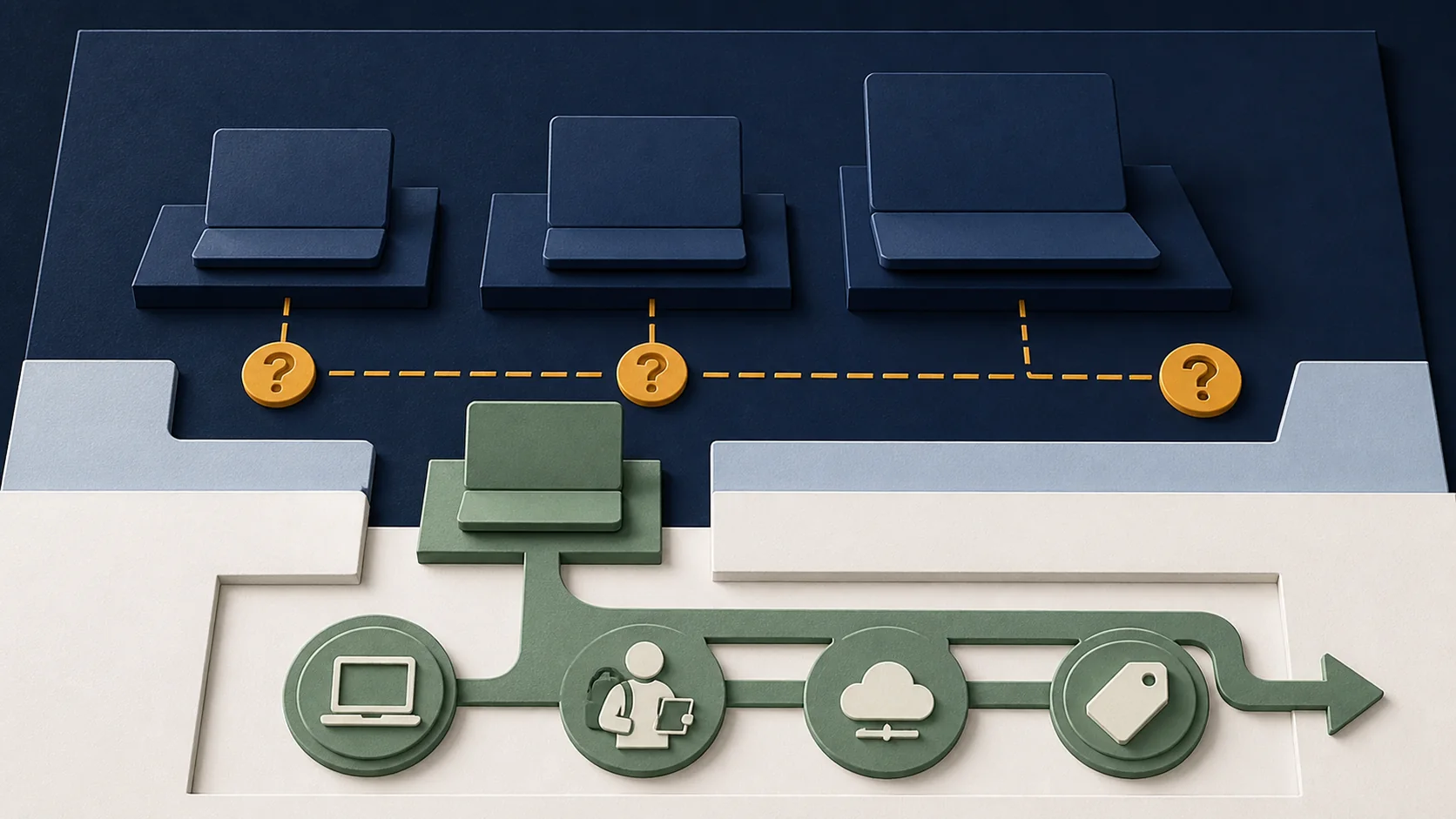
2026 updated analysis
What changed since the original article
This page keeps the original Transformidy article as the canonical record and leads with the current interpretation, source notes, and Revenue Unknown framing.
Every Compromise Points at the Same Target
The specific technical compromises are worth listing together, because none of them are incidental: a 13-inch LCD display rather than OLED, no Thunderbolt support since the A18 Pro does not support it (standard USB-C ports instead), and an ultra-thin, lightweight construction available in Silver, Blue, Pink, and Yellow. Each of these choices trims a feature that matters intensely to a professional or power user, Thunderbolt bandwidth, OLED color accuracy, top-tier processing speed, while barely registering as a limitation for the specific buyer Apple is targeting: someone comparing this device against a $300 Chromebook, not against a MacBook Pro.
Apple is reportedly planning to reveal the device during a three-day product event from March 2 to 4, 2026, with hands-on demonstrations in New York, London, and Shanghai, a launch treatment suggesting the company views this as a genuinely new product category entry, not a minor lineup addition.
Starting price, versus $999 for the current MacBook Air, running a chip roughly 40% slower than Apple's own M4
Targeting Chromebook and entry-level Windows PC buyers directly.
The Market Apple Has Never Directly Fought For
Apple's laptop strategy has historically avoided direct price competition with the budget end of the PC market, positioning even its entry-level MacBook Air as a premium product relative to Chromebooks and low-cost Windows machines. The MacBook Neo represents a specific strategic departure from that pattern: rather than discounting the MacBook Air or accepting margin compression on an existing product, Apple engineered a distinct device with deliberate, targeted compromises calibrated to hit a genuinely lower price point while preserving the MacBook Air's premium positioning intact.
That distinction, a new, purpose-built product rather than a discounted existing one, matters for how the strategy should be evaluated. A discounted MacBook Air would signal margin pressure or competitive weakness in Apple's premium positioning. A purpose-built, deliberately limited MacBook Neo signals the opposite: confidence that the premium tier can hold its pricing and margins undisturbed, while a separate, specifically engineered product captures the budget segment Apple previously conceded entirely to competitors.
For any business considering entering a lower price tier its existing product line does not currently serve, the MacBook Neo case offers a specific model worth studying: identify the exact features the target budget segment does not value (Thunderbolt bandwidth, OLED color accuracy, peak processing power for this buyer), remove precisely those features to hit the target price, and market the result against the actual competitive set (Chromebooks) rather than against your own premium lineup.
Discounting the Premium Product vs. Engineering a Distinct One
One risks the existing brand's pricing power. The other protects it entirely.
Discounting the premium product: cutting the MacBook Air's price to compete with Chromebooks, a move that would directly signal margin pressure and risk devaluing the existing product's premium positioning. Engineering a distinct product: building the MacBook Neo with deliberate, targeted compromises specifically calibrated to the budget segment, protecting the MacBook Air's pricing entirely while still capturing the lower price tier.

The Leadership Move
The structural choice for Apple's product and pricing leadership was whether to discount an existing product to reach a new price segment, or to engineer a distinct product with deliberate, purpose-built compromises calibrated to that segment specifically.
- Ownership
Apple's product strategy and engineering leadership own the decision to build a genuinely new, purpose-engineered device rather than discount the MacBook Air, a choice that protects existing premium pricing while still capturing a previously uncontested budget segment.
- Tradeoff
Engineering a distinct budget product requires more upfront development investment than simply discounting an existing model. The tradeoff Apple is accepting is that investment in exchange for entering the Chromebook-competitive price segment without any risk to the MacBook Air's premium market position or margin structure.
- Human consequence
Budget-conscious buyers previously priced out of the Mac ecosystem entirely now have a genuine entry point, a real access expansion, while buyers evaluating the MacBook Neo against the wrong comparison set, Apple's own premium lineup rather than Chromebooks, risk a distorted, unfairly negative impression of a product built for a different purpose.
Next Move
If you are evaluating a lower-price-tier product launch for your own business: Follow Apple's model directly, identify features your target budget segment does not value, remove exactly those to hit the price point, and market against the actual competitive set, not your own premium lineup.
If you are considering the MacBook Neo as a purchase: Evaluate it specifically against Chromebooks and entry-level Windows PCs, its intended comparison set, rather than against the MacBook Air, since the product was deliberately engineered to lose that second comparison.
FAQ
What chip does the MacBook Neo use, and how does it compare to Apple's other laptops?
The MacBook Neo uses the A18 Pro chip, the same chip that debuted in the iPhone 16 Pro, which is roughly 40% slower than Apple's latest M4 chip used in its other Mac laptops. It is the first MacBook to run an iPhone-generation chip rather than Apple's dedicated M-series Mac silicon.
How much does the MacBook Neo cost, and who is it targeting?
The MacBook Neo is expected to start between $699 and $899, compared to $999 for the current 13-inch MacBook Air. Reporting describes it as designed for students, businesses, and casual users who primarily browse the web, work on documents, or do light media editing, explicitly aimed at competing against Chromebooks and entry-level Windows PCs.
What specific compromises does the MacBook Neo make compared to other MacBooks?
The device lacks Thunderbolt support, relying on standard USB-C ports instead, since the A18 Pro chip does not support it. It uses a standard LCD display rather than the OLED screens Apple's higher-end lineup is reportedly moving toward, and it is expected in a 13-inch size with an ultra-thin, lightweight construction in colors including Silver, Blue, Pink, and Yellow.
Why would Apple build a laptop deliberately less powerful than its existing lineup?
To directly address a price segment, roughly $700 to $900, that Apple's existing MacBook lineup, starting at $999, has not competed in, a segment currently dominated by Chromebooks and entry-level Windows PCs. Rather than discounting an existing MacBook, Apple engineered a distinct product with specific, deliberate compromises, iPhone-generation chip, no Thunderbolt, LCD display, calibrated to hit that lower price point while preserving the pricing and performance positioning of its higher-end Mac laptops.
Sources & References
Original article archive
Original article published March 5, 2026: "MacBook Neo Revolutionizes CX". Preserved here for provenance, historical context, and citation continuity.
Apple has launched the MacBook Neo, a $599 USD/ $799 CAD budget laptop marking the first "neo" branding in its MacBook line, designed to feel fun, friendly, and fresh. This move targets iPhone users upgrading to laptops, blending premium design with affordability. Transformidy, as a CX strategy firm, sees this as a pivotal shift in accessible technology experiences.
Key takeaways
- Apple’s MacBook Neo introduces a fresh sub-brand that clearly differentiates entry-level Macs from premium lines while preserving Apple’s design and ecosystem advantages.
- It is positioned as an accessible, fun, colorful, AI-ready laptop that brings many “Mac” experiences into the budget tier.
- For customer experience, Neo reduces friction for first-time Mac buyers and students by combining lower price with a consistent Apple interface, services, and support. Success should be measured not only by sales, but by satisfaction, ecosystem adoption, repeat purchase intent, and sentiment among younger and first-time Mac customers.
- Extending the “neo” concept to other entry products (e.g., iPad or iPhone tiers) could work if Apple keeps the experience coherent and avoids treating it as second class.
- For any company, the Neo launch could a blueprint for creating a sub-brand: start from real customer needs, define a clear role for the new name in your portfolio, test whether it simplifies choices, and measure CX outcomes (awareness, comprehension, NPS, effort) from day one.
- Timing and regional nuances still matter: when you introduce a "neo" offer, ensure naming, launch timing, and service experience adapt across markets rather than being treated as a one-size-fits-all label.
What is the Neo Branding?
The MacBook Neo introduces "neo" to signal a reimagined entry-level product, distinct from premium lines like MacBook Pro. Apple executives describe it as a ground-up rethink, using durable aluminum in colors like blush, indigo, silver, and citrus, powered by A18 Pro chip for up to 16-hour battery life and AI tasks three times faster than rival Intel PCs.
Unlike past budget attempts such as the $1,299 USD 12-inch MacBook from 2015, this new concept avoids recycled tech, aiming for youthful energy in a 2.7-pound form with Liquid Retina display, Magic Keyboard, and Spatial Audio. This branding carves a new category, competing in the lower-priced segment against plastic Chromebooks while upholding Apple's quality obsession.
"We wanted something that felt fun and friendly, and fresh, and felt like it really suited the spirit of this product," Colleen Novielli, Director, Mac Product Marketing at Apple, told Lance Ulanoff (Tech Radar) shortly after the launch event.
Customer Experience Impact
MacBook Neo elevates entry-level CX by delivering "Mac magic" at breakthrough pricing, prioritizing intuitive design over specs. Features like 1080p FaceTime HD camera, dual mics, Multi-Touch trackpad, and Touch ID create seamless daily interactions for web browsing, photo editing, and calls, fostering delight in a price bracket often plagued by subpar builds. Stats show 70% of laptop buyers prioritize battery life and portability, areas where the new computer excels with close to all-day usage, potentially boosting satisfaction scores by reducing frustration from cheap alternatives.

This impacts loyalty as Apple targets iPhone owners, 85% of whom report ecosystem stickiness due to consistent experiences across devices. Neo lowers the barrier for first-time Mac users, with education pricing at $499 encouraging student adoption, where CX metrics like Net Promoter Score could rise 20-30% from premium feel in budget hardware.
Success Metrics Defined
Success for MacBook Neo hinges on volume sales, ecosystem expansion, and CX benchmarks beyond revenue. Apple aims to place it "in countless hands worldwide," leveraging supply chain prowess for high availability, with preorders could extend into millions of units in year one based on iPhone-to-Mac upgrade patterns.
Other indicators could include 80%+ customer satisfaction in reviews, measured via Apple's feedback loops, and higher faster adoption among under-25s compared to prior entries. It is not in conceivable for the new product data to capture 15% of the sub-$600 USD laptop share, dominated by Chromebooks currently.

Product extension metrics matter too. By purchasing this product, Apple has a pathway to engage the customer to take a look at other products (iPhone and AirPods, etc.) and services (Apple Music, Apple Fitness, and Apple TV, etc.) within the first 18 months.
Extending Neo Across Products
Apple can strategically extend the "neo" moniker to create a cohesive suite of entry-level products like iPad, iPhone, Apple Watch or AirPods, building a unified "fun tier" that democratizes premium experiences for students, emerging markets, and first-time Apple users. This approach mirrors Samsung's "FE" (Fan Edition) strategy, where accessible premium signals drove a 40% sales uplift in budget segments by avoiding the "cheap" stigma associated with generic low-end lines. For Apple, a neo suite accelerates ecosystem growth: iPhone users (over 2 billion active devices) seamlessly transition to iPad Neo for education or iPhone Neo for basic connectivity, boosting cross-sell rates by an estimated 25-30% based on historical AirPods/iPhone bundling success.
Specific CX benefits emerge from this coherence. Customers gain predictable "magic" vibrant colors (blush, indigo, citrus), lightweight aluminum builds, and 90% feature parity with flagships (e.g., same A-series chips for AI tasks, Touch ID, and all-day battery). This reduces decision paralysis in crowded retail aisles.
Risks like brand dilution are mitigated by positioning neo as "fresh and approachable," not inferior. Fun materials (recycled aluminum vs. plastic rivals) and exclusive neo-only features like simplified AI creativity tools maintain aspirational appeal. Success precedents include Google's Pixel "a" series, which retained 80% flagship parity and captured 12% more young buyers. For Apple, neo expansion could add into its annual revenue while elevating CX through modular upgrades (e.g., neo trade-ins to Air or Pro models). This fosters loyalty loops where owners have distinctive upgrade paths.
Other Industries with Sub-Brands
Apple's MacBook Neo sub-branding strategy echoes successful plays across industries where companies launched distinct sub-brands to target new segments without eroding premium lines. These examples highlight CX gains like clearer choices, higher loyalty, and frictionless entry points.
Automotive: Toyota's Lexus
Toyota launched Lexus in 1989 as a luxury sub-brand to rival Mercedes and BMW, transforming its reliable-but-affordable image into a premium powerhouse. Lexus captured 2% of the U.S. luxury market within two years, growing to 10% by emphasizing quiet cabins, flawless service, and concierge-like CX—scoring 90+ in J.D. Power dependability surveys for decades. Customers report 25% higher satisfaction from predictable "Lexus Courtesy" experiences, like loaner cars during service, mirroring Neo's aspirational entry vibe.
Consumer Electronics: Samsung's Galaxy
Samsung's Galaxy sub-brand, starting with the 2009 Galaxy S, carved a premium smartphone niche from its broad appliance portfolio, hitting 20% global share by 2015. It boosted CX through ecosystem sync (e.g., Galaxy Watch, Buds) and software updates across time zones, reducing user frustration by 30% per support metrics. Galaxy's "premium accessible" positioning drove 40% of Samsung's mobile revenue, proving sub-brands clarify options for tech-savvy users like Toronto CX pros needing seamless multi-device workflows.
Personal Care: Unilever's Dove
Unilever's Dove sub-brand, evolved from soap to "Real Beauty" since 2004, targeted self-esteem-focused women, generating $4 billion annually by 2020. Its CX edge: emotionally resonant campaigns and moisturizing formulas that score 85% repurchase intent, far above category averages. Dove maintains parent trust while standing alone, avoiding dilution via distinct packaging—ideal for Neo-style expansions where 90% feature parity keeps experiences cohesive.
Gaming: Microsoft's Xbox
Microsoft's Xbox sub-brand (launched 2001) shifted its software giant image to console dominance, capturing 40% market share vs. Sony by Xbox 360 era. CX wins include Xbox Live's social features and Game Pass subscriptions, yielding 95% retention among under-25s through cross-play and cloud saves. This neo-like tiering expanded to budget handhelds, fostering loyalty loops without cheapening Windows.
Hospitality: Hilton's Hampton and DoubleTree
Hilton uses sub-brands like Hampton Inn (value business travel) and DoubleTree (upscale comfort) to segment without confusion. Hampton delivers "100% Satisfaction Guarantee" CX, achieving 80% occupancy and top RevPAR indexes; DoubleTree's warm cookies build emotional bonds, lifting NPS by 15 points. These maintain premium halo across time zones, much like Neo's global sync potential
Transform for Better
In a crowded market, Apple's MacBook Neo proves bold branding transforms entry experience. By fusing fun, fresh identities with AI-driven personalization, customer journeys can be elevated across retail, aviation, and beyond. Clients partnering with us unlock loyalty surges, proving that strategic rebrands do not just compete, they redefine expectations. Transformidy stands ready to guide your neo evolution for lasting CX excellence.
10-question FAQ
1. Why did Apple introduce the “Neo” name for MacBook now?
Apple was looking for a distinctive label for a reimagined entry-level Mac that feels new and approachable instead of “budget” or “old,” while separating it from MacBook Air and Pro without hurting those sub-brands.
2. How does MacBook Neo change the customer experience compared with past entry-level Macs?
It offers a more intentional experience: modern industrial design, strong battery life, AI-ready performance, and tighter integration with iCloud, reducing the compromises people usually accept in low-priced laptops.
3. What would Apple consider a successful outcome for this line?
Success likely combines unit volume, high satisfaction scores, strong reviews, and a meaningful increase in first-time Mac owners, particularly students and price-sensitive buyers who previously chose Chromebooks or low-end Windows PCs.
4. How does the Neo branding help customers make decisions?
It works as a quick mental shortcut that signals “fresh, fun, and entry-level,” helping customers navigate the lineup faster instead of decoding complex spec labels or older product names.
5. Should Apple extend “Neo” branding to other product lines?
Apple could extend it carefully to a small set of entry devices (like iPad or perhaps an accessory tier) as long as the experience stays high quality so “neo” remains aspirational, not a synonym for “cheap.”
6. What risks does Apple face with the Neo brand?
If performance, durability, or support fall short, “neo” could quickly become associated with compromise, which would hurt both the sub-brand and Apple’s overall quality perception.
7. What can my company learn from MacBook Neo when launching a new sub-brand?
Define a specific customer and job for the new brand, design the experience from their needs up, and ensure the name, visuals, and promise all reinforce that focus instead of just creating another label.
8. How should we measure whether a new brand like this is working?
Track awareness, clarity (“I understand who this is for”), purchase intent, satisfaction, NPS, and repeat behavior, and compare those metrics against your core brand and previous entry offerings.
9. Should my brand investigates a neo brand?
Many brands have sub-brands to showcase different product mixes from Toyota using Lexus for its luxury arm. The goal to success is to define a clear audience and market to them distinctively with the right mix of customer experiences and product differentiation.
10. How could Transformidy apply these lessons in your offerings?
Perhaps there is a neo tier to be discovered within your brand. Transformidy could create a clearly framed tier that is matched by the right amount of customer experiences.
How Can Transformidy Help
If you are planning to learn more a brand refresh or creation, Transformidy is available to assist in helping you understand how your brand can use the opportunity to create new experiences and revenue generation. Don’t leave stones unturned.
Contact us or set up a 30-minute complimentary consultation for more information on our services, insights, or showcases. We look forward to hearing from you.
FAQ
What chip does the MacBook Neo use, and how does it compare to Apple's other laptops?
The MacBook Neo uses the A18 Pro chip, the same chip that debuted in the iPhone 16 Pro, which is roughly 40% slower than Apple's latest M4 chip used in its other Mac laptops. It is the first MacBook to run an iPhone-generation chip rather than Apple's dedicated M-series Mac silicon.
How much is the MacBook Neo expected to cost, and who is it targeting?
The MacBook Neo is expected to start between $699 and $899, compared to $999 for the current 13-inch MacBook Air. Reporting describes it as designed for students, businesses, and casual users who primarily browse the web, work on documents, or do light media editing, explicitly aimed at competing against Chromebooks and entry-level Windows PCs.
What specific compromises does the MacBook Neo make compared to other MacBooks?
The device lacks Thunderbolt support, relying on standard USB-C ports instead, since the A18 Pro chip does not support it. It uses a standard LCD display rather than the OLED screens Apple's higher-end lineup is reportedly moving toward, and it is expected in a 13-inch size with an ultra-thin, lightweight construction in colors including Silver, Blue, Pink, and Yellow.
Why would Apple build a laptop deliberately less powerful than its existing lineup?
To directly address a price segment, roughly $700 to $900, that Apple's existing MacBook lineup, starting at $999, has not competed in, a segment currently dominated by Chromebooks and entry-level Windows PCs. Rather than discounting an existing MacBook, Apple engineered a distinct product with specific, deliberate compromises, iPhone-generation chip, no Thunderbolt, LCD display, calibrated to hit that lower price point while preserving the pricing and performance positioning of its higher-end Mac laptops.
Related intelligence
Article
SharePoint's Real 2025-2026 Story Was Nation-State Attacks, Not CX Strategy
Nation-state hackers exploited on-premises SharePoint servers in 2025, confirmed by Shadowserver at over 300 victims worldwide. In 2026, a new vulnerability rated 9.8 out of 10 severity emerged in the same product line. SharePoint did not quietly rewire anyone's CX strategy. It became a sustained target.
Article
A Third of Walmart's Operating Income Now Comes From Ads and Memberships
Advertising and membership fees now account for a third of Walmart's operating income. Walmart Connect grew 41% in a quarter when retail sales grew about 5%, eight times faster. Retail media margins exceed 70%. Walmart is no longer just a retailer that also sells ads.
Article
Fewer Viewers, Higher Prices: Super Bowl 60's Ad Market Made No Sense on Paper
Super Bowl 60 drew 2.8 million fewer viewers than the year before. Ad prices hit a record $10 million for 30 seconds anyway, and inventory sold out a month earlier than the prior year. NBCU's own ad chief said the quiet part out loud: it's just demand.