
Article
The Early Closure Signal: When Business Distress Shows Up in Operations Before It Shows Up in Closure
Small businesses show operational distress months before closure. Suppliers see the evidence directly and usually file it under normal variation.
- Published
- July 14, 2026
- Updated
- August 19, 2026
- Reading time
- 9 min

The Global Signal
Dun & Bradstreet, one of the largest commercial credit data providers globally, sells a product built specifically around this problem: the Delinquency Predictor Score, which forecasts the likelihood that a business will become severely delinquent on payments, seek creditor relief, or cease operating within twelve months (Dun & Bradstreet). The score is built from granular trade-payment data, specifically how far a business's payments run behind agreed terms over time, combined with firmographic and financial information.
The existence of this product is itself the evidence worth noting. An entire commercial data industry has been built on the premise that payment behavior predicts business distress well before that distress becomes public, which confirms that the signal is real and detectable. The open question for most individual suppliers is not whether the signal exists, but whether they are watching their own transaction data closely enough to catch it themselves, rather than relying entirely on a third-party score.
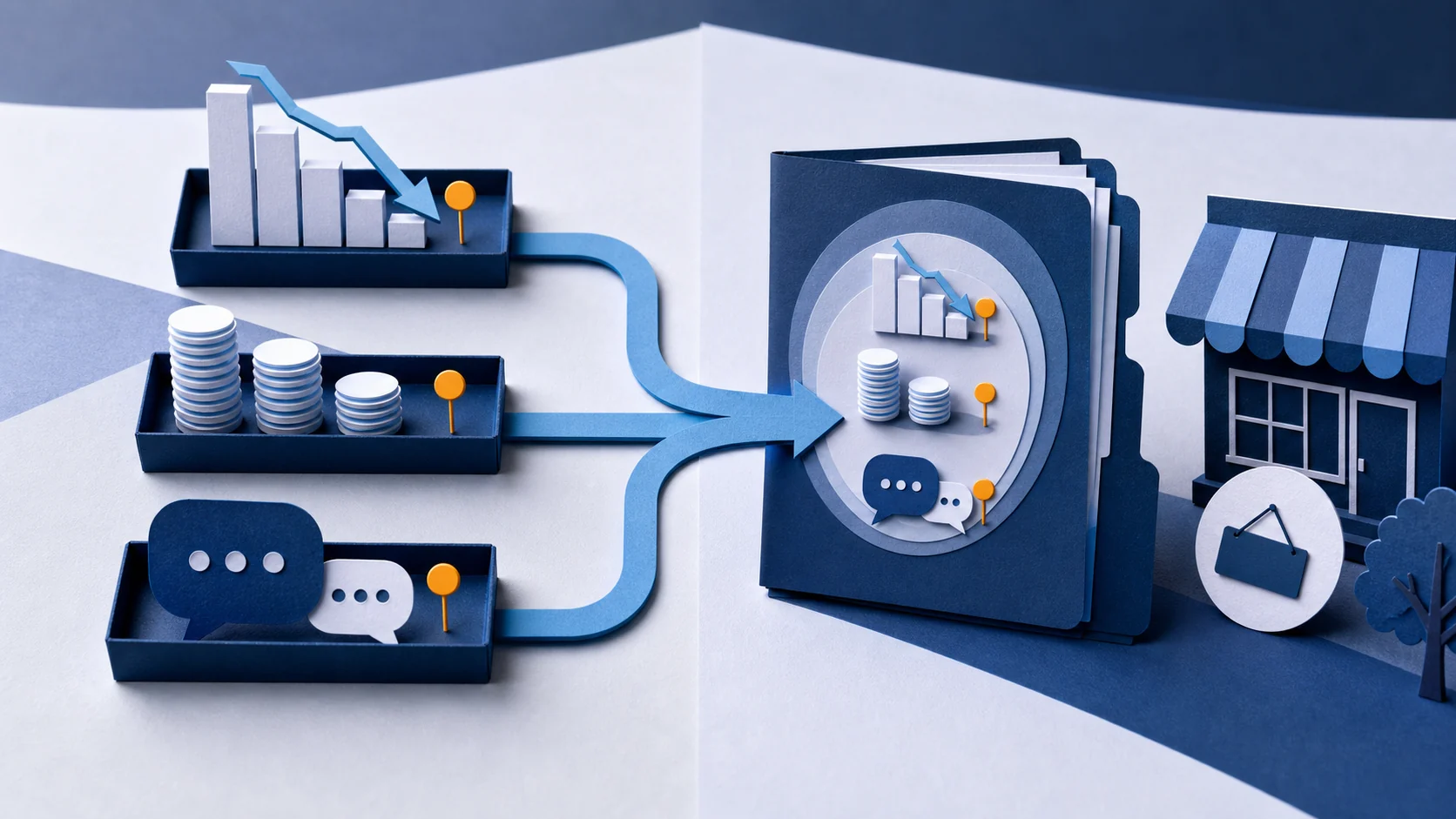
What changes when three signals are read together
Order volume, payment timeliness, and engagement are reviewed separately by different people.
A standing quarterly review overlaying these three signals turns three unconnected reports into one early warning.
Why the Visible Metric Misleads
Most suppliers track order volume, payment timeliness, and, where available, a credit score, and all three are backward-looking by nature: they record what already happened rather than anticipating what is coming. Dun & Bradstreet's own scoring methodology is built around days-beyond-terms trends specifically because a single delayed payment says little, while a sustained trend across several months says a great deal.
The more useful practice is not adding new data sources, since most of this information already exists inside a supplier's own transaction records, but building a standing review that looks at order volume trend, payment timeliness trend, and account engagement together for significant customer relationships, rather than each metric being reviewed separately by a different person for a different reason.
A supplier who says they never saw a customer's closure coming is very often mistaken.
The Leadership Move
The right move is not to treat every slow month as a crisis, nor to assume every distressed customer can be saved. It is to build a standing, consolidated view of the signals that already exist across a supplier's own systems, closer to what commercial data providers like Dun & Bradstreet already do at scale, but applied to a supplier's own most important relationships specifically.
- Ownership
Sales or account management typically holds the relationship and engagement signal. Finance holds the payment-timeliness data. Operations holds order-volume trends. None of these functions alone sees the complete pattern, which is precisely why it tends to go unnoticed even when every individual data point is available somewhere inside the organization.
- Tradeoff
Building a consolidated view takes cross-departmental coordination that competes with other priorities in each function, and the alternative cost, discovering the pattern only once a customer has already closed, is usually larger but easier to postpone thinking about, since it has not happened yet.
- Human consequence
Early detection benefits the supplier through reduced risk exposure, but it also creates room for a conversation that might genuinely help the customer: adjusted terms, a check-in that surfaces a solvable problem before it becomes unsolvable. Late detection, discovered only at closure, removes that option for everyone involved.
Implication for Operators
Dun & Bradstreet's own business model confirms that payment behavior data predicts distress well in advance of closure; the practical question for most suppliers is not whether the signal exists but whether they are consolidating their own version of it, using data most of them already hold, rather than treating each account's declining engagement as an isolated, explainable event.
A supplier who says they never saw a customer's closure coming is very often mistaken. They saw smaller orders, slower payments, and quieter communication, recorded in three separate reports reviewed by three separate people who never compared notes. Dun & Bradstreet has built an entire commercial product on the premise that this data predicts distress reliably; the remaining question for most suppliers is whether they are watching their own version of it closely enough.
The revenue unknown is not a missing signal. It is three real signals sitting in three different systems that nobody has been asked to view together.
Transformidy infographic
What is a Revenue Unknown?
The unresolved value question that becomes visible when evidence is recognized early enough to still change the decision.
- 01
Evidence
A visible event, behaviour, gap, cost, or relationship change.
- 02
Recognition
The interpretation that names what may be changing underneath the evidence.
- 03
Revenue Unknown
The unresolved question about value, risk, demand, trust, cost, or capability.
- 04
Decision window
The period where leaders can still protect value or create a better outcome.
How often do you actively monitor for changes in customer intent, preferences, or behavior—monthly, quarterly, or only when crisis hits?
FAQ
What is the earliest operational signal of small-business distress that a supplier can observe directly?
Sustained decline in order volume, gradually extending payment terms, and reduced engagement with account communications, viewed together over multiple months rather than any single data point in isolation.
Does a formal product like Dun & Bradstreet's Delinquency Predictor Score already solve this problem?
It solves it at the level of aggregated commercial credit data. Dun & Bradstreet's own description of the score confirms that payment-behavior trends meaningfully predict distress within a twelve-month window, which supports building a similar, smaller-scale review using a supplier's own transaction data for its most significant relationships.
Can suppliers reliably prevent every customer's closure by acting on these signals?
No. Some businesses are past the point where outside intervention changes the outcome. What early detection reliably provides is better risk management for the supplier and, in some cases, the possibility of a productive conversation before the situation becomes unrecoverable.
How can a supplier consolidate scattered signals without new systems?
Build a standing review that brings order-volume trend, payment-timeliness trend, and account-engagement level together for significant customer relationships, using data most suppliers already hold in separate reports.
Who should own monitoring for these signals inside a supplier organization?
Responsibility currently spans sales or account management, finance, and operations, with no single owner of the combined view in most organizations. A simple recurring cross-functional review of key accounts closes much of this gap without requiring new infrastructure.
Related intelligence
Article
When Availability Signals Are Not Aligned: The Hidden Inventory-Demand Mismatch
In stock somewhere in the network is not the same as available to this customer, in this format, in time. That gap does not show up in the out-of-stock rate.
Article
Beyond Abandonment: The Validation Moment When Customers Make Final Commitment
Not all cart abandonment is the same behavior. Device friction, first-time-buyer trust gaps, and genuine indecision each need a different recovery tactic.
Article
Work Redesign and Experience Redesign Must Happen Together
A faster-feeling interface attached to an unredesigned back-end process does not create a faster experience. It creates a specific, quiet disappointment.