
Article
Fulfillment Reveals Intent: What Shipment Patterns Tell You About Customer Priorities
How a customer chooses to receive an order reveals priorities the order itself does not. That signal sits in logistics data, unread by merchandising.
- Published
- July 9, 2026
- Updated
- August 19, 2026
- Reading time
- 8 min

The Global Signal
Narvar, a customer experience platform that surveys shoppers on post-purchase behavior, published its State of Returns 2024 report based on a survey of nearly two thousand United States consumers. The findings are direct: 60 percent of shoppers said they preferentially choose retailers that provide exact delivery dates rather than broad windows, and 76 percent of shoppers who rated their returns experience highly said they would shop with that retailer again (Narvar, State of Returns 2024). Narvar's report separately cites a 2022 Ipsos survey finding that 85 percent of shoppers would not reorder from a retailer after a poor delivery experience, a distinct data source worth attributing on its own rather than folding into Narvar's own findings.
Together, these figures describe something retailers rarely treat as a commercial signal: the delivery and returns experience is not a back-office detail attached to a sale that has already happened. It is, by shoppers' own account, a major factor in whether they return at all.
Shoppers with a highly rated returns experience who would shop there again
A direct Narvar finding; delivery precision and returns quality are loyalty signals, not only logistics metrics.
What changes when fulfillment data reaches retention decisions
Fulfillment data lives with logistics; the loyalty behavior it predicts lives with merchandising.
Comparing repeat-purchase rate against delivery experience and shipping method turns industry findings into a usable in-house signal.
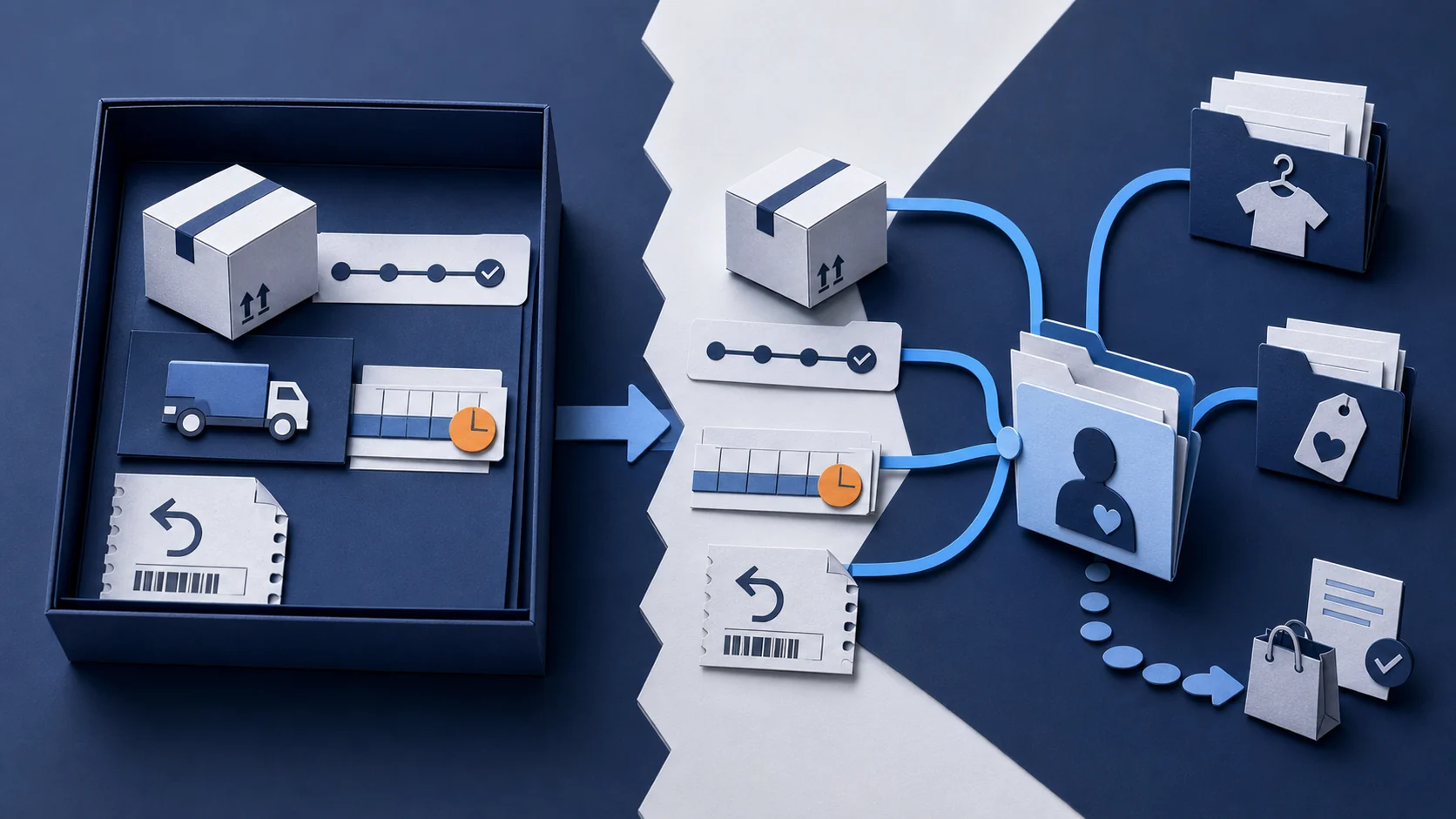
Why the Visible Metric Misleads
Retailers typically track fulfillment cost, average shipping speed, and return rate as operational metrics, managed by logistics for logistics purposes. None of these, on their own, connect to customer retention, even though Narvar's own data suggests that connection is real and measurable. A retailer can have an efficient, low-cost fulfillment operation by every internal metric while still losing exactly the customers Narvar's research describes: the ones who needed a precise delivery date and did not get one, or who had a return handled poorly and, per the 85 percent figure Narvar cites from Ipsos, simply did not come back.
The more useful cut is not fulfillment cost alone, but repeat-purchase rate segmented by delivery experience and by shipping method chosen, a comparison most retailers have the underlying data to make and rarely make in practice, because fulfillment data and retention data are typically managed by different teams with different reporting cadences.
A customer's fulfillment experience is not a footnote to the sale that already happened.
The Leadership Move
The right move is not to make fulfillment a marketing function. It is to make fulfillment data visible to the teams that make retention and merchandising decisions, since Narvar's research shows the connection between the two is real, even though the data currently lives entirely separately.
- Ownership
Logistics holds the raw fulfillment data. Merchandising and customer insight hold the retention decisions that data should inform. The two rarely share a dashboard, let alone a planning meeting, which is exactly why a well-documented driver of loyalty stays disconnected from the strategy conversations it should shape.
- Tradeoff
Building that connection requires logistics to expose its data in a form useful to commercial teams, a real investment that competes with other logistics priorities, for a benefit that primarily accrues to a different department. That tradeoff is worth naming explicitly rather than leaving it as an unstated reason the connection never gets built.
- Human consequence
The customer who did not receive the delivery precision Narvar's research says most shoppers want, or whose return was handled poorly, does not file a complaint about an internal metric. She simply does not come back, and by Narvar's own figures, that is the single most likely outcome of a poor experience at this stage.
Implication for Operators
Retailers that connect fulfillment data to retention decisions are acting on a relationship Narvar's research has already quantified: delivery precision and returns experience meaningfully predict whether a customer returns. The practical shift is treating that data as commercially relevant rather than purely operational, and asking whether repeat-purchase rate has ever actually been compared against delivery and returns experience inside a given organization's own numbers.
A customer's fulfillment experience is not a footnote to the sale that already happened. Narvar's research says otherwise directly: most shoppers prefer precision over convenience in delivery timing, and a strong majority who have a good returns experience come back. Fulfillment data sits with logistics. The behavior it predicts sits with merchandising and retention. Most organizations have simply never joined the two.
The revenue unknown is not in what customers bought. It is in how they experienced receiving it, and Narvar's own research shows how much that experience is already shaping who comes back.
Transformidy infographic
What is a Revenue Unknown?
The unresolved value question that becomes visible when evidence is recognized early enough to still change the decision.
- 01
Evidence
A visible event, behaviour, gap, cost, or relationship change.
- 02
Recognition
The interpretation that names what may be changing underneath the evidence.
- 03
Revenue Unknown
The unresolved question about value, risk, demand, trust, cost, or capability.
- 04
Decision window
The period where leaders can still protect value or create a better outcome.
When customer intent shifts, is there cross-functional alignment on what it means, or do different teams interpret the same signals differently?
FAQ
What does Narvar's research actually establish about delivery and loyalty?
In its State of Returns 2024 survey of nearly two thousand US consumers, Narvar found that 60 percent of shoppers prefer retailers offering exact delivery dates, and 76 percent of shoppers who rated their returns experience highly said they would shop with that retailer again.
Does poor delivery experience really affect whether customers reorder?
Narvar's report cites a separate 2022 Ipsos survey finding that 85 percent of shoppers would not reorder from a retailer after a poor delivery experience, a distinct source from Narvar's own data but a striking figure in the same direction.
Does shipping method choice itself predict customer loyalty?
This is a reasonable, evidence-adjacent hypothesis built on Narvar's findings rather than a directly measured result. Narvar's research establishes that delivery precision and returns experience predict loyalty; whether the specific shipping method a customer selects also predicts it is a related question worth testing against a retailer's own data.
Why does this signal typically go unused inside retail organizations?
Fulfillment data is generated and owned by logistics, while retention and merchandising decisions are made by different teams, often without a shared reporting connection between the two, even though Narvar's research suggests that connection would be commercially valuable.
What is the simplest way to start testing this inside an organization?
Compare repeat-purchase rate against delivery experience and returns handling for a single recent quarter. Most organizations already hold the underlying data in separate systems; the missing step is usually joining them, not collecting them.
Related intelligence
Article
When Availability Signals Are Not Aligned: The Hidden Inventory-Demand Mismatch
In stock somewhere in the network is not the same as available to this customer, in this format, in time. That gap does not show up in the out-of-stock rate.
Article
Beyond Abandonment: The Validation Moment When Customers Make Final Commitment
Not all cart abandonment is the same behavior. Device friction, first-time-buyer trust gaps, and genuine indecision each need a different recovery tactic.
Article
Work Redesign and Experience Redesign Must Happen Together
A faster-feeling interface attached to an unredesigned back-end process does not create a faster experience. It creates a specific, quiet disappointment.