
Article
AI Tools Are Not the Transformation. Work Redesign Is.
Adoption metrics measure whether people use an AI tool. They do not measure whether the work changed. The gap between the two is where AI investment quietly plateaus.
- Published
- June 23, 2026
- Updated
- August 19, 2026
- Reading time
- 9 min

The Global Signal
In 2024, the Swedish fintech company Klarna announced that its AI customer service assistant was handling the work equivalent of more than 800 full-time employees, and it scaled back its outsourced support workforce accordingly. Reported externally as a landmark AI success story, the number was real and the deployment was genuine: a large-scale, functioning system doing the volume of a substantial workforce.
By 2025, the story had gained a second chapter. Klarna's chief executive, Sebastian Siemiatkowski, publicly acknowledged that the company had overcorrected on cost at the expense of quality, and Klarna began bringing human agents back into the support model, this time in a more flexible, remote arrangement (Forbes, May 2025). Klarna has been careful to push back on the popular framing that it "fired everyone and rehired them." The company says it never eliminated human support entirely and that the new hires represent an addition to the model, not a reversal of it.
That distinction is the useful part. Klarna's adoption metric, work equivalent to 800-plus roles, never stopped being true. What changed was the company's own read on whether the redesign underneath that number was actually finished. A tool can do enormous, measurable work and still leave open the harder question of what standard of service that work is supposed to hit, and who decides when it falls short.
Roles worth of work handled by the assistant
A useful adoption signal, but not proof that the workflow redesign was complete.
What changes when work is redesigned
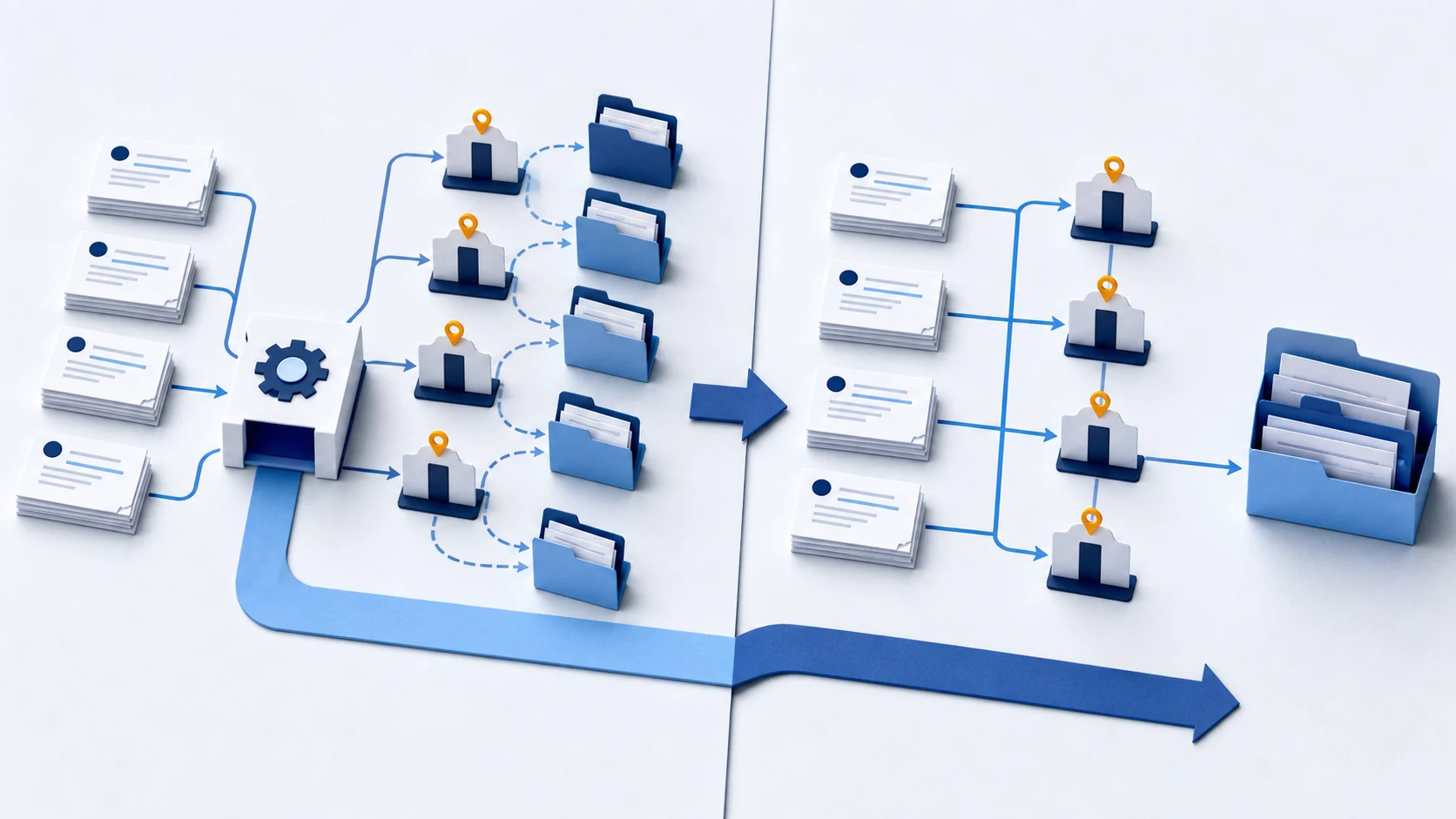
The tool can be adopted while the workflow remains structurally unchanged.
Adoption shows that work can move through the tool. Redesign shows that gates, handoffs, roles, or standards changed because the tool exists.
Why the Visible Metric Misleads
Most organizations track adoption rate, feature usage, training completion, and satisfaction scores, and these are legitimate things to measure. The trouble is that they measure engagement with a tool, not whether the organization's actual output changed. A team can be fully trained and actively using an AI system while executing the identical workflow that existed before the tool arrived, with the same handoffs, the same approval gates, and the same number of people required to get work out the door.
The more useful questions sit one layer down: did tasks disappear, or just get faster? Did the number of people required for a process actually decrease, or only the time each person spends on it? Did the organization redesign the workflow at the same time it deployed the tool, or did it wait to see what the tool would allow, and then never quite get around to redesigning around it? Throughput, measured as units completed per person per month rather than per-task speed, and end-to-end cycle time, measured from request to completion rather than task duration, are far closer to the truth than adoption ever gets. An organization that only tracks adoption can look successful for a long time before anyone notices that the underlying economics never actually moved.
Adoption is permission to start redesigning. It is not evidence that redesign has happened.
The Leadership Move
Adoption is not transformation. It is permission to start redesigning. The practical move is to put the workflow itself on the table at the same time the tool goes live, asking explicitly which approvals, handoffs, or roles should change now that the tool exists, rather than simply layering the tool on top of what already exists.
- Ownership
Redesign cannot happen inside a single team. Operations, the functional leaders who own the process, finance, and the people who manage the tool itself all have a stake, and none of them can make the call alone. When ownership is left ambiguous, the default outcome is that everyone waits for someone else to propose the harder changes, and the tool ends up bolted onto the old process by default rather than by decision.
- Tradeoff
The real choice is between teaching people to adopt a tool and deciding what work becomes unnecessary because of it. The first is comfortable. The second is not, because it forces a conversation about roles blurring, familiar control points disappearing, and status changing inside the organization. Leaders who avoid that conversation get the adoption number without the value it was supposed to unlock.
- Human consequence
When leadership does not name what is supposed to disappear from a workflow, the people doing the work do not know where they stand. Uncertainty accumulates quietly, and the tool that was meant to make work better starts to feel like one more thing to manage on top of an unchanged job. Klarna's own experience shows a version of this on the customer side: when redesign lags behind adoption, the people meant to benefit, whether employees or customers, are the ones who feel the gap first.
Implication for Operators
The organizations that get real value from AI are not the ones that adopt fastest. They are the ones that treat the tool and the redesign as a single decision rather than two separate ones, made months apart. That means asking, before a tool goes live, what specifically should stop happening once it does, and holding that answer to the same scrutiny as the adoption target itself. Klarna's second chapter is a useful reminder that this is not a one-time decision either; even a large, genuinely successful deployment can reveal, well after launch, that the redesign question was never fully closed.
Organizations that capture real value from AI are not simply better at adopting it. They are better at redesigning work alongside the tool, treating the deployment and the redesign as one decision rather than a sequence of two. The tool is the catalyst; the transformation is the deliberate work of deciding what should stop happening at the same time something new starts happening faster. Klarna's experience shows that even a genuinely large-scale success can leave that work unfinished, and that finishing it later is still possible.
The revenue unknown is not in the tool. It is in the redesign that should happen around it, and in whether anyone is still checking on that redesign after the launch announcement fades.
Transformidy infographic
What is a Revenue Unknown?
The unresolved value question that becomes visible when evidence is recognized early enough to still change the decision.
- 01
Evidence
A visible event, behaviour, gap, cost, or relationship change.
- 02
Recognition
The interpretation that names what may be changing underneath the evidence.
- 03
Revenue Unknown
The unresolved question about value, risk, demand, trust, cost, or capability.
- 04
Decision window
The period where leaders can still protect value or create a better outcome.
Have you redesigned work processes to take advantage of what AI can do, or are you using AI as a tool within existing workflows?
FAQ
What is the difference between adoption and value realization?
Adoption means people are using the tool. Value realization means the organization is measurably better off: higher throughput, shorter cycle time, or lower cost. High adoption without workflow redesign often delivers the first without the second.
Why does the workflow need to change for the tool to create value?
An AI tool optimizes existing tasks; it does not, on its own, remove structural bottlenecks. If a process still requires the same approval step regardless of how fast the analysis behind it runs, making that one task faster does not change the overall cycle time or cost. Redesign is what removes the bottleneck; the tool then amplifies the redesigned workflow rather than the old one.
How do you measure whether work has actually been redesigned?
Ask whether tasks disappeared or simply became faster. In a genuinely redesigned workflow, people stop doing certain activities entirely. If everything just moved faster and nothing stopped, the workflow has not actually changed.
What does Klarna's experience suggest about AI deployments that look successful?
That a large, measurable adoption number can be entirely true and still coexist with an unresolved question about quality or service standards. Klarna's own account is that the fix was not abandoning AI, but rebalancing the model with human capacity added back deliberately, which is closer to a second round of redesign than a retreat from the first.
What happens if the tool's architecture does not support the redesign an organization wants?
There are three real options: redesign around the tool's constraints, choose a more flexible tool, or accept incremental gains from task optimization alone. Most organizations end up choosing the third option without ever explicitly deciding to.
Related intelligence
Article
When Availability Signals Are Not Aligned: The Hidden Inventory-Demand Mismatch
In stock somewhere in the network is not the same as available to this customer, in this format, in time. That gap does not show up in the out-of-stock rate.
Article
Beyond Abandonment: The Validation Moment When Customers Make Final Commitment
Not all cart abandonment is the same behavior. Device friction, first-time-buyer trust gaps, and genuine indecision each need a different recovery tactic.
Article
Work Redesign and Experience Redesign Must Happen Together
A faster-feeling interface attached to an unredesigned back-end process does not create a faster experience. It creates a specific, quiet disappointment.