
Article
Three in Four Restaurant Orders Never Touch a Dining Room
Nearly 75% of restaurant traffic is now off-premise. The National Restaurant Association's own economist calls it not a trend but a business model. Most restaurants are still designed, staffed, and measured as if the dining room is the main event.
- Published
- April 16, 2025
- Updated
- June 18, 2026
- Reading time
- 7 min
2026 updated analysis
What changed since the original article
This page keeps the original Transformidy article as the canonical record and leads with the current interpretation, source notes, and Revenue Unknown framing.
75%, and the Word "Essential"
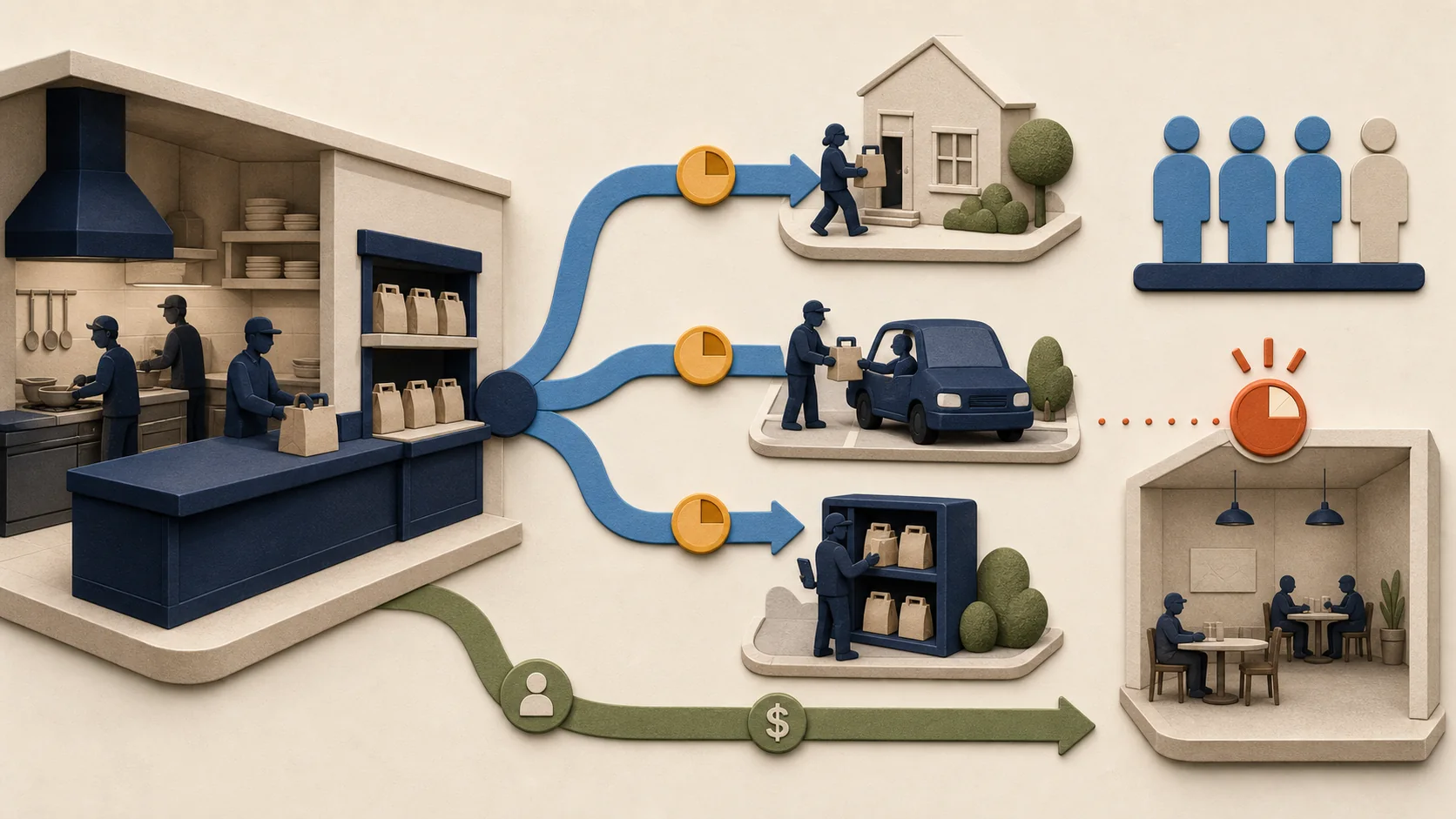
The National Restaurant Association found nearly 75% of all restaurant traffic now happens off-premises, meaning almost three out of four orders are picked up, delivered, or taken through a drive-thru rather than eaten in the dining room. Measured against 2019, 58% of limited-service operators and 41% of full-service operators report off-premises now represents a larger share of their total sales than it did before, a structural, multi-year shift rather than a temporary pandemic-era spike that has since faded.
The report's title itself, "From Trend to Transformation," signals how the National Restaurant Association wants this shift understood, and Chief Economist Dr. Chad Moutray's own framing reinforces it directly: "Off-premises dining has become a key revenue driver and an essential way to engage consumers." That is a deliberate word choice. "Essential" describes a permanent operating condition, not a channel to monitor for eventual reversion to pre-2019 norms.
The consumer-side data supports the same conclusion. Two-thirds of Gen Z and millennial consumers describe takeout as essential to their lifestyle, and nearly six in ten use takeout or drive-thru weekly. That is not occasional convenience behavior; it is a default consumption pattern for a large and growing share of the customer base restaurants are trying to reach.
Of all restaurant traffic now happens off-premises
58% of limited-service and 41% of full-service operators say off-premise sales now exceed their 2019 share.
The Design Lag
The specific gap worth naming is between the speed of the behavioral shift, roughly 75% of traffic, and the speed at which restaurant physical and operational design has adapted to it. Most existing restaurant buildings were designed and built years or decades ago, when dine-in was the assumed primary use case and off-premise was an afterthought handled through a small to-go counter or a phone line. Renovating or redesigning a physical space to reflect a fundamentally different order-volume distribution is slower and more expensive than the underlying consumer behavior shift that made it necessary.
That lag creates a specific, identifiable inefficiency: kitchens optimized for the pacing and plating of dine-in service handling a majority off-premise order flow, front-of-house staff trained primarily in table service managing a growing share of pickup and delivery handoffs, and dining room square footage carrying real estate and staffing cost while serving a shrinking minority of actual transactions. None of these are hypothetical; they follow directly from applying the National Restaurant Association's own traffic-share data to a typical, not-yet-redesigned restaurant operation.
The operators most likely to benefit from this data are the ones treating it as a design brief, not just a trend to acknowledge. A kitchen workflow rebuilt around off-premise order timing, a staffing model that reallocates labor toward fulfillment rather than table service, and a physical footprint that right-sizes dining room space against actual usage are all direct, actionable responses to a shift the industry's own chief economist already describes as essential, not temporary.
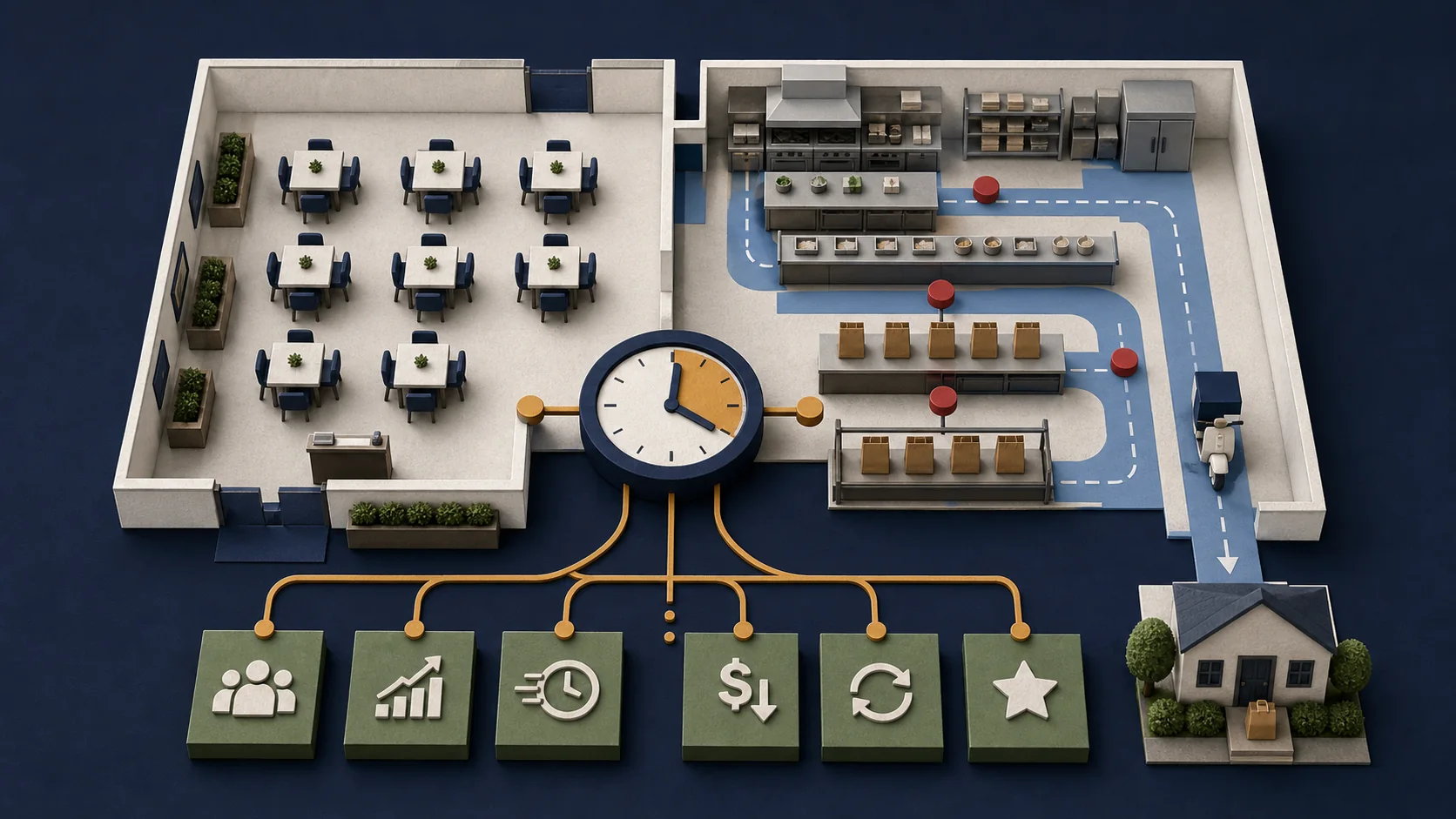
Dine-In-First Design vs. Off-Premise-First Design
One was built for a majority that no longer exists. The other is built for the actual order flow.
Dine-in-first design: large dining room footprint, front-of-house staffing centered on table service, kitchen workflow paced for plated dine-in orders, a model built for an assumption the data no longer supports at roughly 75% off-premise traffic. Off-premise-first design: kitchen workflow and staffing reallocated toward fulfillment speed and packaging, dining room footprint right-sized against actual usage, matching physical and operational investment to where the orders actually come from.
"Off-premises dining has become a key revenue driver and an essential way to engage consumers."
The Leadership Move
The structural choice for restaurant operators is whether to continue treating off-premise as a supplementary channel added onto a dine-in-first design, or to redesign physical space, staffing, and kitchen workflow around the reality that it now represents the majority of order volume.
- Ownership
Restaurant operations and design leadership own the decision to audit current physical footprint, staffing allocation, and kitchen workflow against actual off-premise order share, and to prioritize redesign investment accordingly rather than defaulting to incremental adjustments layered onto a dine-in-centric model.
- Tradeoff
Redesigning physical space and staffing models around off-premise-first operations costs real capital and disrupts an established dine-in service culture. The tradeoff against that investment is continuing to carry dining room space and staffing cost disproportionate to the roughly one-quarter of orders it actually serves, a persistent operational inefficiency the National Restaurant Association's own data makes directly quantifiable.
- Human consequence
Kitchen and front-of-house staff working within a dine-in-optimized design while handling a majority off-premise order flow experience real operational friction, mismatched workflows and pacing, that a redesigned, off-premise-first operation would directly relieve.
Next Move
If you operate a restaurant with a traditional dine-in-centric layout: Audit your actual off-premise order share against current dining room footprint and staffing allocation, and treat any significant gap as a direct, quantifiable design and operational priority.
If you are planning a new restaurant location or major renovation: Design the kitchen workflow, staffing model, and physical footprint around the roughly 75% off-premise baseline this data establishes, rather than defaulting to a legacy dine-in-first template.
FAQ
What share of restaurant traffic is now off-premise?
The National Restaurant Association found nearly 75% of all restaurant traffic now happens off-premises, meaning almost three out of four restaurant orders are taken to go, delivered, or picked up rather than eaten in the dining room.
How has this changed since 2019?
58% of limited-service restaurant operators and 41% of full-service restaurant operators report that off-premises dining now represents a larger share of their total sales than it did in 2019, indicating a structural, multi-year shift rather than a short-term fluctuation.
Is this shift considered temporary or permanent by the industry itself?
The National Restaurant Association's own framing treats it as permanent. Chief Economist Dr. Chad Moutray stated: "Off-premises dining has become a key revenue driver and an essential way to engage consumers." The report also found two-thirds of Gen Z and millennial consumers describe takeout as essential to their lifestyle, with nearly six in ten using takeout or drive-thru weekly.
What is the practical implication for restaurant operators?
A restaurant whose physical layout, staffing model, and operational metrics remain designed primarily around dine-in service is optimizing for a minority of its actual order volume. Operators should audit whether kitchen workflow, staffing allocation, and space design reflect the roughly three-in-four share of orders that are now off-premise, rather than treating off-premise as a secondary channel layered onto a dine-in-first operation.
Sources & References
Original article archive
Original article published April 16, 2025: "Off-Premise Dining Opportunities in 2025". Preserved here for provenance, historical context, and citation continuity.
Off-premise dining has transformed the restaurant industry, becoming a dominant force shaping how consumers enjoy meals today. Imagine a world where nearly three out of every four restaurant orders are taken to go—this is no longer a future prediction but the reality as of 2025. Whether it is grabbing a quick bite via drive-thru, ordering delivery to your doorstep, or picking up takeout on the way home, off-premise dining has embedded itself into everyday life, redefining convenience and customer expectations. This Transformidy insight explores off-premise dining, its customer experience implications, and its future in the marketplace.
Key Takeaways
- Off-premise dining now accounts for nearly 75% of restaurant traffic, reflecting a major shift in how consumers enjoy meals outside traditional dining rooms.
- It includes takeout, delivery, drive-thru, and curbside pickup, offering customers flexibility to eat wherever and whenever they want.
- Customers prioritize speed, ease of use, value, variety, and excellent customer service
- Restaurants expand delivery partnerships, adding curbside and drive-thru options, integrating technology, and innovating menus to meet growing demand.
- The main challenges include maintaining food quality, operational complexity, and rising costs in packaging, workflows, and staff training.
- Off-premise dining's future is shaped by enhanced digital experiences, artificial intelligence, sustainable packaging, diverse menu offerings, and hybrid dining models.
- Embracing off-premise dining is no longer optional but a strategic imperative for restaurant growth, resilience, and customer loyalty in today’s fast-evolving market.
What Is Off-Premise Dining?
Off-premise dining refers to any dining experience where food is prepared by a restaurant but consumed outside the physical location. This broad category includes takeout, delivery, drive-thru, and curbside pickup. Unlike traditional on-premise dining, where customers eat inside the restaurant, off-premise dining lets consumers enjoy restaurant-quality meals wherever they prefer—at home, at work, or on the go.
This shift reflects evolving consumer lifestyles, driven by a demand for flexibility, speed, and convenience. Digital ordering platforms, mobile apps, and third-party delivery services like Doordash, Uber Eats, etc. have made it easier than ever for customers to order food remotely, fueling the rapid growth of off-premise dining. This trend offers restaurants new revenue streams and operational flexibility, enabling them to reach a wider audience beyond those who physically visit their locations.
The Rise of Off-Premise Dining: A 2025 Snapshot
According to the National Restaurant Association’s 2025 Off-Premises Restaurant Trends report, nearly 75% of all restaurant traffic now happens off-premises—meaning almost three out of four restaurant orders are taken to go. This represents a fundamental transformation from ten years ago, when on-premise dining dominated
The growth is driven largely by younger generations: Gen Z and millennials lead the charge, with two-thirds saying takeout is essential to their lifestyle and nearly 60% using takeout or drive-thru at least weekly.
This demand spans urban, suburban, and rural areas. Urban consumers widely embrace takeout and drive-thru options, while 67% of rural consumers appreciate more takeout choices. This highlights untapped opportunities for restaurant operators in less densely populated regions.
Finally, the pandemic that started in March 2020 fostered a change in eating habits. When a sit-down meal was not an option, customers continued to order food from vendors directly or through a third-party application.

"290/365 Take-out" by Mykl Roventine is licensed under CC BY-NC-SA 2.0
Why Off-Premise Dining Matters to Customers
Off-premise dining appeals to consumers because it fits their busy, on-the-go lifestyles. The convenience of ordering food remotely and consuming it wherever they choose is a game-changer. Key factors driving consumer preference include:
- Speed: 94% of consumers say speed is critical when ordering food to go.
- Ease of Use: Intuitive digital ordering and payment systems are essential, with 75% of delivery customers valuing tech-enabled experiences.
- Variety: Consumers want expanded menu options beyond traditional offerings, including snack items, meal bundles, and alcohol to-go.
- Customer Service: Over 90% cite good customer service as a top priority, even when dining off-premise.
- Value: Deals such as limited-time offers, buy-one-get-one promotions, and discounts during off-peak hours motivate 80% of off-premise customers across takeout, delivery, and drive-thru.
These preferences underscore that off-premise dining goes beyond convenience but delivers a rewarding, high-quality experience that encourages repeat business.
How Restaurants Are Responding to Off-Premise Demand
Restaurants have recognized off-premise dining as a critical revenue driver and strategic growth opportunity. The 2025 report reveals that 58% of limited-service (fast casual and quick service) and 41% of full-service operators now see off-premise sales as a larger share of their business than in 2019.
To meet consumer expectations, many restaurants are investing in:
- Delivery Services: 65% of limited-service operators offer delivery, often partnering with third-party platforms like DoorDash, Uber Eats, and Grubhub to expand reach without building their delivery fleets.
- Curbside Pickup and Dedicated Takeout Areas: 43% of full-service restaurants expect curbside pickup to grow, while 31% anticipate more dedicated takeout counters in 2025.
- Drive-Thru Expansion: Although traditionally associated with fast food, 12% of full-service operators foresee adding drive-thru lanes to capture off-premise demand.
- Technology Integration: Mobile ordering is now mainstream, used by 57% of adults, with even higher adoption among millennials (74%) and Gen Z (65%).
- Menu Innovation: Expanding offerings with snack items, meal bundles, and alcohol to-go caters to off-premise diners’ desire for variety and convenience.
These operational changes are strategic moves to build resilience and growth in an evolving market landscape.
Challenges and Opportunities in Off-Premise Dining
While off-premise dining presents significant opportunities, it also brings challenges for operators:
- Maintaining Food Quality: Ensuring that meals retain quality, temperature, and presentation during transport is essential, especially for high-value meals. Innovation in packaging and kitchen operations is needed to meet customer expectations.
- Operational Complexity: Managing takeout, delivery, and drive-thru alongside on-premise dining requires efficient workflows, technology, and staff training.
- Labor and Cost Pressures: Labor shortages, rising food costs, and supply chain issues continue to impact restaurant operations, making it vital to optimize off-premise processes for profitability.
- Customer Experience: Delivering excellent customer service remotely requires clear communication, accurate orders, and timely responses.
Successful operators leverage technology, streamline operations, and innovate menu and service options to overcome these hurdles.
The Role of AI in Enhancing Off-Premise Dining
Artificial intelligence (AI) can be a transformative force in the restaurant industry. By integrating AI technologies, restaurants can streamline operations and enhance the customer experience for takeout, delivery, drive-thru, and curbside pickup services to deliver the best off-premise dining experiences.
AI-Powered Order Accuracy and Speed
Predictive Analytics for Demand Forecasting and Staffing
One of the biggest pain points in off-premise dining has traditionally been order accuracy and wait times. AI-driven voice assistants and chatbots are now being deployed in drive-thrus and digital ordering platforms to take orders with near-perfect accuracy, reducing errors caused by miscommunication. For example, fast-food chains like Wendy’s and Taco Bell have implemented AI voice assistants that understand different accents and slang, speeding up the ordering process while improving accuracy. This leads to faster service and greater customer satisfaction, especially during peak hours.
AI systems analyze historical sales data, weather patterns, local events, and social trends to forecast demand. This allows restaurants to optimize inventory purchasing, reduce food waste, and schedule staff more effectively to meet fluctuating off-premise order volumes. For instance, McDonald’s uses AI to predict drive-thru rushes and popular menu items at different times of day, cutting wait times by an average of 30 seconds. This proactive approach ensures customers receive orders promptly and restaurants maintain operational efficiency.
Route Optimization for Faster Delivery
AI-powered delivery route optimization can revolutionize off-premise dining by making food deliveries faster and more cost-effective. By analyzing real-time traffic data, weather, and driver locations, AI algorithms dynamically calculate the fastest routes for delivery drivers, reducing delivery times by over 15% and cutting driving costs by up to 20%. This can improve customer experience by ensuring hot, fresh meals arrive quickly. It also helps restaurants expand their delivery reach without proportionally increasing costs.
Personalized Customer Experiences
AI enhances off-premise dining by personalizing the ordering experience. Smart recommendation engines integrated into mobile apps and kiosks analyze customers’ past orders, preferences, and external factors like time of day or weather to suggest relevant menu items. This personalization encourages upselling, increases average check sizes by 15% to 25%, and makes ordering more convenient and enjoyable for customers.
Autonomous Delivery and Robotics
Looking ahead, AI-driven autonomous delivery robots and drones are beginning to play a role in off-premise dining. These technologies promise to further reduce delivery times and labor costs, especially amid ongoing staffing challenges. Brands like Domino’s and Subway are experimenting with robot delivery vehicles and drone delivery campaigns, signaling a future where AI-powered automation could become a standard part of the off-premise dining experience.
By integrating AI across ordering, forecasting, delivery, and customer engagement, restaurants can meet the growing demand for off-premise dining with greater speed, accuracy, and personalization. This fusion of technology and convenience is reshaping the industry, making off-premise dining more efficient for operators and more satisfying for customers in 2025 and beyond.
The Future of Off-Premise Dining
Off-premise dining is no longer a trend but a permanent fixture in the restaurant industry. As consumer habits continue to evolve, restaurants have the opportunity to invest in off-premise capabilities to stay competitive.
Key future directions include:
- Enhanced Digital Experiences: More seamless mobile apps, AI-powered ordering, and personalized offers will elevate convenience and engagement.
- Sustainability in Packaging: Eco-friendly packaging solutions will become increasingly important as consumers demand more sustainable options.
- Expanded Menu Creativity: More diverse and customizable off-premise menus will cater to varied tastes and dietary needs.
- Hybrid Models: Restaurants will blend on-premise ambiance with off-premise convenience, offering options like meal kits, virtual brands, and subscription services.
Ultimately, off-premise dining offers restaurants a powerful way to connect with customers, drive revenue, and adapt to a fast-changing marketplace.
Off-premise dining has reshaped how we think about eating out. It offers unparalleled convenience, speed, and choice—qualities that have made it essential to millions of consumers’ daily lives. For restaurants, embracing off-premise dining is no longer optional; it is a strategic imperative that locates new growth, resilience, and customer loyalty in 2025 and beyond.
Frequently Asked Questions - Off-Premises Dining
1. What is off-premise dining?
Off-premise dining refers to meals prepared by a restaurant but consumed outside its physical location. This includes takeout, delivery, drive-thru, and curbside pickup options.
2. Why has off-premise dining become so popular?
Off-premise dining offers consumers convenience, speed, and flexibility to enjoy restaurant-quality meals wherever they want. Changing lifestyles, digital ordering, and third-party delivery services have all contributed to its rapid growth.
3. How much of restaurant traffic is off-premise dining today?
As of 2025, nearly 75% of all restaurant traffic is off-premises. That means three out of every four restaurant orders are taken to go.
4. What do customers value most in off-premise dining?
When ordering off-premise, customers prioritize speed, ease of use, value through deals and promotions, menu variety, and excellent customer service.
5. How are restaurants adapting to the rise of off-premise dining?
Restaurants are expanding delivery partnerships, adding curbside pickup and drive-thru lanes, integrating mobile ordering technology, and innovating menus with snack items, meal bundles, and alcohol to-go.
6. What challenges do restaurants face with off-premise dining?
Key challenges include maintaining food quality during transport, managing operational complexity, handling labor and cost pressures, and ensuring excellent remote customer service.
7. How is AI impacting off-premise dining?AI improves order accuracy and speed through voice assistants, forecasts demand for better staffing and inventory management, optimizes delivery routes, personalizes customer experiences, and paves the way for autonomous delivery robots and drones.
8. What role does technology play in off-premise dining?
Technology enables seamless digital ordering, real-time tracking, personalized recommendations, and efficient operations. They can enhance the overall customer experience.
9. Are off-premise dining options expanding beyond traditional fast food?
Yes. Full-service restaurants are increasingly adopting off-premise options like curbside pickup and drive-thru, and offer new formats such as meal kits, subscriptions, and bundled meals.
10. What does the future hold for off-premise dining?
The future includes enhanced AI-powered digital experiences, sustainable packaging solutions, diverse and customizable menus, and hybrid models blending on-premise ambiance with off-premise convenience to meet evolving consumer demands.
Next Steps
Transformidy is available to help you understand your brand’s value proposition and maximize your customer experience strategy for business growth, engagement, and satisfaction.
Contact us or set up a 30-minute complimentary consultation for more information on our services, insights, or showcases. We look forward to hearing from you.
FAQ
What share of restaurant traffic is now off-premise?
The National Restaurant Association found nearly 75% of all restaurant traffic now happens off-premises, meaning almost three out of four restaurant orders are taken to go, delivered, or picked up rather than eaten in the dining room.
How has this changed since 2019?
58% of limited-service restaurant operators and 41% of full-service restaurant operators report that off-premises dining now represents a larger share of their total sales than it did in 2019, indicating a structural, multi-year shift rather than a short-term fluctuation.
Is this shift considered temporary or permanent by the industry itself?
The National Restaurant Association's own framing treats it as permanent. Chief Economist Dr. Chad Moutray stated: 'Off-premises dining has become a key revenue driver and an essential way to engage consumers.' The report also found two-thirds of Gen Z and millennial consumers describe takeout as essential to their lifestyle, with nearly six in ten using takeout or drive-thru weekly.
What is the practical implication for restaurant operators?
A restaurant whose physical layout, staffing model, and operational metrics remain designed primarily around dine-in service is optimizing for a minority of its actual order volume. Operators should audit whether kitchen workflow, staffing allocation, and space design reflect the roughly three-in-four share of orders that are now off-premise, rather than treating off-premise as a secondary channel layered onto a dine-in-first operation.
Related intelligence
Article
Department Store Strategy: Identity vs. Omnichannel
Department stores pursued omnichannel integration to compete with specialists and e-commerce. But integration without identity eroded customer loyalty. Successful stores rebuilt around curation and experience, not channel consolidation.
Article
Millennials Are Going to Dine Out 14 Times a Month in 2026
Millennials plan to dine out 14 times a month in 2026, well above the 10-times average across all Americans. 55% say they will spend even more on restaurants next year. The generation restaurants most need to design a dine-in experience for has already told OpenTable who they are.
Article
A Third of Walmart's Operating Income Now Comes From Ads and Memberships
Advertising and membership fees now account for a third of Walmart's operating income. Walmart Connect grew 41% in a quarter when retail sales grew about 5%, eight times faster. Retail media margins exceed 70%. Walmart is no longer just a retailer that also sells ads.