
Article
HelloFresh Chose to Lose 11.6% of Its Orders
HelloFresh's Q1 2026 orders fell 11.6% and revenue fell 7.7%. The company let both happen on purpose, trading volume for a smaller base of tenured customers ordering more often at higher basket sizes.
- Published
- September 30, 2024
- Updated
- June 18, 2026
- Reading time
- 8 min

2026 updated analysis
What changed since the original article
This page keeps the original Transformidy article as the canonical record and leads with the current interpretation, source notes, and Revenue Unknown framing.
The Decline and the Number That Explains It
HelloFresh's Q1 2026 group revenue reached €1.7 billion, down 7.7% year over year in constant currency, with total orders falling 11.6% from 28.21 million to 24.94 million, and meals delivered falling 12.1% from 240.5 million to 211.4 million. Read alone, those numbers describe a subscription business shrinking across every core volume metric it reports.
The number that changes the reading is average order value, which rose 4.2% in constant currency to €70.9. A business simply losing customers to churn does not typically see its remaining customers spend more per order; that pattern is more consistent with a company that has deliberately reduced its lowest-value, highest-churn customer segment while retaining and growing spend among its most engaged customers.
HelloFresh's own leadership frames it exactly this way. CEO Dominik Richter stated that "high value customer cohorts demonstrate improved retention and higher ordering frequency after experiencing the new product," and the company's reporting notes that "tenured customers are ordering more frequently and at higher basket sizes, supporting strong revenue retention." This follows a broader pattern set in FY2025, when HelloFresh's revenue intentionally declined to €6.8 billion from €7.66 billion in 2024 as the company pulled back from low-quality, high-churn customer acquisition.
Order volume decline against average order value growth in the same quarter
Revenue fell 7.7% overall; AEBITDA fell from €58M to €24M as the strategy's cost showed up before its full return.
The Strategy Has Not Yet Shown Up in Margin
The honest complication in HelloFresh's story is that the retention strategy's stated benefits, higher order value, improved retention among tenured customers, have not yet translated into improved profitability. Q1 2026 adjusted EBITDA fell to €24 million from €58 million in Q1 2025, with AEBITDA margin at just 1.4% of revenue, and meal kits AEBITDA margin down to 9.0% from 11.4%. Contribution margin fell 1.4 percentage points as well. Free cash flow remained positive at €49 million, a genuine bright spot, but the core profitability metrics moved in the opposite direction from what a successful "quality over quantity" pivot would eventually be expected to produce.
This does not necessarily mean the strategy is failing. Shifting a subscription base toward higher-value, longer-tenure customers is not typically a single-quarter transition; the costs of walking away from volume-driven acquisition can show up before the retention and spend benefits fully compound. But a business, or an outside observer, reading only the CEO's framing risks treating a declared strategy as an already-proven one. The margin data says the jury is still out.
The useful discipline here, for any subscription business watching this case, is separating what management says about a strategy from what the trailing financial metrics confirm about it. HelloFresh's average order value data is real and directionally supportive. Its margin data is real and not yet supportive. Both belong in the same sentence, not just the more flattering one.
The Declared Strategy vs. the Confirmed Strategy
One is a statement about direction. The other requires several quarters of margin data to prove out.
Declared: leadership frames a volume decline as a deliberate quality-over-quantity shift, supported by early average-order-value growth. Confirmed: AEBITDA margin, contribution margin, and free cash flow trend upward across multiple subsequent quarters, providing independent evidence the strategy is paying off rather than just being described as working.
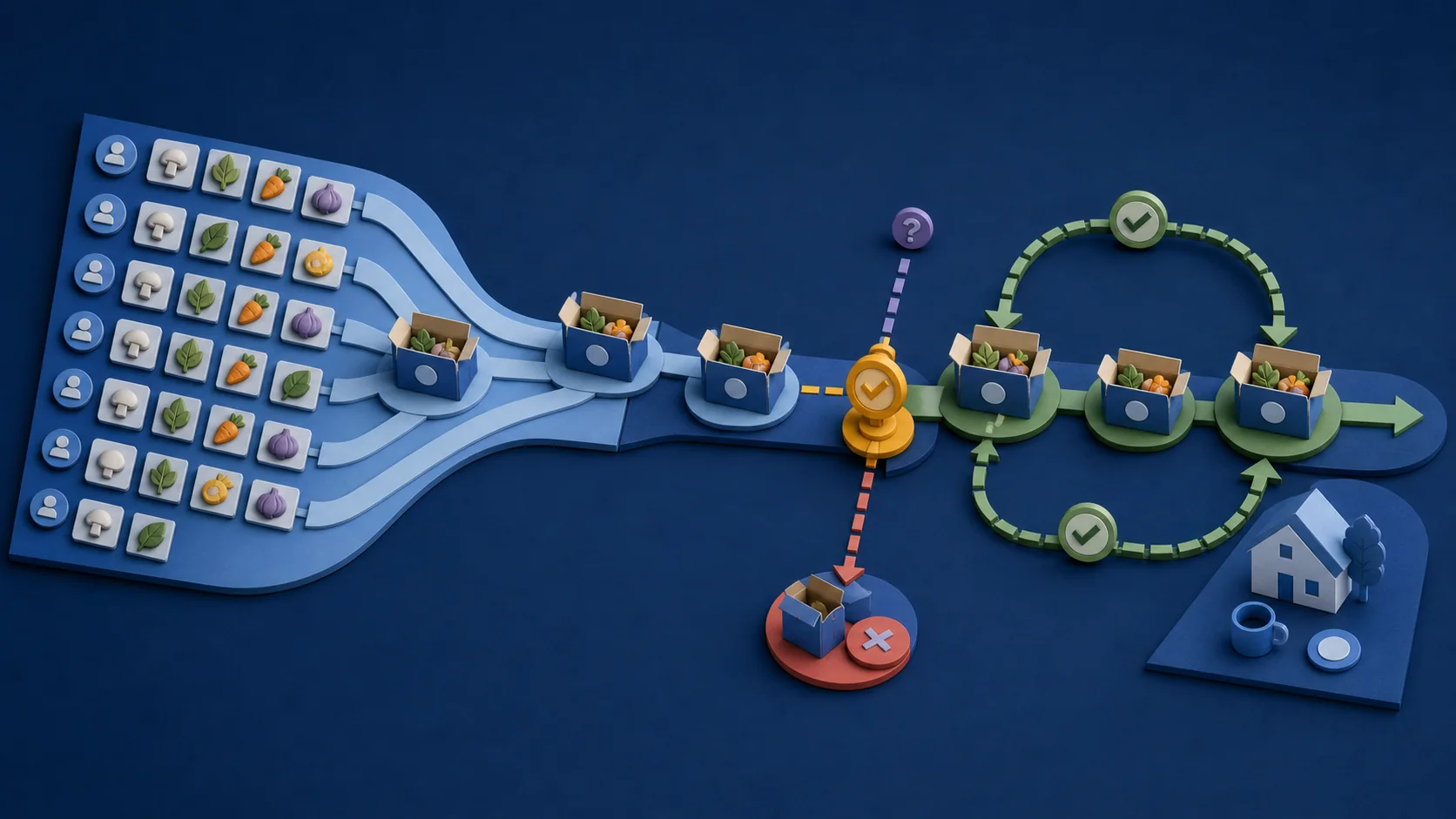
"Tenured customers are ordering more frequently and at higher basket sizes, supporting strong revenue retention."
The Leadership Move
The structural choice for any subscription business considering a similar pivot is whether to trust the declared logic of a quality-over-quantity strategy immediately, or to hold judgment until the margin trend confirms it independently.
- Ownership
Finance and retention leadership own the discipline of reporting both sides of this tradeoff together, average order value and retention gains alongside margin trend, rather than letting the more flattering customer-quality narrative stand alone in investor or board communications.
- Tradeoff
Deliberately shedding volume in favor of retained-customer quality costs real, immediate revenue and margin, visible in HelloFresh's own Q1 2026 numbers. The tradeoff against making that cut is continuing to acquire and retain customers whose lifetime value may not justify the acquisition cost, which is the exact problem HelloFresh's strategy is trying to solve.
- Human consequence
Tenured HelloFresh customers are, per the company's own account, experiencing an improved product and ordering relationship. Customers outside that tenured, high-value segment are no longer the company's acquisition priority, a real shift in who the business is choosing to serve.
Next Move
If you are considering a similar volume-for-retention tradeoff: Define in advance which margin metric will confirm the strategy worked, and set a specific quarter count before declaring success, rather than treating early average-order-value gains as sufficient proof.
If you are evaluating HelloFresh as a case study: Track their AEBITDA margin trend over the next two to three quarters before citing this as a proven playbook; the current data shows a declared strategy, not yet a confirmed one.
FAQ
How much did HelloFresh's orders and revenue decline in Q1 2026?
HelloFresh's Q1 2026 group revenue was €1.7 billion, down 7.7% year over year in constant currency. Total orders fell 11.6%, from 28.21 million to 24.94 million, and meals delivered fell 12.1%, from 240.5 million to 211.4 million.
Is this decline a sign of trouble or a deliberate strategy?
HelloFresh describes it as deliberate. Average order value rose 4.2% in constant currency to €70.9, and CEO Dominik Richter stated that high-value customer cohorts show improved retention and higher ordering frequency, with tenured customers ordering more often and at higher basket sizes. The company reduced FY2025 revenue intentionally by shifting away from lower-quality, high-churn customer acquisition.
What happened to profitability during this shift?
Q1 2026 adjusted EBITDA fell to €24 million from €58 million in Q1 2025, with AEBITDA margin at 1.4% of revenue and meal kits AEBITDA margin down to 9.0% from 11.4%. Free cash flow remained positive at €49 million. The strategy has not yet produced improved near-term profitability, even as the company frames it as building toward a healthier customer base.
How should a subscription business read HelloFresh's numbers?
As a real-time test of whether trading volume for retention actually pays off, still in progress. The average order value and stated retention improvements are early positive signals, but a business considering the same tradeoff should track whether AEBITDA margin recovers over subsequent quarters before treating the strategy as proven, not just declared.
Sources & References
Original article archive
Original article published September 30, 2024: "HelloFresh Transforms Food-Great Experience Award Sep 24". Preserved here for provenance, historical context, and citation continuity.
HelloFresh, a leading meal kit delivery service delivered more than 1 billion+ meal kits in 2023, has transformed its customer experience through new innovative UX strategies and using real-time feedback data to build more personalized products.
With this innovative cycle of product development, the brand won Transformidy’s Great Experience Award for September 2024. This insight delves into the company's UX transformation and explores why it is a great customer experience design.
What Is HelloFresh?
Founded in 2011, HelloFresh has rapidly grown to serve over 7 million active customers globally. The company offers a subscription-based service that delivers fresh ingredients and easy-to-follow recipes directly to customers' doors. As the meal kit industry has become increasingly competitive, HelloFresh recognized the necessity of evolving its UX to meet customer expectations and improve retention rates.
The UX Transformation Journey
Overcoming Skepticism
In a recent keynote at the CX Innovation Summit, James Villacci, HelloFresh's Head of Global UX Research, shared insights into how he turned initial skepticism about UX research into a company-wide commitment to customer-centricity. Villacci introduced innovative concepts such as the "Research Restaurant," which allowed stakeholders to engage with customer insights directly. This initiative not only showcased the tangible value of UX research but also fostered a culture where customer feedback became integral to decision-making processes.

Implementing Machine Learning for Personalization
HelloFresh's commitment to personalization is evident in its use of machine learning algorithms to enhance meal recommendations. By analyzing customer data—such as past orders and dietary preferences—the company can tailor meal suggestions that resonate with individual tastes. This approach mitigates the "paradox of choice," where an overwhelming number of options can lead to decision fatigue. Instead of sifting through a lengthy menu, customers receive curated selections that align with their preferences, making the ordering process smoother and more enjoyable1.
Enhancing the User Journey
A critical aspect of HelloFresh's UX transformation involved redesigning the user journey on its website. Through extensive usability testing, the company identified pain points that deterred new users from completing their first orders. By addressing issues such as information overload and unclear pricing structures, HelloFresh streamlined the subscription process, ensuring that customers can navigate their options effortlessly. Villacci's team focused on reducing cognitive load by making essential information more visible throughout the ordering process. For instance, customers can now see exactly what recipes they have selected and their total cost at any point during their journey. This transparency builds trust and enhances user satisfaction.

Impact on Customer Experience
Increased Customer Satisfaction
The results of these UX improvements have been significant. By personalizing meal recommendations and simplifying the subscription process, HelloFresh has witnessed increased customer engagement and satisfaction. The company's focus on understanding customer needs has led to higher retention rates, addressing previous concerns about churn in subscription models.
Fostering a Customer-Centric Culture
HelloFresh's transformation is not just about implementing new technologies; it represents a broader commitment to fostering a customer-centric culture within the organization. By democratizing knowledge about customer insights across departments, HelloFresh ensures that every team member understands the importance of delivering exceptional experiences. This cultural shift is crucial for long-term success in an industry where consumer preferences are continually evolving.
Future Innovations
Looking ahead, HelloFresh aims to further enhance its UX by integrating real-time feedback mechanisms and expanding its machine learning capabilities. Additionally, the company is using AI to generate more relevant content focusing on its customers. Other future initiatives may include incorporating nutritional considerations into meal recommendations and adapting offerings based on seasonal availability. These advancements will not only improve personalization but also align with growing consumer interest in health-conscious dining options.
Great Experience AwardTM
Transformidy’s Great Experience AwardTM is presented monthly and showcases excellence in experience strategy design or execution. Companies are welcome to submit entrants with support like demos, pictures, videos, press releases, or descriptions (no bigger than 5Mb in size per item), for this monthly award with experience ideas, innovations, or initiatives curated for customers, employees, or stakeholders.
Transformidy will evaluate all entrants and will make the final decision on the winner based on factors including but not limited to how the experience(s) transform or improve the way the company engages, acquires, supports, or maintains its customers, employees, or stakeholders. The experience(s) for consideration can be physical, online, or virtual.
How Can We Help?
Transformidy is available to assist in helping you understand assess how your company’s experience strategy is effective in generating engagement, satisfaction, and business growth.
Contact us or set up a 30-minute complimentary consultation for more information on our services, insights, or showcases. We look forward to hearing from you.
FAQ
How much did HelloFresh's orders and revenue decline in Q1 2026?
HelloFresh's Q1 2026 group revenue was €1.7 billion, down 7.7% year over year in constant currency. Total orders fell 11.6%, from 28.21 million to 24.94 million, and meals delivered fell 12.1%, from 240.5 million to 211.4 million.
Is this decline a sign of trouble or a deliberate strategy?
HelloFresh describes it as deliberate. Average order value rose 4.2% in constant currency to €70.9, and CEO Dominik Richter stated that high-value customer cohorts show improved retention and higher ordering frequency, with tenured customers ordering more often and at higher basket sizes. The company reduced FY2025 revenue intentionally by shifting away from lower-quality, high-churn customer acquisition.
What happened to profitability during this shift?
Q1 2026 adjusted EBITDA fell to €24 million from €58 million in Q1 2025, with AEBITDA margin at 1.4% of revenue and meal kits AEBITDA margin down to 9.0% from 11.4%. Free cash flow remained positive at €49 million. The strategy has not yet produced improved near-term profitability, even as the company frames it as building toward a healthier customer base.
How should a subscription business read HelloFresh's numbers?
As a real-time test of whether trading volume for retention actually pays off, still in progress. The average order value and stated retention improvements are early positive signals, but a business considering the same tradeoff should track whether AEBITDA margin recovers over subsequent quarters before treating the strategy as proven, not just declared.
Related intelligence
Article
SharePoint's Real 2025-2026 Story Was Nation-State Attacks, Not CX Strategy
Nation-state hackers exploited on-premises SharePoint servers in 2025, confirmed by Shadowserver at over 300 victims worldwide. In 2026, a new vulnerability rated 9.8 out of 10 severity emerged in the same product line. SharePoint did not quietly rewire anyone's CX strategy. It became a sustained target.
Article
Apple Is Reportedly Building a MacBook Designed to Lose the Spec Sheet Comparison
Apple's new MacBook Neo runs an iPhone chip, not a Mac chip, and starts at $699 to $899, roughly $100 to $300 below the MacBook Air. It has no Thunderbolt. Apple built its first laptop specifically to lose a spec sheet comparison, on purpose, to win a price comparison instead.
Article
A Third of Walmart's Operating Income Now Comes From Ads and Memberships
Advertising and membership fees now account for a third of Walmart's operating income. Walmart Connect grew 41% in a quarter when retail sales grew about 5%, eight times faster. Retail media margins exceed 70%. Walmart is no longer just a retailer that also sells ads.