
Article
78% Expect Agentic AI to Run Half of Support. 16% Have Actually Done It.
78% of CX leaders expect agentic AI to handle at least half of customer support within 18 months. Only 16% have actually embedded it for support today. The ambition is ahead of the operating foundation.
- Published
- January 16, 2026
- Updated
- June 18, 2026
- Reading time
- 8 min

2026 updated analysis
What changed since the original article
This page keeps the original Transformidy article as the canonical record and leads with the current interpretation, source notes, and Revenue Unknown framing.
A 62-Point Gap
Adobe's 2026 AI and Digital Trends Report found 78% of CX leaders expect agentic AI to handle at least half of customer support within 18 months, while only 16% have actually embedded agentic AI for customer support today, and just 13% have embedded it for brand discovery and search specifically. Fewer than a quarter of organizations are even running limited pilots across their workflows, meaning the large majority have not yet moved past early experimentation, if they have started at all.
That 62-point gap, 78% expecting a specific outcome versus 16% having achieved the underlying deployment, is a genuinely large distance to close in 18 months, especially set against the report's own infrastructure findings. One-third of organizations report prioritizing agentic AI over more established technologies, meaning resourcing is shifting toward this goal. But intention to prioritize and demonstrated readiness to execute are different things, and the report's data on both readiness dimensions, measurement and data infrastructure, suggests the gap is not simply a matter of organizations being early in a smooth rollout.
Only 31% of organizations have measurement frameworks in place for agentic AI specifically, meaning fewer than a third of respondents can currently even verify whether their agentic AI deployment, wherever it exists, is performing as intended. Forecasting that a technology will handle half of customer support within 18 months while lacking the measurement infrastructure to confirm its performance today is a forecast built on aspiration more than evidence.
Expecting agentic AI to handle half of support in 18 months, against those who have actually embedded it today
Only 31% have a measurement framework in place for agentic AI specifically.
The Infrastructure the Forecast Assumes
The 78% expectation figure implicitly assumes a set of infrastructure conditions will be met within 18 months: reliable, accessible customer data unified enough to support autonomous agent decisions, measurement systems capable of verifying agentic AI performance at scale, and organizational alignment between the executives setting the timeline and the practitioners responsible for delivering it. Adobe's own data on all three dimensions suggests each is currently a real gap, not a solved problem awaiting rollout.
On data readiness specifically, the report finds less than half of organizations report adequate data quality and accessibility for AI, with fewer having shared customer data platforms capable of supporting agentic AI. The report's own framing is notable: organizations acknowledge that data unification limits progress, yet fewer prioritize it as an investment, a specific disconnect between recognized need and actual resourcing. On organizational alignment, 61% cite executive misunderstanding of AI as the top driver of misalignment, and 52% cite resistance to change as a secondary factor, meaning the barrier is not purely technical.
None of this means the 78% expectation is wrong in direction, agentic AI adoption in customer support is very plausibly accelerating. It means the specific 18-month timeline, and the assumption that half of support volume will run through it by then, is resting on infrastructure that the same report's own respondents say is not yet in place. A CX leader setting internal expectations, budgets, or staffing plans against that 18-month figure is planning against a target the underlying data does not yet support.
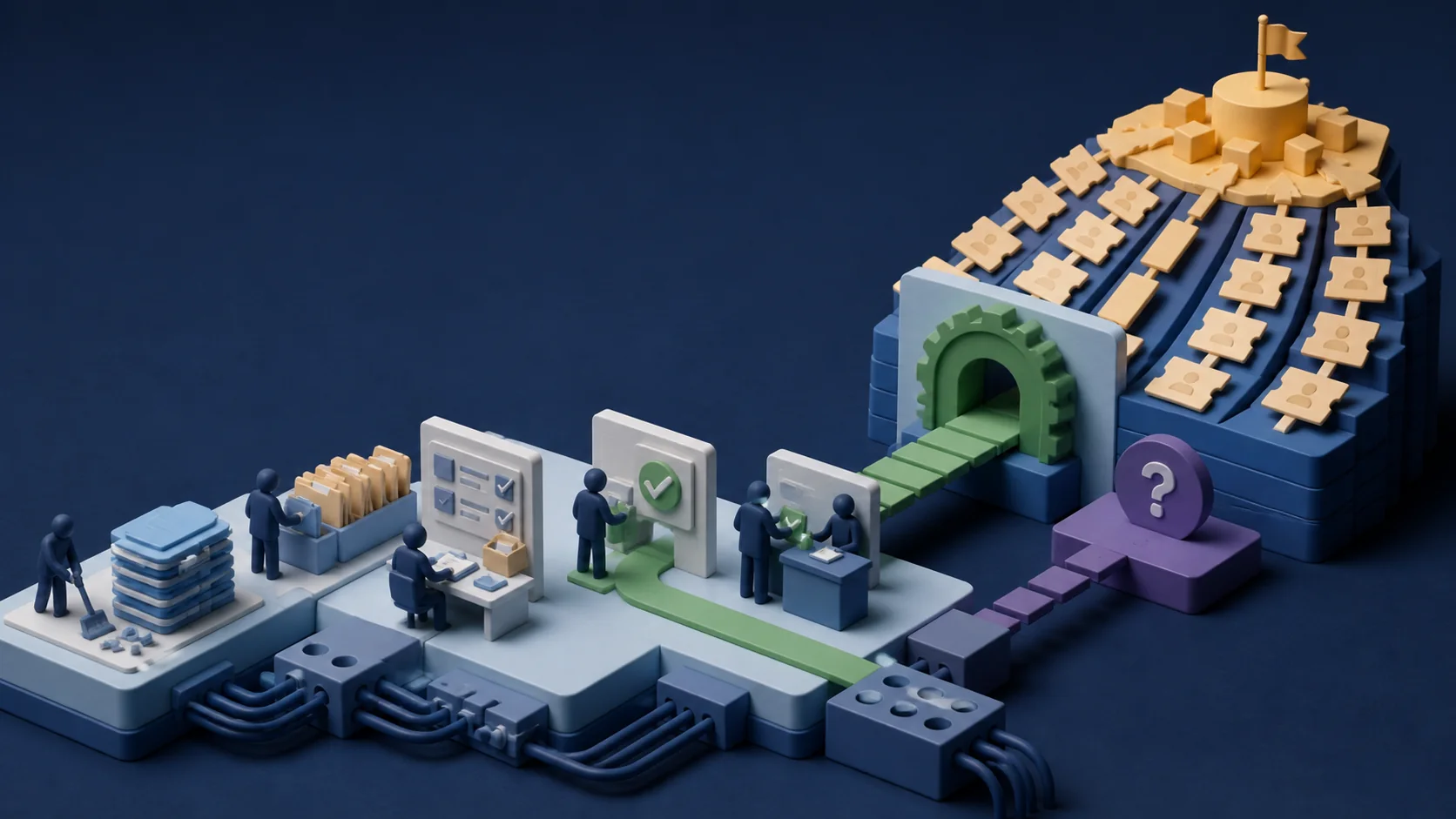
Planning Against the Forecast vs. Planning Against the Infrastructure
One assumes the gap closes on schedule. The other builds toward what would actually need to be true first.
Planning against the forecast: budgeting and staffing decisions built around agentic AI handling half of support within 18 months, treating the 78% figure as a confirmed trajectory. Planning against the infrastructure: prioritizing the specific, named gaps first, data quality and accessibility, measurement frameworks, executive-practitioner alignment, before committing customer-facing volume targets to the same timeline.
The Leadership Move
The structural choice for CX and AI strategy leadership is whether to plan resourcing and customer-facing commitments around the 78% expectation figure, or around the specific infrastructure gaps, data readiness, measurement frameworks, executive alignment, the same research identifies as unresolved.
- Ownership
CX and AI strategy leadership own the responsibility to distinguish between an industry-wide stated expectation and their own organization's actual, verified readiness before committing to an 18-month agentic AI deployment timeline internally or to a board.
- Tradeoff
Prioritizing data infrastructure and measurement frameworks ahead of visible, customer-facing agentic AI rollout is a less exciting, less immediately demonstrable investment than launching a headline AI initiative. The tradeoff against skipping that groundwork is deploying agentic AI at scale without the measurement capability, currently in place at only 31% of organizations, to verify it is actually performing as intended.
- Human consequence
Customers interacting with agentic AI support deployed ahead of adequate data and measurement infrastructure risk experiencing inconsistent or unverified service quality, a real cost to the people the 78% forecast assumes will be well-served within 18 months.
Next Move
If your organization has cited the 78% figure in planning discussions: Pair it explicitly with your own current agentic AI deployment rate and measurement framework status before treating it as a confirmed roadmap.
If you are prioritizing AI investment for 2026: Weight data quality, accessibility, and measurement framework development at least as heavily as customer-facing agentic AI features, given the report's finding that these foundational gaps, not technology availability, are the more likely constraint on the 18-month timeline.
FAQ
How big is the gap between agentic AI expectations and actual deployment?
Adobe's 2026 AI and Digital Trends Report found 78% of CX leaders expect agentic AI to handle at least half of customer support within 18 months, while only 16% have actually embedded agentic AI for customer support today, and just 13% have embedded it for brand discovery and search. Fewer than 25% are even running limited pilots across their workflows.
What is holding organizations back from matching their own expectations?
Less than half of organizations report adequate data quality and accessibility for AI, and the report notes that fewer organizations have shared customer data platforms capable of actually supporting agentic AI at scale. Only 31% have measurement frameworks in place for agentic AI specifically, meaning many organizations lack the infrastructure to reliably deploy or evaluate the technology they are forecasting will handle half their support volume.
Is this a technology problem or an organizational one?
Largely organizational, per the report's own findings. 61% cite executive misunderstanding of AI as the top driver of misalignment between leadership and practitioners, and 52% identify resistance to change as a secondary factor. Nearly one-third report misalignment between executives and practitioners on AI strategy overall, with 47% describing alignment as only partial.
What should a CX leader do given this gap between expectation and deployment?
Treat the 18-month forecast as aspirational rather than a confirmed roadmap, and prioritize the specific infrastructure gaps the report identifies, data quality and accessibility, measurement frameworks, and executive alignment, before committing customer-facing volume targets to agentic AI on that timeline.
Sources & References
Original article archive
Original article published January 16, 2026: "Customer Experience - Six Ways To Elevate In 2026". Preserved here for provenance, historical context, and citation continuity.
The business landscape entering 2026 looks far different from the frenzy that defined the first wave of generative AI and digital transformation. Instead of chasing trends, leading brands are focusing on building trust, coherence, and emotional resonance through the lens of one unshakable principle — customer experience.
As 2025 unfolded, forward-thinking organizations began blending human insight with intelligent technology to reshape engagement, loyalty, and value delivery. But in 2026, we’re stepping into a year where customer experience moves beyond interaction to intention. They are shaping not only what customers do, but how they feel empowered, understood, and connected.
Below are six dominant CX themes evolving from 2025 into 2026: why they matter, and how brands can maximize them to create meaningful and measurable outcomes.
Key Takeaways for CX Leaders
- Design AI to serve, not surveil. Use AI to reduce effort, increase clarity, and support human teams—with clear consent, minimal data, and visible value to customers.(see the generated image above)
- Treat experience equity like financial equity. Make CX a board-level asset, with metrics that link trust, emotion, and loyalty to revenue and brand value.(see the generated image above)
- Build around life moments, not departments. Map journeys that cross industries and explore partnerships to remove friction where customers feel it most.(see the generated image above)
- Elevate emotion intelligence. Move beyond “Are you satisfied?” to “How did this make you feel?” and use that insight to coach teams and refine journeys.(see the generated image above)
- Make privacy part of the promise. Bring CX, legal, and data teams together so every digital touchpoint reinforces control, transparency, and psychological safety.(see the generated image above)
1. Humanized AI and Emotional Intelligence
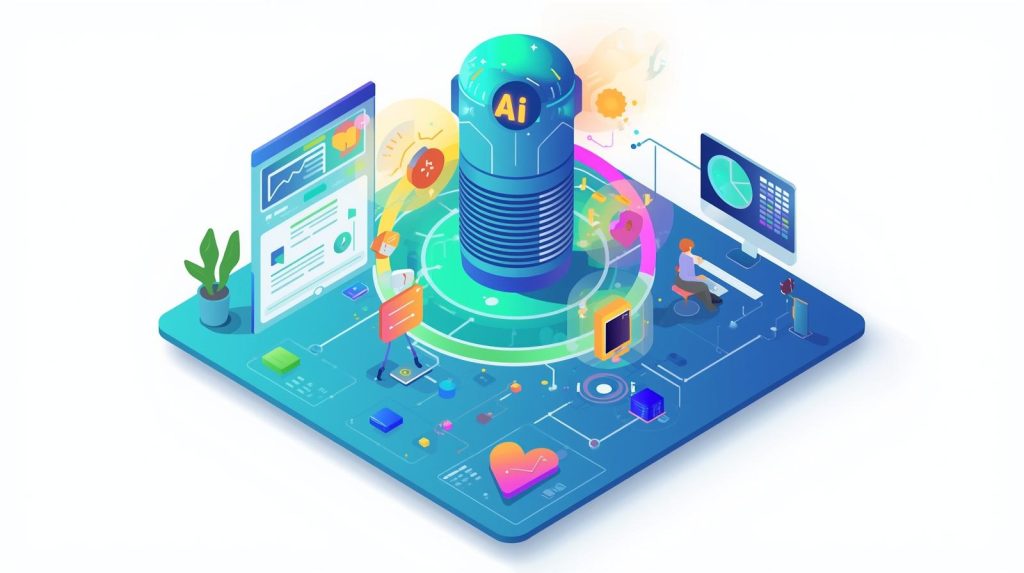
Artificial intelligence has become smarter and faster, but the differentiator in 2026 isn’t computational power — it’s emotional depth. As AI adoption matures, customers no longer marvel at automation; they value empathy delivered through it.
AI-driven customer experience platforms now incorporate sentiment-layered analytics, predictive emotion modeling, and tone calibration, allowing brands to tailor responses with genuine emotional intelligence.
Why it’s important:
In a world saturated with data, people crave empathy. Customers are likelier to stay loyal to brands that make them feel valued — even when interacting with machines.
How brands can maximize it:
- Integrate emotion recognition into chatbots and service journeys.
- Train AI models using real customer feedback to match brand personality.
- Develop “Empathy Design Sprints” where service teams and tech architects collaborate to build AI experiences centered around emotional connection.
The next level of customer experience isn’t just personalization — it’s personalization with purpose.
2. Experience Ecosystems, Not Channels

Gone are the days when CX meant optimizing a few touchpoints; 2026 calls for ecosystems where customer interactions flow effortlessly between digital and human moments.
Every product, partnership, and platform now contributes to a unified customer journey. Instead of treating separate apps, stores, and support systems as silos, leading organizations design interwoven ecosystems that feel like one conversation.
Why is it important?
Customers no longer distinguish between brand departments — they expect one continuous relationship. Experience fragmentation erodes loyalty faster than a pricing error.
How brands can maximize it:
- Map entire experience ecosystems, not just journeys.
- Use unified data intelligence to deliver seamless transitions across devices and physical environments.
- Launch “mirror engagement” dashboards where every team (sales, marketing, service) sees the same customer context in real time.
By treating CX as an ecosystem, brands build trust through coherence — the invisible glue of modern customer experience.
3. Data Dignity and Ethical Personalization

The relationship between customers and data has matured from convenience to consent. In 2026, “data dignity” becomes central to brand trust.
Consumers are more aware, regulators are more stringent, and AI systems require cleaner, consent-driven data to operate effectively. Transparent data practices now directly influence customer experience perception.
Why is it important?
People want personalization, not surveillance. How a brand uses — and explains — its data practices is now integral to the emotional and ethical fabric of CX.
How brands can maximize it:
- Shift from “data collection” to “data collaboration” by co-designing experiences with customers.
- Make privacy experiences conversational — integrating plain-language data transparency moments directly into digital touchpoints.
- Develop a “trust layer” in omnichannel dashboards that translates how customer data powers positive outcomes.
Data dignity isn’t compliance theater; it’s a loyalty driver. When customers trust your data ethics, they trust your brand story and your promises.
4. Predictive CX Through Adaptive Intelligence

Static loyalty programs and rule-based journey mapping no longer cut it. In 2026, customer experience leaders use adaptive intelligence — a dynamic layer that continuously learns, reacts, and predicts.
Imagine CX architecture that senses emotion, anticipates needs, and modifies engagement behaviors in real time. Adaptive intelligence uses context from thousands of micro-interactions — location, phrasing, sentiment, and even silence — to personalize the next moment.
Why is it important?
Customer tolerance for friction is near zero. Predictive CX shortens decision-making and increases conversion without customers realizing it.
How brands can maximize it:
- Deploy micro-journey AI models that learn from small behavioral patterns instead of broad personas.
- Use predictive intent engines to adjust offers, tone, and timing contextually.
- Create dynamic service recovery protocols that activate before a negative experience occurs.
Predictive CX transforms organizations from reactive to pre-emptive, redefining what it means to truly know the customer in real time.
5. Experiential Commerce and Immersive Loyalty

The once-clear line between shopping, entertainment, and content continues to dissolve. By 2026, interactive, gamified, and sensory-driven experiences redefine commerce. The winning equation is simple: make participation part of the product.
What started with immersive virtual stores in 2025 has now evolved into multi-sensory storytelling — soundscapes, interactive narratives, and connected devices that enrich every buying decision.
Why it’s important:
Customers are no longer buying just products; they’re buying belonging. Experience is the product differentiator, and loyalty follows immersion.
How brands can maximize it:
- Build micro-experiences that reward engagement before purchase.
- Combine augmented reality with generative content to turn try-ons, demos, and unboxings into shareable stories.
- Gamify loyalty with emotion-driven design — tracking moments of delight as KPIs.
Experiential commerce is not a novelty — it’s the next growth engine of customer experiencewhere emotion, expectation, and engagement live as one continuum.
6. Purpose-Driven CX and Collective Impact

The final and perhaps most enduring transformation continues the shift from customer-centricity to community-centricity. In 2026, people expect brands to integrate purpose into the design of customer experience — not as a campaign, but as a living principle.
Trust and advocacy now depend on how brands contribute to shared good — sustainability, inclusion, or local engagement. Communities don’t want brands to serve customers; they want them to serve progress.
Why is it important?
Purpose-driven CX extends emotional connection into social value. It strengthens authenticity, employee alignment, and long-term differentiation.
How brands can maximize it:
- Build “community integration touchpoints” into experience design — connecting CX metrics to social metrics.
- Apply AI to measure impact stories in the language customers use.
- Empower customer communities to co-create innovations through open innovation programs.
Purpose-led customer experience blends humanity, strategy, and measurable outcomes. It earns not only attention but advocacy.
Transform for Better
Transformation in 2026 isn’t about adding more technology — it’s about aligning technology with human experience. Every insight above echoes the same truth: customer experience is the new business operating system. It shapes growth, guides innovation, and drives cultural relevance.
At Transformidy, we help brands move from transactional to transformational — turning CX into the competitive advantage that defines your next chapter. Whether you’re reimagining digital engagement, measuring emotion in real time, or crafting AI architectures that feel human, the opportunity is now.
HOW CAN WE HELP?
Transformidy is available to assist in helping you understand assess how your company’s experience strategy is effective in generating engagement, satisfaction, and business growth.
Contact us or set up a 30-minute complimentary consultation for more information on our services, insights, or showcases. We look forward to hearing from you.
FAQ
How big is the gap between agentic AI expectations and actual deployment?
Adobe's 2026 AI and Digital Trends Report found 78% of CX leaders expect agentic AI to handle at least half of customer support within 18 months, while only 16% have actually embedded agentic AI for customer support today, and just 13% have embedded it for brand discovery and search. Fewer than 25% are even running limited pilots across their workflows.
What is holding organizations back from matching their own expectations?
Less than half of organizations report adequate data quality and accessibility for AI, and the report notes that fewer organizations have shared customer data platforms capable of actually supporting agentic AI at scale. Only 31% have measurement frameworks in place for agentic AI specifically, meaning many organizations lack the infrastructure to reliably deploy or evaluate the technology they are forecasting will handle half their support volume.
Is this a technology problem or an organizational one?
Largely organizational, per the report's own findings. 61% cite executive misunderstanding of AI as the top driver of misalignment between leadership and practitioners, and 52% identify resistance to change as a secondary factor. Nearly one-third report misalignment between executives and practitioners on AI strategy overall, with 47% describing alignment as only partial.
What should a CX leader do given this gap between expectation and deployment?
Treat the 18-month forecast as aspirational rather than a confirmed roadmap, and prioritize the specific infrastructure gaps the report identifies, data quality and accessibility, measurement frameworks, and executive alignment, before committing customer-facing volume targets to agentic AI on that timeline.
Related intelligence
Article
SharePoint's Real 2025-2026 Story Was Nation-State Attacks, Not CX Strategy
Nation-state hackers exploited on-premises SharePoint servers in 2025, confirmed by Shadowserver at over 300 victims worldwide. In 2026, a new vulnerability rated 9.8 out of 10 severity emerged in the same product line. SharePoint did not quietly rewire anyone's CX strategy. It became a sustained target.
Article
Apple Is Reportedly Building a MacBook Designed to Lose the Spec Sheet Comparison
Apple's new MacBook Neo runs an iPhone chip, not a Mac chip, and starts at $699 to $899, roughly $100 to $300 below the MacBook Air. It has no Thunderbolt. Apple built its first laptop specifically to lose a spec sheet comparison, on purpose, to win a price comparison instead.
Article
A Third of Walmart's Operating Income Now Comes From Ads and Memberships
Advertising and membership fees now account for a third of Walmart's operating income. Walmart Connect grew 41% in a quarter when retail sales grew about 5%, eight times faster. Retail media margins exceed 70%. Walmart is no longer just a retailer that also sells ads.