
Article
91% of Customers Already Said Yes. Most Programs Never Ask.
GetResponse's 2026 State of Customer Loyalty report found 91% of consumers are willing to share personal preferences in exchange for better rewards. That number is not a privacy story. It is a permission slip that most loyalty programs are not built to actually use.
- Published
- January 6, 2025
- Updated
- June 18, 2026
- Reading time
- 8 min
2026 updated analysis
What changed since the original article
This page keeps the original Transformidy article as the canonical record and leads with the current interpretation, source notes, and Revenue Unknown framing.
The Permission Already Given
GetResponse's 2026 State of Customer Loyalty report, based on 3,000 consumer voices, found 91% of consumers are willing to share personal preferences in exchange for better rewards. That is not a narrow or hedged number; it describes the overwhelming majority of customers as open to a specific, transactional exchange: their preference information, for a reward that actually reflects it.
The finding is usually cited as evidence that consumer attitudes toward data sharing have matured, which is true as far as it goes. What it more precisely establishes is that the barrier to better personalization is not customer reluctance. Customers are, by this data, already saying yes at a rate high enough that reluctance can no longer be the default explanation for why a loyalty program is not personalized.
Consumers willing to share personal preferences in exchange for better rewards
Based on a 3,000-person consumer study focused specifically on loyalty program attitudes.
Collected Is Not the Same as Used
A loyalty program that adds a preference field to its signup form, and then never references that field again in any offer, message, or recognition moment, has technically collected the data the 91% figure describes customers as willing to give. It has not created any of the value the collection was ostensibly for. The customer who filled in that field experiences the same generic program either way, and the only difference is that they spent a moment of effort that produced nothing visible in return.
This is the structural gap most loyalty programs actually have, and it is a different gap than the one the industry has spent the most energy addressing. A great deal of loyalty strategy focuses on whether customers trust a brand enough to share data, treating that trust as the scarce resource. GetResponse's 91% figure suggests that resource is not nearly as scarce as the industry's design choices assume. The scarcer resource is a personalization system capable of turning a collected preference into a changed customer-facing decision, reliably, at scale, across every touchpoint where that preference is relevant.
Closing that gap does not require asking customers for more data. In most cases it requires an honest audit of the data already sitting in a CRM or loyalty platform, tracing whether any of it currently changes anything a customer sees, and building the specific rules that would make it do so, before asking for a single additional data point.
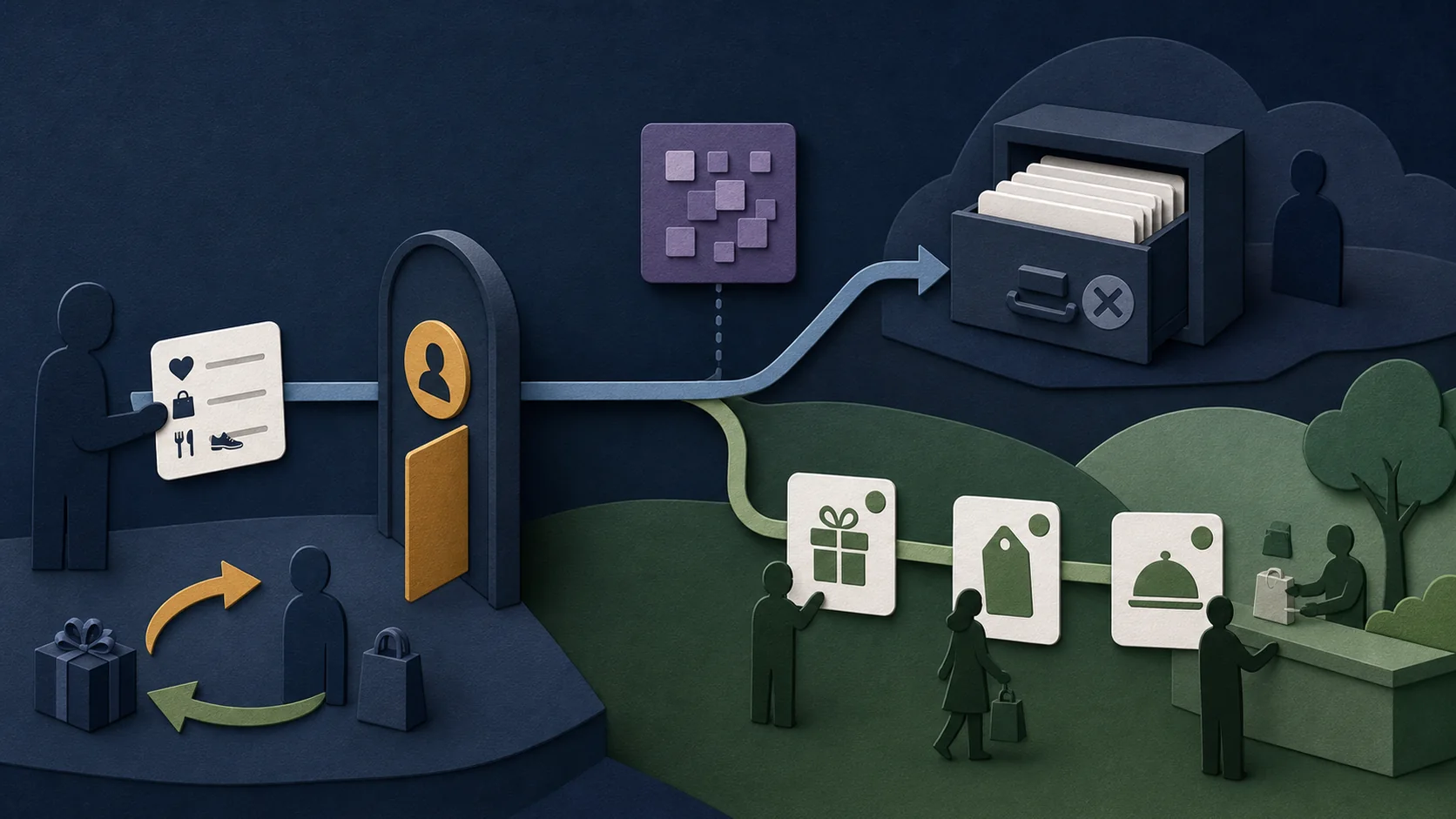
Data Collected vs. Data Acted On
Two different loyalty program states. Only one delivers on the 91% willingness this data describes.
Data collected: preference fields exist in a database, filled in by willing customers, referenced by no downstream system. Data acted on: the same preference data actively changes which offer, message, or recognition a specific customer receives.

Ninety-one percent of customers already agreed to be known. Most programs still treat them as strangers, one unused preference field at a time.
The Leadership Move
The structural choice is whether a loyalty program treats preference data collection as an end in itself, or as the input to a specific, traceable mechanism that changes what a customer subsequently experiences.
- Ownership
Loyalty and CRM teams own data collection design; personalization and marketing technology teams own whether that data actually reaches a decision point. When these two functions are not explicitly connected, collection expands while usage stays flat, and the 91% willingness produces a growing database instead of a better customer relationship.
- Tradeoff
Building the systems to act on preference data, offer logic, communication rules, recognition triggers, requires real engineering and design investment beyond adding a form field. The alternative, continuing to collect without acting, costs little in the short term but wastes the willingness GetResponse's data shows customers are already offering, and risks eroding that willingness over time if customers notice nothing changes.
- Human consequence
A customer who shares a preference and never sees it reflected anywhere experiences the request as a hollow gesture, even if they do not consciously register it that way. Over enough repetitions, this can quietly erode the exact willingness the 91% figure currently describes, turning an open, trusting customer base into a more guarded one for reasons the business itself created.
Next Move
If your loyalty program collects preference data: Trace three specific preference fields already in your system and confirm, concretely, what customer-facing decision each one currently changes. If the honest answer is none, that is the actual gap to close before collecting anything further.
If you are planning to expand data collection to improve personalization: Build the usage mechanism first. GetResponse's 91% figure suggests customer willingness is not the constraint; confirm your system can act on data before asking customers for more of it.
FAQ
How many customers are actually willing to share personal data with loyalty programs?
GetResponse's 2026 State of Customer Loyalty report, based on 3,000 consumer voices, found 91% of consumers are willing to share personal preferences in exchange for better rewards. That figure describes stated willingness under a clear value exchange, not unconditional data sharing.
If customers are this willing, why do most loyalty programs still feel generic?
Because willingness to share and a program's ability to act on what is shared are two separate capabilities, and most loyalty programs were built around point accumulation and redemption logic rather than around using preference data to change what a customer actually sees. Collecting a preference field on a signup form is not the same as a system that adjusts offers, communication, or recognition based on it.
What does "91% willing to share" actually promise a business?
It promises access, not automatic value. The 91% figure means most customers will not refuse a reasonable, clearly framed request for preference data in exchange for a better reward. It does not mean a business automatically knows what to do with that data once collected, or that collecting it alone improves the relationship.
What should a loyalty program do differently given this finding?
Audit whether preference data already being collected is actually changing any customer-facing decision: which offer is shown, which reward is suggested, which communication is sent. If the data sits in a database without visibly changing the customer's experience, the 91% willingness is being collected and wasted in the same motion.
Sources & References
Original article archive
Original article published January 6, 2025: "2025 CX Trends That Will Redefine Customer Loyalty and Growth". Preserved here for provenance, historical context, and citation continuity.
As we step into 2025, customer expectations have never been higher. Customers demand more than great products; they expect seamless, personalized, and meaningful interactions with brands. For businesses, embracing emerging customer experience (CX) trends is no longer optional—it is vital to driving engagement, satisfaction, and long-term loyalty.
This insight discusses the ten biggest CX trends of 2025 and explores how companies can harness these trends to achieve sustainable growth. From total experience design to ethical AI, these innovations are not just reshaping CX—they're redefining the rules of business success.
Introduction - CX Trends 2025
The following ten CX trends are not just theoretical—they are actionable opportunities that can drive engagement, satisfaction, and sustainable growth. Businesses that embrace these CX trends with a strategic focus can position themselves as leaders in their industries for the foreseeable future.
1. Total Experience Design (TX)
Total Experience Design integrates customer experience (CX), employee experience (EX), and user experience (UX) to create cohesive, end-to-end engagement. A Gartner report highlights that organizations implementing TX strategies see a 25% increase in satisfaction metrics compared to those without. By aligning customer and employee experiences, brands ensure consistent interactions and foster empathy at every touchpoint.
How Brands Can Implement:
- Map customer and employee journeys to identify alignment opportunities.
- Invest in cross-functional teams to bridge gaps between CX, EX, and UX.
Early Leaders:
Hilton Hotels offers a compelling case study. By aligning its CX and EX strategies, Hilton achieved a 30% increase in guest satisfaction scores. They synchronized employee training programs with customer feedback to address pain points dynamically, resulting in enhanced guest experiences.
Success Indicators:
- Improved Net Promoter Scores (NPS).
- Increased employee engagement metrics.
- Higher customer retention rates.
Costs and Challenges:
Cost: ⭐⭐⭐
Challenges: Coordination across departments and initial technology investments.
2. AI for Hyper-Personalization
Artificial intelligence enables businesses to analyze vast amounts of customer data, delivering tailored experiences in real time. According to McKinsey, hyper-personalization can drive revenue growth by up to 15%. AI-powered tools such as chatbots, recommendation engines, and predictive analytics have revolutionized how brands engage with customers.
How Brands Can Implement:
- Use machine learning algorithms to analyze purchase history and preferences.
- Implement dynamic content personalization on websites and email campaigns.
Early Leaders:
Sephora’s AI-driven recommendation system boosted conversion rates by 11%. The brand leveraged customer purchase history and preferences to suggest products, creating a seamless shopping journey.
Success Indicators:
- Increased average order value (AOV).
- Higher conversion rates.
- Enhanced customer satisfaction.
Costs and Challenges:
Cost: ⭐⭐⭐⭐
Challenges: Data privacy concerns and maintaining accuracy.
3. Purpose-Driven CX
Purpose-driven CX aligns brand values with customer interactions, focusing on sustainability, inclusivity, and social impact. A Deloitte study reveals that 63% of customers prefer buying from purpose-driven brands, emphasizing the need for authenticity and shared values in CX strategies.
How Brands Can Implement:
- Communicate brand purpose through campaigns and storytelling.
- Ensure alignment between brand values and customer touchpoints.
Early Leaders:
Patagonia exemplifies this trend. Through its eco-friendly initiatives and transparent supply chain practices, the brand has built trust and loyalty among environmentally conscious consumers. These efforts have contributed to consistent year-over-year revenue growth.

Success Indicators:
- Increased customer advocacy.
- Positive brand sentiment.
Costs and Challenges:
Cost: ⭐⭐⭐
Challenges: Balancing profitability with purpose-driven initiatives.
4. Proactive Service with Predictive Analytics
Predictive analytics anticipates customer needs before they arise, offering proactive solutions. Salesforce reports that 73% of customers expect companies to understand their needs without being explicitly told. Proactive service not only builds trust but also reduces customer churn.
How Brands Can Implement:
- Leverage CRM tools to analyze historical data for patterns.
- Offer targeted solutions or recommendations during customer interactions.
Early Leaders:
Netflix’s recommendation algorithm is a prime example. By analyzing user viewing habits, the platform delivers personalized suggestions that account for 80% of its streaming activity. This predictive capability enhances user engagement and satisfaction.

Success Indicators:
- Reduced churn rates.
- Increased customer lifetime value (CLV).
Costs and Challenges:
Cost: ⭐⭐⭐
Challenges: Data quality and integration complexities.
5. CX as a Revenue Generator
Revenue-focuses strategies link customer interactions continues to be a CX trend. In 2025, these strategies are linked to measurable business outcomes. PwC’s research shows that customers are willing to pay 16% more for exceptional experiences, underscoring the financial impact of effective CX initiatives.
How Brands Can Implement:
- Measure CX metrics alongside revenue KPIs.
- Create value-driven upsell opportunities during customer journeys.
Early Leaders:
Amazon’s “frequently bought together” feature is a testament to this approach. By analyzing purchase behavior, the feature increases average order value by 20%, highlighting how CX can drive profitability.

Success Indicators:
- Increased average transaction size.
- Higher ROI on marketing campaigns.
Costs and Challenges:
Cost: ⭐⭐⭐⭐
Challenges: Balancing revenue goals with maintaining genuine customer relationships.
6. Omnichannel 2.0
Omnichannel 2.0 represents an evolved approach to integrating digital and physical platforms for seamless customer experiences. Harvard Business Review reports that omnichannel shoppers spend 10% more than those using a single channel, making this strategy indispensable for modern businesses.
How Brands Can Implement:
- Use AR/VR technology to bridge the digital-physical divide.
- Implement unified commerce platforms for seamless transactions.
Early Leaders:
IKEA’s AR-enabled app demonstrates the power of omnichannel innovation. Customers can visualize furniture in their homes before purchasing, leading to higher confidence and conversion rates.

Success Indicators:
- Increased cross-channel engagement.
- Improved customer satisfaction.
Costs and Challenges:
Cost: ⭐⭐⭐⭐
Challenges: High investment in technology and data synchronization.
7. Ethical AI and Data Privacy
In an era of heightened awareness, ethical AI and data privacy have become essential. Cisco’s study indicates that 84% of consumers prioritize brands with transparent data practices. Responsible AI usage is crucial for building trust and avoiding reputational damage.
How Brands Can Implement:
- Develop AI models with fairness and transparency principles.
- Empower customers with data privacy controls.
Early Leaders:
Apple has emerged as a leader in this space with its App Tracking Transparency feature. By empowering users to control data sharing, Apple has strengthened customer loyalty while setting a new standard for ethical AI.
Success Indicators:
- Increased customer trust.
- Compliance with data regulations.
Costs and Challenges:
Cost: ⭐⭐⭐
Challenges: Technical complexities in ensuring AI fairness.
8. Instant Gratification Economy
The instant gratification economy caters to customers who expect immediate resolutions, faster deliveries, and real-time interactions. Accenture’s research reveals that 57% of consumers remain loyal to brands offering instant support.
How Brands Can Implement:
- Use automation for quick responses in customer support.
- Optimize supply chains for faster deliveries.
Early Leaders:
Domino’s Pizza Tracker is a standout example. By providing real-time updates on order status, Domino’s has enhanced customer satisfaction and cemented its reputation for reliability.

Success Indicators:
- Reduced resolution times.
- Increased repeat purchases.
Costs and Challenges:
Cost: ⭐⭐
Challenges: Balancing speed with quality.
9. CX as a Platform
In 2025, CX as a platform emphasizes the democratization of customer experience tools and processes, allowing businesses of all sizes to implement sophisticated CX strategies. Beyond tools, organizations are recognizing the importance of structured CX functions, dedicated departments, and Chief Experience Officers (CXOs) to drive meaningful, customer-centric transformations. Salesforce data shows that SMBs adopting CX platforms report an average revenue boost of 22%, underlining the strategic value of investing in CX as a core function.
How Brands Can Implement:
Adopt Scalable Platforms: Cloud-based tools such as Salesforce or HubSpot enable smaller businesses to deliver world-class experiences.
Establish CX Functions: Create dedicated CX teams focused on customer journey mapping, analytics, and strategy alignment.
Hire a CXO: Appointing a Chief Experience Officer ensures executive-level accountability for CX initiatives and aligns them with broader business goals.
Early Leaders:
Local Coffee Shops: Independent businesses using platforms like Square or Clover have redefined customer engagement through seamless transactions and loyalty programs.
CX Departments: Walmart recently centralized CX functions, bringing together marketing, IT, and operations under a unified CX vision.
CXOs in Action: Brands like Airbnb have appointed CXOs to oversee everything from booking experiences to post-stay feedback, ensuring consistent excellence.
What Success Looks Like:
- Improved operational efficiency.
- Enhanced customer satisfaction and loyalty.
- Clear accountability for CX outcomes, resulting in faster decision-making.
Costs and Challenges:
Cost: ⭐⭐⭐ (Initial setup and training can be moderate, but scalable platforms help manage costs.)
Challenges: Onboarding employees, integrating with legacy systems, and justifying initial costs to the C-suite.
By making CX a platform and a formalized function, brands not only streamline operations but also elevate customer engagement to new heights.
10. Ad Network-Driven CX
Ad network-driven CX integrates customer experience strategies with targeted advertising campaigns, enhancing relevance and engagement.
How Brands Can Implement:
- Use customer data for hyper-targeted ad placements.
- Integrate CX insights into campaign design.
Early Leaders:
Google’s Performance Max campaigns exemplify this trend. By leveraging AI to optimize ad placements across multiple channels, brands have seen improved conversion rates and customer acquisition.
Success Indicators:
- Increased ad ROI.
- Enhanced cross-channel engagement.
Costs and Challenges:
Cost: ⭐⭐⭐⭐
Challenges: Managing customer data responsibly and ensuring ad relevance.
Table: Comparing the CX Trends
| Trend | Cost | Benefits to Brands | Benefits to Customers | Challenges | Data Required | ROI |
|---|---|---|---|---|---|---|
| Total Experience Design (TX) | ⭐⭐⭐ | Higher satisfaction, reduced churn | Seamless interactions | Coordination complexity | Customer & employee data | High |
| AI for Hyper-Personalization | ⭐⭐⭐⭐ | Increased AOV, engagement | Tailored experiences | Data privacy, accuracy | Purchase history | High |
| Purpose-Driven CX | ⭐⭐⭐ | Positive brand sentiment, advocacy | Alignment with values | Balancing values & profit | Brand sentiment surveys | Moderate to High |
| Proactive Service | ⭐⭐⭐ | Reduced churn, increased CLV | Anticipated needs | Data integration | Historical interaction | High |
| CX as Revenue Generator | ⭐⭐⭐⭐ | Higher transaction size, measurable ROI | More value-driven interactions | Balancing profit with experience | Purchase behavior | High |
| Omnichannel 2.0 | ⭐⭐⭐⭐ | Cross-channel engagement | Seamless shopping journeys | High technology costs | Omnichannel behavior | High |
| Ethical AI | ⭐⭐⭐ | Increased trust, regulatory compliance | Transparency and control | Technical complexities | AI model transparency | Moderate to High |
| Instant Gratification Economy | ⭐⭐ | Higher repeat purchases, brand loyalty | Immediate solutions | Speed vs. quality | Real-time data | High |
| CX as a Platform | ⭐⭐⭐ | Operational efficiency, SMB empowerment | Better access to services | Complexity in adoption | Platform usage data | Moderate to High |
| Ad Network-Driven CX | ⭐⭐⭐⭐ | Improved ad ROI, customer acquisition | Relevant, non-intrusive ads | Data management, ad fatigue | Customer targeting data | High |
The Importance of C-Suite Buy-In
For these CX trends to succeed, C-suite executives, especially those in finance, must champion CX initiatives. Securing buy-in requires presenting data-driven arguments, such as how improved CX increases revenue, customer retention, and brand loyalty. Leaders who understand the connection between CX trends to ideation, investments, and measurable outcomes are more likely to support these transformative changes. Collaboration between departments—marketing, IT, HR, and operations—is also essential for successful implementation.
CX trends may come and go, sustained CX efforts will drive long term success and business growth.
Transform Today, Gain Tomorrow
The CX trends mentioned are some of the more important ones noted for 2025. To capitalize on these them, companies must be proactive and strategic.
Here's how to start:
1. Build C-Suite Advocacy
- Develop a compelling business case for each CX initiative, emphasizing potential ROI and competitive advantages.
- Highlight successful examples from industry leaders to secure buy-in from finance and executive teams.
- Appoint champions, such as CXOs or cross-departmental leaders, to advocate for CX investments.
2. Prioritize Investments
- Use the provided trend table to evaluate costs and benefits based on your organization's priorities.
- Begin with initiatives that offer quick wins, such as proactive service or instant gratification strategies.
3. Scale with Data
- Implement robust data collection and analytics tools to track success metrics and guide future investments.
- Ensure transparency and ethical use of data to maintain customer trust.
4. Train for Excellence
- Provide training programs to upskill employees on emerging technologies and CX strategies.
- Foster a customer-centric culture that values innovation and feedback.
5. Measure and Iterate
- Set clear KPIs for each CX trend to evaluate its impact on engagement, loyalty, and revenue.
- Regularly review progress and adapt strategies to align with evolving customer needs and market conditions.
By acting today, brands can transform their customer experience strategies into powerful engines for growth, ensuring they remain competitive in the dynamic landscape of 2025.
Which of the ten CX trends did you resonant with? Comment below!
How Can We Help?
Transformidy is available to help you understand your brand’s value proposition and maximize your customer experience strategy for business growth, engagement, and satisfaction.
Contact us or set up a 30-minute complimentary consultation for more information on our services, insights, or showcases. We look forward to hearing from you.
FAQ
How many customers are actually willing to share personal data with loyalty programs?
GetResponse's 2026 State of Customer Loyalty report, based on 3,000 consumer voices, found 91% of consumers are willing to share personal preferences in exchange for better rewards. That figure describes stated willingness under a clear value exchange, not unconditional data sharing.
If customers are this willing, why do most loyalty programs still feel generic?
Because willingness to share and a program's ability to act on what is shared are two separate capabilities, and most loyalty programs were built around point accumulation and redemption logic rather than around using preference data to change what a customer actually sees. Collecting a preference field on a signup form is not the same as a system that adjusts offers, communication, or recognition based on it.
What does '91% willing to share' actually promise a business?
It promises access, not automatic value. The 91% figure means most customers will not refuse a reasonable, clearly framed request for preference data in exchange for a better reward. It does not mean a business automatically knows what to do with that data once collected, or that collecting it alone improves the relationship.
What should a loyalty program do differently given this finding?
Audit whether preference data already being collected is actually changing any customer-facing decision: which offer is shown, which reward is suggested, which communication is sent. If the data sits in a database without visibly changing the customer's experience, the 91% willingness is being collected and wasted in the same motion.
Related intelligence
Article
AI Personalization Strategy: Segmentation Before Algorithms
Personalization programs split: those with explicit segment strategy maintained customer satisfaction. Those optimizing for individual conversion without boundaries experienced satisfaction decline and program abandonment.
Article
SharePoint's Real 2025-2026 Story Was Nation-State Attacks, Not CX Strategy
Nation-state hackers exploited on-premises SharePoint servers in 2025, confirmed by Shadowserver at over 300 victims worldwide. In 2026, a new vulnerability rated 9.8 out of 10 severity emerged in the same product line. SharePoint did not quietly rewire anyone's CX strategy. It became a sustained target.
Article
Apple Is Reportedly Building a MacBook Designed to Lose the Spec Sheet Comparison
Apple's new MacBook Neo runs an iPhone chip, not a Mac chip, and starts at $699 to $899, roughly $100 to $300 below the MacBook Air. It has no Thunderbolt. Apple built its first laptop specifically to lose a spec sheet comparison, on purpose, to win a price comparison instead.