
Article
AI Personalization Strategy: Segmentation Before Algorithms
Personalization programs split: those with explicit segment strategy maintained customer satisfaction. Those optimizing for individual conversion without boundaries experienced satisfaction decline and program abandonment.
- Published
- June 7, 2024
- Updated
- June 18, 2026
- Reading time
- 8 min

2026 updated analysis
What changed since the original article
This page keeps the original Transformidy article as the canonical record and leads with the current interpretation, source notes, and Revenue Unknown framing.
The Adoption Divergence
Between 2024 and 2025, personalization programs diverged into two distinct outcomes. While 95% of retailers were experimenting with AI in marketing and ecommerce, only 5% reported clear, scalable returns. That gap marks where personalization split.
Group A: Marketing teams that defined customer strategy first—identifying segments (high-value, occasional, new, price-sensitive) and creating coherent offer strategies for each segment—then used personalization to optimize within those boundaries. Result: stable customer satisfaction, improved repeat purchase rates, and teams that could explain customer strategy to the entire organization.
Group B: Marketing teams that deployed personalization engines and let them optimize for individual response. Initial conversion gains were real. But as personalization scaled, customer satisfaction declined, repeat purchase rates fell, and only 15% of retail brands felt confident their personalization efforts met expectations.
Retail brands confident their personalization efforts meet expectations
85% remain uncertain whether personalization is actually working for customer relationships.
What Changed at Scale
At pilot scale, personalization worked. Each decision felt tailored. At production scale—millions of individual decisions per day—the systems optimized every offer independently. Customers experienced the sequence as incoherent.
A customer might see a 30 percent discount email, then a 15 percent email three days later for the same category, then a reminder for a product they already owned. Real-world examples showed how channel disintegration—such as app-exclusive discounts not available in physical stores—created customer frustration.
Each individual decision was optimized. The sequence felt arbitrary. While 60% of consumers become repeat buyers after personalized experiences, this pattern reversed when offers appeared incoherent or contradictory. Customers tolerated impersonal marketing. They resisted personalization that appeared arbitrary.
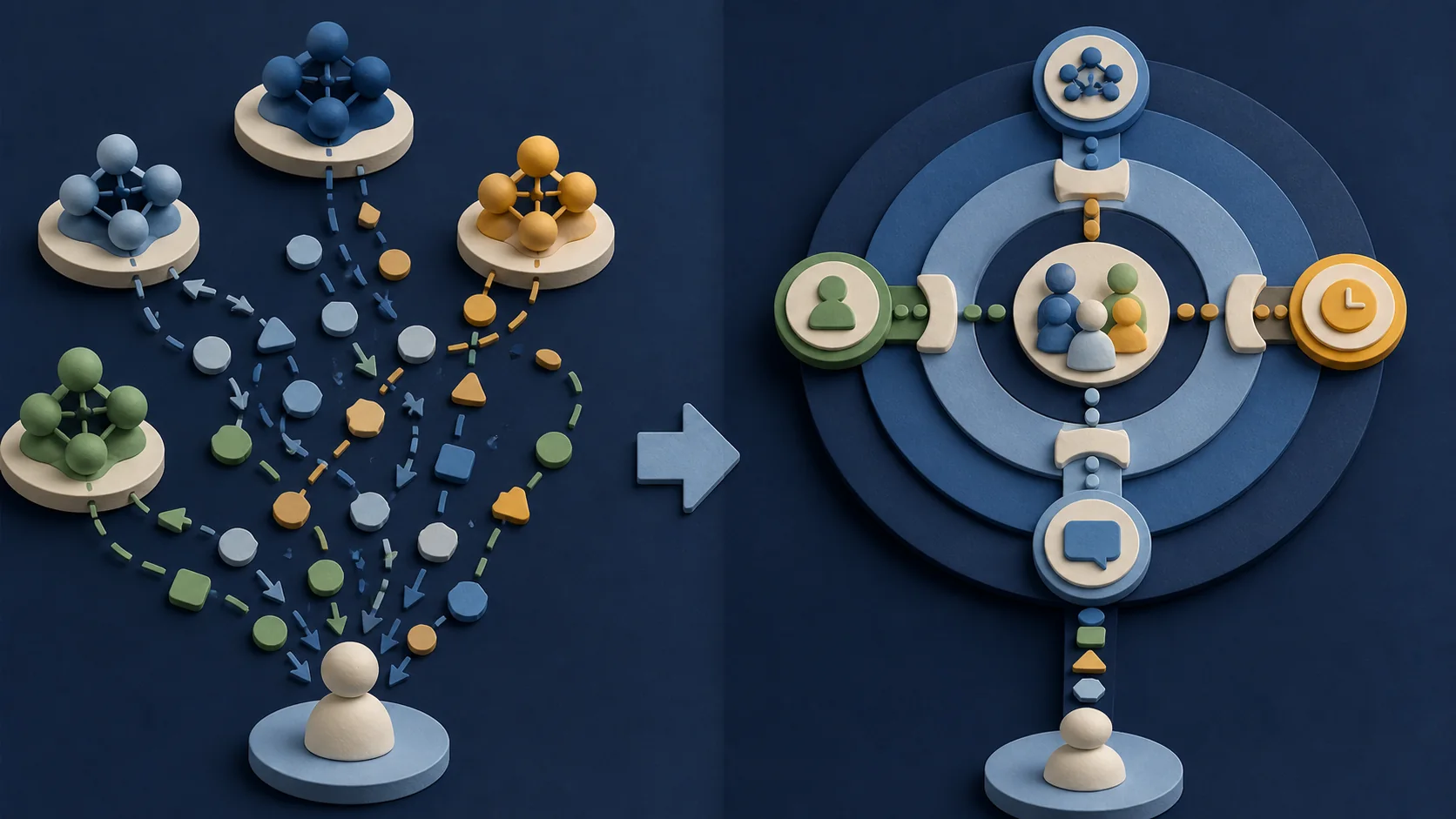
Segmentation-First vs. Algorithmic-Only Personalization
Two different approaches. Different customer outcomes.
Segmentation-first: strategy defines boundaries, AI optimizes within them. Algorithmic-only: AI optimizes every decision independently, creating incoherence.
Why the Visible Metric Misleads
Conversion is visible and clean. Customer satisfaction is harder to see, so many organizations quietly stop looking for it once the conversion number turns green. A team can be fully trained in a personalization system and actively using it while executing incoherent offer strategies that customers resent.
The more useful questions sit deeper: did customer lifetime value actually improve, or only immediate conversion? Did segment strategy exist and guide decisions, or did the system optimize every offer independently? Did customer satisfaction change positively, or did it decline while conversion rose?
Segmentation is permission to personalize. Without it, personalization becomes noise.
The Leadership Move
Segmentation must come first, not as a data science exercise, but as a business strategy exercise. The question is not "what does the data say?" but "what customer segments does our business think about naturally?" Formalize those segments, define strategy for each, then use personalization to optimize within that strategy.
- Ownership
Personalization strategy belongs to marketing, finance, customer experience, and data science together. Marketing owns segment promise. Finance owns margin and lifetime value discipline. Customer experience owns how the sequence feels to customers. Data science owns the system that must honor those boundaries. When ownership is left ambiguous, the system defaults to maximizing the next click instead of the customer relationship.
- Tradeoff
Leaders must decide whether personalization exists to maximize the next click or to strengthen the customer relationship over time. The first path is easier to measure and faster to celebrate. The second requires segment discipline, patience, and the willingness to reject offers that convert but confuse.
- Human consequence
When the hidden signal is missed, customers feel watched but not understood. Marketing teams lose confidence in their own strategy. Service teams inherit confused customers who ask why the brand is sending contradictory offers. The problem is not personalization itself; it is personalization without a human-readable promise.
Next Move
If you are considering personalization for the first time: Name the owners before the segments. Strategy comes first; technology comes second. Formalize strategy explicitly—write it down, get leadership signature. Select technology that enforces strategy-first design. Measure what matters: repeat purchase rate and customer satisfaction by segment, not overall conversion.
If you have personalization deployed but are seeing satisfaction decline: Audit your current approach. Is personalization based on explicit segment strategy, or is the system optimizing for conversion without strategic boundaries? Define segments and strategy if you have not already. Retrofit governance. Accept the short-term conversion tradeoff; segmentation-first approaches may reduce peak short-term conversion, but repeat purchase and lifetime value improve when customers experience a coherent relationship.
FAQ
Does segmentation reduce personalization effectiveness?
Segmentation-first approaches may reduce peak short-term conversion, but they dramatically improve repeat purchase and customer lifetime value over time. Organizations measuring only immediate conversion may see temporary decline. Those measuring lifetime value see sustainable improvement.
How do we define segments without clean customer data?
Start with business judgment, not data. What segments do marketing leaders think about naturally? High-value customers, occasional shoppers, new customers, price-seekers? Formalize that intuition. Then use data to validate and refine.
Can we do segmentation and personalization at the same time?
No. Sequence matters. Deploying personalization before segmentation creates incoherence. Invest time in segmentation first. This discipline prevents the typical failure pattern.
Who owns personalization strategy governance?
CMO and CFO with customer experience and data science collaboration. Not purely technical (data scientists optimize for accuracy, not auditability) and not purely operational. Cross-functional ownership produces best results.
Sources & References
- Adobe: 2025 AI and Digital Trends in Retail Report
- Forrester: 2024 US Customer Experience Index
- Voyado: Why Personalization in Retail Still Breaks Down
- Forbes: Why CX Quality is Simultaneously Soaring & Plummeting
- Envive: Customer Retention Statistics in eCommerce 2026
- Taylor & Francis Online: Customer Lifetime Value (CLV) Insights for Strategic Marketing Success
- KPMG: AI in Retail Report
Original article archive
Original article published June 7, 2024: "Good Personalization Powered By AI". Preserved here for provenance, historical context, and citation continuity.
In recent years, the retail landscape has undergone a profound transformation fueled by artificial intelligence (AI) advancements. This technological revolution has not only reshaped how retailers operate but has also fundamentally altered the way consumers shop.
This insight focuses on personalization. What are the good, bad, and ugly components of using the technology for retail brands to build the best experience for consumers?
Table of Contents
- Personalization – Yesterday, Today and Tomorrow
- Personalization – The Bad Sides
- Measuring Personalization Success
- Privacy Considerations
- Looking Ahead
Personalization – Yesterday, Today and Tomorrow
Personalization has long been a key strategy for retailers looking to engage customers and drive sales. However, traditional approaches to personalization often fell short, delivering generic recommendations based on limited data. AI has changed this paradigm by enabling retailers to harness the power of big data and machine learning to deliver highly personalized experiences tailored to individual preferences and behaviors.
Relevant Statistics:
- Growth potential: A study by AI21 Labs suggests that 87% of customers consider product content crucial when purchasing. AI can personalize product descriptions to different customer segments, boosting sales.
- Revenue impact: Stylitics, an AI-powered retail platform, helped its clients generate over $4 billion in additional revenue through personalized recommendations in 2022.
- Customer influence: Another report highlights that nearly 90% of shoppers expect personalization from brands.
Predictive Analytics
One of the most significant ways AI is revolutionizing personalization in retail is through the use of predictive analytics. AI can accurately anticipate customer needs and preferences by analyzing vast amounts of data, including purchase history, browsing behavior, and demographic information. This allows retailers to offer personalized product recommendations, promotions, and content that resonate with each customer, driving engagement and loyalty.
For example, according to a study by Salesforce, 62% of consumers expect companies to send personalized offers or discounts based on items they’ve already purchased while 57% of consumers say they’re willing to share personal data in exchange for personalized offers or discounts.

AI enables retailers to meet these expectations by analyzing past purchase data to offer personalized discounts and promotions, increasing the likelihood of repeat purchases.
In-store Experiences
Another area where AI is redefining personalization is in-store experiences. Technologies such as facial recognition and computer vision are enabling retailers to deliver personalized experiences in real time. For example, AI-powered mirrors can recommend clothing items based on a customer’s body type and style preferences, while smart shelves can display personalized offers based on a customer’s past purchases.
A prime example of this is Nike’s in-store experience, where customers can use AI-powered foot scanning technology to receive personalized shoe recommendations based on their unique foot shape and size. This level of personalization not only enhances the customer experience but also increases the likelihood of a purchase.
AI is also playing a crucial role in improving customer service and support. Chatbots powered by AI can provide instant, personalized assistance to customers, answering questions, resolving issues, and even processing transactions. This not only enhances the overall shopping experience but also allows retailers to provide round-the-clock support without the need for human intervention.
What Is Hyper-Personalization?
Hyper-personalization refers to the practice of tailoring products, services, content, and marketing efforts to individual customers on a highly granular level. It goes beyond traditional personalization by leveraging advanced technologies, such as artificial intelligence and big data analytics, to create highly individualized experiences for each customer.
Hyper-personalization relies on collecting and analyzing vast amounts of data about customer behavior, preferences, and demographics to understand their unique needs and preferences. This data is then used to deliver personalized recommendations, offers, and experiences across multiple touchpoints, such as websites, mobile applications, emails, and in-store interactions.

For example, a retailer practicing hyper-personalization might use AI algorithms to analyze a customer’s past purchases, browsing behavior, and interactions with the brand to recommend products that are likely to be of interest to them.
They might also personalize the content and layout of their website based on the customer’s preferences and behavior, or send personalized emails with tailored offers and recommendations.
A big plus is that customers get a digital one-to-one connection with the brand while the big downside is that customers might feel like they are being monitored by Big Brother.
Personalization – The Bad Sides
Despite the significant advancements AI has brought to the retail industry, challenges remain. One of the biggest challenges is ensuring the ethical use of AI, particularly in areas such as data privacy and algorithmic bias. Retailers must be transparent about how they use customer data and ensure that their AI systems are designed and trained in a way that is fair and unbiased.
Another challenge is the integration of AI into existing retail systems and processes. Many retailers struggle to effectively implement AI due to a lack of expertise, resources, or a clear strategy. Overcoming these challenges will require a concerted effort from retailers to invest in AI talent, infrastructure, and training to fully realize the benefits of this transformative technology.
Measuring Personalization Success
Implementing AI and personalization in retail can be measured using several key metrics to determine success. Here are the top eight most important ones used by the industry today:
- Conversion Rate: Measure the percentage of website visitors or app users who make a purchase. AI-driven personalization should ideally lead to an increase in conversion rates as customers receive more relevant recommendations and offers.
- Average Order Value (AOV): Track the average value of orders placed by customers. AI-driven personalization can help increase AOV by suggesting complementary products or encouraging upsells and cross-sells.
- Customer Lifetime Value (CLV): Measure the total revenue a business can expect from a single customer over their lifetime. Personalization can help increase CLV by improving customer retention and encouraging repeat purchases.
- Customer Engagement: Monitor metrics such as time spent on site, number of pages visited, and frequency of visits. AI-driven personalization should lead to higher levels of engagement as customers find the content and products more relevant to their interests.
- Customer Satisfaction (CSAT) and Net Promoter Score (NPS): Measure customer satisfaction with the personalized experience and their likelihood to recommend the brand to others. Higher CSAT and NPS scores indicate that AI-driven personalization is resonating with customers.
- Return on Investment (ROI): Calculate the ROI of implementing AI-driven personalization by comparing the cost of the technology and implementation with the increase in revenue or cost savings achieved. A positive ROI indicates that the implementation is successful.
- Retention Rate: Measure the percentage of customers who continue to purchase from the brand over time. AI-driven personalization should help improve retention rates by creating more personalized and engaging customer experiences.
- Personalization Effectiveness: Track the performance of personalized recommendations and offers, such as click-through rates and conversion rates for personalized content. This can help refine personalization strategies to improve effectiveness over time.
By tracking some or all of these metrics, retailers can assess the impact of AI-driven personalization on their business and make informed decisions to optimize and improve their strategies.
Beyond metrics, retailers should take an opportunity to educate the public on how they use AI to drive personalization. They can then build and gauge comfort and trust levels through feedback and provide additional awareness building, as required. The goal is to make people understand how the technology works for them.
Privacy Considerations
When implementing AI and personalization in retail, it is crucial to consider and comply with relevant privacy laws and regulations depending on where the operations are located.
Some of the key global and regional laws and regulations to consider include:
- General Data Protection Regulation (GDPR): GDPR is a comprehensive data protection regulation that applies to businesses operating within the European Union (EU) and regulates the processing of personal data of individuals within the EU. GDPR imposes strict requirements on how personal data is collected, processed, stored, and shared, including requirements for obtaining consent, providing transparency, and ensuring data security.
- California Consumer Privacy Act (CCPA): CCPA is a privacy law that applies to businesses operating in California and governs the collection, use, and sharing of personal information of California residents. CCPA grants consumers certain rights over their personal information, such as the right to access, delete, and opt out of the sale of their personal information.
- Personal Information Protection and Electronic Documents Act (PIPEDA): PIPEDA is a Canadian privacy law that regulates the collection, use, and disclosure of personal information by private sector organizations. PIPEDA requires organizations to obtain consent for the collection, use, and disclosure of personal information and imposes requirements for data security and breach notification.
- Children’s Online Privacy Protection Act (COPPA): COPPA is a U.S. federal law that regulates the online collection of personal information from children under the age of 13. COPPA requires operators of websites and online services directed at children to obtain verifiable parental consent before collecting personal information from children.
- California Privacy Rights Act (CPRA): CPRA is a privacy law that builds upon CCPA and further enhances privacy rights for California residents. CPRA introduces additional requirements for businesses, such as the establishment of a dedicated privacy enforcement agency and the implementation of data minimization and retention requirements.
- Data Protection Directive 95/46/EC: Although superseded by GDPR, the Data Protection Directive (DPD) was the predecessor to GDPR and set out principles for the protection of personal data within the EU. While DPD is no longer in force, it may still be relevant for historical purposes or for organizations operating in countries outside the EU that have adopted similar data protection principles.
- Bonus: Sector-specific regulations: Depending on the nature of the retail business and the data it collects, additional sector-specific regulations may apply (e.g., medical/pharmacy)
Looking Ahead
Looking ahead, the future of AI in retail is bright. As AI continues to evolve, we can expect to see even more innovative applications that further enhance personalization, customer experience, and operational efficiency. Retailers that embrace AI and harness its power effectively will be well-positioned to thrive in the ever-evolving retail landscape.
How Can Transformidy Help?
Transformidy is available to assist in helping you understand artificial intelligence and how prepared your company is in building a solution for customers, employees, stakeholders.
Contact us or set up a 30 minute complimentary consultation for more information on our services, insights, or showcases. We look forward to hearing from you.
FAQ
Does segmentation reduce personalization effectiveness?
Segmentation-first approaches may reduce peak short-term conversion, but they dramatically improve repeat purchase and customer lifetime value over time. Organizations measuring only immediate conversion may see temporary decline. Those measuring lifetime value see sustainable improvement.
Can we do segmentation and personalization at the same time?
No. Sequence matters. Deploying personalization before segmentation creates incoherence. Invest time in segmentation first. This discipline prevents the typical failure pattern.