
Article
Every 2026 CX Success Story Has the Same Asterisk
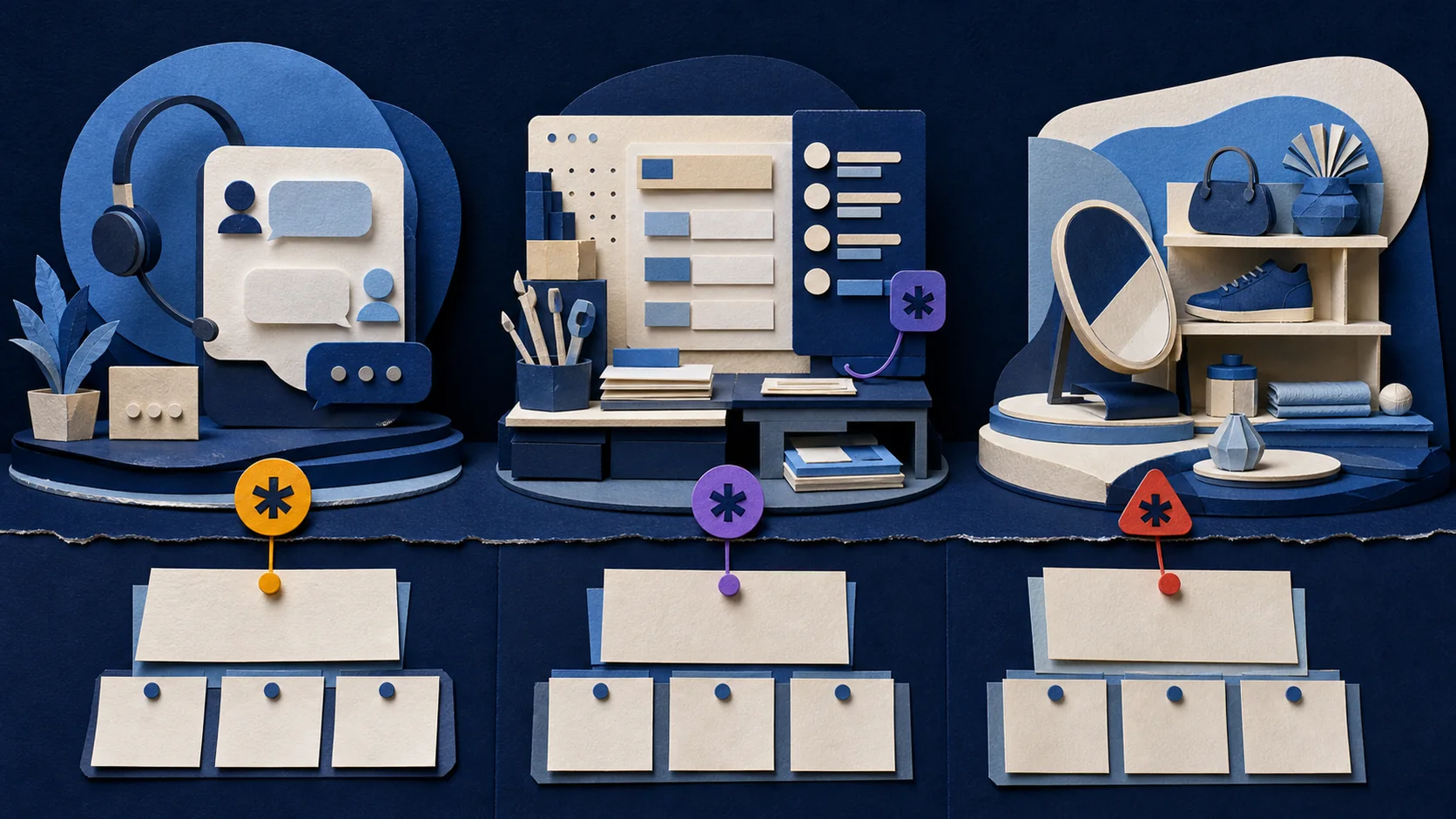
Klarna's assistant handled 2.3 million chats and still got its own story oversimplified. Shopify's AI cut support tickets and was still confidently wrong on billing questions. Sephora's visual AI sped up discovery and still struggled with darker skin tones. Every real 2026 AI-CX success shares the same shape: a genuine win, paired with one specific, named failure mode.
- Published
- December 23, 2024
- Updated
- June 18, 2026
- Reading time
- 8 min
2026 updated analysis
What changed since the original article
This page keeps the original Transformidy article as the canonical record and leads with the current interpretation, source notes, and Revenue Unknown framing.
Three Companies, One Shape
Klarna's OpenAI-powered assistant handled 2.3 million chats in its first month across 35 languages, reached customer satisfaction parity with human agents, and reduced repeat inquiries by 25%. The widely repeated claim that the tool "replaced 700 agents" oversimplified the reality: many of those roles were seasonal BPO staff, not a clean one-for-one substitution of permanent employees, a distinction that got lost in the popular retelling of the number.
Shopify embedded AI assistants, Sidekick and Magic, directly into its merchant admin, reducing friction by placing help where merchants were already working and cutting support ticket volume. The documented limitation was accuracy under pressure: AI-generated answers were sometimes confidently wrong on billing and third-party behavior questions, delivered with the same tone of certainty as correct answers.
Sephora added visual and voice AI, including skin tone analysis, to its Facebook Messenger experience, framed deliberately as a genuine discovery experience rather than a support deflection tool, and it produced faster product discovery than browsing. The documented gap was that the visual AI struggled specifically with darker skin tones, requiring retraining and a public commitment to bias transparency.
Chats handled by Klarna's AI assistant, across 35 languages, with a 25% reduction in repeat inquiries
Documented alongside a specific narrative failure: the popular "replaced 700 agents" framing oversimplified a workforce that was substantially seasonal BPO staff.
The Asterisk Is the Instruction Manual
Case studies get consumed for their headline metric because the headline is what fits in a slide or a summary. But in all three of these documented cases, the paired limitation is not a footnote weakening the success story; it is the specific, actionable information a business considering a similar deployment actually needs. Klarna's story is not "AI handles 2.3 million chats," full stop. It is "AI handles 2.3 million chats, and the workforce narrative around what changed needs to be stated precisely, not left to a simplified public framing." Shopify's story is not "AI reduces support tickets." It is "AI reduces support tickets, and confident wrongness on specific question categories, billing and third-party behavior, needs a human review layer." Sephora's story is not "visual AI speeds up discovery." It is "visual AI speeds up discovery, and it needs active bias auditing on skin tone recognition specifically."
Treating the asterisk as the instructive part rather than the caveat changes how a business should evaluate its own AI-CX plans. The question is not "will this succeed," which all three of these cases answer affirmatively in aggregate. The question is "what is this specific deployment's equivalent failure mode going to be, and has anyone named it in advance," which is the question these three companies answered honestly, in public, after the fact.
None of this diminishes the real gains. 2.3 million chats handled, ticket volume reduced, faster discovery than browsing: these are genuine, measured outcomes, not marketing claims without substance. The point is that genuine outcomes and specific, unresolved limitations are not mutually exclusive, and the businesses getting the most useful signal from these case studies are reading both halves, not just the half that fits in a headline.
Reading the Headline Metric vs. Reading the Paired Failure Mode
Same case study. Different amount of actually usable information.
Headline-only: a business copies the aggregate success metric as a target, without knowing where the deployment is most likely to break. Full-case reading: a business identifies the specific, named failure mode alongside the win, and builds a human-review layer targeted at exactly that gap before scaling.

The failure mode is not the part of the case study to skip. It is the only part that tells you what to actually watch for in your own deployment.
The Leadership Move
The structural choice when evaluating any AI-CX success story, including one from inside your own organization, is whether to stop at the headline metric or to require the specific, named failure mode as part of what counts as a complete result.
- Ownership
CX leadership owns requiring a documented failure mode alongside any reported AI-CX success metric, internally as well as when evaluating external case studies used to justify a similar investment. When only the aggregate win is reported upward, leadership approves further scaling without knowing where the deployment's actual weak point sits.
- Tradeoff
Requiring an honest, named failure mode alongside every success metric slows down how quickly a win can be reported and celebrated internally. The alternative, reporting only the aggregate number, moves faster in the short term while leaving the organization blind to exactly the gap that eventually surfaces as a customer complaint, a bias audit, or a support escalation nobody saw coming.
- Human consequence
Customers who fall into the specific gap each of these three companies documented, the billing question Shopify's AI answers confidently wrong, the skin tone Sephora's visual AI misreads, experience the failure directly and individually, regardless of how strong the aggregate success metric looks in a quarterly report. Naming the failure mode in advance is what gives frontline and support teams a chance to catch it before the customer has to.
Next Move
If you are evaluating an external AI-CX case study to justify your own investment: Require the paired failure mode as part of the evidence, not just the headline metric. Klarna, Shopify, and Sephora's documented 2026 cases each named theirs explicitly; treat a case study that only reports success as an incomplete one.
If you are reporting on your own AI-CX deployment internally: Name the specific failure mode alongside the success metric before leadership approves further scaling. The three cases here suggest a real win and a specific limitation are the normal shape of a 2026 AI-CX deployment, not evidence that something went wrong.
FAQ
What did Klarna's AI customer service actually achieve, and what was the documented problem with it?
Klarna's OpenAI-powered assistant handled 2.3 million chats in its first month across 35 languages, reached customer satisfaction parity with human agents, and reduced repeat inquiries by 25%. The documented problem was narrative, not technical: the popular framing that the AI "replaced 700 agents" oversimplified a situation where many of those roles were seasonal BPO staff, not a direct one-for-one replacement of permanent employees.
What went wrong with Shopify's AI support tools?
Shopify embedded AI assistants (Sidekick and Magic) directly into its merchant admin, reducing friction by placing help where merchants were already working and cutting support ticket volume. The documented failure mode was accuracy: AI-generated answers were sometimes confidently wrong on billing and third-party behavior questions, delivering incorrect information with the same tone of certainty as correct information.
What was the issue with Sephora's visual AI feature?
Sephora added visual and voice AI, including skin tone analysis, to its Facebook Messenger experience, framed as a genuine discovery experience rather than a support deflection tool, and it produced faster product discovery than browsing. The documented failure mode was that the visual AI struggled specifically with darker skin tones, requiring retraining and a public commitment to bias transparency.
Why does the shared pattern across these three cases matter more than any single result?
Because it suggests the current state of AI-driven customer experience is not a binary of success or failure, but a consistent shape: a real, measurable gain paired with one specific, identifiable failure mode that the company documented rather than concealed. Evaluating any single AI-CX deployment by asking what its equivalent named failure mode is, rather than assuming success or failure outright, matches the actual pattern better than either extreme.
Sources & References
Original article archive
Original article published December 23, 2024: "2024's Top 10 CX Success Stories". Preserved here for provenance, historical context, and citation continuity.
2024 was a landmark year for customer experience (CX), as brands pushed boundaries to create innovative, impactful, and seamless experiences. These CX successes illustrate how CX drives engagement, customer satisfaction, loyalty, and revenue. In this first installment of our 2024 CX Landscape series, we explore the top 10 CX success stories, highlighting the strategies and outcomes that defined their achievements.
The 2024 CX Landscape: Highs and Innovations
In 2024, the CX landscape was shaped by groundbreaking innovations and a continued focus on personalization, efficiency, and emotional connection. Advances in artificial intelligence (AI) and machine learning enabled brands to deliver better content and more personalized experiences, while augmented reality (AR) and virtual reality (VR) transformed the way customers interacted with products and services. Omnichannel strategies became the norm, blending digital and physical touchpoints for seamless engagement. All these leads to CX successes.
Key highlights from the year include:
- AI-Powered Personalization: Companies like Sephora and Starbucks used AI to analyze customer data and offer tailored recommendations, leading to higher satisfaction and conversion rates.
- Immersive Technologies: Disney’s integration of AR into theme park visits elevated entertainment, while Ikea’s AR design tools redefined the shopping experience.
- Empathy in Action: Healthcare providers, such as Cleveland Clinic, demonstrated the importance of combining technology with human empathy to improve patient outcomes.
- Sustainability and Purpose: Brands increasingly aligned CX with sustainability goals, as seen in P&G’s eco-friendly initiatives that resonated with environmentally conscious consumers.
What Defines a CX Success?
A CX success story is one where a brand not only meets but exceeds customer expectations, resulting in measurable improvements in engagement, satisfaction, and revenue. Key indicators of success include:
- Higher Engagement Rates: Successful initiatives often lead to greater interaction with the brand, whether through digital platforms, in-store visits, or community events. This builds trust, customer relationships, and revenue capture potential.
- Increased Customer Satisfaction: Successful initiatives builds and sustains higher customer satisfaction. This translates into loyalty and extended engagement and spending.
- Revenue Growth: A well-executed CX strategy drives repeat business, higher conversion rates, and increased average spend per customer with less effort.
With these criteria in mind, let’s dive into the top 10 CX success stories of 2024.
The Top 10 CX Success Stories of 2024
Sephora’s Generative AI-Powered Recommendations
Sephora leveraged generative AI to provide hyper-personalized product recommendations through its app and website. Customers experienced a 25% reduction in browsing time, leading to a 20% boost in conversions. These tailored recommendations helped Sephora cater to customer needs more effectively, creating a seamless shopping experience. Sustaining this success will require continuously improving AI algorithms to adapt to evolving customer preferences.
Southwest Airlines’ CX Comeback
After operational challenges in 2023, Southwest Airlines invested in predictive analytics and proactive customer communication. This approach improved flight reliability. By actively addressing past pain points, Southwest rebuilt customer trust. To maintain this progress, Southwest should continue monitoring operational data, enhancing employee training, and investing in predictive technologies.

Disney’s Augmented Reality Magic
Disney integrated augmented reality (AR) into theme park visits, creating immersive experiences through mobile apps. Guests could unlock hidden features in rides and explore interactive storytelling during their visits. This innovation boosted in-park spending and enhanced the magical experience Disney is known for. Sustaining these outcomes requires constant innovation in AR features and storytelling to keep guests engaged. In 2024, it also established the "Disney Office of Technology Enablement” (OTE) to further research AI, AR, VR, and extended reality (XR).
Gucci’s Authenticity Feature
Gucci introduced a service within its Gucci mobile application that scans and verified products' authenticity. All new products have an NFC chip inside. Shoppers can scan any product by placing a smartphone on the back side of the item to determine the authenticity. This reduces fake items from being sold to unsuspected customers and improve safety.

Starbucks’ AI-Driven Order Customization
Starbucks’ mobile application used AI to predict customer orders based on past preferences and local trends. This feature increased mobile sales, demonstrating the power of predictive technology in enhancing customer convenience. By continuously refining AI predictions and adding localized preferences, Starbucks can deepen customer loyalty and expand its digital footprint.
Ikea’s Omnichannel Revolution
Ikea integrated its mobile application with in-store navigation and AI-powered design tools, creating a seamless shopping experience. Customers could visualize furniture in their spaces using augmented reality and receive in-store assistance via app navigation. This approach enhanced customer satisfaction. Maintaining this momentum requires investing in omnichannel consistency, robust backend systems, and customer feedback mechanisms.

Cleveland Clinic’s Empathy-Focused CX
By using virtual assistants to streamline patient interactions, Cleveland Clinic reduced missed appointments by 35% and improved patient satisfaction. The healthcare provider’s focus on empathy and efficient communication transformed patient experiences. Sustaining this success depends on enhancing both technological capabilities and empathetic human interactions in healthcare delivery.
Instacart's Frictionless Checkout Innovation
Founded in 2016, Caper’s AI-powered smart carts have evolved into series 3 and powered many implementation across supermarket chains in the United States. Those that have the latest model found improved customer satisfaction scores and higher spend owing to a seamless experience.
Nike’s Digital Community Engagement
Nike’s app fostered community engagement through challenges, tutorials, and exclusive content. This approach increased user engagement by 40%, creating a loyal customer base. Keeping the momentum requires continuously updating content, fostering authentic connections, and expanding community-driven initiatives.
Procter & Gamble’s CX Data Hub
P&G centralized its CX data into a unified hub, enabling real-time insights and reducing complaint resolution times by 40%. This comprehensive data strategy allowed for personalized customer interactions and proactive problem-solving. By maintaining a robust data governance framework, P&G can continue delivering efficient and personalized service.
Key Takeaways from 2024’s CX Success Stories
- Leveraging AI and data analytics creates hyper-personalized and efficient experiences.
- Omnichannel strategies that blend digital and physical touchpoints drive higher engagement.
- Transparency, empathy, and innovation are essential for building and sustaining customer trust.
How Can CX Success Be Sustained?
To sustain these CX successes, brands must prioritize ongoing CX innovation and investment, build employee experiences that match the customer experience, and stay attuned to customer feedback and other data points. By fostering a culture of continuous improvement, businesses can turn successful initiatives into long-term competitive advantages.
How Can We Help?
Transformidy is available to help you understand your brand’s value proposition and maximize your customer experience strategy for business growth, engagement, and satisfaction.
Contact us or set up a 30-minute complimentary consultation for more information on our services, insights, or showcases. We look forward to hearing from you.
FAQ
What did Klarna's AI customer service actually achieve, and what was the documented problem with it?
Klarna's OpenAI-powered assistant handled 2.3 million chats in its first month across 35 languages, reached customer satisfaction parity with human agents, and reduced repeat inquiries by 25%. The documented problem was narrative, not technical: the popular framing that the AI "replaced 700 agents" oversimplified a situation where many of those roles were seasonal BPO staff, not a direct one-for-one replacement of permanent employees.
What went wrong with Shopify's AI support tools?
Shopify embedded AI assistants (Sidekick and Magic) directly into its merchant admin, reducing friction by placing help where merchants were already working and cutting support ticket volume. The documented failure mode was accuracy: AI-generated answers were sometimes confidently wrong on billing and third-party behavior questions, delivering incorrect information with the same tone of certainty as correct information.
What was the issue with Sephora's visual AI feature?
Sephora added visual and voice AI, including skin tone analysis, to its Facebook Messenger experience, framed as a genuine discovery experience rather than a support deflection tool, and it produced faster product discovery than browsing. The documented failure mode was that the visual AI struggled specifically with darker skin tones, requiring retraining and a public commitment to bias transparency.
Why does the shared pattern across these three cases matter more than any single result?
Because it suggests the current state of AI-driven customer experience is not a binary of success or failure, but a consistent shape: a real, measurable gain paired with one specific, identifiable failure mode that the company documented rather than concealed. Evaluating any single AI-CX deployment by asking what its equivalent named failure mode is, rather than assuming success or failure outright, matches the actual pattern better than either extreme.
Related intelligence
Article
Luxury Customer Experience: Exclusivity vs. Accessibility
Luxury brands faced a strategic choice: scale through digital accessibility or maintain exclusivity through human gatekeeping. Brands that digitized without losing personalization won. Those that automated pricing and access eroded brand value.
Article
Southwest's CEO Says 80% Wanted This. The Backlash Says Otherwise.
Southwest ended more than five decades of open seating on January 27, 2026. Its CEO says 80% of customers wanted assigned seats. The backlash that followed suggests the number and the reaction are measuring two different things.
Article
One Fountain Stunt Became a 24-Race Season-Long Program
Disney's Fuel the Magic campaign with F1 started as one Mickey Mouse appearance at the Fountains of Bellagio. A year later it is a season-long program across all 24 races, WEBTOON comics, and multiple retail lines. That expansion rate is the actual story, not the fountain stunt.