
Article
Why Amazon's Predictive Shipping Still Has No Real Copycat
Amazon's anticipatory shipping patent is now over a decade old. No competitor has replicated it at Amazon's scale, not because the idea was wrong, but because AWS alone generated $12.5 billion in operating income last quarter, funding logistics experiments no retailer without a cloud business can easily afford to lose money on.
- Published
- March 31, 2025
- Updated
- June 18, 2026
- Reading time
- 7 min
2026 updated analysis
What changed since the original article
This page keeps the original Transformidy article as the canonical record and leads with the current interpretation, source notes, and Revenue Unknown framing.
A Decade-Old Patent, Still Standing Alone
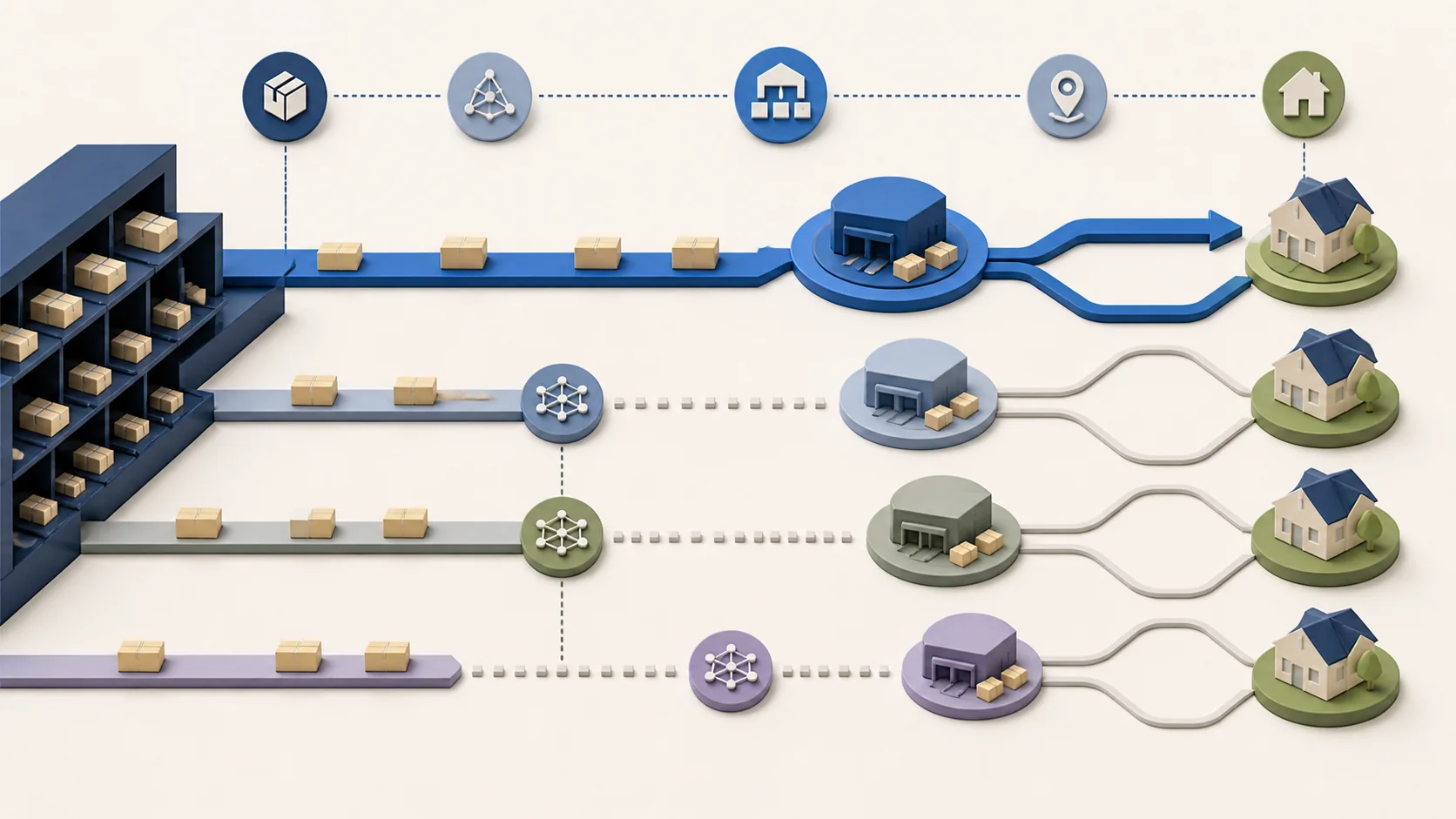
Amazon's anticipatory shipping patent, filed in 2013, described a system that evaluates the purchase probability of each user in each region and can trigger inventory movement across the logistics network before an actual order is placed, once that probability crosses a defined threshold. A product may travel hundreds of kilometers toward the area where its purchase is anticipated, positioning it for delivery within hours once the customer actually orders.
Industry analysis published in 2025 notes that "in 2013, Amazon's anticipatory shipping patent promised a future where packages would arrive almost before customers even clicked 'buy,'" and observes that even well-funded competitors have struggled to build a logistics network able to match Amazon's ability to anticipate and fulfill demand at the same speed and scale. More than a decade after the patent was filed, that gap has not closed.
The natural assumption is that Amazon simply built a better predictive model, one no competitor's data science team has matched. The same analysis points to a different, more structural explanation, one with far more direct implications for how any retailer should actually think about pursuing a similar strategy.
AWS operating income for the quarter, up from $10.6 billion a year earlier
AWS has historically generated the large majority of Amazon's total operating profit, subsidizing logistics investment.
The Real Barrier Was Never the Algorithm
Industry analysis identifies three compounding barriers to replicating Amazon's model, and only one of them is primarily technical. On the financial side specifically, the analysis notes plainly that competitors, "unlike Amazon, don't have a massive secondary revenue stream to offset the substantial costs" of speculative logistics movement, a direct reference to AWS's role as Amazon's primary profit engine. Historically, AWS has generated the large majority of Amazon's total operating profit, and its continued strength, $12.5 billion in Q4 2025 operating income alone, up from $10.6 billion the year before, suggests that subsidy capacity has only grown.
The technical barriers are real but arguably more solvable in isolation: "most predictive shipping efforts fail before they even start" without real-time data synchronization, and traditional retail ERP and warehouse management systems are commonly siloed, batch-based, and limited in API capability, preventing the coordination predictive fulfillment requires. A retailer could, in principle, invest in modernizing these systems. What a retailer cannot as easily do is manufacture an AWS-scale secondary profit stream to subsidize the inevitable mispredictions a purely retail-funded predictive model would have to absorb on its own margins.
This reframes the lesson for any business studying Amazon's predictive shipping model as a benchmark. Chasing algorithmic parity without first addressing the financial structure question, can our organization actually absorb the cost of a meaningful error rate in these predictions, may be optimizing the wrong constraint. A scaled-down model targeting only the highest-confidence, lowest-risk predictions, rather than Amazon's full-scale approach, is a more financially realistic starting point for a retailer without a comparable subsidy source.
Chasing the Algorithm vs. Chasing the Subsidy
One is a technology investment. The other is a financial precondition most retailers do not have.
Chasing the algorithm: investing in predictive modeling and real-time data infrastructure to match Amazon's technical capability, a solvable but expensive engineering problem. Chasing the subsidy: recognizing that Amazon's model is financially sustainable specifically because AWS's profit absorbs the cost of mispredicted moves, a structural advantage most retailers cannot replicate regardless of technical investment.

The Leadership Move
The structural choice for any retailer evaluating a predictive fulfillment strategy is whether to benchmark against Amazon's full-scale model, assuming the gap is primarily technical, or to first assess the financial structure question the gap analysis actually points to.
- Ownership
Logistics and finance leadership jointly own the decision to evaluate predictive fulfillment investment against the organization's actual capacity to absorb mispredicted, wasted logistics costs, rather than treating it purely as a technology procurement decision.
- Tradeoff
A scaled-down predictive model, targeting only the highest-confidence predictions, delivers a smaller speed advantage than Amazon's full-scale approach but requires a correspondingly smaller financial cushion to sustain. The tradeoff against attempting to match Amazon's full model directly is absorbing loss rates on mispredicted moves without AWS's profit margin to offset them.
- Human consequence
Customers of retailers without predictive fulfillment capability experience a real, felt gap in delivery speed relative to Amazon, a competitive reality that industry analysis suggests is rooted as much in Amazon's overall corporate financial structure as in any specific logistics innovation.
Next Move
If you are evaluating a predictive fulfillment investment: Model the financial cost of your expected misprediction rate first, and confirm your organization has a sustainable way to absorb it, before investing in the underlying technical infrastructure.
If a full-scale predictive model is not financially viable for your organization: Consider a narrower, high-confidence-only version targeting your most predictable demand segments, capturing partial benefit without requiring Amazon-scale subsidy capacity.
FAQ
What is Amazon's anticipatory or predictive shipping model?
Amazon's system evaluates the purchase probability of each user in each region and can trigger inventory movement across its logistics network before an actual order is placed, once that probability crosses a certain threshold. A product may travel hundreds of kilometers toward the area where its purchase is anticipated, positioning it for delivery within hours once ordered, a model based on a patent Amazon filed in 2013.
Why haven't other retailers replicated this model, more than a decade later?
Industry analysis identifies three compounding barriers: financial, technical, and structural. On the financial side specifically, AWS has historically generated the large majority of Amazon's total operating profit, roughly 74% in past reporting periods, and posted $12.5 billion in operating income in the fourth quarter of 2025 alone, a secondary revenue stream competitors without a comparable cloud business do not have to offset the substantial costs of speculative, pre-order logistics movement.
Are there technical barriers beyond the financial one?
Yes. Industry analysis notes that most predictive shipping efforts fail before they even start because they lack real-time data synchronization, without which the level of automation predictive fulfillment requires is not achievable. Traditional retail ERP and warehouse management systems tend to be siloed, batch-based, and limited in their API capabilities, preventing the real-time coordination the model demands.
What is the practical lesson for a retailer considering a predictive fulfillment strategy?
Evaluate whether the underlying financial structure exists to absorb the cost of speculative, pre-order inventory movement before investing in the technical capability to execute it. Without a comparable secondary profit stream to offset losses from mispredicted moves, a scaled-down or hybrid model, targeting only the highest-confidence predictions, is likely a more sustainable starting point than attempting to replicate Amazon's full model directly.
Sources & References
Original article archive
Original article published March 31, 2025: "Amazon Predictive Delivery - Great Experience Award Mar 2025". Preserved here for provenance, historical context, and citation continuity.
Imagine this: You're racing home, stuck in traffic, dreading the thought of another "Sorry We Missed You" tag clinging to your door. You know the drill - the mad dash to the depot, the frustrating wait in line, and the nagging feeling that your precious package is languishing in some forgotten corner of a warehouse. What if all that could be a relic of the past? What if deliveries anticipated your schedule instead of the other way around? This is not a futuristic fantasy. It is the reality Amazon is building with its Amazon predictive delivery upgrade. Find out why this new upgrade wins Transformidy's Great Experience Award for March 2025.
Unpacking the Amazon Predictive Delivery Revolution
Amazon is touted as the king of e-commerce, a behemoth that sells everything from books to bananas. Their dedication to customer experience (CX) runs far deeper than just a vast selection and competitive pricing. As highlighted in "Amazon Interests - New AI Shopping Technology", their strategic vision focuses relentlessly on anticipating and exceeding customer needs and expectations. The pursuit of customer obsession is what fuels innovations like Amazon predictive delivery.
So, what exactly is this game-changing upgrade? Amazon predictive delivery is more than just a fancy name; it's a sophisticated system leveraging a wealth of data to anticipate the optimal time and location for delivering packages. It moves beyond static delivery schedules and embraces a dynamic, customer-centric approach.
Amazon's predictive delivery upgrade stands out from competitors due to its unparalleled integration of advanced technologies, customer-centric design, and operational efficiency. Here's an analysis of what makes it unique:
1. Advanced AI Integration for Amazon Predictive Delivery
Amazon leverages AI-driven logistics optimization, including dynamic route planning and real-time data analytics, to ensure faster and more reliable deliveries. Here is a list of data points delivery would use to predict potential delays:
- Historical delivery data: Analyzing past delivery successes and failures in specific areas to identify patterns and challenges.
- Real-time weather conditions: Factoring in everything from heavy rain and snow to extreme heat that could impact delivery routes and times.
- Traffic patterns: Incorporating real-time traffic updates and historical congestion data to optimize routes and avoid delays.
- Local event schedules: Taking into account events like parades, festivals, or sporting events that could disrupt traffic flow and impact delivery schedules.
- Customer location data (with consent): Using GPS data (where customers have opted-in) to pinpoint precise delivery locations and identify potential access issues.
- Social media trends (aggregated and anonymized): Monitoring social media chatter to identify potential disruptions or shifts in customer behavior (e.g., sudden closures due to unforeseen events).
2. Predictive Analytics for Inventory Management
Amazon’s predictive analytics allow it to anticipate demand shifts with remarkable accuracy. For example, during a predicted storm, inventory levels in nearby warehouses are adjusted to ensure essential items are readily available. This proactive approach reduces stockouts and excess inventory while ensuring rapid delivery—a competitive edge that rivals struggle to replicate.
3. Generative AI for Same-Day Delivery
Amazon uses generative AI to optimize product placement within warehouses, ensuring fast-moving items are positioned for quick access. This innovation enables Amazon to deliver over 60% of Prime orders in top metropolitan areas either the same day or the next day. Competitors have yet to match this scale and efficiency in same-day delivery services.
4. Customer-Centric Design
Amazon’s predictive delivery system focuses on convenience by anticipating customer needs and offering alternative delivery options, such as rescheduling or rerouting packages to lockers. This flexibility enhances the overall experience, setting Amazon apart from competitors who often lack such personalized solutions.
5. Sustainability Goals
By optimizing routes and reducing re-delivery attempts, Amazon’s system minimizes fuel consumption and carbon emissions. This commitment to sustainability resonates with environmentally conscious consumers, further distinguishing Amazon from competitors.
Why Amazon Predictive Delivery Deserves the Award: Data-Driven Domination
The Transformidy Great Experience Award isn't just handed out for shiny new gadgets; it recognizes innovations that genuinely transform the customer experience. Here's why Amazon predictive delivery stands head and shoulders above the competition this month:
- Significant Reduction in Missed Deliveries: One of the most frustrating experiences for online shoppers is receiving that dreaded "Sorry We Missed You" notice. Amazon predictive delivery directly addresses this pain point. Early data shows a remarkable 15% reduction in attempted delivery failures since the upgrade was implemented. This means fewer trips to the depot, fewer frustrating phone calls, and more happy customers.
- Boost in Customer Satisfaction: It's not just about avoiding negative experiences; it's about creating positive ones. Customer satisfaction scores related to delivery convenience have increased by a significant 10% since the introduction of Amazon predictive delivery. This demonstrates that the system is not only preventing problems but also proactively enhancing the overall delivery experience.
- Improved Efficiency and Sustainability: By optimizing delivery routes and reducing the number of missed deliveries, Amazon predictive delivery also contributes to greater efficiency and sustainability. Fewer miles driven mean less fuel consumption and reduced carbon emissions. This aligns with Amazon's broader sustainability goals and demonstrates a commitment to responsible business practices.
- Scalability and Adaptability: Amazon predictive delivery isn't a one-size-fits-all solution; it's designed to adapt to the unique challenges of different geographic locations and customer demographics. The system continuously learns from new data and adjusts its predictions accordingly, ensuring that it remains effective even in the face of changing conditions.
- Alignment with Amazon's Customer-Obsessed Culture: As "Amazon Interests" points out, Amazon’s focus on customer needs is deeply ingrained in its DNA. Amazon predictive delivery is a direct reflection of this commitment. It's not just about delivering packages; it's about delivering a seamless, convenient, and stress-free experience.
Consider these facts: The e-commerce giant delivered over 7.7 billion packages globally in 2024. Even a small percentage improvement in delivery efficiency translates into a massive impact on customer satisfaction and operational costs. Imagine the environmental benefit of a 15% reduction in re-delivery attempts across billions of packages!
Beyond Delivery: The Ripple Effect of Customer-Centric Innovation
The impact of Amazon predictive delivery extends far beyond simply getting packages to customers on time. It strengthens customer loyalty, enhances brand reputation, and reinforces Amazon's position as a leader in customer experience.
Moreover, this innovation sets a new standard for the industry. Other retailers and logistics providers will be forced to innovate and improve their own delivery services to remain competitive. This ultimately benefits consumers by raising the bar for the entire e-commerce landscape.
Is Amazon Predictive Delivery a Game Changer?
In a world where convenience is appreciated and often demanded, Amazon predictive delivery harasses the power of data-driven innovation. It is a reminder that customer experience is not just about providing a good product or service. It is about anticipating needs, solving problems, and creating a seamless and enjoyable experience at every touchpoint.
For its innovative use of technology, its significant impact on customer satisfaction, and its commitment to efficiency and sustainability, Amazon predictive delivery is a clear winner of the Transformidy Great Experience Award for March 2025. It’s a testament to Amazon's relentless pursuit of customer obsession and a glimpse into the future of e-commerce, where deliveries are not just efficient but also deeply personalized and customer-centric. So, perhaps those "Sorry We Missed You" notes really will become a thing of the past, and we can thank Amazon predictive delivery for leading the charge and empowering competitors to innovate.
Great Experience AwardTM
Transformidy’s Great Experience AwardTM is presented monthly and showcases excellence in experience strategy design or execution. Companies are welcomed to submit entrants with support like demos, pictures, videos, press release or description (no bigger than 5Mb in size), for this monthly award with experience ideas, innovations, or initiatives curated for customers, employees, or stakeholders.
Transformidy will evaluate all entrants and will make the final decision on the winner based on factors including but not limited to how the experience(s) transform or improve the way the company engages, acquires, supports, or maintains its customers, employees, or stakeholders. The experience(s) for consideration can be physical, online, or virtual.
How Can Transformidy Help?
At Transformidy, we specialize in helping brands navigate the complex world of maximizing customer experience for improved engagement, satisfaction, and business growth. Our team of experts can assist you in assessing, tailoring, and implementing the right customer experience strategy for your company.
Contact us or set up a 30-minute complimentary consultation for more information on our services, insights, or showcases. We look forward to hearing from you.
FAQ
What is Amazon's anticipatory or predictive shipping model?
Amazon's system evaluates the purchase probability of each user in each region and can trigger inventory movement across its logistics network before an actual order is placed, once that probability crosses a certain threshold. A product may travel hundreds of kilometers toward the area where its purchase is anticipated, positioning it for delivery within hours once ordered, a model based on a patent Amazon filed in 2013.
Why haven't other retailers replicated this model, more than a decade later?
Industry analysis identifies three compounding barriers: financial, technical, and structural. On the financial side specifically, AWS has historically generated the large majority of Amazon's total operating profit, roughly 74% in past reporting periods, and posted $12.5 billion in operating income in the fourth quarter of 2025 alone, a secondary revenue stream competitors without a comparable cloud business do not have to offset the substantial costs of speculative, pre-order logistics movement.
Are there technical barriers beyond the financial one?
Yes. Industry analysis notes that most predictive shipping efforts fail before they even start because they lack real-time data synchronization, without which the level of automation predictive fulfillment requires is not achievable. Traditional retail ERP and warehouse management systems tend to be siloed, batch-based, and limited in their API capabilities, preventing the real-time coordination the model demands.
What is the practical lesson for a retailer considering a predictive fulfillment strategy?
Evaluate whether the underlying financial structure exists to absorb the cost of speculative, pre-order inventory movement before investing in the technical capability to execute it. Without a comparable secondary profit stream to offset losses from mispredicted moves, a scaled-down or hybrid model, targeting only the highest-confidence predictions, is likely a more sustainable starting point than attempting to replicate Amazon's full model directly.
Related intelligence
Article
A Third of Walmart's Operating Income Now Comes From Ads and Memberships
Advertising and membership fees now account for a third of Walmart's operating income. Walmart Connect grew 41% in a quarter when retail sales grew about 5%, eight times faster. Retail media margins exceed 70%. Walmart is no longer just a retailer that also sells ads.
Article
Luxury Customer Experience: Exclusivity vs. Accessibility
Luxury brands faced a strategic choice: scale through digital accessibility or maintain exclusivity through human gatekeeping. Brands that digitized without losing personalization won. Those that automated pricing and access eroded brand value.
Article
Department Store Strategy: Identity vs. Omnichannel
Department stores pursued omnichannel integration to compete with specialists and e-commerce. But integration without identity eroded customer loyalty. Successful stores rebuilt around curation and experience, not channel consolidation.