
Article
Starbucks Rewards Drives 60% of US Revenue. The Company Still Changed It Anyway.
Starbucks Rewards drives 60% of US company-operated revenue from 35.5 million members who spend 2.5 to 3 times more than non-members. The company still restructured the program into tiers in March 2026, and this is the second time in three years it has taken backlash for changing how stars work.
- Published
- January 29, 2026
- Updated
- June 18, 2026
- Reading time
- 8 min
2026 updated analysis
What changed since the original article
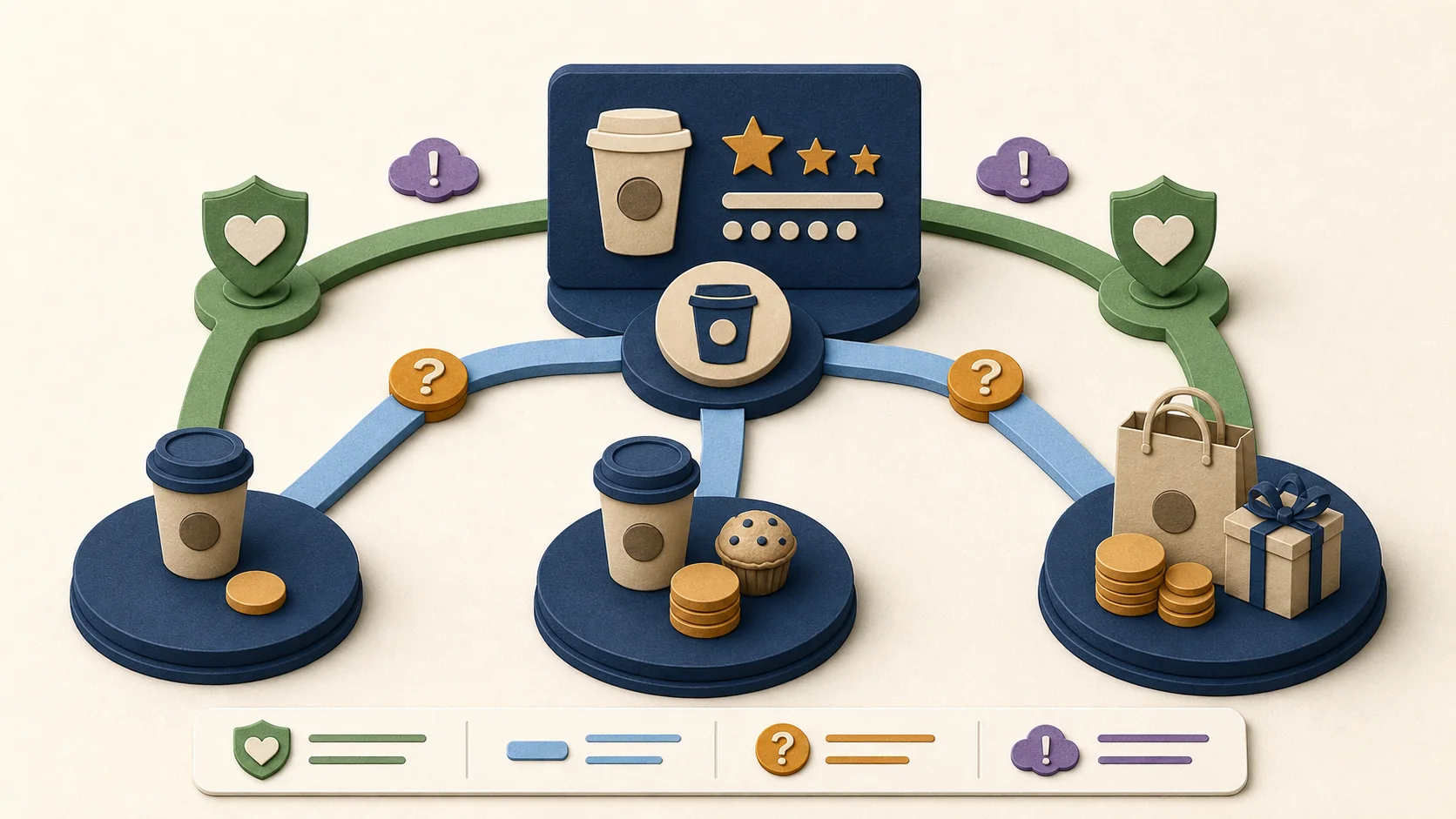
This page keeps the original Transformidy article as the canonical record and leads with the current interpretation, source notes, and Revenue Unknown framing.
Three Tiers, and a Reset Clock
Starbucks Rewards had 35.5 million active US members as of Q1 2026, generating over $13 billion in annual revenue, approximately 60% of US company-operated revenue, with members spending 2.5 to 3 times more than non-members. On March 10, 2026, the company replaced its flat-rate earning structure with three tiers: Green (free, automatic enrollment, 1.0 star per dollar, 6-month star expiration), Gold (500 stars within roughly 12 months, about $500 spend, 1.2 stars per dollar, stars never expire), and Reserve (2,500 stars within roughly 12 months, about $1,470 to $2,500 spend, 1.7 stars per dollar, stars never expire).
Existing members were sorted into these new tiers based on Stars accumulated in 2025, a design choice that produced the sharpest visible backlash: longtime members with years of accumulated status found themselves reset to entry-level Green status if their 2025 spending did not clear the new Gold threshold. The response was immediate and specific: one TikTok criticism of the change drew more than half a million views and nearly 3,400 replies within a day, and one commenter's objection, noting they had "held Gold status since 2013," captured the specific grievance driving much of the reaction.
The core criticism, as PYMNTS characterized it, was that the changes effectively raise "spending thresholds for members who want to maintain their previous reward frequency," meaning members would need to spend more under the new system to achieve the same reward level they had under the old one.
Of US company-operated revenue driven by 35.5 million Rewards members
Members spend 2.5 to 3 times more than non-members; the program generates over $13 billion annually.
This Is Not the First Time
The most important context for evaluating Starbucks' March 2026 decision is that this is not a first-time miscalculation. The company faced similar backlash in 2023 when it removed a popular 50-Star reward tier, a documented precedent for exactly the kind of reaction the 2026 tier restructuring generated. Starbucks' leadership went into this redesign with direct institutional knowledge of how members respond to earning-structure changes that feel like a reduction in value, and proceeded with a comparably disruptive change anyway.
That pattern suggests the backlash itself, however vocal and immediate on social platforms, is a cost Starbucks has already priced into its loyalty program strategy, rather than an unanticipated crisis. A company redesigning its highest-revenue-concentration program for the second time in three years, after already experiencing the backlash pattern once, is very likely making a considered tradeoff: near-term member frustration and public criticism, in exchange for program economics leadership believes better serve long-term revenue growth or member value capture.
Whether that tradeoff proves correct is the actual open question, not whether backlash would occur, which the 2023 precedent made highly predictable. The relevant test is whether Starbucks' subsequent member engagement and spending data show the tier restructuring achieving its underlying business goals, higher earning-rate tiers presumably designed to reward and retain the highest-value 2.5-to-3x spenders, at a scale that outweighs the churn or goodwill cost among members who felt reset or devalued.
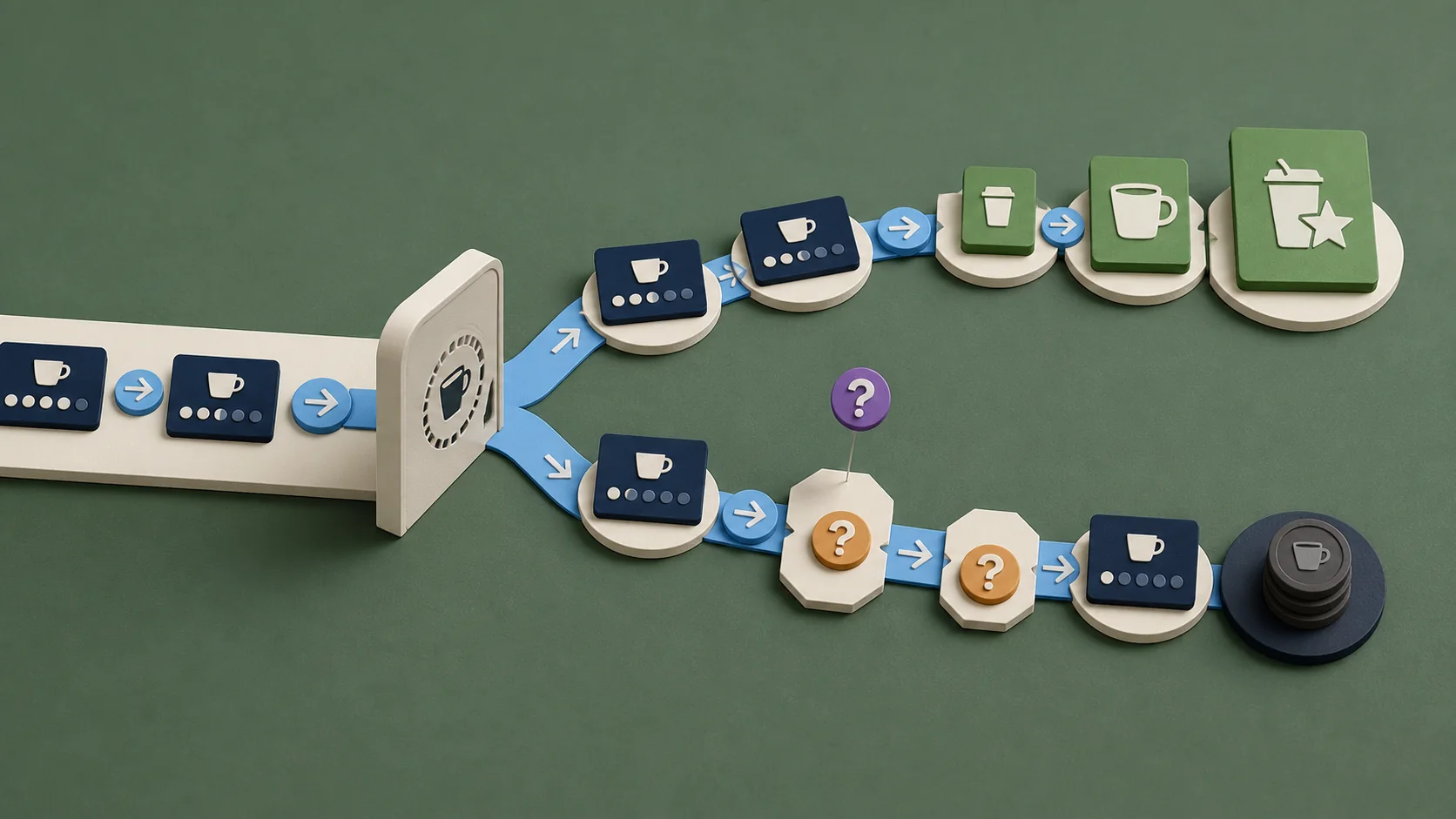
An Unanticipated Crisis vs. a Priced-In Tradeoff
One is a mistake a company scrambles to fix. The other is a bet made with open eyes.
Unanticipated crisis: a company blindsided by backlash it did not expect, requiring reactive damage control. Priced-in tradeoff: Starbucks entering its second major Rewards restructuring in three years with direct precedent from the 2023 backlash, suggesting leadership weighed the predictable public reaction against the program's revenue-concentration stakes and proceeded deliberately.
The Leadership Move
The structural choice for any company managing a high-revenue-concentration loyalty program is whether to avoid disruptive redesigns entirely given the concentration risk, or to accept predictable, priced-in backlash as the cost of periodically realigning program economics with business goals.
- Ownership
Starbucks' loyalty program and customer experience leadership own the decision to proceed with a second major Rewards restructuring despite direct 2023 precedent for the backlash it would generate, a choice that implies deliberate acceptance of near-term member friction in service of a longer-term program economics goal.
- Tradeoff
Redesigning a program responsible for 60% of US company-operated revenue risks real member churn and public relations cost, evidenced directly by the March 2026 backlash. The tradeoff Starbucks appears to be accepting is that an aging, flat-rate loyalty structure carries its own long-term risk, declining member engagement and undifferentiated incentives, that periodic, disruptive realignment is judged necessary to address.
- Human consequence
A member who held Gold status since 2013 and was reset to entry-level status experienced a real, specific loss of recognized loyalty, a felt consequence that a company-level revenue and retention calculation does not capture at the individual level.
Next Move
If you manage a high-revenue-concentration loyalty program: Study Starbucks' 2023-to-2026 pattern directly, and if you proceed with a similarly disruptive redesign, build a specific plan for long-tenured member status transition, since that group generated the sharpest backlash in both instances.
If you are evaluating Starbucks as a loyalty case study: Track subsequent quarterly member retention and spending data rather than treating the initial backlash alone as evidence the redesign failed or succeeded.
FAQ
How large is Starbucks Rewards, and how much revenue does it drive?
Starbucks Rewards had 35.5 million active US members as of Q1 2026, generating over $13 billion in annual revenue, representing approximately 60% of US company-operated revenue. Rewards members spend 2.5 to 3 times more than non-members.
What changed in the March 2026 Rewards overhaul?
Starbucks replaced its flat-rate earning structure with three tiers, Green (free, automatic, 1.0 star per dollar), Gold (500 stars within 12 months, roughly $500 spend, 1.2 stars per dollar, stars never expire), and Reserve (2,500 stars within 12 months, roughly $1,470 to $2,500 spend, 1.7 stars per dollar, stars never expire), sorting existing members into tiers based on Stars accumulated in 2025.
How did customers react to the change?
The response was swift and largely hostile. One TikTok criticism drew more than half a million views and nearly 3,400 replies within a day. One commenter noted having held Gold status since 2013 and objected to being reset to Green-tier status under the new system. Many members argued they would need to spend more to earn the same rewards as under the prior program.
Has Starbucks faced this kind of backlash before?
Yes. The company faced similar backlash in 2023 when it removed a popular 50-Star reward tier, meaning this is at least the second time in three years Starbucks has taken significant public criticism for restructuring how its Rewards program's earning and redemption mechanics work.
Sources & References
Original article archive
Original article published January 29, 2026: "Starbucks Canada Rewards Revamp Drives Smarter, Happier Loyalty?". Preserved here for provenance, historical context, and citation continuity.
Starbucks Canada is preparing to relaunch Starbucks Rewards as a three tier program that is designed to deliver more value, more personalization and more reasons to stay in the app every day. For brands watching loyalty dynamics in Canadian retail and foodservice, this is a pivotal CX moment for Starbucks Canada.
Key Takeaways
- Starbucks Canada's reimagined Rewards program launches March 1, 2026, with three tiers (Green, Gold, Reserve) that offer escalating perks based on annual Star accumulation, replacing a flat structure to better recognize loyalty levels.
- The new 60 Star redemption for $2 off addresses customer feedback for quicker rewards, shortening the path to value compared to the old program's higher thresholds, though it introduces some complexity for legacy members.
- Stars no longer expire with regular activity, boosting perceived long-term value and tying into personalization via app-based offers, which strengthens CX by reducing anxiety and encouraging consistent engagement.
- Success hinges on clear communication, undeniable value proof, AI-driven personalization, ecosystem partnerships, and real-time CX metrics, positioning loyalty as a "customer operating system" for sustained growth.
What is the new Starbucks Canada rewards program
The reimagined Starbucks Rewards program introduces three member levels Green, Gold and Reserve for customers in Canada and across North America. Members will earn 1 Star per dollar on eligible purchases, with accelerated earning when they digitally reload a Starbucks Card, such as 10 Stars for a 30 dollar reload and 25 Stars for a 50 dollar reload.
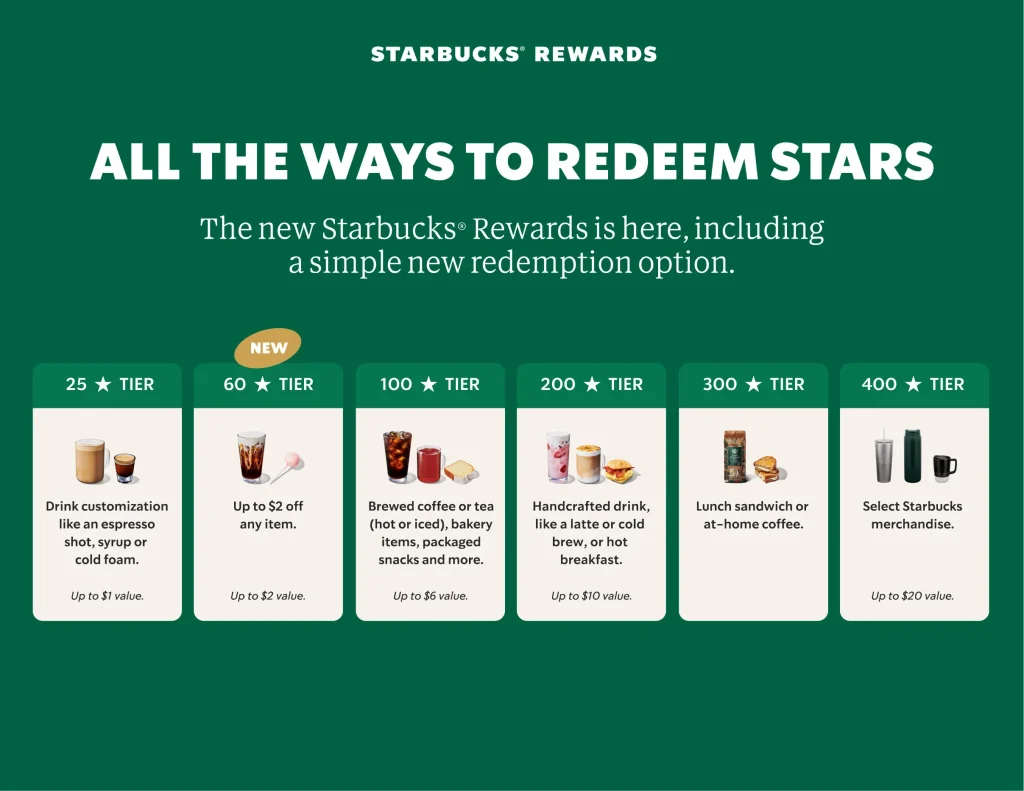
Tier benefits scale with engagement. Green members get core earn and burn benefits, access to free customization at 25 Stars and the new 60 Star tier that delivers 2 dollars off a qualifying purchase, based on member demand for faster early rewards. Gold and Reserve members unlock richer perks, including more generous redemption options, extended benefits windows and increasingly premium experiences as their annual Star total grows.
Star redemption is also being reshaped. Members can redeem 25 Stars for drink customizations, 60 Stars for 2 dollars off, 100 Stars for brewed coffee, tea, bakery items or snacks up to about 6 dollars in value, and higher tiers for handcrafted beverages, hot breakfast and merchandise. Stars in Canada will no longer automatically expire after a fixed period as long as members maintain activity appropriate to their tier, which deepens perceived value and encourages regular visits.

How it differs from the old program
Historically, Starbucks Canada Rewards operated as a largely flat structure where all active members accessed the same redemption grid and Stars expired on a time based schedule. The new March 2026 launch replaces that with a clearly tiered system, using annual Star accumulation to assign Green, Gold or Reserve status, with 12 month validity for tier levels and clear thresholds to maintain or upgrade.
From a CX lens, the biggest change is not just the tiers but the introduction of a 60 Star 2 dollar off reward that shortens the distance to the first meaningful benefit. This directly addresses member feedback that waiting for larger redemptions reduced day to day excitement and made the program feel abstract rather than immediate.
There are pros and cons for customers. On the upside, high frequency visitors gain status based perks, more tailored offers and more transparent value ladders that recognize their loyalty, while occasional guests still see earlier rewards and clearer choices. On the downside, any structural change creates perceived complexity, and some legacy members may feel that shifting thresholds and tier rules force them to relearn what their loyalty is worth, especially if they sit just below a key level.
Evolution of Starbucks Rewards in Canada
Starbucks Rewards has been one of the defining loyalty programs in Canadian quick service and specialty coffee for over a decade, moving from punch card style incentives to a sophisticated, app first, points based ecosystem. Over time, the program has been shaped by digital ordering, mobile payment and partnerships with financial and travel brands, including linkages with selected TD cards and Aeroplan to let members double dip value across everyday spending.
The new three tier structure marks a return to a more explicit status model, echoing earlier phases where Gold cards symbolized a higher relationship with the brand. Today, that status is no longer a physical card in the wallet but a dynamic signal inside the app, with real time visibility into Star balances, tier progress and personalized offers that respond to visit patterns.
This evolution aligns with Starbucks broader Back to Starbucks Canada strategy, which emphasizes deeper connection, operational consistency and more emotionally resonant coffee moments at scale. Loyalty is not a bolt on for Starbucks Canada it is a core engine for revenue, guest satisfaction and the data capability that fuels product innovation and store experience design.
CX implications for Starbucks Canada
From a customer experience standpoint, the shift to tiered rewards changes how value is felt across the journey, not just at checkout. The non expiring or extended life of Stars tied to activity patterns reduces anxiety about losing value and can increase emotional attachment at pivotal life moments, such as seasonal traditions, exam periods or weekday commuter rituals.
Personalization sits at the heart of the redesign. Starbucks Canada is explicitly positioning the program to deliver benefits that customers say matter most, from faster rewards to more relevant offers and experiences that feel like recognition rather than generic promotions. The company’s more than 38 million active loyalty members across North America represent a massive testbed for AI driven targeting, daypart specific promotions and micro segments like plant based drink lovers or cold coffee enthusiasts.
Operationally, a tiered program does add complexity at the barista level and in store communication, which can become a CX risk if staff are not equipped with clear explanations and digital tools to support conversations. However, when executed well, it can create a virtuous cycle where more engaged members use mobile ordering, reduce friction in queues and unlock more predictable demand patterns that improve consistency for everyone in the café.
Competitive landscape and benchmarks
Starbucks Canada is not alone in using loyalty to anchor growth. Tim Hortons’ Tims Rewards program offers a points based structure where guests can redeem from 300 points for classic donuts up to 1,800 points for bowls and flatbread pizzas, and it is tightly integrated with the Tims Mastercard, delivering up to 6 percent back at Tims through statement credits with the credit card. Tim Hortons recently highlighted momentum in Tims Rewards membership and digital ordering, alongside more than 50 million dollars raised in 2025 through community programs that reinforce emotional loyalty beyond the app.
In this context, Starbucks Canada’s move to tiers and non expiring Stars is a direct response to a market where coffee loyalty is becoming more financialized and more experiential at the same time. Competitors are building ecosystems that span credit, merchandise, delivery and cause marketing, so Starbucks must ensure that its reimagined Rewards program feels both generous and culturally relevant, not just mathematically optimized.
For years, members have voiced their feedback to Starbucks to include a tier based system through spending with an improved benefits set beyond items that haven't changed in years.
The Canadian guest also compares Starbucks Rewards with airline, hotel and grocery programs, where tiers and elite benefits are well understood and often aspirational. Gold and Reserve need to feel meaningful enough to change behaviour, whether through exclusive menu previews, limited Reserve experiences or deeper integration with travel and financial partners that resonate with Canadian lifestyles.
Scores factor in value efficiency (40%), ease of earning/redeeming (30%), perks/features (20%), and Canadian market fit (10%), derived from program structures and reported values. Starbucks leads with new low-threshold options like 60 Stars for $2 off, enhancing CX for casual users while rewarding superfans via tiers. Tim Hortons excels in volume-driven redemptions, fitting Canada's quick-grab culture.
Recipe for loyalty success
For Starbucks Canada, the recipe for success with this new program will blend five ingredients: First, simplicity in explanation will be critical in stores, on receipts and within the app, using intuitive tier naming and clear earn and burn visuals that demystify the journey from Green to Reserve.
Second, value proof must be undeniable. Members should quickly see Star activity and savings over time, with simple stories such as how many handcrafted beverages they effectively received free this quarter or how much they saved via 60 Star 2 dollar discounts.
Third, personalization needs to move beyond drink suggestions into proactive moments, like targeted offers for lapsed segments, climate or mood aware promotions and curated experiences for Gold and Reserve that tap into local Canadian communities.
Fourth, ecosystem partnerships should be expanded thoughtfully so members can earn Stars through everyday behaviors such as transit, grocery or digital entertainment, not just inside the café, building on existing financial and travel linkages.
Fifth, CX measurement must be tightly integrated with loyalty data, connecting changes in customer satisfaction scores, visit frequency, average spend, promotion activation, and complaint themes to specific elements of the new program in near real time.
What is next for Starbucks Canada and its customers
The reimagined Starbucks Rewards program is positioned as a long term platform, not a one off promotion, which means Canadian customers should expect continued experimentation with tier benefits, limited time earn accelerators and more sophisticated personalization over the next few years. As AI and predictive analytics mature, Starbucks Canada will increasingly be able to orchestrate highly tailored journeys where the app, in store experience and partner ecosystems feel like one connected interface.
For customers, the opportunity is to be more intentional about their Starbucks relationship. Those who embrace the app, link partner accounts and understand the new tiers will extract outsized value, while those who remain occasional and anonymous will experience Starbucks primarily as a premium café with some incidental discounts. The brand will need to balance this bifurcation so that non members still feel welcome and valued, even as the loyalty engine increasingly defines the enterprise.
As competitive coffee and quick service landscapes evolve, Starbucks Canada also has an opportunity to extend Reserve tier experiences, sustainability storytelling and community impact into the loyalty narrative, creating reasons to feel proud of membership beyond transactional savings. In a market where Tim Hortons can raise more than 50 million dollars for community causes in a single year, the emotional side of loyalty will matter just as much as the financial calculus.
If Starbucks Canada is successful, look for other coffee chains to introduce similar tiered systems based on spending and refine their relationships with customers through new data points.
FAQ - Starbucks Canada Rewards Program Changes 2026
1.When does the new Starbucks Canada Rewards program start?
It launches on March 1, 2025, introducing tiered levels and updated redemption options across Canada.
2. What are the three tiers in the new program?
Green offers core benefits like the 60 Star $2 off reward; Gold adds more generous redemptions and perks; Reserve provides premium experiences for top annual Star earners.
3. How do you earn Stars now?
Earn 1 Star per dollar spent, with bonuses like 10 Stars for $30 reloads or 25 for $50, accelerating progress especially via app or Starbucks Card.
4. Do Stars still expire under the new rules?
No, Stars stay active with regular tier-appropriate activity, unlike the old fixed expiration schedule, making value more enduring.
5. What's the value per Star compared to before?
Approximately 3-6¢ per Star based on redemptions like 60 Stars for $2 off or 200 for a $6 drink, offering better early access than prior higher-point needs.
6. How does Starbucks Rewards compare to Tim Hortons?
Starbucks edges out with higher point value (3-6¢ vs. 0.5¢ on food) and tiers, while Tim Hortons shines in food redemptions and Mastercard cashback integration.
7. What are the pros of the tiered system?
It rewards superfans with tailored perks, provides faster wins for casual users, and uses data for personalization, enhancing emotional connection.
8. Any cons to the changes?
Increased complexity may confuse some users, and those near tier thresholds could feel shortchanged initially, requiring strong onboarding.
9. How does Second Cup Rewards stack up?
Second Cup offers ~1¢ per point with specialty drink focus but loses points after 6 months, scoring lower (6.5/10) than Starbucks' flexible, non-expiring model.
10. What's next for members after launch?
Expect ongoing tweaks like limited-time accelerators, deeper AI personalization, and expanded partnerships, turning Rewards into a dynamic loyalty ecosystem.
Transform for better
For CX leaders, the Starbucks Canada rewards transformation is a powerful reminder that loyalty programs are no longer static punch cards but living customer operating systems. The brands that will win are those that treat loyalty as a continuous cycle of listening, designing, testing and refining, where every Star or point is attached to a human story and a measurable business outcome.
Transform for better means using loyalty not just to drive repeat purchases, but to architect better experiences at every touchpoint guided by data, grounded in empathy and designed for long term trust in the Canadian marketplace and beyond.
HOW CAN TRANSFORMIDY HELP?
If your organization is rethinking loyalty in the shadow of the new Starbucks Canada program, Transformidy can help you reframe the challenge as a CX opportunity instead of a discount race. Our team works with brands to map member journeys, audit current programs against evolving customer expectations and design loyalty ecosystems that integrate digital, in store and partner touchpoints for sustainable growth.
Contact us or set up a 30-minute complimentary consultation for more information on our services, insights, or showcases. We look forward to hearing from you.
FAQ
How large is Starbucks Rewards, and how much revenue does it drive?
Starbucks Rewards had 35.5 million active US members as of Q1 2026, generating over $13 billion in annual revenue, representing approximately 60% of US company-operated revenue. Rewards members spend 2.5 to 3 times more than non-members.
What changed in the March 2026 Rewards overhaul?
Starbucks replaced its flat-rate earning structure with three tiers, Green (free, automatic, 1.0 star per dollar), Gold (500 stars within 12 months, roughly $500 spend, 1.2 stars per dollar, stars never expire), and Reserve (2,500 stars within 12 months, roughly $1,470 to $2,500 spend, 1.7 stars per dollar, stars never expire), sorting existing members into tiers based on Stars accumulated in 2025.
How did customers react to the change?
The response was swift and largely hostile. One TikTok criticism drew more than half a million views and nearly 3,400 replies within a day. One commenter noted having held Gold status since 2013 and objected to being reset to Green-tier status under the new system. Many members argued they would need to spend more to earn the same rewards as under the prior program.
Has Starbucks faced this kind of backlash before?
Yes. The company faced similar backlash in 2023 when it removed a popular 50-Star reward tier, meaning this is at least the second time in three years Starbucks has taken significant public criticism for restructuring how its Rewards program's earning and redemption mechanics work.
Related intelligence
Article
McDonald's CEO Named the Exact Chain Reaction Behind a Bad Quarter
McDonald's CEO told investors directly: this was not a strategy problem. Restaurant teams were overwhelmed by too many menu deployments in a single quarter, service times rose, and satisfaction scores fell as a direct result. He named the mechanism, not just the symptom.
Article
A Third of Walmart's Operating Income Now Comes From Ads and Memberships
Advertising and membership fees now account for a third of Walmart's operating income. Walmart Connect grew 41% in a quarter when retail sales grew about 5%, eight times faster. Retail media margins exceed 70%. Walmart is no longer just a retailer that also sells ads.
Article
AI-Referred Shoppers Convert at Twice the Rate of Everyone Else
A new buyer arriving at a Shopify store through AI-driven traffic converts at twice the rate of one arriving through any other channel. AI-originated orders tripled year over year. That is not a traffic story. It is evidence AI referrals are pre-qualifying purchase intent before the customer even lands on the page.