
Article
The Future Flagship May Need Less Space And More Relationship
Harry Rosen's Cumberland flagship shows why luxury retail may be shifting from merchandise density toward relationship capacity.
- Published
- September 14, 2026
- Updated
- September 14, 2026
- Reading time
- 7 min
Article Body
A flagship store used to prove its importance by being large.
More floors. More inventory. More brands. More visual dominance. More space to walk through.
Harry Rosen's Toronto flagship transition suggests a different question for modern retail: what if the future flagship proves its value by using less space to create more relationship?
The retailer closed its long-time 82 Bloor Street West flagship on September 12, 2026 after nearly 39 years at the address. Its replacement at 153 Cumberland Street is scheduled to open September 21. The new location is smaller, moving from more than 50,000 square feet across five levels to roughly 38,000 square feet across three. But the reduction in square footage is not the strategic story by itself.
The important signal is what the space is being asked to do.
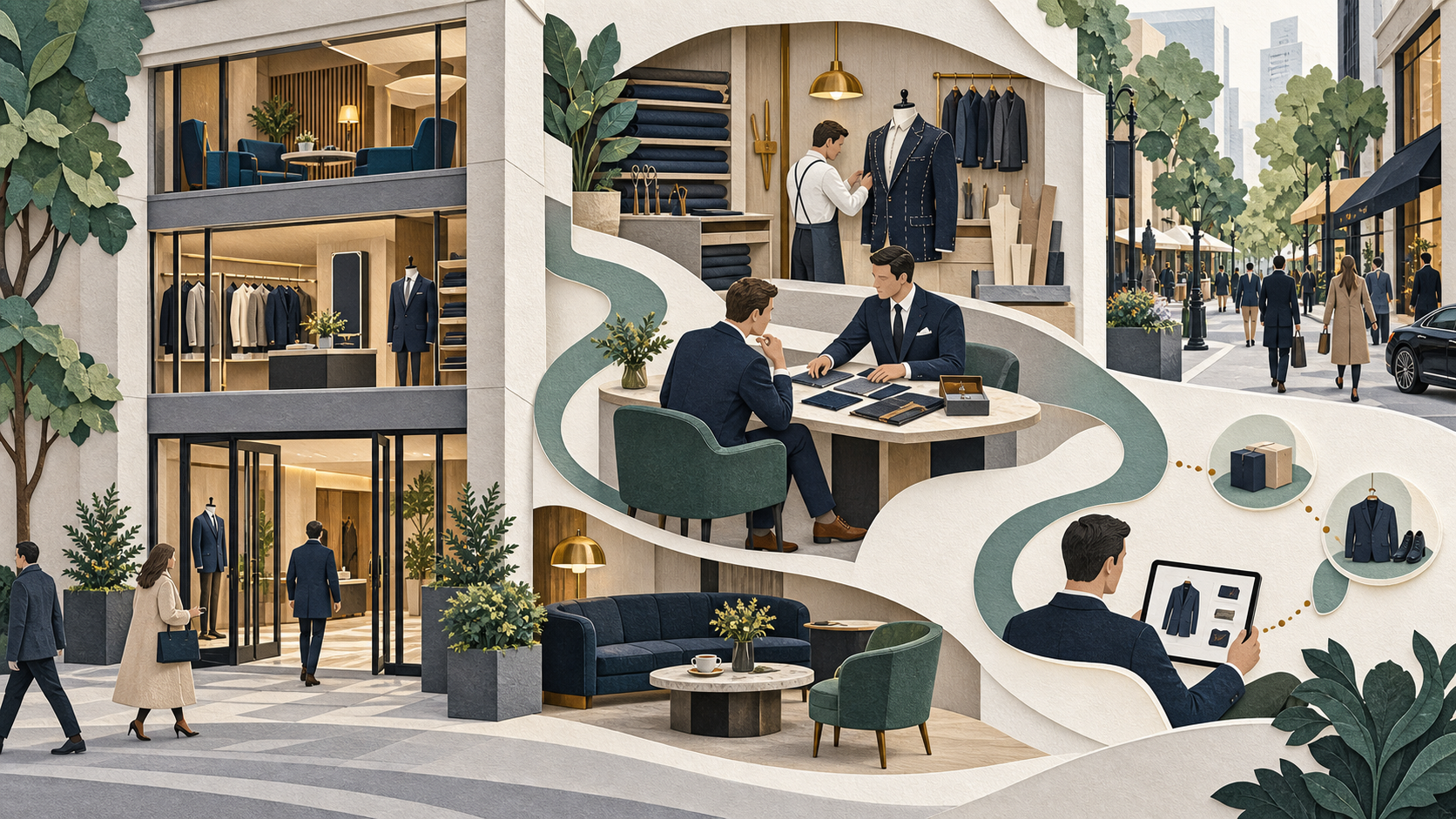
Harry Rosen's own store-reinvention program has emphasized a more modern retail experience after several years of digital investment. Reporting on the new Yorkville flagship points to tailoring, private client spaces, hospitality, a client lounge, espresso service, designer environments and programming. In other words, the store appears to be shifting from a primarily merchandise-heavy flagship toward a more relationship-intensive flagship.
That makes this a Retail Mashup case, not merely a store-opening story.
The Revenue Unknown is:
What proportion of flagship space should generate transactions directly, versus deepen relationships that generate revenue elsewhere?
The Store Is No Longer The Whole Store
Physical retail used to carry more of the customer journey inside one building.
Discovery happened there. Inventory was there. Advice was there. Fit was there. Payment was there. Service was there. In luxury and premium menswear, the flagship also carried brand authority. A large store told the customer the retailer had range, confidence and permanence.
Digital commerce changed that division of labour.
A customer can now discover brands, inspect product, compare prices, browse availability, book appointments, check social proof and complete transactions without entering the flagship. That does not make the flagship irrelevant. It makes the flagship's job more specific.
The store has to do what digital channels cannot do as well:
- build trust through human advice;
- solve fit and wardrobe uncertainty;
- create confidence around higher-value purchases;
- host private-client and community moments;
- turn service into loyalty;
- connect local place, hospitality and brand memory;
- make a customer feel recognized rather than processed.
If the physical store does not perform those jobs, square footage becomes expensive theatre.
That is the decision facing many retailers. They are not choosing between stores and ecommerce. They are deciding which parts of the relationship deserve physical space.
From Merchandise Density To Relationship Capacity
The old retail productivity equation centered heavily on sales per square foot.
That metric still matters. It is hard to sustain a store that does not produce enough economic return. But sales per square foot can undercount the value of a modern flagship if the store is also producing appointments, advisor relationships, alterations, event participation, cross-channel purchases, private-client growth and lifetime value.
The better question is not only:
How much did this store sell today?
It is:
What relationship did this store make possible that would not have happened through another channel?
Harry Rosen is a useful case because menswear has a natural relationship layer. A suit, jacket, formalwear purchase, wardrobe refresh or higher-end casual look often involves uncertainty. Fit matters. Occasion matters. Confidence matters. A customer may not know what they need, what works together, which alteration matters, or whether an item is worth the price.
That is where space can become productive without behaving like a warehouse.
A tailoring area is not just a service counter. It is confidence infrastructure.
A client lounge is not just hospitality. It is relationship infrastructure.
An espresso service is not just a nice touch. It can extend dwell, reduce pressure and make consultation feel less transactional.
Private-client rooms are not just premium decor. They create a different decision environment for customers whose value is not captured by a single visit.
The future flagship may therefore need less merchandise capacity and more relationship capacity.
The Retail Mashup Lens
Retail Mashup should treat this as a flagship recomposition case.
Modern retail is a mix of store, ecommerce, loyalty, service, clienteling, local district movement, social discovery, inventory visibility, events and post-purchase follow-up. The customer does not experience those as separate departments. They experience a sequence.
The flagship becomes useful when it connects that sequence.
A customer may see a product online, book a fitting, meet an advisor, attend a style event, buy in-store, alter the garment, receive follow-up, buy a second item digitally and return to the store for a later occasion. Which channel "made" the sale?
The wrong answer is to force the value into a single channel.
The better answer is to measure the relationship system.
That is why the Harry Rosen move matters. The smaller Cumberland flagship should eventually be judged against the old Bloor store not only by square footage or opening-week traffic, but by whether it improves the relationship economics of the business.
Retail Mashup should watch for five signals after the September 21 opening:
- whether appointment and tailoring use increases;
- whether client advisors become more central to revenue;
- whether events and programming create repeat visits;
- whether digital follow-on purchases rise after store visits;
- whether Yorkville district movement improves the value of the location.
The store is not only a location. It is a relationship operating layer.
Smaller Can Still Mean More Ambitious
Retail often treats shrinking as failure.
That can be true. A smaller store can be a defensive move when sales weaken, rent becomes excessive or the brand loses confidence. But a smaller store can also be more ambitious if the retailer has decided that old space was doing the wrong work.
The question is not whether the new Harry Rosen flagship is smaller.
The question is whether the new flagship is more precise.
Does the customer move through it more easily? Does the advisor relationship become easier to start? Does tailoring feel central rather than tucked away? Does hospitality create more useful time? Does the space support discovery without overwhelming the visitor? Does the location fit how Yorkville customers now move? Does the store give digital shoppers a reason to come in?
Those are experience questions, but they are also revenue questions.
The Revenue Unknown is not whether physical retail still matters. It clearly can.
The Revenue Unknown is which physical capabilities matter enough to deserve space, staff, rent and executive attention.
Why This Matters Beyond Luxury Menswear
The same pattern applies beyond Harry Rosen.
Department stores have to decide whether large assortments still create confidence or simply create exhaustion. Beauty retailers have to decide how much space should support consultation, samples, services and creator-led discovery. Athletic brands have to decide whether stores should act as product showrooms, community hubs, fitting labs, event spaces or returns infrastructure. Malls and BIAs have to decide whether anchors create traffic because they are large, or because they create relationship value customers cannot get online.
This is where sales-per-square-foot thinking can become incomplete.
A store can look less productive if it is measured only as a transaction box. It may be highly productive if it creates customer knowledge, trust, follow-on purchases and district movement. The opposite can also be true: a beautiful store can create attention without meaningful relationship value.
Transformidy's question is therefore practical:
What is the Relationship Productivity of Space?
That model would connect:
visit -> advisor interaction -> service -> trust -> cross-channel purchase -> repeat visit -> lifetime relationship value
For luxury retail, that may be more useful than asking whether the store is big enough.
What To Measure After Opening
The Cumberland flagship should become a baseline case.
Before declaring the strategy successful, the measurement system should separate visible activity from relationship progress. Opening traffic, media attention and social posts will matter, but they will not prove the operating model.
The stronger indicators are downstream:
- revenue per visitor;
- appointment conversion;
- alteration attachment;
- advisor-attributed repeat purchases;
- private-client growth;
- event participation;
- cross-channel purchase after a store visit;
- dwell that leads to a useful next step;
- customer migration from the old Bloor location;
- surrounding Yorkville cross-shopping and district effects.
That last point matters. A flagship does not sit alone. It participates in a district experience. Yorkville's value depends on how retailers, restaurants, hotels, offices, cultural destinations and public realm movement reinforce one another. A smaller but more relationship-intensive anchor may produce more district value than a larger merchandise-led footprint if it causes higher-quality visits and repeat movement.
But that is an evidence question.
The useful stance is not to praise the move before outcomes exist. It is to recognize what the move is testing.
Harry Rosen is testing whether the future flagship should be measured less like a stockroom and more like a relationship system.
The Executive Lesson
Executives should be careful with the word "flagship."
It can become nostalgic. It can imply the largest store, the most expensive address, the broadest assortment or the strongest architectural statement.
But customers do not need nostalgia from a flagship. They need usefulness.
The most valuable flagship may be the one that helps the customer decide, trust, fit, return, deepen and continue. It may be smaller, more hosted, more service-intensive and more connected to digital behaviour. It may carry less inventory but create more confidence.
That is why this belongs in Transformidy's Revenue Unknowns work.
The visible change is square footage.
The invisible question is value architecture.
When physical retail is expensive and customer behaviour is fragmented, leaders need to know which experiences deserve space and which historical assumptions are only occupying it.
Sources
- Yahoo Finance / WWD, "Harry Rosen to Open New Toronto Flagship on Sept. 21," September 10, 2026: https://ca.finance.yahoo.com/news/harry-rosen-open-toronto-flagship-175417416.html
- Retail Insider, "Harry Rosen to Relocate Bloor Street Flagship to New Cumberland Street Premises in Toronto," March 14, 2024: https://retail-insider.com/retail-insider/2024/03/harry-rosen-to-relocate-bloor-street-flagship-to-new-cumberland-street-premises-in-toronto/
- Connect CRE Canada, "Harry Rosen Moves Bloor Flagship As Redevelopment Site Clears," September 11, 2026: https://www.connectcre.ca/stories/harry-rosen-moves-bloor-flagship-as-redevelopment-site-clears/
Related Reading
FAQ
What is the main idea of The Future Flagship May Need Less Space And More Relationship?
The Future Flagship May Need Less Space And More Relationship explains a change leaders should not treat as background noise. It shows what evidence is visible, what may be changing underneath it, and which decision window remains open.
Why does The Future Flagship May Need Less Space And More Relationship matter for Experience Intelligence?
The article helps readers see how an experience, relationship, capability, or value condition may be changing before the consequence is fully visible.
What Revenue Unknown does this article help identify?
It frames the unresolved commercial or operating question created by the change: what value, risk, hidden demand, relationship movement, or capability gap may exist but has not yet been measured or decided.
How should leaders use this article in the Special Intelligence series?
Use it as a prompt to separate observed evidence from interpretation, name the decision that still has to be made, and identify what would validate whether the interpretation is right.
Related intelligence
Article
LEGO Has The IP. The Revenue Unknown Is Whether The Moment Is Connected.
LEGO's Marvel, F1 and LEGO House examples show why licensed products need moment activation, not only availability.
Article
The Store Network Built For Yesterday's Customer Can Become Tomorrow's Liability
Groupe Dynamite shows why retail growth can come from replacing the customer architecture a brand built around yesterday's shopper.
Article
When AI Builds The Basket, Who Owns The Purchase Decision?
Instacart's Clementine advances AI shopping from discovery into delegated basket formation, changing how retailers and brands compete for consideration.