
Article
Chatbot Quality: Decision Clarity Over Automation Rate
Chatbot adoption exploded but quality problems emerged at scale. Organizations discovered that automation rate and decision quality diverged. High automation without decision quality destroyed customer trust faster than slow, high-quality service.
- Published
- June 7, 2024
- Updated
- June 18, 2026
- Reading time
- 8 min

2026 updated analysis
What changed since the original article
This page keeps the original Transformidy article as the canonical record and leads with the current interpretation, source notes, and Revenue Unknown framing.
The Adoption Boom
Chatbot adoption accelerated from 2020 to 2025 with a 16x increase in five years; by 2025, 80% of companies were using or planning to adopt AI chatbots. Many organizations deployed them. The early metrics—cost per contact, response time, availability—improved. Success seemed clear.
At production scale, the picture changed. The cost reduction was real. But when chatbots handled a broader range of decisions at scale, customers sometimes received decisions they could not understand. A refund denied because of a missing detail. A solution that did not match their specific situation. An escalation that took longer than just handling it manually. Research shows 81% of consumers expect bots to escalate to humans when needed, but only 38% report this happens "always or often".
Chatbot adoption growth: 2020 to 2025
Adoption exploded. Decision quality did not keep pace.
What Changed at Scale
At small scale (early 2024): Chatbots handle a narrow range of questions well. Customer satisfaction is high. Cost savings are clear. The deployment looks like success.
At scale (by late 2025): Chatbots handle a much broader range, many requiring judgment. A billing error inquiry, a service complaint, a special case request now goes to the chatbot. The chatbot makes a decision. The customer perceives it as illogical or unfair. Frustration increases.
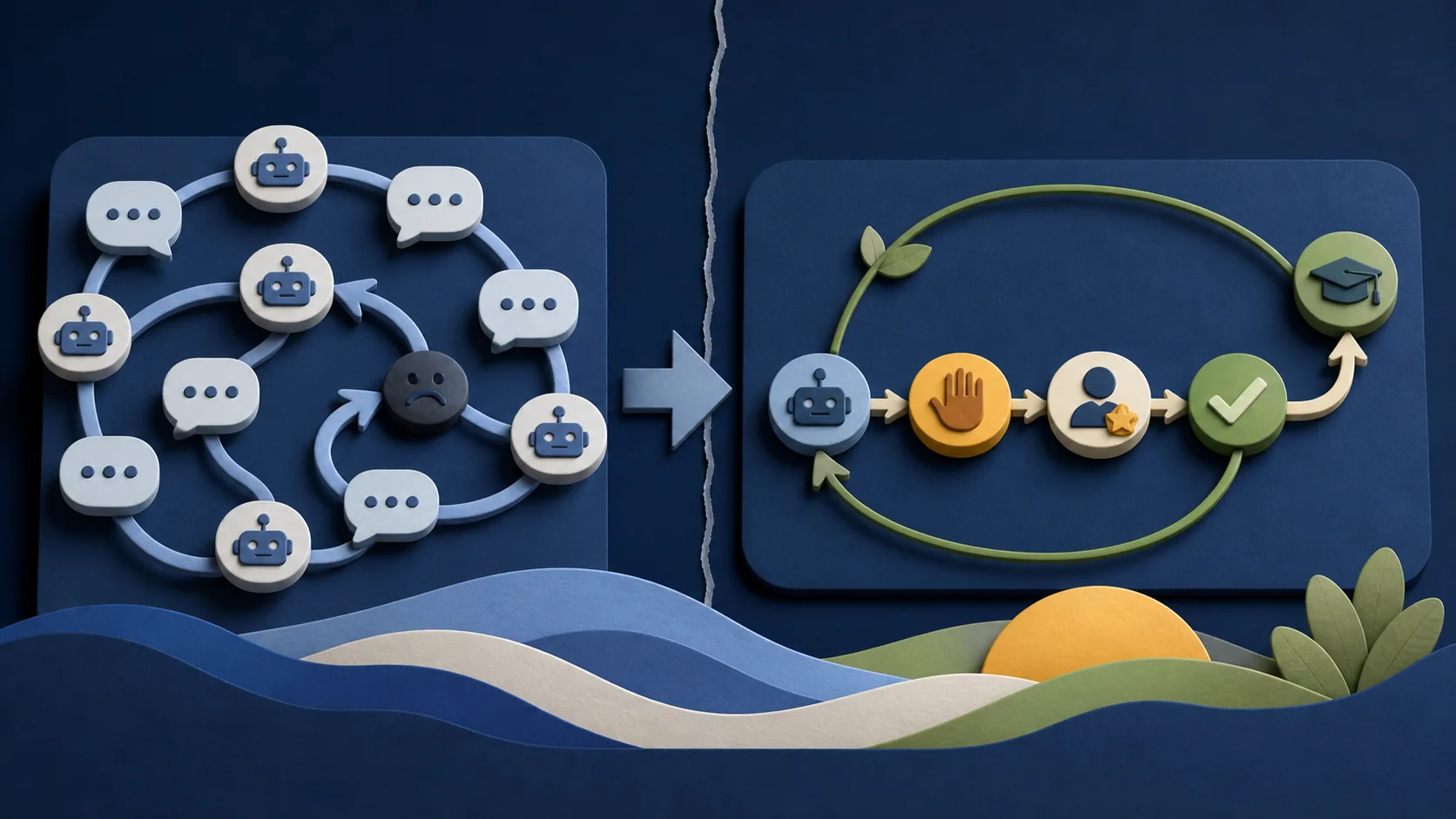
The core issue: chatbots were making autonomous decisions without organizational visibility into the decision logic. When a decision felt wrong, the customer had no way to understand or contest it. A contact center with chatbot clarity could answer: "For billing errors with supporting documentation, we authorize refunds up to $500. For refunds above that, we escalate to a specialist." Every decision was explicable. Customers understood the reasoning.
Automation Rate vs. Decision Quality Matrix
Two different dimensions. Target is not maximum automation—it is maximum decision quality with reasonable automation rate.
High automation + low quality destroys customer trust faster than slow, high-quality service.
Why the Visible Metric Misleads
Most organizations track automation rate, feature usage, training completion, and satisfaction scores. These are legitimate things to measure. The trouble is that they measure engagement with a tool, not whether the organization's actual customer outcomes changed.
A team can be fully trained and actively using a chatbot system while executing decisions that customers resent. Throughput per person per month and customer satisfaction with decisions are far closer to the truth than automation rate ever gets. An organization that only tracks automation can look successful for a long time before anyone notices that customer satisfaction actually declined.
Customers accept slower service if they understand the decision logic. They reject fast service when decisions feel arbitrary.
The Leadership Move
The choice is not chatbot or no chatbot. It is whether to use chatbots to automate decisions within explicit rules or to let the system learn decision logic from data. The practical move is to define decision rules explicitly—what approvals are within scope, what requires escalation—before deploying the chatbot, rather than letting the system decide.
- Ownership
Chatbot quality is not owned by the vendor or the automation team alone. Customer service owns policy. Legal and risk own decision limits. Operations owns escalation capacity. Data science owns model behavior. Product and experience leaders own what customers actually feel when the system responds. When ownership is left ambiguous, no one questions whether decisions are actually defensible.
- Tradeoff
Leaders must decide whether they want maximum automation or explicable decisions that customers understand. Strategy-first approaches may reduce peak automation slightly. But they improve long-term customer outcomes: faster adaptation when policies change, higher customer trust, lower regulatory risk.
- Human consequence
When the hidden signal is missed, customers feel unheard and dismissed. Support teams inherit escalations that could have been prevented. Leadership loses visibility into what the system is actually deciding on behalf of the organization.
Next Move
If you have not deployed AI chatbots yet: Assign cross-functional ownership first. Define decision rules explicitly—approval limits, escalation conditions—before vendor selection. Choose technology that enforces explicit rules. Demand explainability: every decision must generate an explanation the customer understands.
If you have deployed chatbots lacking clarity: Audit your current system. Can you explain why it recommended a decision? If not, you have Revenue Unknown. Map decisions back to implicit rules—your system is deciding based on something; figure out what. Implement decision logging and explanation generation. Establish monthly reviews to understand patterns and refine policy.
FAQ
What is the difference between automation rate and decision quality?
Automation rate measures whether the chatbot handled the request. Decision quality measures whether customers understood and accepted the decision. High automation without quality destroys customer satisfaction faster than slow, high-quality service.
How do we build explainability without slowing operations?
Build it into the chatbot system itself, not as an afterthought. The system should generate human-readable explanations for significant decisions as part of normal operation. This is faster than retrofitting clarity after complaints arrive.
What if the chatbot could decide better than a human?
Customers still need to understand the decision. An unexplainable "correct" decision is worse than a slower, explainable one. Build the decision logic explicitly so customers, operators, and the organization understand what the system is allowed to do.
Who owns chatbot quality governance?
Chief Customer Officer and Chief Risk Officer with operations collaboration. Quality is fundamentally a customer experience decision and a risk decision. Cross-functional ownership works best.
Sources & References
- ChatMaxima: 55+ AI Customer Support Statistics and Trends for 2026
- Zoom: 65+ Chatbot Statistics for Customer Service Teams in 2025
- CallBotics: AI Contact Center Statistics and Trends in 2026
- Sprinklr: Contact Center AI: 7 Trends Defining 2025 and Beyond
- Quidget: How AI Improves First Contact Resolution Rate
- Pylon: How AI-Powered Customer Support Reduces Response Times by 97%
Original article archive
Original article published June 7, 2024: "How To Build Good ChatBots Through AI?". Preserved here for provenance, historical context, and citation continuity.
Chatbots, a form of artificial intelligence (AI), have transformed how retailers engage with customers. These intelligent conversational agents are deployed on various platforms, including websites, messaging apps, and social media, to assist customers with queries, provide product recommendations, and even facilitate transactions.
Part 4 of the series will explore the definition of chatbots, their evolution in retail, examples of retailers using them, and how AI enhances both chatbots and the customer experience. Additionally, we’ll discuss the pros and cons of using AI for chatbots in retail settings.
What Are ChatBots?
Chatbots are software programs designed to simulate human conversation, allowing users to interact with a computer system using natural language. In the retail sector, chatbots have evolved from basic scripted bots to sophisticated artificial intelligence (AI)-powered assistants capable of understanding and responding to complex queries.
Early retail adopters to the chatbot technology include:
- Sephora: Sephora launched its chatbot on Kik in 2016, allowing customers to interact with the bot to discover new beauty products and receive personalized recommendations.
- H&M: H&M introduced a chatbot on the messaging app Kik in 2016, enabling users to receive personalized style recommendations and browse products directly within the chat interface.
- eBay: eBay launched a chatbot on Facebook Messenger in 2016, allowing users to search for products, receive recommendations, and track orders using natural language commands.
- 1-800-Flowers: 1-800-Flowers introduced a chatbot on Facebook Messenger in 2016, enabling users to order flowers and gifts through a conversational interface.
https://www.youtube.com/embed/5M7elAK5ANs?feature=oembedH&M was an early adapter to the chatbot revolution. This was a version of the social messaging application called KiK (Source: YouTube)
How Is AI Involved In ChatBots?
In today’s digital age, chatbots are revolutionizing customer interactions with the help of Artificial Intelligence (AI). AI enables chatbots to understand natural language, learn from interactions, and provide personalized responses.
Natural Language Processing (NLP) allows chatbots to interpret human language, while Machine Learning (ML) helps them improve over time by analyzing data. Natural Language Generation (NLG) enables chatbots to respond in a human-like manner, enhancing user experience.
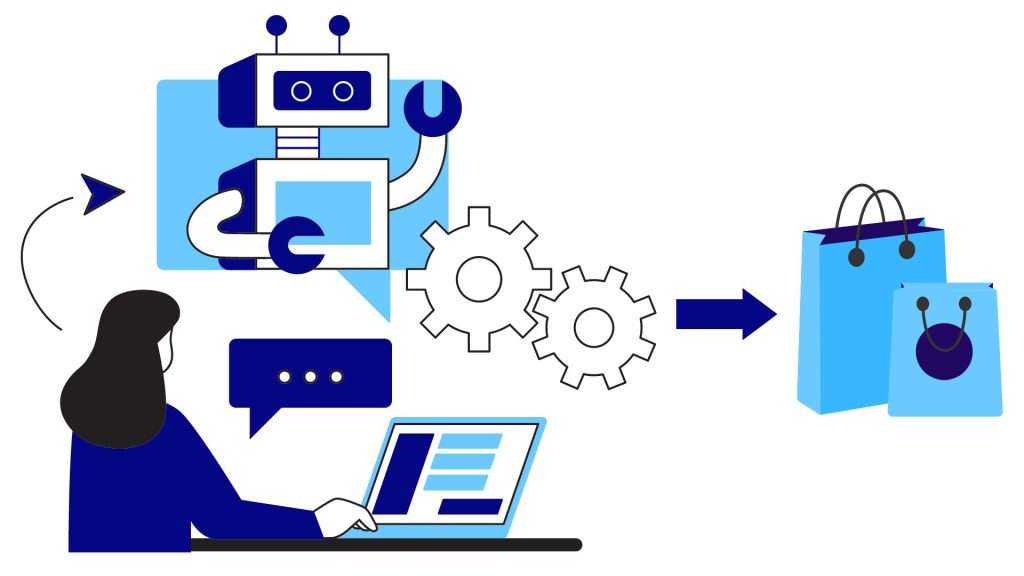
AI also enables chatbots to maintain context during conversations, personalize interactions based on user data, and continuously learn from new interactions. Additionally, AI-driven automation allows chatbots to automate tasks, saving time and resources.
Who Are The Top AI Chatbot Players Today?
Several AI chatbot companies are considered leaders in the industry today. They include:
- IBM Watson: IBM Watson offers a range of AI-powered chatbot solutions for businesses, including virtual assistants and customer service bots. Watson’s AI capabilities enable chatbots to understand natural language, learn from interactions, and provide personalized responses.
- Google Cloud Dialogflow: Google Cloud’s Dialogflow is a powerful AI platform for building natural and rich conversational experiences. It offers robust NLP capabilities and integration with Google Cloud’s other AI services.
- Microsoft Azure Bot Service: Microsoft Azure Bot Service provides tools and services for building, testing, and deploying intelligent bots. It integrates seamlessly with Microsoft’s AI services, such as Azure Cognitive Services and Azure Machine Learning.
- Amazon Lex: Amazon Lex is a service for building conversational interfaces into any application using voice and text. It powers Amazon’s Alexa and provides advanced NLP and speech recognition capabilities.
- Chatfuel: Chatfuel is a popular AI chatbot platform for creating Facebook Messenger bots. It offers a drag-and-drop interface and integration with AI services like Dialogflow for advanced functionality.
- ManyChat: ManyChat is another platform for building Facebook Messenger bots. It offers a visual bot builder and features like AI-driven conversations, broadcasting, and analytics.
- Rasa: Rasa is an open-source AI chatbot framework that allows developers to build and customize their chatbots. It offers NLP capabilities, dialogue management, and integration with popular messaging platforms.
Pros and Cons Of The AI-Powered Chatbot Technology
Many brands are exploring, evaluating, and investing into AI-powered chatbot technologies. Before doing so, brands should consider the following pros and cons:
Pros of Using AI-Powered chatbot technology:
- Improved Customer Service: According to a study by Oracle, 80% of businesses plan to use chatbots for customer interactions by 2020, highlighting the growing importance of AI-powered chatbots in enhancing customer service.
- Personalized Interactions: A report by Accenture found that 91% of consumers are more likely to shop with brands that provide personalized offers and recommendations, demonstrating the importance of AI in enabling chatbots to offer personalized interactions.
- Cost-Effective: Research by Juniper Research suggests that chatbots could help businesses save over $8 billion per year by 2022, primarily through reduced customer service costs and increased operational efficiency.
- Scalability: With AI, chatbots can handle multiple customer queries simultaneously. For example, Bank of America’s chatbot, Erica, has already handled over 100 million client requests, showcasing the scalability of AI-powered chatbots.
Cons of Using AI-Powered chatbot technology:
- Lack of Human Touch: Despite advancements in AI, some customers still prefer human interaction. A survey by PwC found that 59% of consumers feel companies have lost touch with the human element of customer experience. This is especially important if a retailer is used to interacting with customers through a high time highly physical environment.
- Initial Investment: Implementing AI-powered chatbots can be costly. According to Gartner, the average cost of developing and deploying a chatbot ranges from US$30,000 to $150,000+, depending on complexity. Beyond technology investment, training, maintenance, and continual improvement costs may also need to be factored in.
- Maintenance and Updates: AI systems require regular maintenance and updates to remain effective. According to a report by Forrester, companies spend an average of 40% of their AI budgets on ongoing maintenance and updates.
- High Failure Rates: According to a study by Gartner, up to 80% of chatbot implementations will not deliver the desired outcomes due to various factors such as inadequate understanding of user needs, poor design, and lack of integration with other systems.
- Privacy Concerns: AI-powered chatbots collect and analyze customer data, raising privacy concerns. A survey by Edelman found that 81% of consumers are concerned about how much data companies collect on them.
Measuring Success
Retailers can use a variety of metrics to measure the effectiveness of using AI in chatbots, particularly focusing on engagement time, issue resolution, and upselling. Here are some key metrics for each category:
Engagement Time:
- Average Session Duration: This metric tracks the average amount of time customers spend interacting with the chatbot in a single session. A higher average session duration indicates that customers are engaging with the chatbot for longer periods, which can indicate a positive user experience.
- Average Response Time: This metric measures the average time it takes for the chatbot to respond to a customer query. A lower average response time indicates that the chatbot is providing timely and efficient assistance to customers.
- Number of Interactions per Session: Tracking the number of interactions per session can provide insights into how engaged customers are with the chatbot. A higher number of interactions may indicate that customers are finding the chatbot helpful and are actively seeking information or assistance.
Issue Resolution:
- First Contact Resolution Rate: This metric measures the percentage of customer issues resolved during the first interaction with the chatbot. A higher first-contact resolution rate indicates that the chatbot effectively resolves customer issues without needing escalation.
- Resolution Time: This metric tracks the average time it takes for the chatbot to resolve customer issues. A lower resolution time indicates that the chatbot is efficient at resolving issues, which can lead to higher customer satisfaction.
- Customer Satisfaction (CSAT) Score: While not specific to issue resolution, the CSAT score measures overall customer satisfaction with the chatbot experience. A high CSAT score indicates that customers are satisfied with the chatbot’s ability to resolve their issues.
Upselling:
- Conversion Rate: This metric measures the percentage of interactions with the chatbot that result in a successful upsell. A higher conversion rate indicates that the chatbot is effective at driving additional sales.
- Average Order Value (AOV): Tracking the AOV of customers who interact with the chatbot can provide insights into the effectiveness of upselling efforts. A higher AOV among chatbot users indicates that the chatbot is successful at encouraging customers to purchase additional items.
- Upsell Success Rate: This metric measures the percentage of upselling attempts that result in a successful upsell. A higher upsell success rate indicates that the chatbot is effective at persuading customers to make additional purchases.
By tracking these metrics, retailers can assess the effectiveness of using AI in chatbots and make informed decisions to optimize their chatbot strategies for improved engagement, issue resolution, and upselling.
Looking Ahead
Incorporating AI in chatbots to further improve customer engagement, issue resolution, and upselling requires a strategic approach. Looking ahead, brands should go on a journey to explore their capabilities, capacities, and general expertise in the following areas:
1. Determining the Customer Engagement/Communication/Feedback Strategy
- Explore and finalize a strategy for customer engagement and evaluate why AI-powered chatbot technology should be used over other forms of communication
- Determine the touch points where the technology would be maximized
- Determine whether the chatbot would be used in the process (e.g., sales, support, general information, etc.)
2. Implementing/Enhancing Natural Language Processing (NLP) Capabilities
- Invest in advanced NLP algorithms to improve the chatbot’s ability to understand and respond to complex queries more accurately and efficiently.
- Implement sentiment analysis to gauge customer emotions and tailor responses accordingly, leading to more personalized interactions and improved issue resolution.
3. Implementing Machine Learning (ML) for Personalization
- Utilize ML algorithms to analyze customer data and behavior patterns, enabling the chatbot to offer personalized product recommendations and upsell opportunities.
- Leverage ML for continuous learning and improvement of the chatbot’s responses based on customer interactions and feedback.
4. Introducing Chatbot Analytics and Reporting
- Implement robust analytics tools to track key metrics related to engagement time, issue resolution, and upselling.
- Use data-driven insights to identify trends, optimize chatbot performance, and enhance the overall customer experience.
5. Integrating with CRM and other Platforms
- Integrate the chatbot with customer relationship management (CRM) systems to access customer data and provide more personalized interactions.
- Integrate with e-commerce platforms to facilitate seamless transactions and upselling opportunities directly within the chatbot interface.
6. Enhancing Multi-channel Support
- Extend chatbot support to additional channels such as voice assistants, social media platforms, and messaging apps to reach customers wherever they are.
- Ensure consistent and seamless experiences across all channels to improve customer satisfaction and engagement.
- Omni-channel support should be mapped out and seamlessly integrated to remove friction.
7. Implementing Proactive Engagement
- Use AI to analyze customer behavior and predict needs, enabling the chatbot to proactively reach out with relevant information or offers/deals.
- Proactively address potential issues before they escalate, improving customer satisfaction and loyalty.
8. Integrating Human-Assisted Support
- Implement a seamless handoff between the chatbot and human agents for complex issues that require human intervention.
- Use AI to assist human agents by providing relevant information and suggestions, improving issue resolution and customer satisfaction.
9. Continuous Monitoring and Optimization
- Regularly review chatbot interactions, feedback, and performance metrics to identify areas for improvement.
- Continuously update and optimize the chatbot’s algorithms and responses based on user feedback and changing customer needs.
10. Metrics for Success
- Determine what metrics to use to determine success for the technology (i.e., improved sales, customer satisfaction, level 1/2 interactions, etc.)
- Use metrics that may be cross-departmental to maximize its contribution.
Looking ahead, retail brands have lots to think about before committing to an AI-powered chatbot.
How Can Transformidy Help?
Transformidy is available to assist in helping you understand artificial intelligence and how prepared your company is in building a solution for customers, employees, stakeholders.
Contact us or set up a 30 minute complimentary consultation for more information on our services, insights, or showcases. We look forward to hearing from you.
FAQ
What is the difference between automation rate and decision quality?
Automation rate measures whether the chatbot handled the request. Decision quality measures whether customers understood and accepted the decision. High automation without quality destroys customer satisfaction faster than slow, high-quality service.
How do you measure whether work has actually been redesigned?
Ask whether decisions became more explainable or just faster. In a properly designed chatbot, customers understand the decision logic. If everything just moved faster and decisions remained opaque, the design has not actually changed.