
Article
Careem's Revenue Grew 20%. Its Losses Grew Faster.
Careem's revenue grew 20% in H1 2026. Its operating losses grew almost a third faster than that, to $122 million. In the same period, Uber paid $100 million to buy 12.5 percentage points of Careem Technologies back from e&.
- Published
- May 31, 2025
- Updated
- June 18, 2026
- Reading time
- 8 min

2026 updated analysis
What changed since the original article
This page keeps the original Transformidy article as the canonical record and leads with the current interpretation, source notes, and Revenue Unknown framing.
The Numbers and the Ownership Reversal
Careem Technologies' first public financial results, disclosed through parent company e&'s (formerly Etisalat) own reporting, showed H1 2026 revenue rising 20% year over year to AED884 million, roughly $241 million, while operating losses climbed nearly a third to AED447 million, roughly $122 million. Revenue growth is real; loss growth is outpacing it. e& has reclassified Careem Technologies as a discontinued operation in its own financial reporting, a specific accounting signal about how the parent company now views the business.
In June 2026, Uber acquired 12.5 percentage points of Careem Technologies from e& for $100 million, taking a controlling position and reducing e&'s ownership from 50.03% to 37.53%. That is a striking reversal on a short timeline: e& had originally acquired its majority stake in Careem Technologies for $400 million in December 2023, less than three years earlier. Both companies retain put and call options on the remaining shares, exercisable between December 2031 and January 2032, leaving the door open for a further ownership shift down the road.
Careem CEO Mudassir Sheikha framed the change as restoring familiarity: "This move brings Careem and Uber back into a closer, deeply familiar alignment," a reasonable description given Uber's original $3.1 billion acquisition of Careem's ride-hailing business in 2019. e&'s own statement pointed toward a different motivation on its side: the sale would let Careem Technologies "benefit from Uber's global technology experience and platform synergies," while e& itself cited "increased strategic focus on its core businesses and disciplined capital allocation priorities," language that reads as an acknowledgment that funding Careem's super app ambitions no longer fit e&'s own priorities.
Revenue growth against operating loss growth, year over year
Disclosed the same period Uber acquired a controlling stake back from e& for $100 million.
What $400 Million and $100 Million Actually Bought
The price sequence here is worth sitting with directly. e& paid $400 million in December 2023 to acquire majority control of Careem Technologies. Uber paid $100 million in June 2026, roughly two and a half years later, to acquire 12.5 percentage points of Careem Technologies, sufficient to take back control. Those two transactions are not directly comparable, different stakes, different points in the company's growth, different strategic contexts, but the gap is large enough to suggest something changed materially about how each party valued control of the business between 2023 and 2026.
e&'s own stated rationale, "increased strategic focus on its core businesses and disciplined capital allocation priorities," reads as acknowledgment that continuing to fund a capital-intensive, still-loss-making super app was pulling resources and attention away from its primary telecommunications business. That is a common pattern for a non-core strategic investment made during a period of broader ambition, later unwound once the parent company refocuses on its core competency, especially when the investment's returns have not yet materialized at the pace originally expected.
Uber's willingness to buy back in, despite Careem's widening losses, suggests a different calculation: platform and technology synergies, the ability to apply Uber's existing global infrastructure and expertise to Careem's super app ambitions, that e& as a telecommunications company was structurally not positioned to provide. Whether that platform advantage actually narrows Careem's loss trajectory in subsequent quarters is the open question this ownership change is now being tested against.
Telecom-Parent Ownership vs. Platform-Parent Ownership
One provides capital. The other provides infrastructure the super app actually needs.
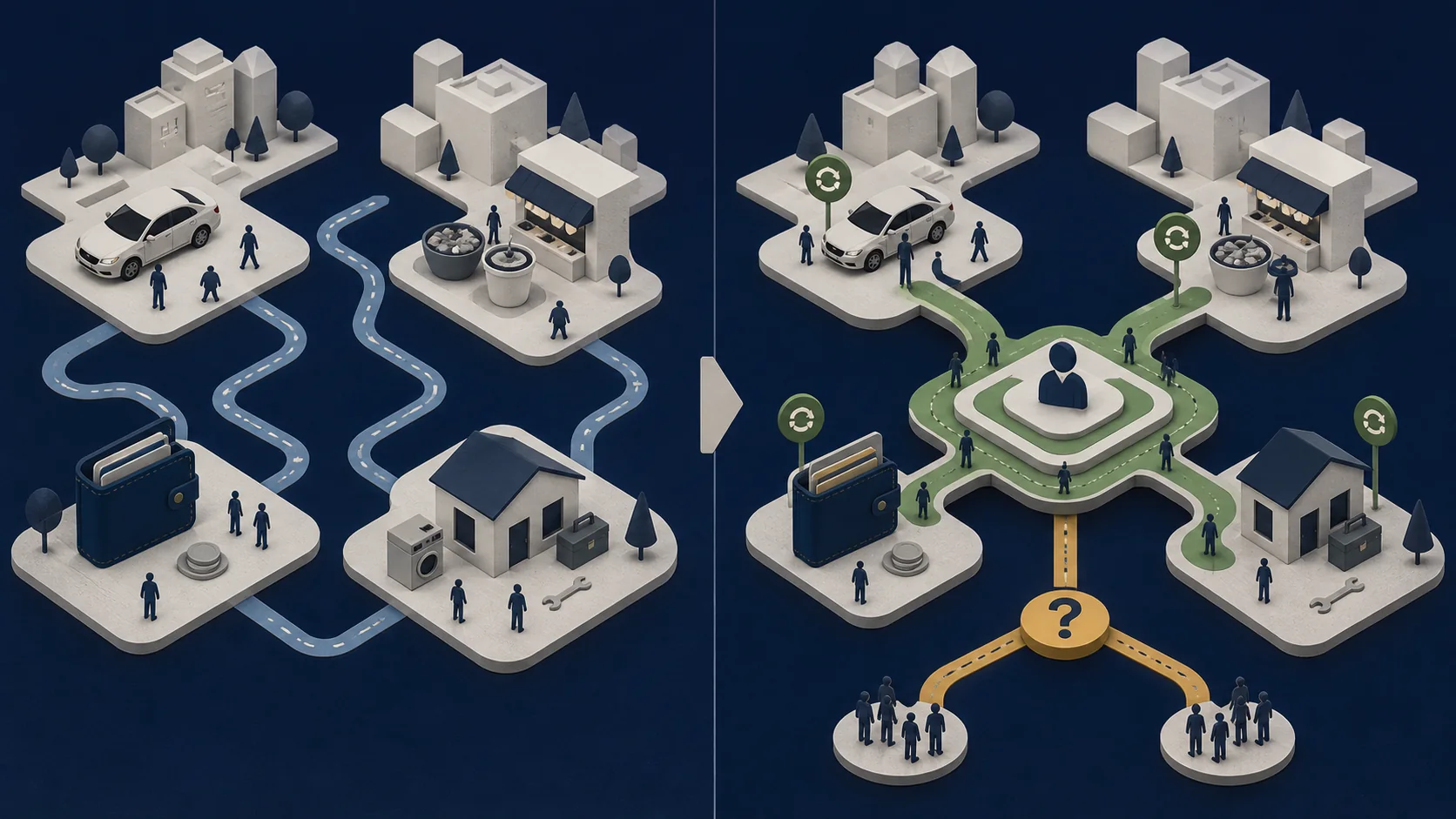
Telecom-parent ownership (e&, 2023-2026): capital and majority control, but limited platform-specific technology synergy, alongside a strategic refocus away from non-core investments. Platform-parent ownership (Uber, 2026 onward): a smaller equity stake but direct access to Uber's existing global ride-hailing and delivery infrastructure, the specific synergy both companies cited as the rationale for the ownership shift.
"This move brings Careem and Uber back into a closer, deeply familiar alignment."
The Leadership Move
The structural choice for any diversified parent company holding a majority stake in a capital-intensive, non-core growth business is whether to continue funding it through widening losses, or to bring in a strategically better-positioned partner even at the cost of ceding control.
- Ownership
e&'s corporate leadership owns the decision to reduce its Careem Technologies stake and cede control to Uber, a choice framed explicitly as strategic refocusing rather than a forced exit, made while the business's losses were still widening relative to revenue.
- Tradeoff
e& traded majority control and the associated upside of a successful super app for capital discipline and strategic focus on its core telecommunications business. Uber traded $100 million and renewed operational responsibility for a still-loss-making business in exchange for platform synergy potential and closer alignment with its existing global infrastructure.
- Human consequence
Careem's employees and users across its food, grocery, payments, and courier services now operate under a materially different parent company with different strategic priorities and technology resources than they did under e&'s ownership, a transition with real operational implications regardless of how the financial numbers eventually resolve.
Next Move
If you are tracking Careem or similar super app investments: Watch subsequent quarterly results specifically for whether operating losses narrow relative to revenue growth under Uber's renewed control, as the direct test of whether the platform synergy rationale holds up.
If your organization holds a non-core majority stake in a still-unprofitable growth business: Use e&'s framing, "disciplined capital allocation priorities," as a model for how to communicate a strategic exit without it reading as an admission of failure, while being honest internally about whether continued funding still serves your core priorities.
FAQ
What do Careem's first public financial results show?
Careem Technologies' first public P&L, disclosed via parent company e&'s financial results, showed H1 2026 revenue rising 20% year over year to AED884 million ($241 million), while operating losses climbed nearly a third to AED447 million, roughly $122 million. Revenue growth is slowing relative to prior periods even as losses widen faster than revenue.
What changed in Careem's ownership structure in 2026?
In June 2026, Uber acquired 12.5 percentage points of Careem Technologies from e& for $100 million, taking a controlling position and reducing e&'s ownership from 50.03% to 37.53%. Both companies hold put and call options for the remaining shares, exercisable between December 2031 and January 2032. E& had originally acquired its majority stake in Careem Technologies for $400 million in December 2023.
Why did Uber and e& make this ownership change?
Careem CEO Mudassir Sheikha described the move as bringing "Careem and Uber back into a closer, deeply familiar alignment." e& framed the sale as enabling Careem Technologies to "benefit from Uber's global technology experience and platform synergies," while also citing its own "increased strategic focus on its core businesses and disciplined capital allocation priorities."
How should the ownership change and the financial results be read together?
The ownership shift back toward Uber arrived in the same period Careem's own numbers showed losses outpacing revenue growth, suggesting the super app's non-rideshare businesses, food and grocery delivery, digital payments, courier services, still need scaled platform support that e& alone was not providing, while e& simultaneously narrowed its own strategic focus away from that capital-intensive business.
Sources & References
Original article archive
Original article published May 31, 2025: "Careem Wins Great Experience Award May 25". Preserved here for provenance, historical context, and citation continuity.
Careem stands out as the winner of the Transformidy Great Experience Award for May 2025 due to its groundbreaking CX product innovation—a super app that consolidates multiple daily services into one user-friendly platform. This innovation has redefined convenience and customer engagement in a highly competitive and diverse market.
What Is Careem?
Careem, founded in 2012 by Mudassir Sheikha and Magnus Olsson, began as a website-based service for corporate car bookings in the Middle East and quickly evolved into the region’s leading ride-hailing company. With Abdulla Elyas joining as a co-founder in 2014, Careem expanded its services beyond transportation to become the first true "super app" in the Middle East, integrating ride-hailing, food delivery, digital payments (Careem Pay), grocery delivery, and more into a single seamless platform.
The super app design is powered by advanced technologies such as AI, machine learning, and microservices architecture. This modular approach allows Careem to scale individual services independently, deploy updates rapidly, and maintain high reliability. AI-driven features include dynamic pricing, demand forecasting, personalized recommendations, and real-time GPS tracking, optimizing both customer experience and driver efficiency. Careem Pay enhances the platform with secure digital wallets and fintech services, enabling users to pay for rides, food, bills, and peer-to-peer transfers all within the app.
Careem’s super app deemed the "Everything App" is designed to offer a unified and consistent experience across diverse services, making it feel like one cohesive ecosystem despite the complexity of different customer journeys involved in ride-hailing, food delivery, and financial transactions. This human-centered design approach ensures ease of use and customer satisfaction across its 100+ cities in 14 countries in the region, serving over 50 million users and creating more than one million jobs in the region.
The company’s growth trajectory includes key acquisitions such as RoundMenu (a food ordering platform) and strategic expansions into new markets, demonstrating its commitment to localization and addressing regional needs like cash payments and language support. The company's acquisition by Uber in 2020 for $3.1 billion USD further accelerated its growth and technological capabilities, positioning it as a dominant player in the MENA ride-hailing and super app space.
Why Careem Won?
Careem won the Transformidy Great Experience Award for May 2025 because it has successfully transformed from a regional ride-hailing service into a comprehensive super app that seamlessly integrates multiple daily services—ride-hailing, food and grocery delivery, digital payments, and more—into one user-friendly platform. The application includes the following key features that is unique to the region and globally:
- Integrated Service Ecosystem: Careem’s super app combines ride-hailing, food delivery, payments, and more, allowing customers to access multiple services without switching apps. This seamless integration reduces friction and enhances the overall user experience.
- Customer-Centric Design: The app’s intuitive interface and personalized recommendations cater to diverse customer needs, improving usability and satisfaction.
- Localized Innovation: Careem’s deep understanding of regional customer preferences and challenges has enabled tailored solutions, such as cash payment options and localized language support, boosting accessibility and inclusivity.
- Data-Driven Personalization: Leveraging data analytics, Careem offers personalized promotions and service suggestions that increase engagement and loyalty.
- Social Impact and Community Engagement: Beyond CX, Careem has invested in community initiatives and sustainability, strengthening its brand reputation and customer trust.
How Others Can Succeed in CX Innovation?
- Adopt a Holistic Approach: Like Careem, companies should aim to integrate multiple customer needs into a single, seamless platform to reduce complexity and enhance convenience.
- Focus on Localization: Understanding and addressing local market nuances and customer preferences is critical for relevance and adoption.
- Leverage Data Intelligently: Use customer data to personalize experiences and anticipate needs, but maintain transparency and trust.
- Prioritize Accessibility and Inclusion: Ensure services are accessible to diverse customer segments, including those with limited digital literacy or payment options.
- Invest in Community and Social Impact: Building a brand that resonates beyond transactions fosters deeper customer loyalty and advocacy.
- Continuously Innovate: CX innovation is ongoing; companies must iterate based on customer feedback and emerging technologies.
Careem’s success exemplifies how CX innovation rooted in integration, personalization, and local relevance can create transformative customer experiences that set new industry standards. Other organizations aiming for CX excellence should draw lessons from Careem’s approach to build customer-centric, inclusive, and innovative solutions that truly resonate with their audiences.
This recognition aligns with the 2025 Transform Awards emphasis on transformative tech and connected culture, highlighting Careem’s role as a leader in shaping the future of customer experience in the digital age.
Great Experience AwardTM
Transformidy’s Great Experience AwardTM is presented monthly and showcases excellence in experience strategy design or execution. Companies are welcomed to submit entrants with support like demos, pictures, videos, press release or description (no bigger than 5Mb in size), for this monthly award with experience ideas, innovations, or initiatives curated for customers, employees, or stakeholders.
Transformidy will evaluate all entrants and will make the final decision on the winner based on factors including but not limited to how the experience(s) transform or improve the way the company engages, acquires, supports, or maintains its customers, employees, or stakeholders. The experience(s) for consideration can be physical, online, or virtual.
How Can We Help?
Transformidy is available to assist in helping you understand trust and assess how your company’s experience strategy’s effectiveness in generating engagement, satisfaction, and business growth.
Contact us or set up a 30 minute complimentary consultation for more information on our services, insights, or showcases. We look forward to hearing from you.
FAQ
What do Careem's first public financial results show?
Careem Technologies' first public P&L, disclosed via parent company e&'s financial results, showed H1 2026 revenue rising 20% year over year to AED884 million ($241 million), while operating losses climbed nearly a third to AED447 million, roughly $122 million. Revenue growth is slowing relative to prior periods even as losses widen faster than revenue.
What changed in Careem's ownership structure in 2026?
In June 2026, Uber acquired 12.5 percentage points of Careem Technologies from e& for $100 million, taking a controlling position and reducing e&'s ownership from 50.03% to 37.53%. Both companies hold put and call options for the remaining shares, exercisable between December 2031 and January 2032. E& had originally acquired its majority stake in Careem Technologies for $400 million in December 2023.
Why did Uber and e& make this ownership change?
Careem CEO Mudassir Sheikha described the move as bringing 'Careem and Uber back into a closer, deeply familiar alignment.' E& framed the sale as enabling Careem Technologies to 'benefit from Uber's global technology experience and platform synergies,' while also citing its own 'increased strategic focus on its core businesses and disciplined capital allocation priorities.'
How should the ownership change and the financial results be read together?
The ownership shift back toward Uber arrived in the same period Careem's own numbers showed losses outpacing revenue growth, suggesting the super app's non-rideshare businesses, food and grocery delivery, digital payments, courier services, still need scaled platform support that e& alone was not providing, while e& simultaneously narrowed its own strategic focus away from that capital-intensive business.
Related intelligence
Article
Thrive Market Stopped Being Just a Membership Business
Thrive Market crossed 1.6 million members and $700 million in sales, then spent 2024 building three things that were not more members: a retail media network, in-house frozen fulfillment, and AI-assisted shopping. A membership business just quietly became three businesses.
Article
McDonald's CEO Named the Exact Chain Reaction Behind a Bad Quarter
McDonald's CEO told investors directly: this was not a strategy problem. Restaurant teams were overwhelmed by too many menu deployments in a single quarter, service times rose, and satisfaction scores fell as a direct result. He named the mechanism, not just the symptom.
Article
Your Rivalry Is a Line Item in Someone's Pricing Model
NHL ticket prices rose 65% from 2015 to 2025. A Michigan Journal of Economics study found rivalry history and regional proximity are specific, usable inputs teams already feed into variable pricing models. The emotion of a rivalry has become a line item in a pricing algorithm.