
Article
Hudson's Bay: What the Brand Survived and the Retailer Did Not
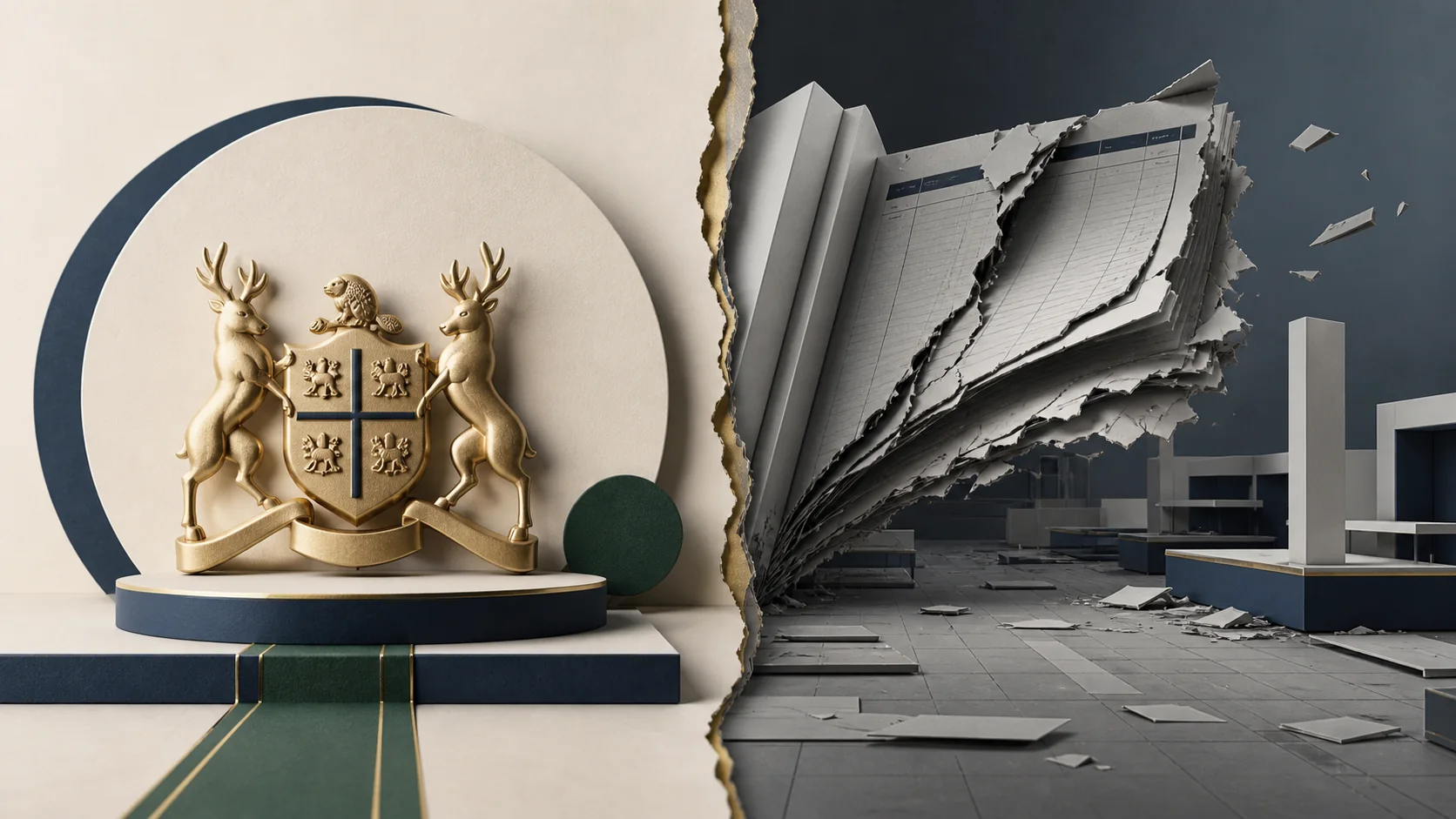
Hudson's Bay did not collapse because of tariffs alone. It collapsed because a 355-year-old brand had no operating business left to defend it. One year later, Canadian Tire owns the name and stripes for $30 million—the brand outlived the retailer.
- Published
- March 14, 2025
- Updated
- June 18, 2026
- Reading time
- 8 min
2026 updated analysis
What changed since the original article
This page keeps the original Transformidy article as the canonical record and leads with the current interpretation, source notes, and Revenue Unknown framing.
The Collapse in Numbers
Hudson's Bay Company filed for creditor protection under Canada's CCAA process in March 2025. Court filings showed a net loss of approximately $329.7 million for the twelve months ending January 31, 2025, against $1.1 billion in outstanding secured debt—roughly $724.4 million in mortgage debt and $405 million across three credit facilities. The company took an emergency $16 million debtor-in-possession advance just to keep operating through the filing.
The liquidation that followed was not partial. Approximately 8,347 employees were terminated as the company wound down its retail operations, ending a 355-year retail presence in Canada.
What survived was narrower than the company itself. Canadian Tire acquired the Hudson's Bay brand and intellectual property—including the iconic striped pattern—for approximately $30 million in June 2025. The stores, the leases, the 8,347 jobs: gone. The name and the stripes: sold, to a company that had nothing to do with the retail operation that just failed.
Net loss in the 12 months before Hudson's Bay's CCAA filing
Against $1.1 billion in secured debt. The brand later sold for about $30 million—less than a tenth of that debt.
The Brand Outlived the Business
The Hudson's Bay story is usually told as a tariff story or a department-store-decline story. Both are true and neither is the point. The point is that a name Canadians had trusted for 355 years turned out to be separable from the business operating under it—and once separated, the name was worth keeping while the business was not.
Retail Insider's retrospective identifies the structural root: "Even though Saks Global separated Hudson's Bay from its structure, the Canadian banner was left to fend for itself"—an ownership restructuring that removed parent-company support at the exact moment trade tensions and declining department-store traffic required it most. The brand did not fail. The specific corporate structure holding it did.
This is the uncomfortable lesson for any legacy brand leadership team: heritage generates goodwill, not cash flow. Goodwill shows up in a buyer's willingness to pay $30 million for a name and a stripe pattern. Cash flow shows up in whether the stores under that name can service their debt. Confusing the two is how a company runs a $329.7 million annual loss while executives still describe the brand as strong.
Brand Equity vs. Operating Health: Two Separate Ledgers
One asset can survive bankruptcy. The other cannot.
Brand equity (name, heritage, recognition) transfers to a buyer even in liquidation. Operating health (debt service, margin, store economics) does not transfer—it is either solvent or it is not.

A brand is what a buyer will pay for after everything else is gone. That is a real number. It is just not the same number as whether the business survives.
The Leadership Move
Every legacy brand's board faces a version of this choice before a crisis forces it: track brand equity and operating health as two separate reports, or let brand sentiment stand in for financial health until a lender forces the distinction.
- Ownership
The CEO and CFO jointly own this distinction—CFO for the operating numbers, CEO for whether brand strategy is being asked to compensate for operating weakness it cannot fix. When a board only hears brand-health metrics in strategy sessions, operating deterioration goes unaddressed until a covenant breach or a court filing surfaces it.
- Tradeoff
Naming the gap between brand equity and operating health early means admitting a business may not be viable in its current form, well before a crisis makes that admission mandatory. The alternative—waiting for a forcing event—costs jobs, landlords, suppliers, and eventually the brand's ability to attach to a healthy operator on favorable terms.
- Human consequence
8,347 people lost their jobs when the distinction was finally forced by a court rather than addressed by a board. Landlords absorbed vacant square footage. Suppliers absorbed unpaid invoices. None of that was inevitable at the moment the ownership restructuring happened—it became inevitable only because the operating gap was left unaddressed for years afterward.
Next Move
If you lead a legacy or heritage brand: Ask your CFO to present operating health with zero reference to brand sentiment, and ask your CMO to present brand equity with zero reference to store profitability. If either report leans on the other to look acceptable, you have found the gap Hudson's Bay's leadership did not close in time.
If your brand sits inside a larger corporate parent: Confirm explicitly, in writing, what support the parent will and will not provide if trade conditions or category decline hit your banner specifically. Hudson's Bay's Canadian operation was left to fend for itself after a structural separation from Saks Global—know now whether your banner has that same exposure.
FAQ
Why did Hudson's Bay collapse if the brand was still valuable?
Because brand value and operating viability are different balance sheets. The Bay's name, stripes, and heritage retained enough value for Canadian Tire to pay roughly $30 million for the intellectual property. The retail operation carrying that name had accumulated $1.1 billion in secured debt and lost $329.7 million in a single year. A brand can be worth buying even when the business behind it is worth liquidating.
Could better customer experience have saved Hudson's Bay?
Not on its own. The retailer's problems were structural: debt load, an ownership split that left the Canadian banner without parent-company support, and a cost base that did not match declining department-store traffic. Customer experience investment matters, but it cannot outrun a balance sheet that is already underwater.
What happened to Hudson's Bay's stores and leases?
Most were liquidated. Landlords successfully opposed a bid to transfer 25 leases to a single buyer, and large former department-store spaces are now being redeveloped for mixed-use projects combining retail with housing and office space—a sign that the real estate outlasted the retail format that once justified it.
What should other legacy retailers take from this?
That brand equity is a separate asset from operating health, and boards need to track both, not assume one protects the other. If leadership cannot say clearly what the operating business earns independent of brand nostalgia, they are one bad year away from finding out the hard way.
Sources & References
Original article archive
Original article published March 14, 2025: "Can Hudson's Bay Brand Be Fixed For Better?". Preserved here for provenance, historical context, and citation continuity.
The bankruptcy filing of Hudson’s Bay Company (HBC), North America’s oldest retailer, marks a pivotal moment for Canadian retail. With 355 years+ of history, the company’s insolvency reflects systemic operational failures, financial mismanagement, and an inability to adapt to modern consumer demands. As HBC seeks protection under the Companies’ Creditors Arrangement Act (CCAA), its restructuring efforts will test whether legacy department stores can survive in an era defined by digital-first shopping and experiential expectations.
Update (May 16, 2025)
The bankruptcy courts approved Canadian Tire Corporation's Canadian $30 million bid for Hudson's Bay's intellectual properties including the historic brand name, multicoloured stripes, and coat of arms. This represents a unique opportunity for another Canadian brand.
By integrating these deeply Canadian symbols into its portfolio, Canadian Tire can leverage the emotional connection and heritage associated with Hudson’s Bay to engage and attract customers who value tradition and quality. This acquisition also supports Canadian Tire’s “True North” strategy by reinforcing its identity as a steward of Canadian retail heritage, which can strengthen brand loyalty and differentiate it across its 1,700 locations.
Some may ask if Canadian Tire should change its name to Hudson’s Bay? There are pros and cons: Retaining the Hudson’s Bay name preserves its rich legacy and some customer goodwill, which could be a powerful asset in maintaining trust and emotional resonance. However, integrating the brand under the Canadian Tire umbrella could streamline marketing and operational efficiencies, potentially modernizing the brand for new audiences.
Update (April 25, 2025)
For department stores strategizing their future with CX, here is a guide that speaks about the evolution, innovation and future opportunities available.
Update (April 1, 2025)
On Saturday, March 30, 2025, Justice Peter Osborne of the Ontario Superior Court of Justice rejected a HBC's restructuring agreement citing "neither necessary nor appropriate at this time." Without additional rescue plans in place, the last remaining locations will also go into liquidation and the once-behaved Canadian icon might go into court approved receivership.
Update (March 21, 2025)
On Thursday, March 21, 2025, HBC received court approval to start liquidating all but six of its 96 stores (including HBC, Saks Fifth Avenue, and Off-5th) starting on Monday, March 24, 2025.
The six stores that are not affected are:
- Toronto - CF Eaton Centre
- Toronto - Yorkdale Shopping Centre
- Richmond Hill - Hillcrest Mall
- Montreal - Flagship Sainte-Catherine downtown store
- Montreal - CF Fairview Pointe-Claire mall
- Laval - CF Carrefour Laval mall
Key Takeaways
- Hudson's Bay Company's Challenges:
- Financial Struggles: HBC faces significant financial challenges, including declining sales and operational inefficiencies.
- Bankruptcy Filing: The company has filed for bankruptcy protection under the CCAA to restructure its operations.
- Impact on Employees and Customers: This situation affects employees' job security and customers' trust in the brand.
- Customer Experience Strategies:
- Personalization: Implement personalized shopping experiences through tailored recommendations and style consultations.
- Community Engagement: Host workshops, events, and leverage social media to build a community around the brand.
- Digital Transformation: Enhance digital platforms for seamless omnichannel experiences.
- Long-Term Impacts on Retail Industry:
- Shift Away from Department Stores: HBC’s challenges highlight the decline of traditional department stores.
- Importance of Digital Transformation: The need for retailers to adapt to digital trends and consumer behaviors.
- Impact on Small Vendors: Potential financial strain on suppliers due to unpaid debts.
- Canadian Customers’ Perspective:
- Emotional Attachment: Many Canadians view HBC as a cultural icon, making its potential loss significant.
- Desire for Personalized Experiences: Customers seek unique, personalized truly Canadian interactions with brands.

Hudson's Bay Company - History
Hudson's Bay Company, founded in 1670 with a royal charter from King Charles II, is Canada's oldest company. Initially a fur trading enterprise, the company played a pivotal role in the colonization and development of vast regions of North America.
Key milestones include the merger with the North West Company in 1821, which solidified its dominance in the fur trade. In 1869, HBC sold Rupert's Land to the Canadian government, marking a shift towards retail and real estate. The early 20th century saw significant expansion into department stores, with the first store opening in Calgary in 1913. By the 1960s, HBC had expanded eastward, acquiring Morgan's department stores and rebranding them as The Bay.
The 1970s brought further acquisitions, including Simpsons and Zellers, while the 2000s saw a strategic shift towards luxury retail with the purchase of Saks, Inc. in 2013. In 2023, it brought back Zellers with a brand within a brand concept to recapture short-lived nostalgia. Today, HBC operates over 239 stores across North America, including Saks Fifth Avenue and Saks Off 5th. Despite its rich history, the company now faces significant challenges in adapting to modern retail demands.
At one point in the 2010s, it had the biggest women's shoe department at its Queen Street location in Toronto, Canada. The HBC's iconic Point Blanket featuring a white base with green, red, yellow and indigo stripes was first introduced in 1779. It serves as the department store's emblem today and can be found on other clothing, accessories, and household items. Its red tag deal days were once seen as the social gathering focal point.
Bankruptcy Implications
There are significant implications to HBC filing for CCAA protection. Below, we analyze the impacts on customers, employees, and stakeholders, and outline a path forward for customer experience transformation:

Impact on Customer Experience: Erosion of Trust and Deteriorating Standards
HBC's bankruptcy is the culmination of years of declining customer satisfaction. Operational neglect—such as broken escalators, malfunctioning HVAC systems, and sparse staffing—has turned stores into post-prime wasteland. These issues eroded consumer trust, with sales plunging over the past decades. Shoppers faced empty shelves, limited assistance, and outdated product assortments, driving them toward competitors like Simons, specialty retailers (e.g., Sephora and H&M) or online platforms (e.g, Amazon, Temu, and Shein).
Its loyalty program, Rewards, relaunched in 2023 with personalized offers and a tiered rewards system, failed to offset these challenges. Despite having over 8 million members in 2025, the program’s $5-per-1,000-points redemption rate (0.5%) lagged behind rivals like Nordstrom’s more generous incentives. Customers also reported frustration with inconsistent app functionality and lackluster “quest” rewards, which failed to drive meaningful engagement. As of March 12, 2025, the program is no longer operational.
Impact on Employees: Payroll Crises and Job Insecurity
HBC’s 9,400 Canadian employees face acute uncertainty. Court filings revealed the company risked missing payroll within days without emergency financing, exacerbating morale issues. Staffing cuts and reduced hours had already strained operations, leaving remaining employees overworked and unable to deliver adequate service. Unfortunately, negative press coverage combined with uninviting shopping experiences could drive some customers away.
The CCAA process allows the retailer to continue paying wages, but restructuring may lead to layoffs or store closures. Employees at 80 Hudson’s Bay locations and 13 Saks Off 5th stores now grapple with the likelihood of reduced benefits or job loss, particularly if liquidations proceed.
Impact on Stakeholders: Creditors, Suppliers, and Landlords
HBC’s CA$3.2 billion in liabilities has left suppliers unpaid and landlords anxious. The CCAA stay of proceedings temporarily shields HBC from creditor lawsuits, but vendors face write-downs on pre-filing debts. The company’s 2024 acquisition of Neiman Marcus for $2.7 billion diverted critical liquidity to Saks Global, worsening cash flow issues.
Landlords, already struggling with retail vacancies, may face lease renegotiations or store closures. The court-approved CA$16 million debtor-in-possession financing provides short-term relief, but long-term recovery depends on the company's ability to monetize real estate or attract new investors.
Long-term Effects of Hudson's Bay's Bankruptcy on the Retail Industry?
Operating more than 80 physical locations across Canada requires an enormous footprint in many malls. The long-term effects of Hudson's Bay's bankruptcy on the retail industry are multifaceted and far-reaching. Here are some key impacts:
- Vacancies in Shopping Malls: The potential closure of stores could leave significant vacancies in Canadian shopping malls, as many malls were built with department stores like Hudson's Bay as anchor tenants. As noted by Bruce Winder, this could lead to a broader decline in mall traffic and viability.
- Shift Away from Department Stores: Hudson's Bay's struggles highlight the decline of the traditional department store model. Consumers increasingly prefer specialty retailers or direct-to-consumer brands, which could accelerate this shift. Department stores used to be a source of knowledge for many shoppers. HBC has not been seen as a trend setter for Canadians in a while.
- Impact on Small Vendors: Hudson's Bay's financial troubles could severely affect smaller vendors who rely on the company for distribution and sales. If they are unable to recover debts owed by the company, these vendors might face financial strain or even bankruptcy.
- Job Losses: Mass store closures would result in significant job losses, affecting not only Hudson's Bay employees but also impacting the broader retail ecosystem. This could exacerbate economic challenges in regions heavily reliant on retail employment.
- Consumer Confidence and Trust: The erosion of consumer trust in Hudson's Bay reflects broader challenges in maintaining customer loyalty in the retail sector. Other retailers may need to focus on enhancing their own customer experiences to avoid similar declines in trust.
- Digital Transformation Imperative: This failure underscores the necessity for retailers to further invest in digital transformation and omnichannel retail strategies. Companies that fail to adapt to changing consumer behaviors risk facing similar challenges.
Survival Strategy: Reimagining Customer Experience
If Hudson's Bay emerges from restructuring, it must prioritize experiential retail and digital integration. Below are key pillars for transformation:

1. Store Experience Reinvention
HBC must address operational failures head-on:
- Invest in store maintenance to repair infrastructure and ensure climate control, addressing maintenance issues like broken escalators, elevators, and washrooms.
- Reduce store numbers and sizes but increase staffing in remaining locations, training employees for a consistent service quality across product lines.
- Work with vendors to create localized “retail-tainment” experiences through pop-up vendors, styling workshops, or exclusive in-store events to rebuild foot traffic.
2. Product Assortment and Omnichannel Integration
HBC’s product mix has lagged behind trending categories like sustainable fashion and premium wellness. A leaner, curated assortment should:
- Highlight Canadian designers and the brand's heritage status through exclusive collaborations, mirroring Simons’ success with local talent.
- Leverage data analytics to align inventory with regional preferences, reducing inventory purchases and overstock in underperforming categories.
- Unify online and offline operations, enabling seamless click-and-collect services and real-time inventory checks—a reversal of the 2021 split that “detrimentally” impacted stores.

3. Brand Overhaul
While HBC no longer operates a loyalty program as a source to analyze customer data and build engagement, it still has one of the biggest newsletter lists. There is an urgency for the company to rebrand for Canadians.
- Use its 355th anniversary has a way to re-engage past, current, and future customers on the brand values, and its products/services across Canada.
- Partner with media companies such as the CBC, CTV, and Global TV to showcase its rich history. Use social media (e.g., YouTube, TikTok, Instagram) to showcase products to digital-first generations.
- Use thank you cards to remind customers what shopping used to be.
- Establish positions to ensure newly established expectations meet reality through engagement analysis, touch point observations, and feedback for customers, employees, and other stakeholders.
- Partner with other Canadian brands to rent out retail spaces and work with them on generating buzz.
Transform for the Better
Hudson’s Bay’s bankruptcy is a wake-up call for traditional retailers. While CCAA protection offers a lifeline, survival hinges on embracing agility and customer-centric innovation. As Carl Boutet notes on Retail Insider, “The model that worked 50 years ago isn’t sustainable today”.
For many Canadians, Hudson’s Bay is more than just a department store—it is a cultural and historical symbol. Its potential closure as part of bankruptcy proceedings has sparked widespread concern among loyal shoppers who fear losing access to a brand that has been a cornerstone of Canadian retail for over 355 years. The risk of losing this iconic retailer feels like losing a piece of national heritage. The emotional attachment to the brand underscores the urgency for its reinvention to preserve its legacy.
Shoppers like Eileen Tymm, an 88-year-old from Penticton, expressed sadness over the decline, stating, “It has always had the quality items I’ve looked for. If the store closes, I won’t be able to find the same high-quality items all in one place anymore—and shopping on Amazon just isn’t the same”. This sentiment reflects a broader dissatisfaction with the erosion of in-person shopping experiences and the convenience of curated product offerings under one roof.
If given the opportunity, the iconic Canadian company needs to restructure itself into a versatile brand with a smaller footprint but with bold ideas to regain shoppers' attention.
Frequently Asked Questions (FAQs)- Hudson's Bay Company
Q: What is Hudson's Bay Company?
A: Hudson's Bay Company (HBC) is Canada's oldest company, founded in 1670 as a fur trading enterprise. It has evolved into a major retail and real estate business.
Q: Why is Hudson's Bay Company facing financial difficulties?
A: HBC is facing financial challenges due to declining sales, operational inefficiencies, and an inability to adapt quickly to changing consumer preferences and digital retail trends.
Q: What is the current status of Hudson's Bay Company?
A: HBC has filed for bankruptcy protection under the Companies' Creditors Arrangement Act (CCAA) to restructure its operations and address financial liabilities.
Q: How does this affect employees?
A: Employees face uncertainty regarding job security, with potential layoffs or store closures as part of restructuring efforts. However, the CCAA process ensures wages are paid during this period.
Q: What changes should Hudson's Bay Company make to improve customer experience?
A: HBC should focus on enhancing its loyalty program, improving store maintenance and staffing, and integrating digital and physical retail experiences more seamlessly.
Q: What are some historical milestones of Hudson's Bay Company?
A: Key milestones include its founding in 1670, the merger with the North West Company in 1821, and significant retail expansions in the 20th century. HBC also acquired luxury brands like Saks Fifth Avenue in 2013.
Q: How many stores does Hudson's Bay Company operate?
A: HBC operates over 239 stores across North America, including Hudson's Bay, Saks Fifth Avenue, and Saks Off 5th locations.
Q: What is the future outlook for Hudson's Bay Company?
A: The future depends on successful restructuring and adapting to modern retail trends. If HBC can improve customer experience and operational efficiency, it may regain its footing in the retail market.
Q: What will happen to the HBC Rewards program?
A: As of March 14, 2025, CA$58 million worth of points from 8.5 million+ account holders are outstanding for redemption. For the time being, the company has paused all earning and redemption activities for the program.
Q: What will happen to the HBC gift cards?
A: As of March 14, 2025, the company will honor all gift cards at its online and physical locations.
How Can Transformidy Help?
At Transformidy, we specialize in helping brands navigate the complex world of maximizing customer experience for improved engagement, satisfaction, and business growth. Our team of experts can assist you in assessing, tailoring, and implementing the right customer experience strategy for your company.
Contact us or set up a 30-minute complimentary consultation for more information on our services, insights, or showcases. We look forward to hearing from you.
FAQ
Why did Hudson's Bay collapse if the brand was still valuable?
Because brand value and operating viability are different balance sheets. The Bay's name, stripes, and heritage retained enough value for Canadian Tire to pay roughly $30 million for the intellectual property. The retail operation carrying that name had accumulated $1.1 billion in secured debt and lost $329.7 million in a single year. A brand can be worth buying even when the business behind it is worth liquidating.
Could better customer experience have saved Hudson's Bay?
Not on its own. The retailer's problems were structural: debt load, an ownership split that left the Canadian banner without parent-company support, and a cost base that did not match declining department-store traffic. Customer experience investment matters, but it cannot outrun a balance sheet that is already underwater.
What happened to Hudson's Bay's stores and leases?
Most were liquidated. Landlords successfully opposed a bid to transfer 25 leases to a single buyer, and large former department-store spaces are now being redeveloped for mixed-use projects combining retail with housing and office space—a sign that the real estate outlasted the retail format that once justified it.
What should other legacy retailers take from this?
That brand equity is a separate asset from operating health, and boards need to track both, not assume one protects the other. If leadership cannot say clearly what the operating business earns independent of brand nostalgia, they are one bad year away from finding out the hard way.
Related intelligence
Article
Department Store Strategy: Identity vs. Omnichannel
Department stores pursued omnichannel integration to compete with specialists and e-commerce. But integration without identity eroded customer loyalty. Successful stores rebuilt around curation and experience, not channel consolidation.
Article
13 Automakers Signed On to CarPlay Ultra. One Shipped It.
Standard CarPlay is in effectively every new car sold in America. CarPlay Ultra, announced with 13 automaker partners, is shipping in exactly one brand a year later. Mercedes, Audi, Volvo, and Renault walked back their commitments. Ford's CEO explained why in one sentence.
Article
Millennials Are Going to Dine Out 14 Times a Month in 2026
Millennials plan to dine out 14 times a month in 2026, well above the 10-times average across all Americans. 55% say they will spend even more on restaurants next year. The generation restaurants most need to design a dine-in experience for has already told OpenTable who they are.