
Article
Consumer Confidence Hit a Decade Low. Sales Grew 7.1% Anyway.
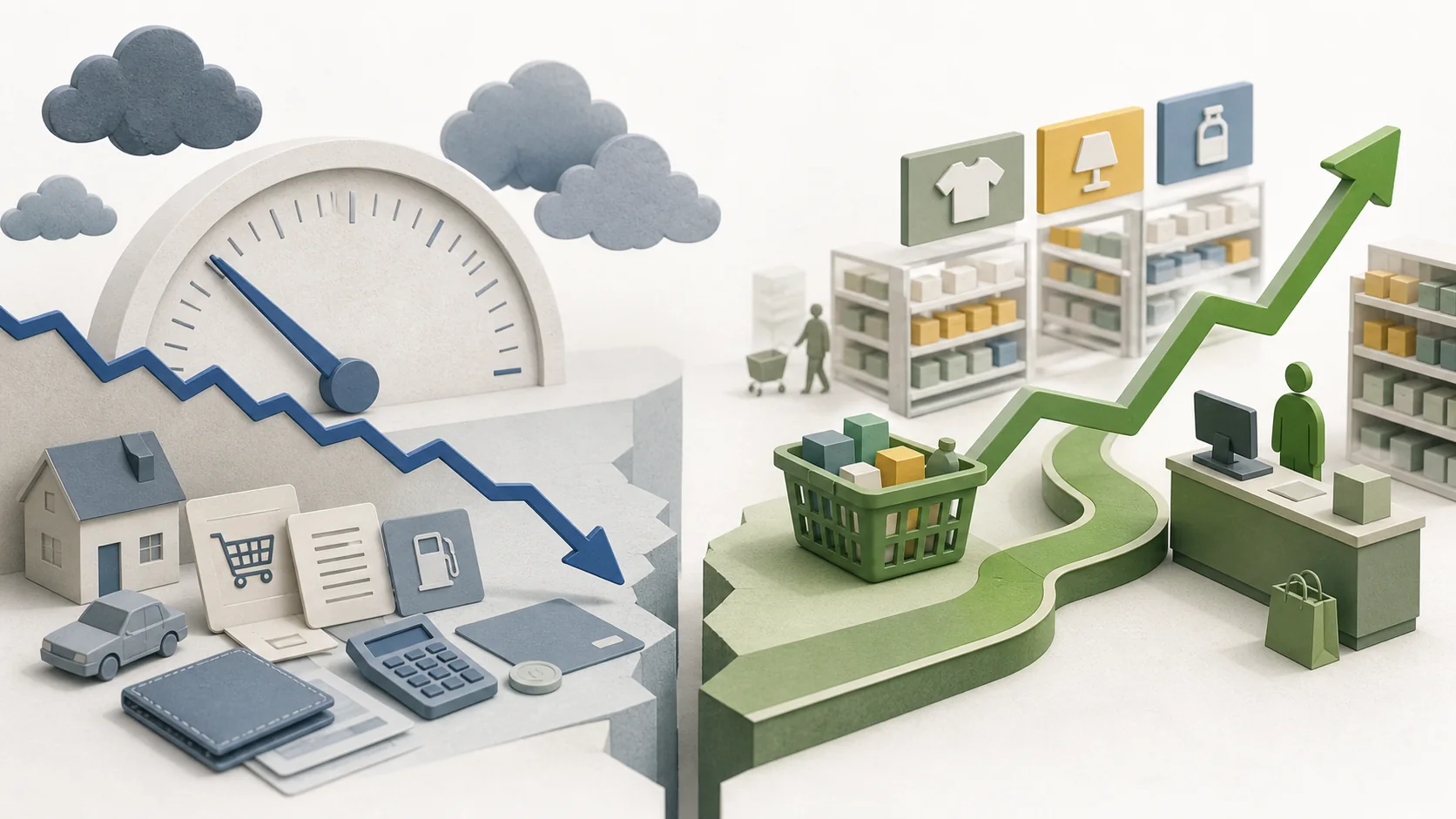
Consumer confidence hit a decade-low of 84.5 in January 2026. Same-store sales grew 7.1% year over year in the same period. Two numbers this far apart are not describing the same customer, and most retailers are only tracking one of them.
- Published
- January 19, 2026
- Updated
- June 18, 2026
- Reading time
- 7 min
2026 updated analysis
What changed since the original article
This page keeps the original Transformidy article as the canonical record and leads with the current interpretation, source notes, and Revenue Unknown framing.
84.5 and 7.1%, in the Same Month
Consumer confidence indices plummeted to a decade-low of 84.5 in January 2026, while the Johnson Redbook Index showed a 7.1% year-over-year increase in same-store sales in the same period. One data source describes consumers as more pessimistic about the economy than they have been in ten years. The other describes those same consumers spending noticeably more than they did a year earlier.
The analysis behind this data used a specific, useful term for the gap: "vibecession," a psychological downturn in sentiment that "has yet to fully manifest in the checkout line." That phrasing matters because it does not claim the confidence data is wrong or the sales data is wrong; it frames the divergence as a real, current state, sentiment has deteriorated, behavior has not yet followed, with an open question about which one moves toward the other next.
Real personal spending data reinforces the complexity rather than resolving it cleanly: US real personal spending rose a modest 0.1% month over month in January 2026, with goods spending actually falling 0.4%, led by weaker motor vehicle and recreational goods purchases, while services spending rose 0.3%, driven by housing, utilities, healthcare, and financial services. The picture beneath the headline same-store sales figure is uneven, some categories genuinely cooling even as overall retail same-store sales posted a strong year-over-year gain.
Decade-low consumer confidence reading, against year-over-year same-store sales growth
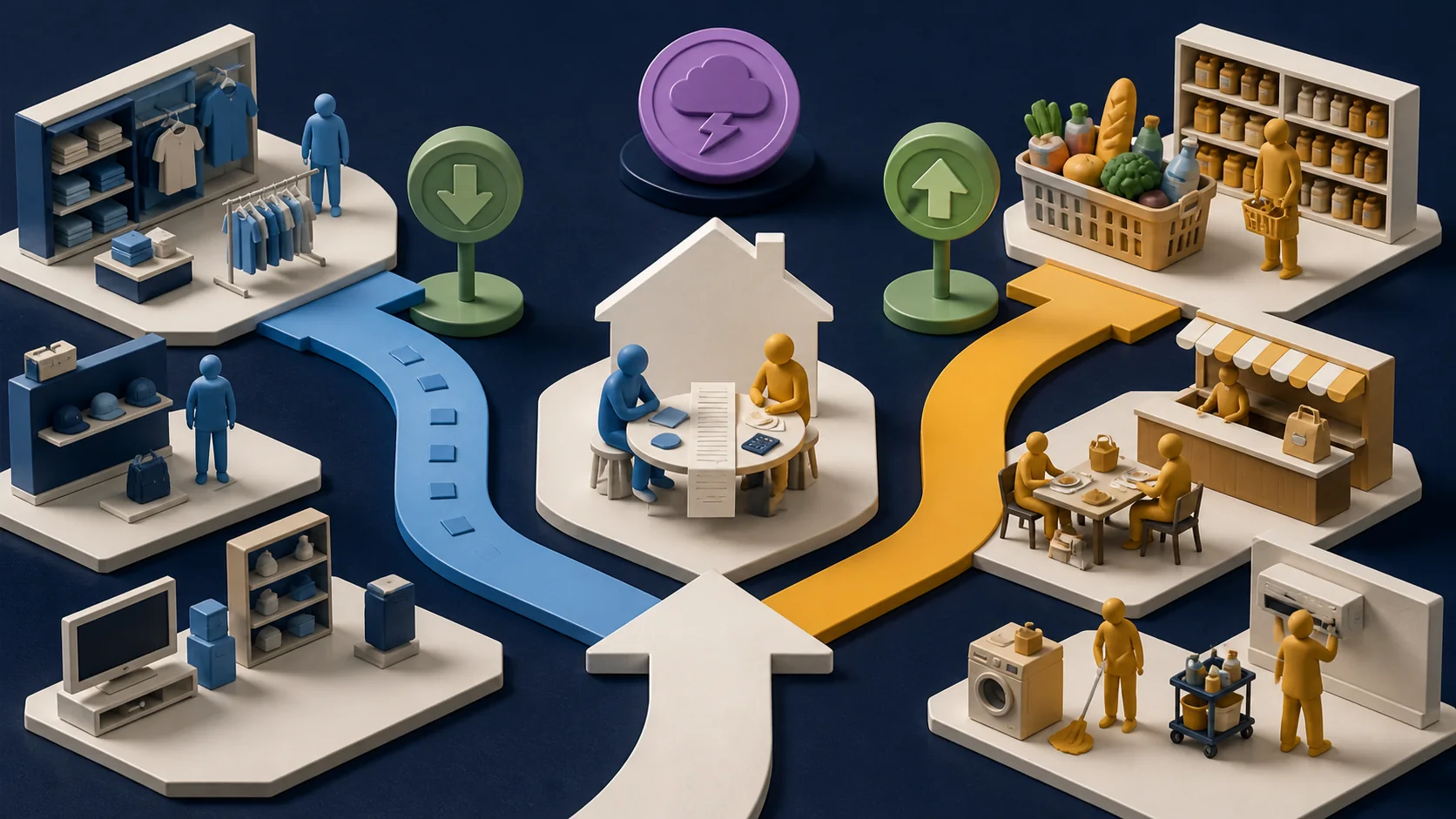
Underlying spending was uneven: goods down 0.4% month over month, services up 0.3%.
The Litmus Test Still Has Not Run
The market analysis behind this data frames the divergence as unresolved rather than settled, explicitly naming the January retail sales report as "the definitive judge of the market's trajectory for the first half of 2026." That framing is worth taking seriously: neither the confidence data nor the sales data alone tells a business what happens next. The confidence reading suggests households may be preparing to pull back. The sales data suggests they have not yet done so, and may not.
The uneven category-level spending data adds a layer of nuance a single headline figure obscures. Goods spending, motor vehicles and recreational purchases specifically, already fell in January, while services spending, housing, healthcare, financial services, rose. That is not uniform consumer resilience; it looks more like consumers continuing to spend on necessities and obligations while pulling back on discretionary goods purchases, a pattern consistent with declining confidence even while the aggregate same-store sales figure stays positive.
The practical discipline this suggests for any business is to track spending behavior at the category level relevant to its own business, not the aggregate same-store sales figure alone, and to watch the confidence trend as a leading indicator worth taking seriously even when current transaction data has not yet confirmed it. A business selling discretionary goods specifically should weight the confidence signal more heavily than a services business currently seeing spending hold up.
Tracking the Aggregate vs. Tracking Your Category
One blended number can hide two very different stories moving in opposite directions.
Aggregate tracking: the headline 7.1% same-store sales figure reads as broad consumer resilience, masking the goods-versus-services split underneath it. Category-level tracking: goods spending (motor vehicles, recreational purchases) already falling while services spending rises, a pattern more consistent with the declining confidence reading and a more useful signal for a business in either category specifically.
The Leadership Move
The structural choice for retail and CX leadership is whether to plan primarily around consumer confidence data, actual spending data, or to explicitly track the gap between the two as its own signal worth monitoring.
- Ownership
CX, retail, and demand planning leadership own the responsibility to track both sentiment and transaction data simultaneously, and specifically to monitor category-level spending patterns relevant to their own business, rather than relying on either a single sentiment survey or a single aggregate sales figure as sufficient signal.
- Tradeoff
Building planning processes that track both sentiment and spending data, and reconcile divergences between them, takes more analytical effort than defaulting to one metric. The tradeoff against that effort is being caught flat-footed in whichever direction the current gap eventually resolves, either an unexpected spending pullback or an unnecessarily cautious posture during continued resilience.
- Human consequence
Consumers navigating declining confidence while continuing to spend on necessities are managing real financial anxiety even as their purchasing behavior has not yet visibly changed, a lived tension the aggregate sales figure alone does not capture.
Next Move
If your business planning currently relies on a single consumer metric: Add the counterpart, sentiment data if you track spending, spending data if you track sentiment, and monitor the gap between them directly.
If you sell primarily discretionary goods: Weight the declining confidence signal more heavily than the aggregate same-store sales figure, given the category-level data showing goods spending already softening even as the blended figure stays positive.
FAQ
How far apart were consumer confidence and actual spending in January 2026?
Consumer confidence indices fell to a decade-low reading of 84.5 in January 2026. In the same period, the Johnson Redbook Index recorded a 7.1% year-over-year increase in same-store sales, a significant divergence between how consumers said they felt about the economy and how they were actually spending.
What does "vibecession" mean in this context?
The term describes a period where negative economic sentiment, measured through confidence surveys, has not yet translated into reduced actual spending. One market analysis described it directly: this disconnect "suggests a psychological vibecession that has yet to fully manifest in the checkout line."
Is spending data or confidence data the more reliable signal for a business?
Neither is more reliable in isolation; they measure different things. Confidence data captures stated sentiment and expectation, which can predict future behavior change before it shows up in transactions. Spending data captures actual, current behavior. A business relying only on confidence data in January 2026 would have braced for weaker sales than what the Johnson Redbook Index actually recorded.
What should a business do when confidence and spending diverge this sharply?
Treat the divergence itself as the signal worth monitoring closely, since it indicates elevated uncertainty about which direction consumer behavior moves next. A business should track both metrics together rather than defaulting to one, and prepare contingency plans for either a continued spending resilience or a delayed pullback that eventually catches up with the confidence reading.
Sources & References
Original article archive
Original article published January 19, 2026: "7 Ways Blue Monday Impacts Customer Experience and How to Transform It". Preserved here for provenance, historical context, and citation continuity.
Blue Monday is widely used by brands as a moment to talk about winter blues, money stress, and mental health, even though the “most depressing day of the year” claim is not scientifically valid. The best CX examples lean into empathy, wellbeing, and financial relief rather than exploiting the narrative of sadness.
Key Takeaways
- Blue Monday reflects real emotional states, even if the science behind it is debated.
- CX teams must anticipate emotional shifts in consumers and employees.
- Empathy is measurable — social listening and AI sentiment tools quantify it.
- Employee experience drives CX stability, especially during low morale periods.
- January engagement should prioritize comfort and value, not just conversions.
- Data-informed empathy enhances personalization without infringing privacy.
- Resilient experience design fosters emotional safety through consistency and clarity.
- Reframing negative narratives builds positive connection energy.
- Emotional awareness should be a CX metric, not just a soft skill.
- Transform for Better begins with making emotional intelligence a business culture, not a campaign.
Introduction: Blue Monday and the Mood of Modern Consumers
Every third Monday of January is often labeled Blue Monday — the so-called “most depressing day of the year.” The concept emerged from a blend of factors: post-holiday fatigue, cold winter weather, and mounting credit card bills. Whether scientifically supported or not, Blue Monday represents something every business should take seriously: the emotional state of customers in mid-January.
Customer experience (CX) professionals understand that emotions drive perception, and perception drives loyalty. A few gloomy days can trigger behavioral shifts that affect shopping patterns, brand interactions, and even employee energy. In a world where real-time engagement defines brand value, emotional awareness becomes a CX competency.
Companies that anticipate emotional fluctuations — not just sales cycles — distinguish themselves by humanizing digital experiences and showing empathy at scale. On Blue Monday, empathy is currency.
reality behind the myth
- Blue Monday is typically the third Monday in January and in 2026 falls on January 19.
- It originated in 2005 when a UK travel company, Sky Travel, hired psychologist Cliff Arnall to promote winter getaways with a pseudo‑formula mixing weather, debt, and time since Christmas.
- The idea has been heavily criticized as pseudoscience and “unhelpful nonsense” by psychologists and mental health organizations, which stress there is no single “saddest day.”

Despite this, the timing aligns with real winter pressures:
- Seasonal Affective Disorder affects about 5% of adults annually, with symptoms peaking in January and February in many northern regions.
- Broader “winter blues” symptoms are reported by a much larger share of the population; some reports estimate around 15% experience at least some seasonal depressive symptoms in winter.
- UK estimates suggest mental health issues cost employers around £15 billion in lost productivity and more than 91 million lost workdays per year, which makes emotionally aware EX and CX design a material business issue.
This mix of myth, media attention, and genuine seasonal strain gives brands a once‑a‑year hook to demonstrate emotionally intelligent customer and employee experience.
7 Ways Blue Monday Impacts Customer Experience and How to Transform It
1. The Psychology Behind the January Slump
Post-holiday blues often emerge as a mix of emotional and financial fatigue. January’s slower pace contrasts sharply with the high-speed celebration of December. Consumers are trying to reset routines while coping with reduced social interaction and shorter days.
From a CX perspective, this psychological dip reveals stress points in the customer journey. Decision fatigue increases. Attention spans shrink. Patience for friction in online shopping or service queues disappears.

Forward-thinking brands use these insights to simplify interfaces, clarify communication, and send emotionally calibrated messages. Not every campaign has to inject forced positivity. Sometimes acknowledgment — a simple “We know the start of the year can be tough” — builds credibility faster than a bright, tone-deaf blast of optimism.
2. Creating Emotional Intelligence in CX
Emotional intelligence (EI) in customer experience means understanding what drives customer feelings and adjusting communication to meet their state of mind. On Blue Monday, that empathy matters more than ever.
Brands can strengthen EI-based CX strategies through:
- Social listening: Identify sentiment shifts in real time, especially around wellness and mood.
- Tone calibration: Adapt messaging to match customer sentiment without feeding negativity.
- Support training: Equip frontline teams to deal with emotionally sensitive customers compassionately.
AI-driven analytics can supplement intuition. Sentiment detection, behavioral nudges, and conversation design tools combine data and empathy, turning CX into an emotionally intelligent ecosystem.
3. The Employee Experience Effect
You cannot deliver empathy externally if it does not exist internally. Blue Monday often affects employees just as strongly as customers. Remote workers may feel disconnected. Retail staff face slower foot traffic. Service teams deal with more frustrated callers.
CX leaders must recognize that employee experience (EX) is the foundation of customer perception. Actions that reinforce morale during emotionally flat periods have ripple effects, such as:
- Sharing appreciation messages that feel genuine, not performative.
- Encouraging team support days with lighter workloads or shortened meetings.
- Offering digital wellness check-ins or gentle mental health reminders.
When employees feel cared for, customers notice the difference. Compassion travels through every interaction channel.
4. Rethinking January Engagement Strategies
Instead of pushing sales with urgency-driven campaigns, brands can position January as a “reset” month. This reframe aligns with consumer psychology — a time for clarity, self-reflection, and renewal.
Tactical ideas include:
- Wellness partnerships: Collaborate with lifestyle or mental health brands to add value beyond discounts.
- Micro incentives: Reward small actions like engagement or feedback submission to boost participation.
- Community storytelling: Share customer stories about growth and perseverance.
By aligning engagement strategies with emotional relevance, brands meet customers where they are — not where a calendar says they should be.
5. Using Data to Predict Emotional States
Behavioral data helps forecast when customers might disengage or need reassurance. Transaction dips, browsing hesitation, or increased customer service pings can all signal mood-related behavioral patterns.
A data-enlightened CX strategy can:
- Cluster customers by engagement sentiment rather than only spending.
- Trigger context-aware experiences at emotional low points.
- Build long-term personalization that respects emotional privacy.
Canadian privacy expectations demand transparency in these uses. CX teams should communicate how data improves emotional well-being and ensures fair personalization, honoring trust at every step.
6. Designing for Human Resilience
In the face of emotional downturns, resilient experience design offers stability. A resilient CX model doesn’t only aim to delight; it aims to support.
Examples include:
- Predictable navigation: Reducing anxiety through consistent design.
- Adaptive interfaces: Letting users control tone or visual brightness.
- Reassuring messaging: A subtle layer of calm throughout digital touchpoints.
The guiding principle is: consistency comforts. When the outside world feels chaotic, a brand that delivers reliability feels emotionally safe.
7. Transforming Blue Monday into Connection Monday
The essence of transformation lies in reframing. What if Blue Monday became Connection Monday? A day when brands use emotional intelligence to reconnect authentically — not to sell, but to support.
Actions that reinforce this idea might include a “Kindness Activation Day” across digital channels or loyalty programs that reward sharing appreciation posts. Retailers can create small gestures such as gratitude messages in delivery boxes or positive surprises during checkout.
When customers feel emotionally seen, they not only remember that brand but talk about it. Word-of-mouth thrives on empathy moments, not marketing slogans.
Transform for Better
In a world that grows more automated every day, emotional intelligence remains the human difference. Blue Monday reminds every CX leader that customers are not data points — they are people navigating both optimism and exhaustion. Sustainable progress depends on designing experiences that nurture both sides.
Transform for Better is not just a project tagline. It’s a mindset: to listen deeply, design thoughtfully, and act with empathy even when business metrics seem cold. By transforming emotional understanding into measurable CX strategy, brands earn not only loyalty but trust — the true currency of the modern economy.
10-Question FAQ
1. What is Blue Monday?
Blue Monday refers to the third Monday of January, believed to be the most depressing day of the year, caused by post-holiday fatigue and financial pressure.
2. Does Blue Monday actually affect customer behavior?
Yes. Even if it’s psychological, mood declines influence buying patterns, content engagement, and service interactions.
3. How can businesses show empathy during this period?
By recognizing emotional context in communication, offering reassurance, and giving customers low-pressure ways to interact.
4. What role does employee morale play in CX during Blue Monday?
Employee sentiment directly influences how customers perceive interactions. Happy teams create emotionally stable service environments.
5. Can AI help detect customer emotions?
Yes. Sentiment analysis, behavioral triggers, and customer feedback analytics can reveal mood trends in real time.
6. How can companies balance personalization with emotional privacy?
By being transparent about data use and ensuring emotional signals are used to enhance—not exploit—the customer experience.
7. Should marketing campaigns acknowledge Blue Monday directly?
When done authentically, yes. Acknowledgment shows emotional awareness and helps customers feel understood.
8. What are good engagement strategies for January?
Themes like renewal, wellness, and community connection outperform high-pressure promotions.
9. How can retail and service teams prepare for emotional dips?
Through empathy training, morale-boosting initiatives, and flexible communication guidelines.
10. What does “Transform for Better” mean in this context?
It means turning awareness into action. By understanding collective mood and embedding empathy in every touchpoint, we transform not just the experience but the relationship between people and brands.
HOW CAN Transformidy HELP?
Transformidy is available to assess your company’s customer experience strategy in generating engagement, satisfaction, and business growth, enhance/rebuild it and monitor it for opportiunties and growth.
Contact us or set up a 30-minute complimentary consultation for more information on our services, insights, or showcases. We look forward to hearing from you.
FAQ
How far apart were consumer confidence and actual spending in January 2026?
Consumer confidence indices fell to a decade-low reading of 84.5 in January 2026. In the same period, the Johnson Redbook Index recorded a 7.1% year-over-year increase in same-store sales, a significant divergence between how consumers said they felt about the economy and how they were actually spending.
What does 'vibecession' mean in this context?
The term describes a period where negative economic sentiment, measured through confidence surveys, has not yet translated into reduced actual spending. One market analysis described it directly: this disconnect 'suggests a psychological vibecession that has yet to fully manifest in the checkout line.'
Is spending data or confidence data the more reliable signal for a business?
Neither is more reliable in isolation; they measure different things. Confidence data captures stated sentiment and expectation, which can predict future behavior change before it shows up in transactions. Spending data captures actual, current behavior. A business relying only on confidence data in January 2026 would have braced for weaker sales than what the Johnson Redbook Index actually recorded.
What should a business do when confidence and spending diverge this sharply?
Treat the divergence itself as the signal worth monitoring closely, since it indicates elevated uncertainty about which direction consumer behavior moves next. A business should track both metrics together rather than defaulting to one, and prepare contingency plans for either a continued spending resilience or a delayed pullback that eventually catches up with the confidence reading.
Related intelligence
Article
SharePoint's Real 2025-2026 Story Was Nation-State Attacks, Not CX Strategy
Nation-state hackers exploited on-premises SharePoint servers in 2025, confirmed by Shadowserver at over 300 victims worldwide. In 2026, a new vulnerability rated 9.8 out of 10 severity emerged in the same product line. SharePoint did not quietly rewire anyone's CX strategy. It became a sustained target.
Article
Three Years of Snoopy Flights, Zero Published Numbers
STARLUX Airlines just launched its third consecutive year of Snoopy-themed flights, expanded to nearly its entire route network. The airline has never published a booking or revenue number to justify it. That silence is the actual story.
Article
Why Customer Experience Became an Operating System Problem
Customer experience failure is no longer a touchpoint problem. It is a system problem that reveals how the organization is designed.