
Article
An 87% Renewal Rate Is Not a Marketing Story
The San Jose Sharks' 2024 season ticket renewal campaign hit an 87% renewal rate. The number that explains it is not the campaign. It is one source of truth connecting front and back-end fan data that let the team build the campaign in the first place.
- Published
- December 2, 2024
- Updated
- June 18, 2026
- Reading time
- 7 min

2026 updated analysis
What changed since the original article
This page keeps the original Transformidy article as the canonical record and leads with the current interpretation, source notes, and Revenue Unknown framing.
The Campaign and What Sits Under It
In 2024, Sharks Sports & Entertainment deployed a personalized season ticket renewal campaign that achieved a 75% open rate, a 28% click rate, and an 87% renewal rate, a set of results the organization and SAP both describe as exceeding typical industry benchmarks for renewal marketing. Those numbers are the part of the story that is easy to celebrate and easy to try to copy.
What made the campaign possible was less visible and took longer to build: correlation between front-end and back-end customer data, which helped the organization understand the habits and tenure of season ticket holders well enough to build a precisely targeted campaign quickly once the decision was made to run one. Neda Tabatabaie, SVP of Business Analytics and Technology at SSE, described the outcome directly: "We now have one source of truth and deep insight that allow us to better connect with fans."
One source of truth is the operative phrase. Before that existed, front-end data (how fans behaved, what they clicked, what they attended) and back-end data (billing, tenure, account history) likely sat in separate systems, answering separate questions. The renewal campaign became possible once those two views could be read together as a single picture of each season ticket holder.
Renewal rate, alongside a 75% open rate and 28% click rate, built on correlated front-end and back-end fan data
The campaign is the visible output. The data correlation that made it possible existed before the campaign was built.
The Pattern Repeats Beyond Marketing
The most useful part of the Sharks' case is that the same underlying change, connected data across more than five third-party sources, shows up in results that have nothing to do with fan-facing marketing. A 33% reduction in onboarding time is an HR outcome. A 12-hour reduction in reporting turnaround is an operations outcome. Real-time staffing adjustments triggered by a traffic threshold are a venue operations outcome. None of these required a separate data project; all of them drew on the same connected foundation that also produced the renewal campaign.
This is the pattern a business should actually be looking for when it reads a case study like this one: not "what campaign did they run," but "what had to be true about their data before any of these four unrelated outcomes became possible." When one underlying change produces gains across marketing, HR, operations, and venue management simultaneously, that is a signal the change was infrastructural, not tactical. A tactic produces one result. Infrastructure produces several, in places you would not necessarily expect to look.
The reverse is also instructive. An organization that tries to build a Sharks-style renewal campaign without first building the underlying data correlation is optimizing the part of the story that photographs well while skipping the part that actually explains the 87% figure. The campaign is downstream of the infrastructure, not a substitute for it.
Copying the Campaign vs. Building the Data Foundation
One produces a single campaign. The other produces four unrelated outcomes.
Campaign-first: a business studies the renewal email and offer structure, and gets a modest lift limited to that one channel. Infrastructure-first: a business connects front-end and back-end customer data as a standing capability, and the same connection surfaces gains in marketing, HR, operations, and venue management, the way it did for the Sharks.
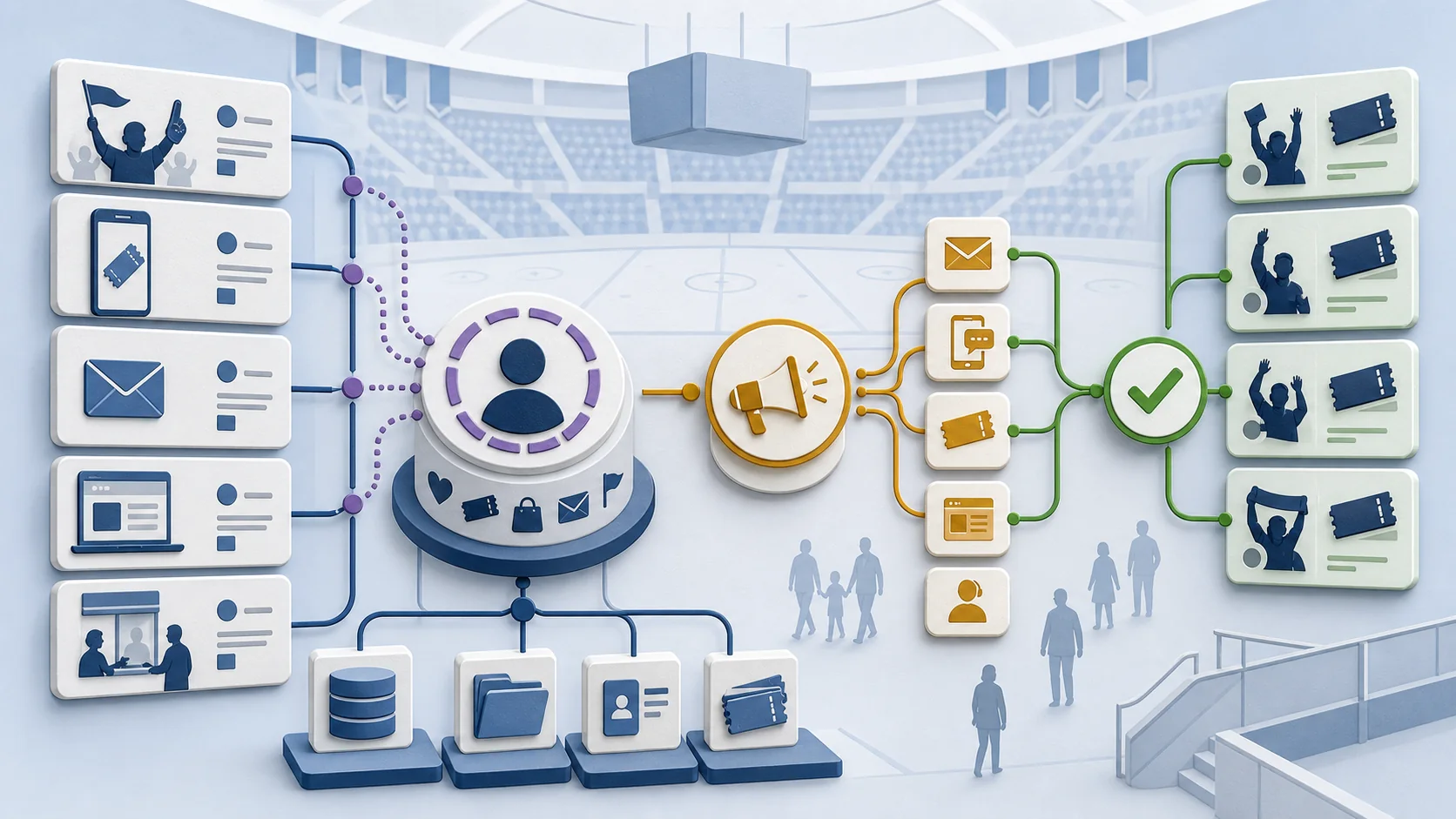
"We now have one source of truth and deep insight that allow us to better connect with fans."
The Leadership Move
The structural choice is whether to evaluate a case study like this one by its most photogenic output, the renewal campaign, or by the infrastructural change that made several unrelated outcomes possible at once.
- Ownership
Leadership overseeing customer data infrastructure owns the decision to invest in connecting front-end and back-end systems as a standing capability, rather than approving isolated campaign-level projects that borrow the language of personalization without the underlying data correlation.
- Tradeoff
Building a connected data foundation across more than five sources takes longer and costs more upfront than running a single well-designed campaign. The tradeoff is that a single campaign produces one result, while the Sharks' connected foundation produced measurable gains in marketing, HR, operations, and venue staffing simultaneously, a return that a campaign-only investment cannot replicate.
- Human consequence
Season ticket holders experienced a renewal message that reflected their actual relationship with the organization rather than a generic prompt, which is the tangible, felt difference behind the 87% figure. Employees experienced faster onboarding, and venue staff experienced better-matched staffing levels during high-traffic events, all from the same underlying change.
Next Move
If you are evaluating this case study for your own organization: Do not start by studying the renewal campaign's design. Start by checking whether your own front-end and back-end customer data are connected into anything resembling a single source of truth, because that connection is the actual precondition the Sharks needed before the campaign existed.
If you already have a connected data foundation and have not looked beyond marketing: Check adjacent functions, HR, operations, venue or facilities management, for the same kind of gains the Sharks found. An infrastructural change that only gets applied to one function is likely leaving value unclaimed in the others.
FAQ
What were the actual results of the San Jose Sharks' 2024 renewal campaign?
The personalized season ticket renewal campaign achieved a 75% open rate, a 28% click rate, and an 87% renewal rate, results the team and SAP both describe as exceeding typical industry standards for renewal marketing.
What made this campaign possible, beyond the marketing execution itself?
The correlation between front-end and back-end customer data. Sharks Sports & Entertainment built a connected view of season ticket holder habits and tenure using SAP Customer Experience solutions and SAP Business Technology Platform, which let the organization identify who to target and with what message before the campaign was built, rather than segmenting after the fact.
Did the same data integration help with anything beyond marketing?
Yes. The organization also reported a 33% reduction in full-time employee onboarding time, a 12-hour reduction in venue operational reporting time, and real-time entry-point monitoring at SAP Center that allows staffing adjustments when traffic exceeds baseline by more than 10%. All draw on the same underlying data integration effort, across more than five third-party sources.
Why does it matter that this was a data integration story and not a marketing story?
Because a business that reads this as a marketing case study will look for a better renewal email template. A business that reads it as a data integration case study will look at whether its own front-end and back-end customer data are connected at all, which is the actual precondition the Sharks needed before any renewal campaign could be built this precisely.
Sources & References
Original article archive
Original article published December 2, 2024: "San Jose Sharks Better Customer Experience With SAP". Preserved here for provenance, historical context, and citation continuity.
The San Jose Sharks, a professional ice hockey team in the National Hockey League (NHL), have emerged as a leader in customer experience (CX) innovation within the sports industry. Sharks Sports & Entertainment (SSE) manages other teams and venues and has embraced technology to enhance fan engagement and drive business growth. Find out why they won Great Experience Award for November 2024TM.
Who are the San Jose Sharks?
The San Jose Sharks are more than just a hockey team; they are a multifaceted sports and entertainment organization. SSE, the parent company, oversees the NHL's San Jose Sharks, the AHL's San Jose Barracuda, and operates multiple venues including the SAP Center and TechCU Arena. This diverse portfolio requires a comprehensive approach to customer experience management across various touch points.

Customer Experience Challenges
“My direct competition isn’t other live experiences; it’s figuring out how to get people off their couch and then back home safely,” SSE President Jonathan Becher said during a virtual session for media and analysts hosted by SAP. “Technology has a huge role in making those experiences happen.”
SSE faced several challenges in delivering a seamless customer experience:
- Data Silos: The organization struggled with multiple third-party systems across departments, leading to siloed data that hindered real-time reporting and informed decision-making.
- Diverse Customer Base: With various entertainment offerings, SSE needed to cater to different audience segments, from hockey fans to concert-goers.
- Digital Transformation: The shift to digital ticketing and other modern expectations required careful implementation to avoid fan dissatisfaction
- Competition with At-Home Entertainment: SSE President Jonathan Becher noted that their main competition was not other live experiences, but rather the challenge of enticing people away from their couches.
Enhancing Fan Experiences
SSE leveraged SAP technologies, including SAP Datasphere and SAP Business Technology Platform (BTP), to create a centralized data strategy. This allowed them to integrate 15-20 data sources weekly, providing a comprehensive view of their business operations and customer interactions.
Personalized Fan Engagement
By utilizing SAP CX solutions such as SAP Customer Data Platform, SAP Customer Data Cloud, and SAP Emarsys Customer Engagement, the Sharks could manage fan information, preferences, and communications more effectively. This enabled them to create more personalized and relevant campaigns for individual fans.
Digital Ticketing and Mobile Experience
The Sharks pioneered digital ticketing in their league, demonstrating a commitment to innovation despite initial challenges. This move improved the fan experience by streamlining entry to events and providing a platform for further digital engagement.
Youth Engagement Initiatives
Recognizing the importance of cultivating future fans, SSE invested in youth skating programs. By synchronizing data from these initiatives with their overall fan engagement strategy, they discovered that for every child under 12 who learns to ice skate, they create 2.3 new hockey fans.
Revenue Generation Considerations
The focus on CX has directly impacted San Jose Sharks's revenue generation:
- Improved Marketing Effectiveness: Email open rates soared from 26% to 80%, indicating more effective and targeted communications.
- Cross-Selling Opportunities: By understanding fan preferences across different events, SSE can better cross-promote their various offerings.
- Youth Engagement: Data-driven insights have shown that for every child under 12 who learns to ice skate, SSE creates 2.3 new hockey fans, potentially leading to long-term revenue growth.
Here's a comparison of key metrics before and after implementing their CX strategy:
| Metric | Before | After |
|---|---|---|
| Season Membership Renewal Rate | <77% | 87% |
| Email Open Rate | 26% | 80% |
| Data Sources Integrated | Siloed | 15-20 weekly |
| Full-time Employee Onboarding Processing Time | Baseline | 33% decrease |
“Last season (2023), we got our renewals plus upsells just shy of 90%, which was above our target of 85% and more than 10 percentage points higher than the previous season,” Becher explained, citing the organization’s use of SAP solutions as a game-changer for membership renewal.
“We were able to much more easily build a more engaging, relevant campaign for individual people about renewals,” he added. “90% is a phenomenal renewal rate in this industry.”
What's Next for the San Jose Sharks
Looking ahead, the San Jose Sharks are poised to continue their CX innovation:
- Further AI Integration: As AI technology evolves, SSE plans to explore more ways to leverage it for predictive analytics and enhanced personalization.
- Expanding Digital Offerings: Continuing to improve digital platforms to meet changing fan expectations and preferences.
- Deeper Data Analysis: Utilizing the integrated data platform to uncover new insights and opportunities for fan engagement.
- Sustainability Initiatives: Exploring ways to incorporate sustainability into the fan experience, aligning with growing environmental concerns.
Lessons for Other Sports Brands
Other sports organizations can learn from the San Jose Sharks' approach:
- Embrace Technology: Invest in integrated technology solutions that provide a holistic view of operations and customer interactions.
- Prioritize Data: Centralize data from various sources to gain actionable insights and drive decision-making.
- Personalize Experiences: Use AI and data analytics to create tailored experiences for different fan segments.
- Focus on Omni-channel: Ensure consistency across all touch points, from digital to in-person experiences.
- Innovate Continuously: Maintain a pioneering spirit, being willing to take risks and learn from mistakes to stay ahead of fan expectations.
- Extend Beyond the Game: Consider the entire customer journey, including pre and post-event experiences, to create lasting fan relationships.
By following these principles and continuously innovating in the realm of customer experience, sports brands can create deeper connections with fans, drive loyalty, and ultimately achieve sustainable business growth in an increasingly competitive entertainment landscape.
Great Experience AwardTM
Transformidy’s Great Experience AwardTM is presented monthly and showcases excellence in experience strategy design or execution. Companies are welcome to submit entrants with support like demos, pictures, videos, press releases, or descriptions (no bigger than 5Mb in size per item), for this monthly award with experience ideas, innovations, or initiatives curated for customers, employees, or stakeholders.
Transformidy will evaluate all entrants and will make the final decision on the winner based on factors including but not limited to how the experience(s) transform or improve the way the company engages, acquires, supports, or maintains its customers, employees, or stakeholders. The experience(s) for consideration can be physical, online, or virtual.
How Can We Help?
Transformidy is available to assist in helping you understand assess how your company’s experience strategy is effective in generating engagement, satisfaction, and business growth.
Contact us or set up a 30-minute complimentary consultation for more information on our services, insights, or showcases. We look forward to hearing from you.
FAQ
What were the actual results of the San Jose Sharks' 2024 renewal campaign?
The personalized season ticket renewal campaign achieved a 75% open rate, a 28% click rate, and an 87% renewal rate, results the team and SAP both describe as exceeding typical industry standards for renewal marketing.
What made this campaign possible, beyond the marketing execution itself?
The correlation between front-end and back-end customer data. Sharks Sports & Entertainment built a connected view of season ticket holder habits and tenure using SAP Customer Experience solutions and SAP Business Technology Platform, which let the organization identify who to target and with what message before the campaign was built, rather than segmenting after the fact.
Did the same data integration help with anything beyond marketing?
Yes. The organization also reported a 33% reduction in full-time employee onboarding time, a 12-hour reduction in venue operational reporting time, and real-time entry-point monitoring at SAP Center that allows staffing adjustments when traffic exceeds baseline by more than 10%. All draw on the same underlying data integration effort, across more than five third-party sources.
Why does it matter that this was a data integration story and not a marketing story?
Because a business that reads this as a marketing case study will look for a better renewal email template. A business that reads it as a data integration case study will look at whether its own front-end and back-end customer data are connected at all, which is the actual precondition the Sharks needed before any renewal campaign could be built this precisely.
Related intelligence
Article
A Third of Walmart's Operating Income Now Comes From Ads and Memberships
Advertising and membership fees now account for a third of Walmart's operating income. Walmart Connect grew 41% in a quarter when retail sales grew about 5%, eight times faster. Retail media margins exceed 70%. Walmart is no longer just a retailer that also sells ads.
Article
AI in Hospitality: Personalization and Guest Experience Risk
Hotels deployed AI for personalization and staff augmentation. But automation that removes human touch from high-stakes moments (room issues, service recovery) creates guest frustration. Successful properties used AI to enable staff, not replace judgment.
Article
Department Store Strategy: Identity vs. Omnichannel
Department stores pursued omnichannel integration to compete with specialists and e-commerce. But integration without identity eroded customer loyalty. Successful stores rebuilt around curation and experience, not channel consolidation.